Asana vs ClickUp 2026: Calm or Configurable, and the Third Option
Asana and ClickUp are usually the last two tabs open when a team is picking a project tool, and they represent two genuinely different bets. Asana bets that the way to get work done is to remove choices: one clear structure, a small set of well made views, and an interface that stays quiet while your team uses it. ClickUp bets the opposite way: give people every field, every view, and every switch, and let each team assemble the tool it wants.
Both bets pay off, and both send you a bill for the payoff. Asana's calm has a ceiling, and you reach it the moment your work needs something the product does not believe in. ClickUp's flexibility has a floor, and you fall through it the moment nobody on your team has three weekends to design the workspace. Most comparisons stop there, declare Asana easier and ClickUp cheaper, and leave you exactly where you started.
This one goes further, because for a lot of small businesses the answer is neither. Both tools organise work that already exists. Neither of them does any of it. The enquiry that came in overnight, the quote that has gone quiet for nine days, the client who needs rebooking, all of that still needs a person to notice, decide, and act. So this comparison walks through onboarding, configurability, automation, reporting, AI, and price, then looks at a third option built on a different idea entirely: software that operates the business rather than displaying it.
Pricing reflects published rates as of August 2026; check each vendor's pricing page for current figures.
Asana vs ClickUp at a glance
| Dimension | Asana | ClickUp | Zoye |
|---|---|---|---|
| Core idea | Opinionated structure, minimal choices | Maximum configurability | An operator that does the work |
| Time to running properly | About a day | Two to four weeks | Same day |
| Views | List, board, timeline, calendar, Gantt higher up | 15+ including mind map and workload | List, board, calendar, timeline |
| Automation style | Rules you build in the UI | Rules, plus custom fields and formulas | Described in one plain sentence |
| Who keeps records current | Your team | Your team | The operator does it itself |
| Customer follow-ups | Not covered | Not covered | Captured, chased, and logged automatically |
| AI | Advanced tier and above | Brain, paid add-on | Included on every plan |
| WhatsApp and customer messages | Not available | Not available | Native, with drafted replies |
| Pricing model | Per seat | Per seat | Flat rate per plan |
| Entry price | Free Personal plan, paid from $10.99/user/mo | Free Forever plan, paid from $7/user/mo | Almost Free at $5/month for 1 member |
Onboarding: how long before it actually helps
Asana's biggest advantage is that it is hard to set up badly. There is essentially one right way to build a project, the defaults are sensible, and a manager who has never used it can create a project, assign work, and understand the timeline in an afternoon. That matters more than feature checklists suggest, because a project tool only pays off when the whole team uses it, and adoption dies during setup far more often than it dies later.
ClickUp starts from the other end. Before it feels right you have decisions to make about spaces, folders, lists, custom statuses, custom fields, and which of the many views each team sees. Made well, those decisions produce a workspace that fits your business precisely. Made badly, or made by nobody, you get a slightly overwhelming grid that half the team quietly stops opening. In practice teams report a few weeks of settling, and that period needs an owner.
The honest framing is that ClickUp asks for an investment up front and pays it back later, while Asana pays out immediately and asks for less. If your team has an operations-minded person who enjoys building systems, ClickUp's tax is worth paying. If your smallest unit of spare time is fifteen minutes between client calls, it is not.
Verdict: Asana, clearly, unless someone is genuinely excited to design the workspace.
Configurability: the ceiling and the floor
Where ClickUp earns its reputation is depth. Custom fields with formulas, per list statuses, nested subtasks and checklists, workload views, mind maps, native time tracking, docs, whiteboards, and a very large integration catalogue. A production studio tracking assets through eight stages, or an operations team modelling a physical process, can represent all of it without leaving the tool. That is real, and Asana cannot match it.
Asana's answer is that most teams do not need that, and that the cost of having it is a workspace nobody trusts. Its model connects tasks to projects, projects to portfolios, and portfolios to goals, so leadership can see how daily work ladders up to what the company said it would do this quarter. That chain is the thing Asana does better than almost anyone, and it only works because the structure is enforced rather than optional.
The failure modes are opposite. Asana teams hit a wall and start keeping the missing part in a spreadsheet next to it. ClickUp teams do not hit a wall; they slowly accumulate fields, statuses, and views that nobody remembers agreeing to, until the workspace needs a cleanup nobody schedules.
Verdict: ClickUp for teams with genuinely complex processes and someone to own them. Asana for teams that want the tool to hold a line.
Want to see it in action?
Watch how Zoye automates your daily workflow - from lead management to team collaboration.
See How It WorksAutomation: rules are not the same as follow-through
Both platforms automate the mechanics inside themselves well. In Asana you build rules from triggers and actions in a clean builder: move a task to a section and it reassigns, set a field and it notifies, complete a milestone and the next batch of work appears. In ClickUp you get the same idea with more surface area, since automations can read your custom fields and formulas, so the conditions can be far more specific.
What both share is the boundary. Their automations act on records inside the tool. A task changes stage, a field updates, a message posts in a channel. When the required action is outside, sending a client a proper reply, chasing a proposal that has gone quiet, rearranging a booking because someone cancelled, the automation stops at reminding a human. That is the moment small teams lose things, and it is the same moment in both products.
There is also a build cost that rarely gets counted. Every rule is something a person has to think of, configure, test, and then maintain when the process changes. Rules that were written for last year's workflow are one of the quietest reasons a workspace stops matching reality.
Verdict: A tie on internal automation, with more range in ClickUp. Neither one closes the loop on work that leaves the tool.
Reporting: dashboards versus answers
ClickUp's dashboards are the more powerful reporting surface. You can assemble cards from almost any field, chart custom data, and build a view that answers a specific operational question, provided your data is clean and your fields were filled in consistently. That last condition is doing a lot of work in that sentence, and it is the usual reason a dashboard quietly stops being trusted.
Asana approaches reporting through portfolios, workload, and goal progress. It is less configurable and considerably harder to get wrong. A director can open a portfolio and see which projects are drifting without anyone having built anything, which for many businesses is a better trade than infinite chart options.
Both, though, report on what was entered. If a project ran mostly over email and nobody updated the tasks, the dashboard is confidently wrong, and it is wrong in the direction that makes people relax.
Verdict: ClickUp for depth, Asana for reports that stay honest with less discipline.
See what Zoye can do for you
From CRM and deal tracking to AI-powered task management - explore everything Zoye offers in one workspace.
Explore FeaturesAI in 2026: what each one actually does
Asana's AI features sit in the Advanced tier at $24.99 per user per month and above. They summarise projects, surface risk, help build workflows without technical setup, and can take on assignable pieces of routine work. It is a coherent set of features, and it is priced as a reason to move up a tier.
ClickUp Brain is sold as an add-on of roughly $9 per user per month on top of your plan. It answers questions about your workspace, drafts tasks and documents from a prompt, and writes summaries. Cheaper to add, but it is an extra line on the invoice at every seat rather than something included.
The more useful question than price is what the AI is for. In both products the AI helps you produce and digest text about work: it summarises the project, drafts the update, explains the backlog. It is a writing and reading layer on top of records humans maintain. What it does not do is go and perform the outstanding work, because the outstanding work mostly lives with your customers rather than in the tool.
Verdict: Asana bundles more but only high up the price list. ClickUp is cheaper to add. Both assist rather than operate.
Pricing: what each one costs at fifteen people
Asana pricing
- Personal: free, up to 10 users, basic features
- Starter: $10.99 per user per month billed annually
- Advanced: $24.99 per user per month billed annually, includes the AI features
- Enterprise and Enterprise+: custom
ClickUp pricing
- Free Forever: $0, generous limits, no AI
- Unlimited: $7 per user per month billed annually
- Business: $12 per user per month billed annually
- Enterprise: custom
- ClickUp Brain: paid add-on, around $9 per user per month, not included in any plan
Zoye pricing (flat rate, AI included on every plan)
- Almost Free: $5 per month, 1 member, 1GB storage, full platform including AI
- Starter: $29 per month, 10 members, 5GB storage
- Growth: $59 per month, 20 members, 10GB storage, 24/7 support
- Scale: $119 per month, 100 members, 25GB storage
- Customize: custom limits and dedicated support
Run it at fifteen people. Asana Advanced with AI is about $375 a month. ClickUp Business plus Brain is roughly $315 a month. Zoye Growth covers up to twenty members with the AI included for $59 a month, and the number does not move when the sixteenth person joins.
The structural point matters more than the arithmetic. Per seat pricing charges you for headcount, which means the tool gets more expensive precisely as you grow, and it quietly encourages you to leave people off the licence, which is how half your work ends up back in email.
Verdict: ClickUp is the cheaper sticker, Asana bundles more at the top, and both bills scale with hiring while a flat rate does not.
The third option: Zoye
Asana and ClickUp are both places where work is written down. Zoye is built on a different premise: the AI Business Operator that runs the work instead of displaying it. It captures the leads, chases the follow-ups, books the clients, keeps its own customer records current, and builds automations from a plain sentence you type or say, including over WhatsApp and Slack.
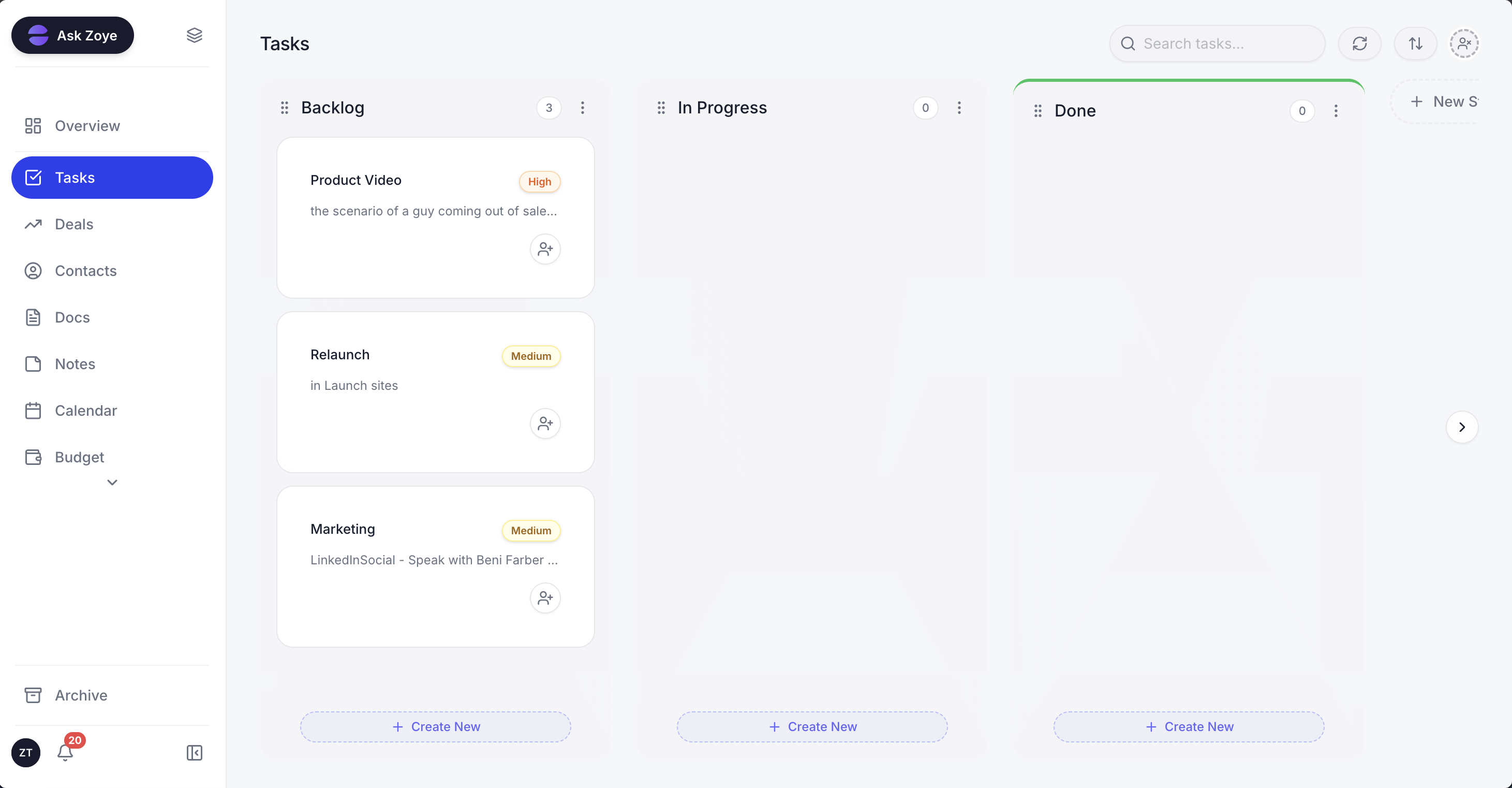 Tasks in Zoye across list, board, calendar, and timeline, with the assistant doing the moving rather than waiting for you to
The practical difference shows up in the gap between tools. In Asana or ClickUp, an enquiry that arrives on a Tuesday evening becomes work only if somebody sees it, decides it matters, creates a task, assigns it, and later remembers to follow up. In Zoye that same enquiry is captured, answered, qualified, and booked, with the record written afterwards by the operator that did it. Nobody had to be at a keyboard for the sequence to happen.
The same applies to the follow-through neither project tool covers. A proposal that has been quiet for a week gets chased with a message drafted in your voice. A client who cancelled gets offered the next available slot. An invoice that is nine days late gets a polite nudge before it becomes an awkward conversation. And when you want new behaviour you describe it: tell Zoye that anyone who asks about pricing on WhatsApp should be asked for their timeline and added to the pipeline, and that is now how it works. No builder, no nodes, no weekend.
Underneath the operator is the workspace itself: tasks with list, board, calendar, and timeline views, a calendar, customer records and deals, budget tracking, and live reports, all connected, so a small team is not paying for a project tool and a customer tool and hoping the two stay in sync. The villain here is software you bought and stopped using. Zoye is designed so there is nothing to keep using, because it does the operating.
Real example: A two-person consultancy finishes a discovery call and one of them says out loud, "they want the audit and a workshop, roughly nine thousand, decision by the end of the month." Zoye opens the deal, files the contact, drafts the follow-up email, sets the chase for the following Tuesday, and puts the workshop prep tasks on the board against the deadline. In either project tool, that is four screens and a CRM they do not have.
Ready to streamline your business?
Zoye brings AI-powered CRM, task management, and automation into one workspace.
Get StartedWhen to choose each
Choose Asana if:
- You want a team productive this week with no configuration project
- Connecting daily work to quarterly goals is a genuine operational need
- You would rather the tool enforce one structure than offer twelve
- Your budget can absorb Advanced if you want the AI features
- Your work is mostly internal projects rather than customer follow-up
Choose ClickUp if:
- Your process is genuinely complex and needs custom fields, statuses, and formulas
- Somebody on the team will own the workspace design and its upkeep
- You want docs, whiteboards, and time tracking without extra subscriptions
- You want the most features for the lowest per seat price
- You accept a few weeks before the setup settles
Choose Zoye if:
- The work that pays you is customer facing, and it is what keeps slipping
- You want AI that performs the follow-up rather than summarising it
- You want to describe an automation in a sentence instead of building it
- You want the price to stay flat as the team grows
- You want customer conversations, including WhatsApp, in the same place as the work
Frequently asked questions
Yes, for most teams. Asana is deliberately opinionated: there are fewer ways to build a project, so a new team is usually running properly within a day. ClickUp gives you far more choices, and those choices have to be made before the tool feels right, which is why teams typically report two to four weeks before ClickUp settles. If nobody on your team wants to own the setup, Asana is the safer pick.
On the sticker price, yes. ClickUp Unlimited is around $7 per user per month billed annually against Asana Starter at $10.99, and the mid tiers are $12 against $24.99. The gap narrows once you add ClickUp Brain, which is a paid add-on of roughly $9 per user per month. Both are per seat, so both bills grow every time you hire. (Rates as of August 2026; check each vendor's pricing page.)
Not at the entry tiers. Asana bundles its AI features into Advanced at $24.99 per user per month and above. ClickUp sells Brain as a separate add-on at roughly $9 per user per month on top of whatever plan you are on. In both cases the AI mainly drafts, summarises, and answers questions about work you already logged. Zoye includes its AI on every plan, starting with the Almost Free plan at $5 per month.
For a small business where nobody is a full-time admin, Asana wins on time to value and ClickUp wins on how much it covers for the money. Neither of them touches the work that actually pays a small business: capturing the enquiry, chasing the quote, booking the client, and keeping the customer record current. That gap is why many owners end up buying a second tool alongside either one.
Yes. ClickUp ships an Asana importer that carries across projects, tasks, assignees, due dates, subtasks, and comments, and the import itself usually runs in minutes. What does not carry across is your rules, custom statuses, dashboards, and the habits your team built around them, so budget a couple of weeks of rebuilding and nudging before the new setup sticks.
No. Both are built around internal projects and tasks, so a customer message on WhatsApp lives outside them entirely and only enters as a task somebody remembers to create. Zoye centralises those conversations and the assistant drafts and sends replies, chases quiet threads, and updates the customer record itself, so the conversation and the work stay in the same place.
The bottom line
Asana and ClickUp are both good at what they set out to do, and the choice between them is mostly a choice about who you are. Asana suits a team that wants clarity handed to it and is willing to live inside someone else's opinion about how projects should look. ClickUp suits a team that wants to shape the tool around its own process and has the appetite to do that work and keep doing it.
The question worth asking before either is whether an organised list of work is the thing your business is missing. For a lot of small teams it is not. The tasks were never the bottleneck; the follow-up was. The enquiry nobody answered fast enough, the quote nobody chased, the client nobody rebooked. No amount of view configuration fixes that, because the tool is waiting for a person and the person is busy.
That is the problem Zoye was built for: an operator that does the chasing, the booking, and the record keeping itself, in the same workspace as your tasks and calendar, at a flat price that does not climb with headcount.
Try Zoye with your team. The entry plan is Almost Free at $5 per month, with the full platform including AI.
For more context, see ClickUp vs Asana, the best Asana alternatives, the best ClickUp alternatives, Notion vs Asana, and the rest of the Zoye blog.