
ClickUp and Asana land on almost every project management shortlist in 2026, and they pull in opposite directions. ClickUp wants to be the one tool that swallows every other tool. Asana wants to be the tool that keeps a team's daily work visibly tied to its goals. Each does its thing well, and each asks you to give something up to get it.
This comparison covers what each actually does well, where each one breaks down, and a third option that solves the problem both share - AI as a paid extra and no native CRM or budget tracking. If the two of them feel like a coin toss, that is usually a sign the real answer is a different tool entirely.
ClickUp vs Asana at a glance
| Dimension | Zoye | ClickUp | Asana |
|---|---|---|---|
| AI assistant | Included on every plan, executes across workspace | ClickUp Brain - paid add-on (~$9/user/mo) | Asana AI - Advanced tier ($24.99/user/mo) and up |
| CRM / Deals | Built in, all plans | CRM module - newer, less mature | Not included |
| Task management | Streamlined, deal-linked | 15+ views, deepest hierarchy | Clean, goal-aligned, Work Graph |
| Budget / finance | Built in | Not included | Not included |
| Reports / analytics | Cross-workspace live reports | Highly customisable dashboards | Portfolios + workload views |
| WhatsApp integration | Live | Not available | Not available |
| Pricing model | Tier-based, not per seat | Per seat | Per seat |
| Free plan | No free plan - entry from $5/mo | Unlimited users, limited storage | Personal, 10 users, limited features |
| Paid entry price | $4/mo annual (Almost Free, 1 member) | $7/user/mo annual | $10.99/user/mo annual |
| Setup time | Same day | 2-4 weeks for full adoption | 1 day for basic, weeks for advanced |
| Mobile / voice | WhatsApp by text or voice | App only | App only |
Pricing: ClickUp vs Asana
ClickUp wins on raw per-seat price. Asana wins on what is bundled at each tier. The question is total cost of ownership for what you actually need.
ClickUp pricing:
- Free Forever: $0 (unlimited users, limited storage, no AI)
- Unlimited: $7/user/month annual
- Business: $12/user/month annual
- Enterprise: Custom
- ClickUp Brain (AI): a paid add-on (around $9/user/month), not included in any plan
Asana pricing:
- Personal: Free (up to 10 users, basic)
- Starter: $10.99/user/month annual
- Advanced: $24.99/user/month annual (includes Asana AI)
- Enterprise / Enterprise+: Custom
Pricing reflects published rates as of June 2026; check each vendor's pricing page for current figures.
The 15-person team math:
- ClickUp Business + Brain: 15 x about $21/mo = about $315/month (about $3,780/year)
- Asana Advanced (AI included): 15 x $24.99/mo = about $375/month (about $4,500/year)
- Zoye Growth (20 members, AI included, CRM + budget included): $59/month ($708/year)
For the same headcount, Zoye saves roughly $2,800 a year versus ClickUp with AI and roughly $3,500 versus Asana Advanced - while also covering CRM and budget that both ClickUp and Asana require separate tools for.
Verdict: ClickUp is cheaper than Asana per seat. But once you add AI and the tools both platforms leave out, the per-seat model loses to a tier-based platform that includes everything.
See what Zoye can do for you
CRM, deals, tasks and your Instagram, Facebook and WhatsApp automations in one workspace. Just ask Zoye and it sets any of it up for you.
Explore FeaturesFeatures and views: depth versus discipline
ClickUp offers 15+ views (Gantt, Kanban, Timeline, Workload, Calendar, Mind Map, List, Board, and more), nested subtasks, custom statuses per project, formulas, custom fields, and 1,000+ integrations. For technical teams that need to model complex work in granular detail, no other PM tool matches this depth.
Asana offers fewer views by design (List, Board, Timeline, Calendar, Gantt on higher tiers) but every one is polished. Its Work Graph data model links every task to a project, every project to a portfolio, and every portfolio to a goal - creating a visible chain from daily work to company strategy. If goal-to-task alignment is a real operational need, Asana implements it better than anyone.
Verdict: ClickUp for teams that need maximum flexibility and feature density. Asana for teams where strategic clarity and ease matter more than configuration depth.
AI capabilities: who actually has it
This is where most teams discover the hidden cost.
Asana AI (now branded as Asana Intelligence) includes Smart Summaries, AI Studio for no-code workflow builders, and AI Teammates for assignable AI agents. Strong feature set, but only at Advanced ($24.99/user/month) and above.
ClickUp Brain generates summaries, drafts tasks from text, and answers questions about your workspace. It is a paid add-on (around $9/user/month), not included in any plan, including Business.
Both AIs primarily assist. They write, summarise, and search. Neither carries a request through across modules (deal, calendar, tasks) the way an AI-native workspace does.
Verdict: Asana AI bundled-but-expensive. ClickUp AI cheaper-but-extra. For an AI that takes real action across CRM, tasks, calendar, and budget when you simply tell it what you need, see the third option below.
Ease of use and setup
This is the dimension where ClickUp and Asana diverge most sharply.
Asana is rated easier to learn, faster to set up, and faster to use day-to-day. Most teams are productive within a day. The mobile app is responsive. Switching between projects is immediate.
ClickUp packs more into the same UI. The trade-off is that new users typically need 2-4 weeks to feel comfortable, and large workspaces can slow down without disciplined governance. The configuration that makes ClickUp powerful is the same configuration that makes it heavy.
Verdict: Asana for teams that need productivity now. ClickUp for teams willing to invest in setup for long-term flexibility.
Ready to hand off the busywork?
Zoye brings AI-powered CRM, task management, and automation into one workspace.
Get StartedClickUp vs Asana for small business
For teams under 25 people choosing between just these two:
- Pure budget priority: ClickUp Unlimited at $7/user/month gives you the most features per dollar
- Speed of adoption priority: Asana Starter at $10.99/user/month gets a non-technical team productive faster
- OKR / goal alignment priority: Asana's Work Graph beats anything ClickUp offers structurally
- All-in-one tool consolidation: ClickUp covers more functions (docs, chat) than Asana
Neither covers CRM, budget tracking, or includes AI in the entry-level tier. For small businesses that need those things, the honest answer is that ClickUp and Asana solve part of the problem and leave the rest for additional subscriptions.
The third option: Zoye
Both ClickUp and Asana leave the same two holes: AI costs extra, and there is no CRM or budget built in. Zoye is an AI-native workspace that closes both - tasks, deals, contacts, calendar, budget, docs, and reports in one place, with a personal AI assistant included on every plan that takes real action across all of them when you ask by text or voice.
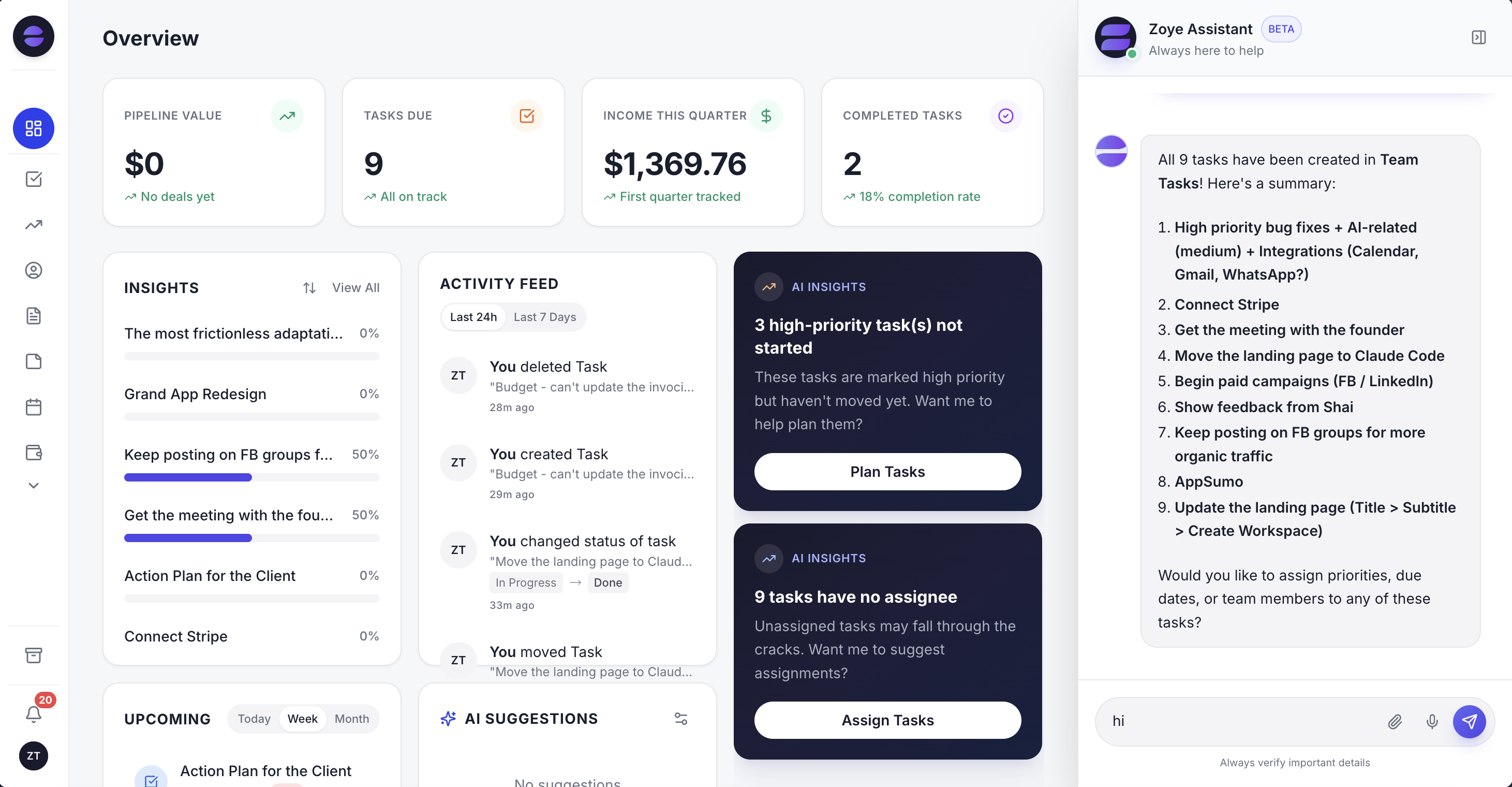 Zoye: tasks alongside CRM, budget, and live AI Insights in one connected workspace
In short, Zoye includes AI on every plan, a real Deals-and-Contacts CRM connected to tasks, native budget tracking, live WhatsApp management by text or voice, flat tier-based pricing, and same-day setup. A 20-member Growth plan with all of that is $59/month.
Real example: A boutique recruitment agency owner finishes a coffee with a hiring manager and sends Zoye a voice note from her phone: "Westbrook Logistics wants three mid-level ops hires, retainer about $42K, kickoff in two weeks." Zoye opens the client deal, files the contact, books a kickoff event on the calendar, and drafts the three role tasks against the retainer - work that in ClickUp or Asana would be a handful of separate screens, and neither would record the client or the retainer because neither has a CRM.
Want to see it in action?
See Zoye catch a new lead, answer on WhatsApp and set up the follow-up, all from one message.
See How It WorksHow to choose
Choose ClickUp if:
- You need maximum feature depth and customisation at the lowest per-seat price
- Your team has the patience for a 2-4 week setup and ongoing configuration
- You do not need CRM, budget, or AI included
- Your primary need is sophisticated task hierarchy and view flexibility
Choose Asana if:
- Goal-to-task strategic alignment is a real operational priority
- You need a tool your team can adopt in days, not weeks
- You can absorb the cost of Advanced ($24.99/user/month) for AI access
- You do not need CRM or budget management included
Choose Zoye if:
- You want AI included at every tier - not a paid add-on
- You need CRM, tasks, calendar, and budget in one connected workspace
- You prefer flat-rate pricing over per-seat charges
- You want to manage your business from WhatsApp by text or voice
- You want to be operational the same day with no configuration project
Ready to hand off the busywork?
Zoye brings AI-powered CRM, task management, and automation into one workspace.
Get StartedFrequently asked questions
Yes. ClickUp's paid tier starts at $7/user/month annual (Unlimited) versus Asana's Starter at $10.99/user/month. At the mid-tier the gap widens further: ClickUp Business is $12/user/month against Asana Advanced at $24.99/user/month. Both still charge per seat and both gate AI behind extra cost, so total cost depends on team size and AI usage.
Yes. Asana is consistently rated easier to learn and faster to set up - most teams are productive within a day. ClickUp's feature density makes setup take longer, typically 2-4 weeks before a team is comfortable. Asana's interface also loads faster and switches between views more smoothly. ClickUp's depth is its strength and its onboarding tax.
No. ClickUp Brain is a paid add-on (around $9/user/month), not included in any plan, including Business or Enterprise. Asana AI is bundled into Advanced ($24.99/user/month) and higher. Neither platform includes AI in their entry-level paid plans. (Pricing as of June 2026 - check each vendor's pricing page.)
For small businesses on tight budgets, ClickUp delivers more features per dollar - native time tracking, 15+ views, and 1,000+ integrations starting at $7/user/month. For small teams that prioritise immediate productivity and ease of use over feature depth, Asana is faster to adopt. Neither covers CRM, budget tracking, or AI execution natively at small-team prices.
Yes - Zoye is built for teams that want what neither covers: a personal AI assistant included on every plan, CRM and budget tracking native to the same workspace as tasks, and tier-based pricing instead of per-seat charges. A 15-person team pays $59/month on Zoye Growth with AI included, versus about $180/month on ClickUp Business or about $375/month on Asana Advanced - and Zoye also replaces the CRM and budget tools you would buy separately.
Yes. Asana Personal is free for up to 10 users with unlimited tasks, projects, and basic views. ClickUp's Free Forever plan is more generous - unlimited users, unlimited tasks, more view types, and limited automations - though it lacks AI and has storage caps. If you want CRM included at the lowest cost, Zoye's entry plan Almost Free starts at just $5/month (or $4/month billed annually, about the price of a cup of coffee), covering 1 member with the full workspace and the AI assistant - cancel or upgrade anytime.
ClickUp offers a one-click Asana importer that brings over projects, tasks, assignees, due dates, and comments. The migration itself takes minutes; the real work is rebuilding your views, custom statuses, and automations to match ClickUp's model. Plan 2-3 weeks for full team adoption regardless of which tool you switch from.
The bottom line
ClickUp and Asana are both capable platforms doing very different things well. ClickUp is the feature-maximalist consolidator at the lowest per-seat price - if you have time to configure it and do not need CRM, budget, or AI included. Asana is the disciplined, goal-aligned platform with the cleanest user experience - if you can absorb the Advanced tier cost for AI access.
The real question for most teams in 2026 is whether either of them is built for how your business actually runs. If you need an AI assistant that takes action across your whole workspace, a real CRM connected to tasks, budget tracking that integrates with project work, and a pricing model that does not grow every time you hire - the honest answer is neither. Zoye is built for that team, with all of it included on every plan and operational the same day you sign up.
For more context, see the best ClickUp alternatives, the best Asana alternatives, Asana vs Monday.com, ClickUp vs Trello, and the rest of the Zoye blog.