
Best Clientify Alternatives 2026: 7 Tools That Run the Work, Not Just Store It
Clientify earned its place with small businesses and agencies, especially across Spain and Latin America, by bundling a CRM, email marketing, landing pages, and WhatsApp into a single affordable suite. For a team that was juggling four disconnected tools, having sales, marketing, and messaging in one login is a real step up. The all-in-one SMB CRM was a good answer to the "too many tabs" problem.
The problem in 2026 is not that suites like Clientify lack features. It is that they still depend on you. The CRM only knows what someone typed into it. The follow-up only happens if a human remembers to send it. The WhatsApp inbox only moves when someone opens it and works each conversation. The moment the team gets busy, which is exactly when the pipeline matters most, the data entry slips, the follow-ups stop, and the expensive suite quietly turns into software you bought and stopped using.
This guide compares the seven best Clientify alternatives in 2026, ranked for small businesses and agencies that want less manual upkeep and more actual follow-through. The tools below range from a true AI operator that runs the work itself to the established CRM suites you already know. We lead with what each one leaves on your plate, so you can pick honestly.
Pricing reflects published rates as of July 2026; check each vendor's pricing page for current figures.
Why teams are looking beyond Clientify in 2026
Four shifts are driving the search for something different.
The bottleneck moved from features to execution. A decade ago the pain was not having a CRM. Today most small businesses have one, and the pain is that nobody keeps it current. Suites solved consolidation but not operation. The winning question in 2026 is no longer "does it have a WhatsApp inbox and a pipeline?" but "will it capture the lead, log it, and chase it without me?"
WhatsApp became the main sales channel, and a shared inbox is not enough. For service businesses and LatAm and Spanish markets in particular, most leads and most deals now happen on WhatsApp. A tool that gives you a shared WhatsApp inbox still needs a person to read, reply, tag, and follow up on every thread. When 200 conversations pile up, that person becomes the bottleneck. Teams want the conversations worked, not just centralised.
AI that only suggests does not remove the work. Almost every CRM added an AI feature in the last two years, Clientify included. Most of it drafts a message or scores a lead and then hands the task straight back to you. That helps a little, but it does not change the fundamental math: someone still has to do the doing. The tools pulling ahead are the ones where the AI takes the action itself.
Manual data entry is the number one reason CRMs fail. Empty databases, stale records, and follow-ups nobody sent are the classic symptoms of an abandoned CRM. Any suite that leans on human discipline to stay accurate will eventually rot under a busy team. The alternative teams now want is a system that keeps its own records up to date as a side effect of doing the work.
The 7 best Clientify alternatives in 2026
1. Zoye - the WhatsApp-native AI operator that runs your business
Zoye is the strongest Clientify alternative for small businesses and agencies that are tired of feeding a CRM and want the tool to run the customer work itself. Instead of being another suite you log into and update, Zoye is an AI Business Operator: it captures leads, updates its own records, books clients, and chases follow-ups, over WhatsApp and email, so a small team runs like a much larger one.
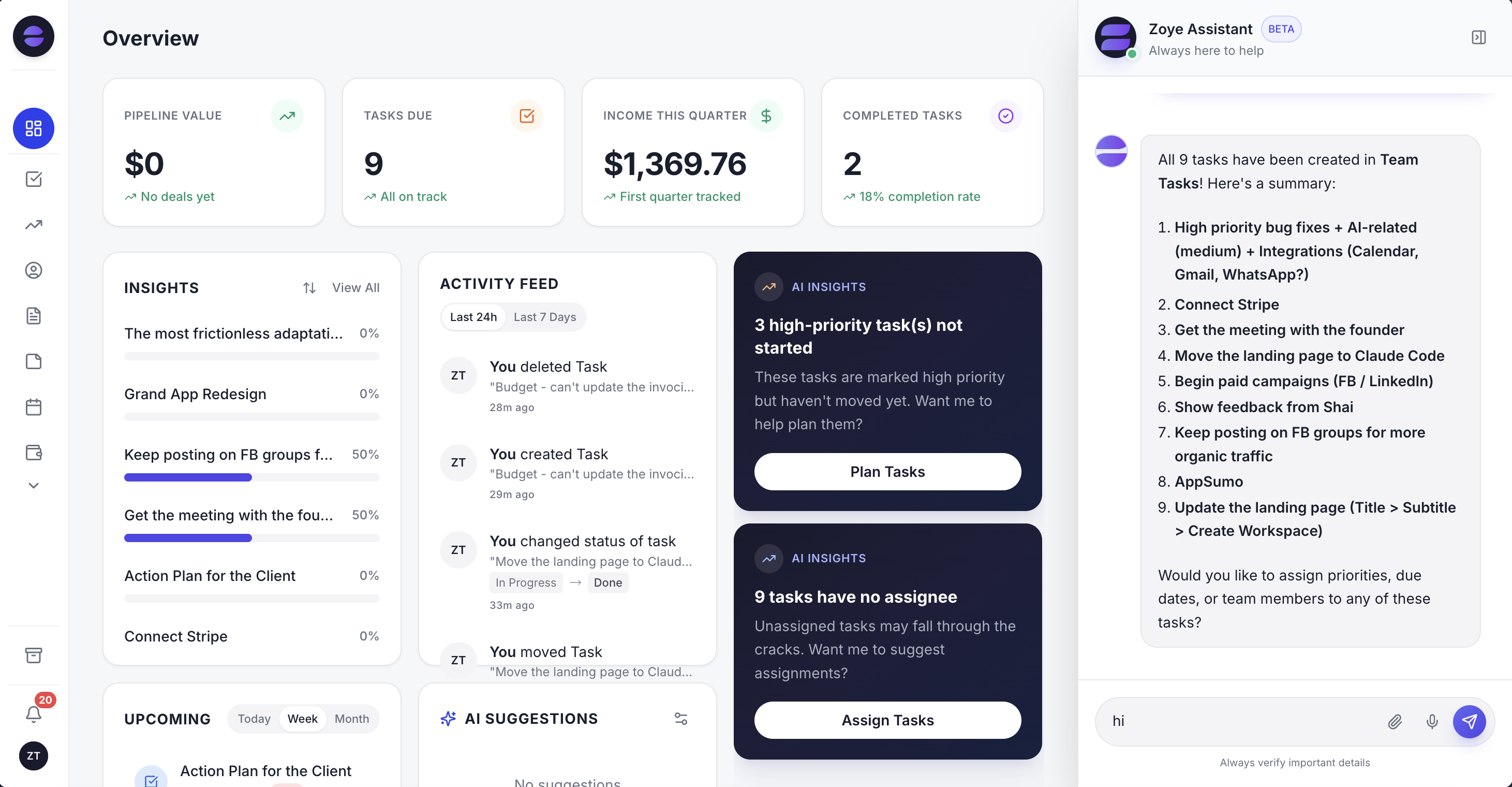 The Zoye dashboard shows the whole business at a glance, with proactive insights and the assistant ready to act.
The difference is not a longer feature list, it is who does the work. In Clientify, you enter the contact, you write the follow-up, you work the inbox. In Zoye, the operator does those things and shows you the result, so the pipeline stays current even in your busiest week.
The Zoye Assistant takes action, it does not just suggest
This is the core distinction. When a message comes in on WhatsApp, the assistant reads it, captures the lead into the CRM with the right details, drafts or sends the reply, books the appointment on the calendar, and sets the follow-up, then chases it later without being reminded. It surfaces overdue deals, drafts the next nudge, and produces a report on demand. Where a suite's AI writes you a suggested reply and waits, Zoye's assistant does the task and reports back.
Build automations by describing them in plain language
You do not configure trigger-and-action rules in a builder. You tell Zoye what you want in a sentence, including over WhatsApp: "when a new lead comes in from the Instagram form, message them within five minutes, and if they do not reply in a day, remind me." The operator builds and runs that automation. That is the practical version of automation for a busy owner who does not have time to learn a workflow canvas.
One place for the customer, sales, and follow-up work
Zoye keeps contacts, deals, tasks, calendar, and reports together, and it keeps them current itself because it is the one filling them in. For a small agency or service business, that means the CRM is never a separate chore. The record updates as a by-product of the conversation the operator just handled.
WhatsApp-native, not WhatsApp-attached
Because the assistant works the conversations rather than parking them in an inbox, WhatsApp becomes a channel where deals actually move on their own. Replies go out fast, leads get captured every time, and nothing sits unread because a person did not get to it. The same operator works across email too, so the channel does not fork the workflow.
Pricing: Almost Free at $5 per month for 1 member with the full platform including AI. Starter from $29 per month (10 members). Growth from $59 per month (20 members). Scale from $119 per month (100 members).
Best for: Small businesses and agencies, especially WhatsApp-first ones, that want the tool to run the customer work instead of asking them to maintain it.
2. Clientify - the affordable all-in-one SMB suite
Clientify remains a reasonable choice if you specifically want CRM, email marketing, landing pages, and a WhatsApp inbox bundled at an SMB price, with strong Spanish-language support and a familiar footprint in LatAm markets.
The honest limitation is the one this whole guide is about: it is a suite you operate. The records are only as current as your data entry, and the WhatsApp inbox and marketing campaigns still need a person to run them. It stores and organises the work well, but it does not do the work for you.
Pricing: Tiered SMB plans by contact volume and features; check the current pricing page for figures.
Best for: Small teams that want a low-cost bundled CRM plus marketing and are willing to operate it hands-on.
3. HubSpot - the polished CRM that scales (and gets expensive)
HubSpot is the most refined CRM in this comparison, with a genuinely useful free tier and a deep ecosystem of marketing, sales, and service hubs. For teams that value polish and integrations, it is hard to beat on breadth.
The trade-offs are cost and operation. The price climbs quickly once you need Marketing or Sales Hub features and more contacts, and like any CRM it still relies on your team to keep records updated and follow-ups moving. Its AI assists but does not run the pipeline for you.
Pricing: Free CRM tier. Paid Starter, Professional, and Enterprise tiers that rise steeply with contacts and hubs.
Best for: Teams that want a polished, scalable CRM and can absorb the cost as they grow.
4. Zoho CRM - the deep, configurable value pick
Zoho CRM offers remarkable depth for the price and slots into the wider Zoho ecosystem of business apps. For teams that want extensive customisation and are comfortable configuring it, Zoho delivers a lot of capability per dollar.
The trade-off is that depth means setup and upkeep. Zoho rewards teams that invest time in configuration, and it can feel heavy for a small business that just wants leads captured and chased. As with the others here, it organises the work rather than performing it.
Pricing: Free tier for up to 3 users. Standard, Professional, and Enterprise paid tiers per user per month.
Best for: Teams that want maximum configurability and value, and have someone to set it up.
5. Kommo - the messaging-first sales CRM
Kommo (formerly amoCRM) is built around chat-based selling, with WhatsApp, Instagram, and other messengers wired into a pipeline. For teams that sell primarily in DMs, its messenger-centric design feels natural.
The limitation is that Kommo centralises and organises the conversations, but a salesperson still works each one. Its Salesbot can automate some steps, yet you build and maintain those flows, and the day-to-day replying and follow-up remain human tasks. It is a strong inbox-plus-pipeline, not an operator that runs the thread itself.
Pricing: Base, Advanced, and Enterprise tiers per user per month.
Best for: Small sales teams that sell mostly through messaging and want a pipeline built around it.
6. Pipedrive - the simple, sales-focused pipeline
Pipedrive is a clean, sales-first CRM that small teams adopt for its clarity. The visual pipeline is easy to understand, and reps tend to actually use it, which is more than many CRMs can claim.
The trade-off is scope and execution. Pipedrive is deliberately focused on the sales pipeline, so marketing and messaging need add-ons, and like the rest of this list it depends on reps to log activity and send follow-ups. It keeps the pipeline tidy, but the chasing is still on you.
Pricing: Essential, Advanced, Professional, and Enterprise tiers per user per month.
Best for: Sales teams that want a simple, focused pipeline they will actually maintain.
7. Bitrix24 - the free-heavy all-in-one workspace
Bitrix24 packs an enormous amount into one platform: CRM, tasks, chat, telephony, and even a website builder, with a free tier that supports a lot of users. For budget-conscious teams that want breadth, it is a lot of software for the money.
The trade-off is complexity. Bitrix24's sheer breadth makes it busy to learn and configure, and small teams often use only a fraction of it. And, familiar refrain by now, it houses the work rather than running it. The records and the outreach still depend on your team.
Pricing: Generous free tier. Basic, Standard, and Professional paid plans by feature set and users.
Best for: Budget-focused teams that want maximum breadth in one platform and do not mind the learning curve.
Want to see it in action?
Watch how Zoye automates your daily workflow - from lead management to team collaboration.
See How It WorksBest Clientify alternative for WhatsApp-first businesses
If most of your leads and deals happen on WhatsApp, the deciding question is whether the tool merely centralises the conversations or actually works them. Clientify, Kommo, and the shared-inbox tools give you one place to see every thread, which is useful, but a person still has to reply, tag, and follow up on each one.
Zoye is the clearest pick here because the operator does that work. It replies or drafts the reply, captures the lead into the CRM automatically, books the appointment, and chases the follow-up, so conversations keep moving even when nobody is watching the inbox. For a service business where speed of reply decides who wins the deal, that is the difference between catching a lead in five minutes and losing it overnight. See our guide on how to sell on WhatsApp for the full playbook.
Best AI-powered Clientify alternative
Almost every tool on this list now has an AI feature. The honest distinction is between AI that suggests and AI that acts. HubSpot, Zoho, and Clientify use AI to draft a message, score a lead, or summarise a record, then hand the task back to you. That is helpful, but it does not remove the work.
Zoye is the only pick here built AI-first, where the assistant takes the action itself: it creates and updates records, captures leads from messages and forms, books clients, sends and chases follow-ups, and builds automations from a plain-language instruction. The test is simple. Ask the tool to "message every lead from last week who did not reply, and remind me tomorrow about the ones who still do not." A suggestion engine writes you a draft. An operator does it.
See what Zoye can do for you
From CRM and deal tracking to AI-powered task management - explore everything Zoye offers in one workspace.
Explore FeaturesHow to choose the right Clientify alternative for your business
Three questions narrow the field fast.
1. Do you want a tool you operate, or one that operates for you? If you have the discipline and time to keep a CRM current and work the inbox by hand, the classic suites (Clientify, HubSpot, Zoho, Pipedrive) all do that job well. If your real problem is that upkeep keeps slipping because you are busy running the business, you want an operator like Zoye that keeps its own records and does the follow-through.
2. How central is WhatsApp? If messaging is where your deals live, weight the decision heavily toward tools that work the conversation, not just store it. Zoye runs the thread, Kommo centralises it, most generic CRMs bolt it on.
3. How big is your team and budget? Solo owners and small teams benefit most from flat-rate pricing and a low entry price, so the tool pays back immediately. Per-seat suites can get expensive fast as you add people. Zoye's flat plans (Almost Free at $5 per month for 1 member, then $29 and $59 per month) keep the cost predictable as you grow.
Migrating from Clientify without losing momentum
The good news is that a CRM migration is mostly a data move plus a workflow rethink, and the workflow rethink is where the real gain lives. Export your contacts, deals, and notes from Clientify, then decide what is genuinely active. Most databases carry a large tail of cold, stale records that are better archived than imported. Bring forward the live relationships and the open deals.
The bigger shift is in how the work gets done afterward. On Clientify you were the engine: you entered the data and sent the messages. Moving to an operator like Zoye means you describe how you want leads handled once, and the assistant runs it from there. Point it at your WhatsApp and email, tell it your follow-up cadence in plain language, and it starts capturing and chasing on its own. Most small teams are fully switched over in an afternoon, and the difference they notice first is that the CRM finally stays current without anyone tending it.
For the broader picture of why CRMs get abandoned in the first place, see our guide on customer management software and CRM for small business.
Why teams pick Zoye as their Clientify replacement
A few themes come up again and again.
The CRM stops rotting. Because the operator keeps its own records as it works, there is no data-entry chore to fall behind on, which is the single biggest reason CRMs get abandoned.
WhatsApp deals actually move. The assistant replies fast, captures every lead, and chases follow-ups, so the channel where your business really happens stops leaking opportunities to slow responses.
The work gets done, not just organised. Instead of a tidy database you still have to act on, you get an operator that captures, books, and chases by itself, and builds new automations the moment you describe them.
Try Zoye with your team. The entry plan is Almost Free at $5 per month for 1 member, with the full platform including AI.
For more context, see CRM for small business, how to sell on WhatsApp, and the best CRM for a one-person business.