
Vacation Rental SEO in 2026: Rank a Direct Booking Site
Most small rental portfolios have a website, and most of those websites do nothing. There is a homepage with a slideshow, an "our properties" grid, a contact form, and a paragraph about the region written years ago. The pages exist, they are indexed, and they receive almost no search traffic, because none of them was ever built to answer a question anybody types into Google.
That matters more every year, because the alternative is renting your demand. The OTAs are excellent at filling calendars and they charge for it: commission on Booking.com commonly sits in the mid teens, Vrbo and Airbnb take their own cut, and every one of those bookings arrives with a guest relationship you do not own. Direct bookings are the only channel where the margin, the guest data, and the repeat business stay with you, and search is the cheapest reliable way to create them.
This guide is the technical version of that project: how to structure destination and property-type pages, how to make one page per property actually earn its place, how local intent works for lodging, what to mark up, how to keep an image-heavy site fast, and what to do with the enquiries the site produces once it starts working. The last part is where most of the money is lost, so it gets its own section.
Platform details and commission ranges reflect what was accurate as of August 2026; check each platform's current terms before you plan around them.
What you are actually competing against
Type "3 bedroom villa with pool algarve" into Google and look honestly at the result. You will see OTA category pages, metasearch, one or two large aggregators, a travel magazine listicle, and possibly a local agency. You will rarely see a five-property management company on page one for that phrase, and pretending otherwise is how SEO budgets get wasted.
The winnable ground is narrower and more valuable than the head term:
- Attribute-rich long tail. "Dog friendly cabin with hot tub near Keswick" has low volume and high intent. Ten of those beat one impossible head term.
- Named property and brand searches. People who saw your unit on an OTA and want to check you out, or past guests looking for you again. These are yours to lose.
- Neighbourhood and micro-location. "Apartment walking distance to old town", "villa near the marina", "cottage close to the coast path".
- Occasion and group intent. "Large house for family reunion", "cottage for a hen weekend", "villa for a small wedding party".
- Practical questions. "Is a car needed in X", "best area to stay in X for families", "where to stay near X airport for an early flight".
Two consequences follow. First, your keyword research should start from your actual inventory and location rather than a generic list: every property is a set of attributes, and every attribute combination is a potential query. Second, most of your pages exist to serve a small number of high-intent searches each, which is fine. A property page converting one booking a month at full rate is a better asset than a blog post with a thousand irrelevant visits.
It is also worth deciding early who the site is selling to. A management company has two audiences: guests, and the homeowners whose properties you want to manage. They need separate sections, separate content, and separate follow-up, and the owner side is usually the more profitable one. That side of the operation is covered in our vacation rental CRM page, and we will come back to it once the guest-facing structure is in place.
The architecture that ranks: destinations and property types
The default rental site is flat: a homepage, a properties grid, and a set of listing pages hanging off it. Nothing on that site targets a destination search, so nothing ranks for one.
The structure that works is a hub and spoke. Destination hubs sit above property-type pages, which sit above individual properties, and local content links across into all of them.
| Page type | Example URL | Search intent it serves |
|---|---|---|
| Destination hub | /stay/lake-district | "where to stay in the lake district" |
| Destination plus property type | /stay/lake-district/cottages | "lake district cottages" |
| Destination plus attribute | /stay/lake-district/dog-friendly | "dog friendly lake district cottages" |
| Individual property | /stay/lake-district/fell-view-cottage | branded, attribute and repeat searches |
| Local guide | /guides/lake-district-with-dogs | research intent, links down to inventory |
| Owner-facing | /property-management/lake-district | "holiday let management lake district" |
A few rules keep this from turning into a doorway-page problem, which is the classic way rental sites get penalised or simply ignored:
One page per real intent, not per keyword permutation. A page for "cottages" and a page for "cottage rentals" is duplication. A page for "cottages" and a page for "dog friendly cottages" is a genuine distinction, because the content differs: different properties, different practical advice, different questions.
Every hub needs content only you could write. Which valley suits a first visit, where parking is genuinely difficult, which beach is safe for small children, how long the drive from the airport really takes in August. That is the part an OTA category page cannot produce, and it is the reason your page deserves to exist.
Never generate hubs for places you have no inventory in. An empty destination page is a soft 404 waiting to happen.
Keep URLs canonical and stable. Shallow, readable, lowercase, hyphenated, no session or tracking parameters in the indexable version. If you run faceted filters (sleeps, price, pool, dates), those parameter URLs should be canonicalised or blocked rather than indexed, because a filter combinatorial explosion is the fastest way to burn your crawl budget on near-duplicates.
Decide in advance what happens when a property leaves. Owners take homes back; units get sold. A dead property page that 404s loses the equity it built. Redirect it to the closest sibling property or the destination hub, and if the page had links or rankings, say plainly at the destination that the home is no longer available and show the alternatives.
One page per property, done properly
"One page per property" is repeated so often that it has become an instruction to publish thin pages. The page only helps if it is the best available answer about that specific home.
A property page that earns its ranking usually contains:
- A specific title and heading that reads like a search: property name plus what it is plus where, for instance "Fell View Cottage: 3 bedroom dog friendly cottage in Grasmere".
- Bed and bathroom configuration written out. Not just "sleeps 8" but which rooms have what, and whether the sofa bed is counted in that number. This is the single most common pre-booking question.
- Genuinely unique prose. Copy pasted from your Airbnb listing appears verbatim on a domain with vastly more authority than yours, which is not a legal problem but is a positioning one: there is no reason to prefer your version.
- Micro-location detail. Walking minutes to the bakery, the pub, the beach, the bus stop. Parking reality. Whether the lane is suitable for a large car. What the wifi speed is, honestly, because remote workers filter on it.
- Honest limitations. Steep stairs, no air conditioning, road noise at the front, a garden not enclosed for dogs. Stating these reduces the wrong bookings and the complaints that follow, and it visibly increases trust.
- Images that carry information. Descriptive alt text, sensible file names, a compressed modern format, and captions where a photo needs context.
- A short FAQ block answering the questions you actually receive by email about that unit, marked up as FAQPage.
- Availability and a clear next step. If your booking engine or PMS provides a calendar widget, embed it, but do not let it be the reason the page is slow (more on that below).
If a unit cannot support that page, do not publish a stub. Group similar units under a property-type page, describe the differences in a table, and give each unit its own page once you have something to say. Ten strong property pages outperform forty thin ones, and thin pages also dilute the destination pages you do want to rank.
Want to see it in action?
Watch how Zoye automates your daily workflow - from lead management to team collaboration.
See How It WorksLocal intent, Google Business Profile, and being a real place
Lodging is a local category, and search engines treat it that way. Two distinct local plays matter.
The business itself. A management company with a real office should have a complete Google Business Profile: correct category, real address, service area, hours you actually answer, photos, and a steady flow of reviews. This is what surfaces for searches like "holiday let management near me" and it is one of the strongest owner-acquisition channels most small operators completely ignore.
The properties as places. Individual homes are usually not eligible as their own business listings, so the local signal has to come from your pages: geo coordinates in structured data, an address or clear micro-location, embedded map where useful, and content that names the surrounding places in the way locals and visitors do. Mentioning the nearest town, the national park, the airport, the beach, and the notable landmarks is not keyword stuffing when it is genuinely how someone describes where they are staying.
Consistency is what ties it together. Business name, address and phone should match across your site, your profile, your OTA host profiles, and any local directories. Search engines resolve entities from repeated agreement, and inconsistency is the most common reason a small operator with good content still fails to appear locally.
Schema for lodging: what to mark up
Structured data will not lift a weak page, but it removes ambiguity, and ambiguity is expensive now that AI answer engines quote pages directly.
What to ship, in order of return:
- Your organisation as a lodging entity.
LodgingBusiness, or the more specificVacationRentaltype, with name, url, logo, telephone,address,geo,sameAslinks to your OTA host profiles and social accounts, andpriceRangeif you are comfortable publishing one. - Each property as an
Accommodation. The subtypes matter:House,Apartment,Suite. Populateoccupancywith aQuantitativeValuefor maximum guests,numberOfBedrooms,numberOfBathroomsTotal,floorSize,petsAllowed,amenityFeatureentries asLocationFeatureSpecificationfor pool, hot tub, air conditioning, parking, wifi, andaddressplusgeofor the location. AddcheckinTimeandcheckoutTimewhere they are fixed. BreadcrumbListon every property and hub page, matching the visible breadcrumb and the URL hierarchy.FAQPagefor the property FAQ and destination-guide FAQ blocks, using the same questions and answers that are visible on the page.ImageObjectreferences for your primary photography, andVideoObjecton the single canonical page of any property video.- Reviews, carefully. Only mark up reviews that are genuinely collected and displayed on your own site, and be aware that search engines discount or ignore self-serving review markup about your own business. Never fabricate an
aggregateRating, and never mark up ratings pulled from an OTA as though they were collected by you.
One honest caveat worth knowing before you brief a developer: Google's dedicated vacation rental rich results run through Hotel Center feeds for eligible partners, not through open schema markup on your own site. So treat this work as entity clarity, AI-answer accuracy, and eligibility groundwork rather than a guaranteed visual upgrade in the SERP.
Reviews as an SEO and conversion asset
Reviews affect direct bookings in three separate places, and most operators only work on one of them.
On your Google Business Profile, review volume and recency are local-pack signals and they influence whether owners trust you enough to call. On your property pages, first-party reviews are conversion content: a guest who has never heard of you is being asked to send money to an unfamiliar brand instead of booking through a platform with a refund policy, and other guests' words are what closes that gap. On your OTA listings, review scores drive placement in a system you do not control, which is precisely why the direct site matters.
The practical routine is unglamorous. Ask every departing guest, at the moment they are happiest, which is usually within a day of checkout. Send one message, not four. Make it a single tap. Collect at least some reviews on your own domain so you have content you own, and reply to every review in public, especially the critical ones, because prospective guests read the reply more carefully than the complaint.
See what Zoye can do for you
From CRM and deal tracking to AI-powered task management - explore everything Zoye offers in one workspace.
Explore FeaturesPage speed for an image-heavy site
Rental sites are photography sites, and photography is where their performance dies. Google's Core Web Vitals thresholds are the target to design against: largest contentful paint under 2.5 seconds, cumulative layout shift under 0.1, and interaction to next paint under 200 milliseconds, measured on real mobile devices rather than your laptop on office wifi.
The specific fixes that matter for this category:
- Serve modern formats at the right size. AVIF or WebP with a JPEG fallback, multiple widths via
srcset, and never a 4000 pixel hero scaled down in the browser. - Preload the hero, lazy-load the rest. The first image is your LCP element, so it should be discoverable in the HTML with high fetch priority and must not be lazy-loaded. Everything below the fold should be.
- Do not put a JavaScript carousel above the fold. A gallery slider is the classic LCP killer. Render a single hero image, and let the gallery load on interaction.
- Reserve space for everything. Width and height attributes on images, fixed containers for the availability calendar and any review widget. Layout shift on a booking page costs bookings, not just a score.
- Defer the booking widget. Third-party calendar and quote widgets are often the heaviest thing on the page. Load them on interaction or below the fold, and never let the property description depend on their script running.
- Render content in HTML. If your property copy only appears after a client-side fetch, you are betting your rankings on a crawler executing your JavaScript correctly. Static generation or server rendering removes that risk.
- Use a CDN and long cache lifetimes for images. Your photos do not change; your visitors are often in another country.
When you evaluate a hosted vacation rental website builder, this is the checklist to test with, not the template gallery. Ask whether you control titles, meta descriptions, URLs, headings, image formats, structured data and internal links, and run a real page through a field-data test before you migrate.
Internal linking and the content that earns its place
Property pages rarely attract links on their own. Local content does, and internal links are how you move that authority to the pages that make money.
Write the guides your guests keep asking for: the best area to stay for a first visit, what is actually open off season, the walk that suits children, the event calendar, how to get in from the airport without a car. Each guide should link down to the destination hub and to two or three specific properties with descriptive anchor text, and each property page should link back up to its hub and sideways to genuine alternatives, which also rescues an enquiry when a unit is booked.
The housekeeping matters as much as the content. No orphan property pages. A clean XML sitemap that contains only canonical, indexable URLs. Pagination handled properly on long grids. Filter and search parameter URLs kept out of the index. And a periodic sweep for pages that get impressions but no clicks, because those are usually a title and meta description problem you can fix in ten minutes.
What to do with the enquiries the site produces
Here is the part that decides whether any of the above was worth doing. A direct booking site does not produce bookings, it produces enquiries: a form submission at 11pm, an Instagram message about the same property, a WhatsApp asking whether the dates are still free, a phone call while you are driving. Somebody has to answer them fast, know which property and which dates, follow up when there is no reply, and remember the answer next season.
That is the leak. The enquiry that arrived at 11pm and was answered at noon is already booked elsewhere. The guest who asked about a booked week and was never offered the sister cottage is gone. The homeowner who filled in your management form during a viewing and heard nothing for a week signed with the manager down the road. None of that is an SEO problem, and no amount of ranking fixes it.
This is where a business layer sits next to your operational stack. Your PMS and channel manager own the bookings: availability, rates, OTA sync, the guest inbox, the calendar. Zoye does not replace any of that. It has no channel manager, no OTA sync, no nightly rates, no booking engine and no owner trust accounting, and it is not trying to. It runs the business around the bookings, alongside Guesty, Hostaway, Lodgify, OwnerRez or Smoobu.
In practice, that means the enquiry your site earned becomes a lead with a source attached, so you can finally see which destination page, which guide and which channel produce revenue rather than sessions. The first reply happens quickly, including over WhatsApp, and the follow-up happens without anyone remembering it. The homeowner pipeline gets real stages, from first conversation to viewing to proposal to signed agreement, with the chasing built in. Management agreements and owner documents live in one place instead of three inboxes and a shared drive. Cleaner and turnaround tasks stop living in a spreadsheet only you can open. And you describe new routines in a sentence rather than building them: "when a website enquiry comes in, reply within five minutes and ask for dates and group size", or "if an owner proposal has no answer in three days, follow up".
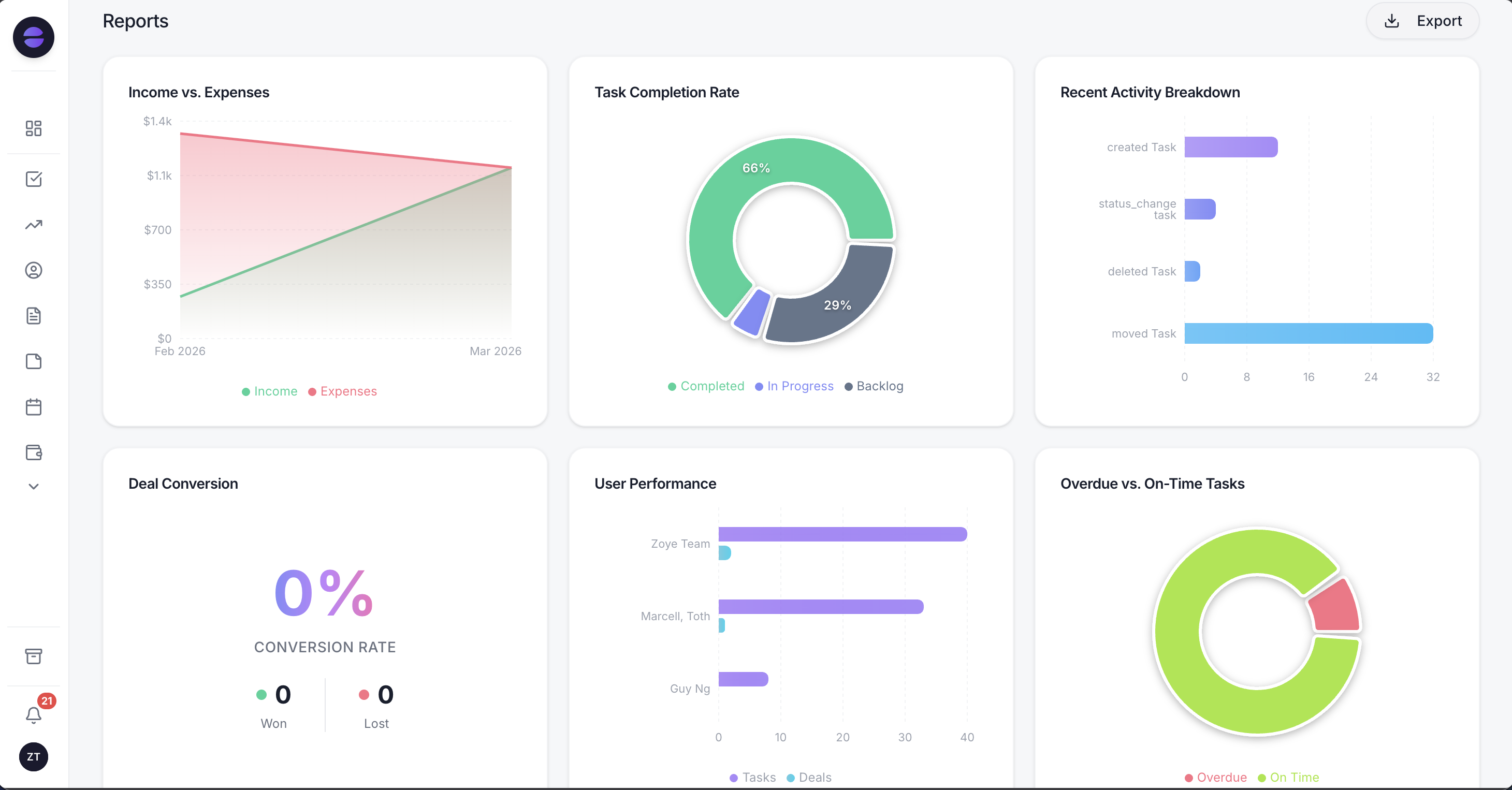 Zoye's reports: which destination pages and channels actually produced enquiries, how fast each was answered, and what is still sitting in the pipeline
The reporting closes the loop back to the SEO work. Once every enquiry carries a source, the question stops being "did traffic go up" and becomes "which pages produced booked revenue", which is the only version of the question worth answering. Attribution is also what stops you from over-investing in the content that feels productive and under-investing in the three pages that quietly pay for everything.
Ready to streamline your business?
Zoye brings AI-powered CRM, task management, and automation into one workspace.
Get StartedA sensible order to do the work in
Rental demand is seasonal, so sequence backwards from the booking window you want to fill.
Months one and two: foundations. Fix the URL structure, ship the destination hubs for the locations you actually have inventory in, and rewrite the top five property pages properly. Get the structured data and breadcrumbs in place. Fix the hero image and the carousel so the pages are fast.
Months two and three: capture. Before more traffic arrives, make sure nothing leaks: short enquiry form, WhatsApp option, a response-time promise you can keep, and every enquiry landing somewhere with a source and a follow-up attached. Do this before the content push, not after.
Months three to six: content and links. Publish the local guides, link them into inventory, build the Google Business Profile and review routine, and start the owner-facing section if you manage for other people.
Ongoing: improve rather than add. Every month, look at the pages with impressions and no clicks, the pages with clicks and no enquiries, and the enquiries with no follow-up. Those three lists contain almost all of the available upside.
Frequently asked questions
Vacation rental SEO is the work of making your own booking site visible in search for the trips people are actually planning, rather than depending entirely on Airbnb, Booking.com and Vrbo to find guests for you. In practice it means a page structure built around destinations and property types, one genuinely useful page per property, correct lodging structured data, real reviews, fast image-heavy pages, and internal links that connect your local content to the properties it should sell.
Plan in seasons, not weeks. Property and destination pages usually need a few months to settle, and because rental demand is seasonal you often only learn whether a page works when its booking window opens. A practical rhythm is to publish the structure and the top destination pages six to nine months before the season you want to fill, then keep improving the pages that already get impressions instead of constantly adding new ones.
Yes, if each page can carry unique content that answers real questions: specific rooms and bed configuration, what the neighbourhood is like, walking distances, parking, what the wifi is actually like for remote work, and honest limitations. A page that is a photo gallery plus copy pasted from your OTA listing is thin content, competes with your own destination pages, and rarely earns anything. If you cannot write a distinctive page for a unit, group it under a property-type page until you can.
Structured data is not a ranking factor by itself, but it is how machines confirm what your page is. Marking up your business as a LodgingBusiness or VacationRental, each property as an Accommodation with occupancy, amenities and geo coordinates, plus BreadcrumbList and FAQPage where relevant, makes your pages far easier for search engines and AI answer engines to quote accurately. Google's dedicated vacation rental rich results are limited to partners feeding data through Hotel Center, so treat schema as clarity and eligibility groundwork rather than an instant visual upgrade.
The best choice is whichever platform lets you control page titles, meta descriptions, URL structure, headings, image sizes and formats, structured data, and internal links, and renders content in HTML rather than only in JavaScript. Hosted vacation rental website builders that come with a PMS are convenient because availability and rates stay in sync, but check those controls before committing, because a template that generates one identical page per listing with no editable copy will cap your organic ceiling.
Rankings only create enquiries; bookings come from what happens next. Make the reason to book direct explicit, keep the enquiry form short, publish a response-time promise you can actually keep, and offer the channel people prefer, which is often WhatsApp. Then treat every enquiry as a lead with a source and a follow-up, because the majority of lost direct bookings are not lost in search, they are lost in the hours between an enquiry arriving at 11pm and someone answering it at noon.
The bottom line
Vacation rental SEO is not a content problem, it is a structure problem followed by an operations problem. Build destination and property-type hubs above property pages that genuinely deserve to exist, mark them up so machines cannot misread them, keep an image-heavy site fast, earn reviews, and link your local knowledge into the inventory it should sell. That is the whole ranking half, and it is very achievable for a portfolio of five to forty homes because the competition at that level is mostly not doing it.
Then respect the second half. Every ranking you win converts into an enquiry that needs answering in minutes and following up for weeks, and every homeowner conversation needs a pipeline rather than a good memory. Your PMS will keep running the bookings. What decides whether the SEO pays is whether anything is running the business around them.
For more context, see the wider vacation rental marketing playbook, the vacation rental CRM page for the owner and enquiry side, the best business management software, and the rest of the Zoye blog.