
monday.com vs Jira 2026: Which One Fits Your Team?
monday.com and Jira end up on the same shortlist far more often than they should, because they were never really built for the same job. monday.com is a colourful work operating system aimed at business teams: campaigns, client projects, operations, hiring pipelines, anything you can lay out as a grid of rows with coloured status pills. Jira is an issue tracker built by an engineering company for engineering teams, and every part of it, from issue types to sprint burndown, reflects that.
So the honest version of this comparison is not "which tool is better". It is "which kind of work do you actually have, and who is going to keep the tool fed once it is set up". That second question is the one most shortlists ignore, and it is where both tools leave the same thing on the table.
This comparison walks through who each tool is built for, how boards and workflows differ, what automation and reporting really give you, integrations, AI, and pricing. Then it covers the part neither tool touches: the client work, the follow-ups, and the admin that keeps a small business running.
monday.com vs Jira at a glance
| Dimension | monday.com | Jira | Zoye |
|---|---|---|---|
| Built for | Business teams, client and marketing work | Software teams, issues and releases | Business owners and client-facing teams |
| Learning curve | Hours | Weeks, with configuration | Same day, describe what you want |
| Boards | Colour-coded grids, many views | Scrum and Kanban with sprints | List, board, calendar, timeline |
| Automation | Recipe builder, no-code | Rule engine, powerful and technical | Built from a plain-language sentence |
| Reporting | Dashboards and widgets | Sprint, velocity, and issue reports | Live cross-workspace reports on request |
| CRM and clients | Separate monday CRM product | Not included | Built in, kept current by the assistant |
| Customer messaging | Not native | Not native | WhatsApp and Slack, assistant can reply |
| AI | Credit-based AI features by tier | Atlassian Intelligence on higher tiers | Included on every plan, takes action |
| Pricing model | Per seat, three-seat minimum | Per user | Flat rate per plan |
| Entry paid price | Around $9 per seat per month annual | Around $8 to $9 per user per month | $5 per month, Almost Free, 1 member |
Pricing reflects published rates as of August 2026; check each vendor's pricing page for current figures.
Who each tool is actually built for
monday.com sells itself as a work OS, and the description fits. You build a board, define columns, and the visual grid does the explaining. A marketing lead can hand a board to a freelancer with no training. Operations teams like it because a board can model almost anything: an onboarding checklist, a content calendar, a stock list, an approval queue. The company also sells separate products for CRM, dev work, and service, which tells you something in itself: the core product is a flexible surface, and the specialised jobs get their own paid product.
Jira is not trying to be that. It models software delivery: issues with types, statuses tied to a workflow, sprints with committed scope, versions and releases, and links from a ticket to a branch, a pull request, and a deploy. In an Atlassian-centred company that chain is genuinely valuable, and no colourful grid replaces it. Atlassian also ships Jira Work Management for business teams, but outside engineering-heavy organisations it rarely feels native.
Verdict: monday.com for business teams who need clarity fast. Jira for engineering teams who need the delivery chain modelled properly. If you are choosing for a mixed company, expect to end up with both, or with Jira for engineering and something lighter for everyone else.
Boards and workflows
monday.com boards are rows and columns with status, people, date, number, and formula columns, viewed as a table, Kanban, calendar, timeline, Gantt, or chart. Changing structure is dragging a column. That flexibility is the appeal and also the risk: without conventions, a company ends up with forty boards nobody agrees on, and reporting across them gets fuzzy.
Jira workflows are stricter by design. An issue moves through defined transitions, with conditions, validators, and post-functions attached. That rigidity is the point. It means a "Done" ticket really has passed review, and the sprint report is trustworthy. The cost is that changing how work flows means editing a workflow scheme, which in most companies means asking an admin.
Verdict: monday.com wins on speed of change. Jira wins on integrity of process. Pick according to whether your bigger risk is bureaucracy or drift.
Want to see it in action?
Watch how Zoye automates your daily workflow - from lead management to team collaboration.
See How It WorksAutomation
monday.com automations are recipe-shaped: when a status changes to Done, notify someone and move the item to a group. Non-technical people build them without help, which is exactly right for the audience. The limits show with conditional branching, cross-board logic, and anything that needs a state check before acting. Action volumes are also capped per tier, so heavy use pushes you up the price ladder.
Jira automation is the stronger engine. Multi-step rules, smart values, branching over related issues, scheduled rules, and cross-project scope give you real programmability, and it is included in a usable form even on lower tiers. It is also less approachable: writing a rule that touches subtasks and linked issues feels like writing code with a form builder.
Both share one boundary, though. Automation here moves work items around inside the tool. It does not go outside and chase the client who has not replied, or answer the WhatsApp message that came in at 9pm.
Verdict: Jira for depth, monday.com for accessibility. Neither operates the customer-facing half of the business.
Reporting
monday.com dashboards assemble widgets across boards: workload, time tracking, numbers, charts, battery-style progress. They are quick to build and easy to read, which makes them good for a weekly review with a client or a founder. The depth is moderate, and cross-board reporting depends on how disciplined your board structure is.
Jira reporting is narrower and deeper. Burndown, velocity, cumulative flow, control charts, and release readiness are all standard, and they are computed from data the workflow guarantees. If you want to know whether your sprints are predictable, Jira answers honestly. If you want to know whether this client account is profitable this quarter, it has no opinion at all.
Verdict: Jira for delivery metrics. monday.com for readable operational dashboards. Neither reports on revenue, pipeline, or client health without another tool.
Integrations and ecosystem
Both connect widely. monday.com ships integrations for email, calendars, Slack, storage, forms, and the usual SaaS suspects, and its marketplace keeps growing. Jira sits inside the Atlassian ecosystem alongside Confluence, Bitbucket, and Jira Service Management, plus an unusually large third-party marketplace built up over many years. For engineering tooling specifically, Jira's ecosystem is deeper than almost anything else in the category.
The practical difference is what the integrations do for you. In both tools an integration is a pipe: it moves data in and out and then waits for a person to act. Nothing in either ecosystem takes the incoming enquiry and turns it into a qualified lead, a booked call, and a follow-up sequence without someone driving.
Verdict: Jira for engineering-tool depth, monday.com for general business apps. Both leave the acting to you.
See what Zoye can do for you
From CRM and deal tracking to AI-powered task management - explore everything Zoye offers in one workspace.
Explore FeaturesAI in monday.com and Jira
monday.com AI shows up as assistants inside boards and docs: generating item text, summarising updates, categorising, drafting formulas, and building automation recipes from a description. Usage runs on a credit allowance that scales with your plan, so heavy use has a cost attached.
Atlassian Intelligence in Jira does summaries, natural-language issue search, and drafting help, and it sits on the higher paid tiers rather than the entry ones. In an Atlassian-heavy company it is genuinely useful for making sense of a long ticket thread.
Both are assistive. They write, summarise, and suggest. Neither one goes and does the multi-step business job end to end: read the enquiry, decide it is worth pursuing, reply, book the meeting, record the client, and chase the answer three days later.
Verdict: useful AI in both, gated and credit-limited in both, and assistive rather than operational in both.
Pricing
monday.com charges per seat with a three-seat minimum, which is the detail that surprises small teams. Paid plans typically begin around $9 per seat per month billed annually on the entry tier, with Standard and Pro tiers above it unlocking more automation actions, more integrations, and more capable dashboards. Because the minimum applies even to a two-person business, the effective floor is higher than the headline.
Jira is more generous at the bottom: a free tier covers small groups, and the paid Standard tier lands in the region of $8 to $9 per user per month, with Premium roughly double that for advanced admin controls, more automation, and Atlassian Intelligence. For very small teams Jira can genuinely cost nothing, which is a fair point in its favour.
Pricing reflects published rates as of August 2026; check each vendor's pricing page for current figures.
The twelve-person team math. On monday.com's mid tier, twelve seats lands in the region of $150 per month, more once you add the automation volume a busy operation needs. On Jira Standard, twelve users is closer to $110 per month, and Premium roughly doubles it. Either way you are then buying a CRM separately, and probably something for customer messaging too.
Verdict: Jira is cheaper at small scale and has the better free tier. monday.com costs more but is usable by everyone in the company. Both scale by headcount, so both get more expensive every time you hire.
The third option: Zoye
Here is what neither comparison column covers. monday.com and Jira are both places where work is recorded. Somebody still has to notice the enquiry, reply to it, qualify it, book the call, write the follow-up, and update the record afterwards. That work is the actual operating cost of a small business, and buying a project tool does not reduce it. It is why so many boards go quiet three months after rollout: the software was never the part that was doing the work.
Zoye is built the other way round. It is an AI operator that runs the business side rather than a surface you maintain. It captures leads from your forms, WhatsApp, and email, replies and qualifies them, books the appointment, updates its own records without anyone typing them in, chases the follow-up that would otherwise be forgotten, and builds new automations from a sentence you type in plain language.
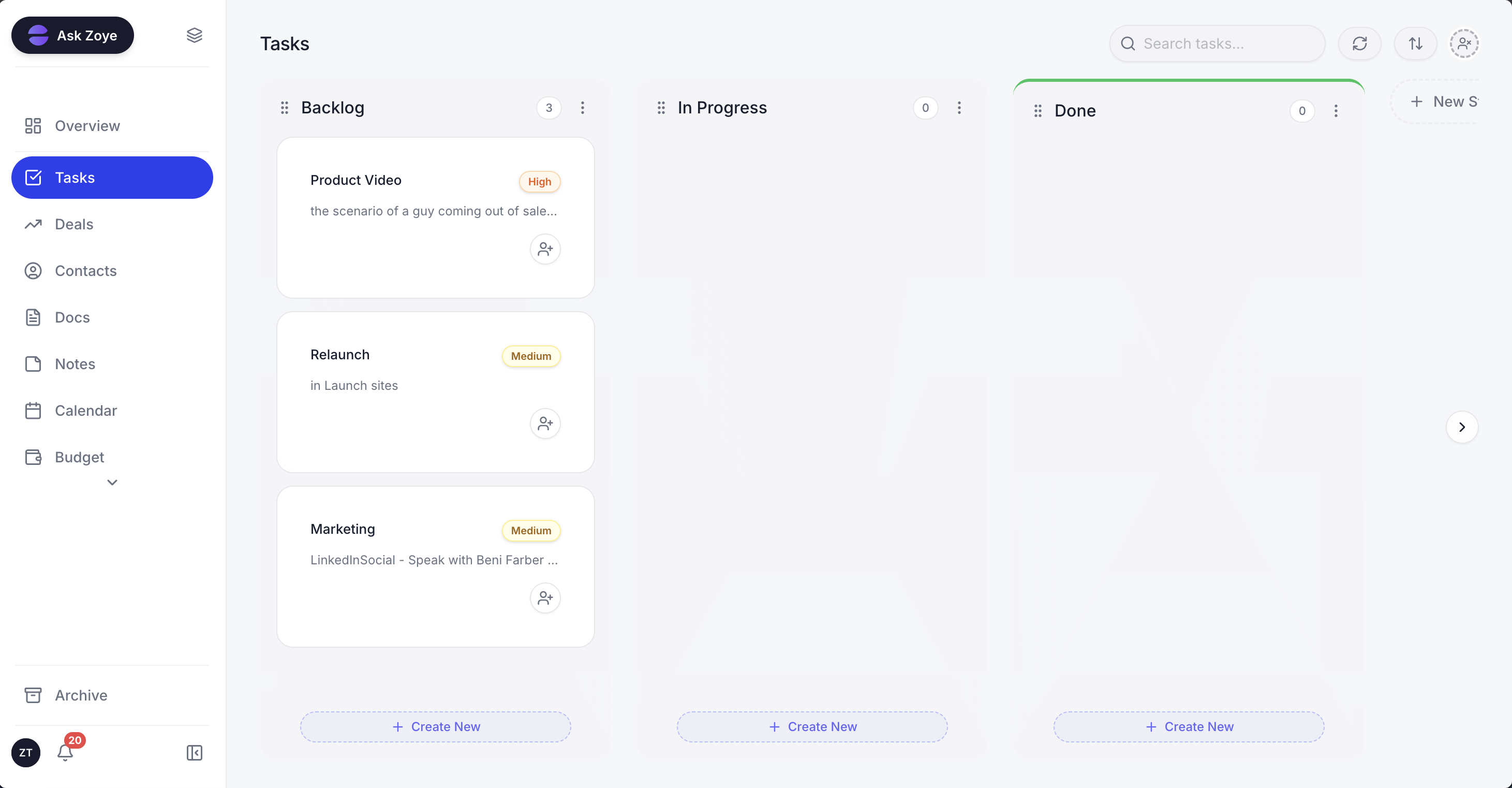 Zoye keeps tasks on a familiar board while the assistant handles the client work behind it
To be clear about the boundary, because it matters: Zoye is not a software-engineering issue tracker. If your team runs sprints against a release train with branch-linked tickets, keep Jira. Zoye is for the other half of the company, the half that has clients, quotes, appointments, invoices to chase, and messages that arrive at inconvenient hours.
Practically, that means tasks with list, board, calendar, and timeline views, a real client and deal record connected to those tasks, a calendar the assistant can book into, budget tracking, live reports generated on request, and WhatsApp and Slack conversations the assistant can answer or draft replies for. Collaborative notes are rolling out.
Pricing: Almost Free at $5 per month for 1 member with 1GB storage and the full platform including AI. Starter at $29 per month for 10 members with 5GB. Growth at $59 per month for 20 members with 10GB and 24/7 support. Scale at $119 per month for 100 members with 25GB. A Customize tier covers custom limits and dedicated support.
Best for: owners and client-facing teams who want the follow-up work done rather than tracked.
Ready to streamline your business?
Zoye brings AI-powered CRM, task management, and automation into one workspace.
Get StartedWhen to choose each
Choose monday.com if:
- Your work is client projects, campaigns, operations, or cross-department coordination
- Non-technical people need to build and read boards without training
- Visual dashboards for weekly reviews matter more than delivery metrics
- You are willing to pay per seat and accept the three-seat minimum
Choose Jira if:
- You ship software, run sprints, and care about releases and bug workflows
- You already use Confluence or Bitbucket and want the chain intact
- Process integrity is worth the configuration cost
- A capable free tier for a small team is a deciding factor
Choose Zoye if:
- Your real bottleneck is client follow-up, enquiries, and admin, not task tracking
- You want an assistant that acts rather than one that drafts text
- You want client records, tasks, calendar, budget, and messaging in one place
- You want flat pricing that does not rise with every hire
- You want to describe an automation in a sentence instead of building it
Use both if: your engineering team lives in Jira and the rest of the company needs something readable. That is a common and perfectly sensible setup. The question is just what runs the client side, and the answer is usually neither of them.
Migrating between them
Moving from Jira to monday.com is mostly a mapping exercise: issue types become groups or boards, statuses become status column values, and epics become items with subitems. What breaks is anything that relied on workflow rules, permission schemes, or sprint history, since there is no equivalent to carry across.
Going the other way, monday.com to Jira, tends to be harder culturally than technically. The data moves fine as CSV; the friction is that a team used to reshaping a board freely now has to request workflow changes. Budget a few weeks of grumbling either way, and decide up front who owns configuration.
If what you actually want is to stop running the follow-ups manually, a migration between these two will not deliver that, because both destinations have the same gap.
Frequently asked questions
It depends entirely on the work. monday.com is better for business teams running client projects, marketing calendars, operations, and cross-department work, because anyone can read a board on day one. Jira is better for software teams shipping code, because it models issues, sprints, releases, and bug workflows in a way monday.com does not. Neither is better in the abstract, and neither runs your client follow-ups for you.
Not strictly, but that is where it earns its keep. Jira Work Management exists for business teams, and marketing or HR groups do use Jira boards inside Atlassian-heavy companies. Outside that context, non-technical teams usually find the issue-type, workflow, and permission model heavier than the work justifies. If nobody on your team says the word sprint, Jira is probably more machinery than you need.
Both charge per seat. monday.com paid plans typically start around $9 per seat per month billed annually with a three-seat minimum, rising through Standard and Pro tiers. Jira has a free tier for small groups and paid tiers starting in the region of $8 to $9 per user per month, with Premium roughly double that. Figures reflect published rates as of August 2026, so check each vendor's pricing page before you budget.
For lightweight development work, yes. Small teams do run their backlog on a monday.com board and get by. For teams that depend on release versions, complex bug workflows, sprint reporting, and deep code-repository links, monday.com will feel approximate. Most companies that try the swap either simplify their engineering process to fit, or keep Jira for engineering and use something else for the business side.
monday.com, comfortably. A non-technical team can build a usable board in an afternoon because the colour-coded grid explains itself. Jira takes longer, mainly because schemes, issue types, workflows, and permissions have to be configured before the tool behaves the way a given team expects. The Jira learning cost is real, and for engineering teams it usually pays back.
Neither monday.com nor Jira chases a lead, answers a customer message, books an appointment, or updates a client record on its own. Zoye is built for exactly that gap. It is an AI operator that captures leads, follows up, books clients, keeps its own records current, and builds automations from a plain sentence you type, including over WhatsApp and Slack. Plans start at $5 per month on the Almost Free tier for 1 member.
The bottom line
monday.com and Jira are both good at what they were built for, and they were built for different things. monday.com gives business teams a readable, flexible surface they can adopt in an afternoon, with a per-seat bill and a three-seat floor. Jira gives engineering teams a rigorous delivery model, the deepest automation engine of the two, a strong free tier, and a learning curve that pays back only if you genuinely ship software.
What neither one does is operate your business. They hold the record of work while a person does the chasing. If the thing quietly costing you money is the enquiry nobody answered, the quote nobody followed up, and the client record nobody updated, the tool you need is not a better board. Zoye runs that work itself, from $5 per month on the Almost Free plan, and you instruct it in the same plain language you would use with a new hire.
For more context, see ClickUp vs monday.com, the best Jira alternatives, the best monday.com alternatives, Asana vs ClickUp, and the rest of the Zoye blog.