Best Miro Alternatives 2026: 8 Tools That Turn Workshops Into Real Work
Miro is very good at the thing it was built for. An infinite canvas, thousands of sticky notes, a timer, a voting round, and everyone in the company able to think in the same space at the same time. For a remote strategy day or a product discovery session, it still sets the standard, and the template library alone saves a facilitator hours.
The problem shows up on the Monday after. The board captured the thinking beautifully, and then nothing moved. Those sticky notes are not tasks. That column of "who owns this" is not a real assignment with a date on it. The customer name written on a card is not a record anywhere. So one person volunteers to write up the actions, copies half of them into a task tool, forgets the rest, and the board quietly becomes a link nobody clicks again. Multiply that across a year of workshops and you have paid for a lot of seats to produce a lot of pictures.
This guide covers the eight best Miro alternatives in 2026 for small teams, agencies, consultants, and business owners. Some of them are better whiteboards, and where that is genuinely what you need, we say so plainly. But the first entry is deliberately not a whiteboard, because for most small teams the real gap is not the canvas. It is that the work decided on the canvas never gets done.
Pricing reflects published rates as of August 2026; check each vendor's pricing page for current figures.
Why teams are looking beyond Miro in 2026
Four things drive the search.
Per-seat pricing punishes occasional use. Whiteboards are bursty. A small team might run one real session a month and then not open the tool for three weeks. Paying a full seat price every month for every person who occasionally joins a workshop is hard to justify, especially when the free tier caps you at a handful of editable boards right when you start relying on it.
The board and the work live in different worlds. The output of a good session is decisions, owners, and dates. The output of a whiteboard is a picture of decisions, owners, and dates. Bridging the two is manual, and manual bridges are where small teams lose things. The follow-up call that never got booked and the quote that never got sent both started life as a sticky note somebody meant to action.
Heavy canvases feel slow and overwhelming. As boards grow past a few hundred objects, load times climb and new joiners get lost. Plenty of teams discover that what they actually wanted was a fast diagram, a simple flowchart, or a shared sketch, not a warehouse-sized canvas with an entire app ecosystem attached.
AI that summarises is not AI that acts. Every whiteboard now has AI that clusters sticky notes and writes a summary of the session. That is useful. It is also the easy half. Nobody has to be persuaded to read a summary. The hard half is the chasing that comes after, and a summary does none of it.
The 8 best Miro alternatives in 2026
1. Zoye - the AI operator that runs what the workshop decided
Zoye is the strongest pick for teams whose real complaint is not the whiteboard but the silence after it. It is an AI business operator: you tell it in a plain sentence what came out of the session, and it turns that into tracked work it then carries out and follows up on itself.
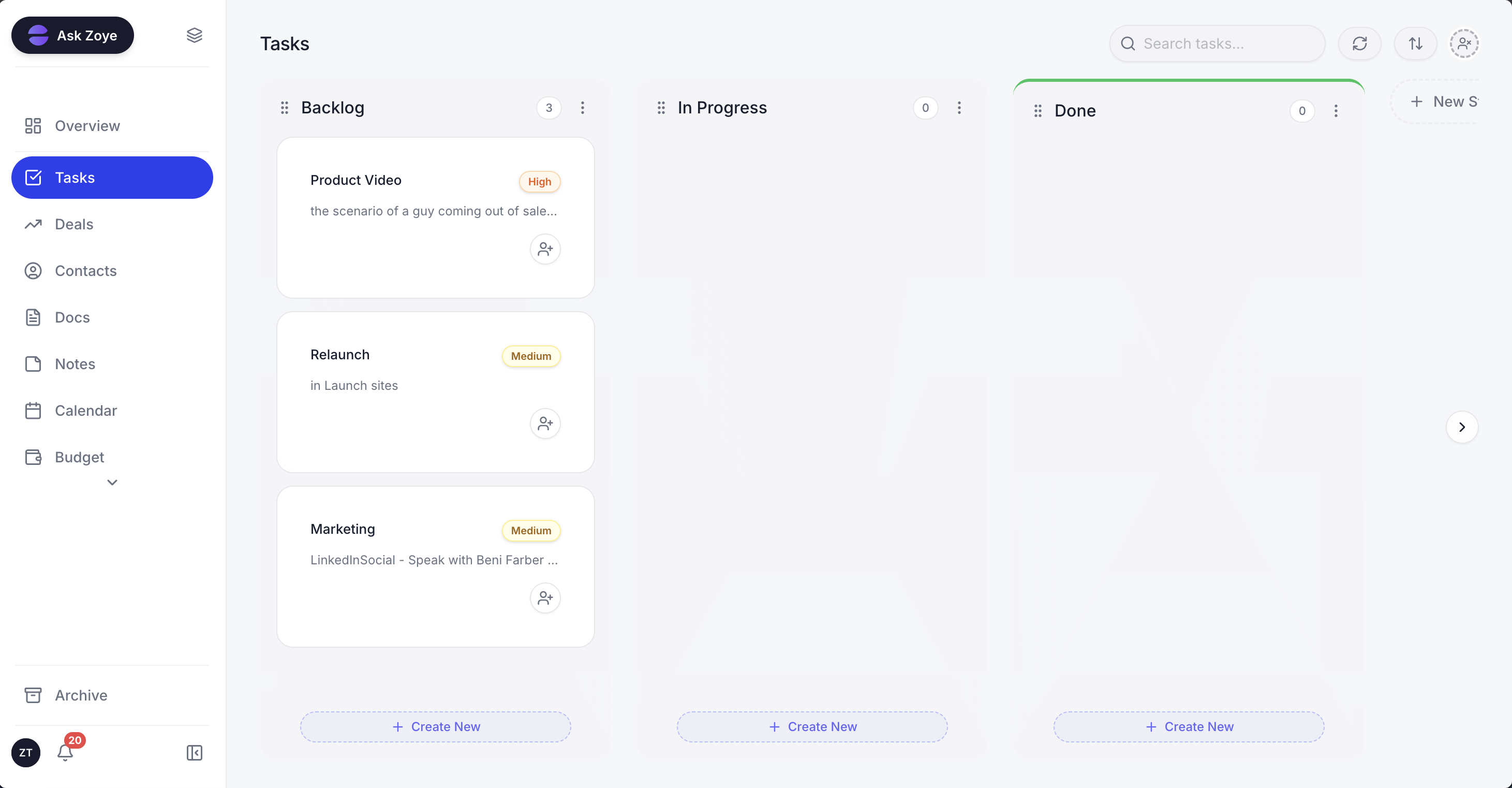
Everything the session decided becomes work with an owner, a date, and something chasing it.
Here is what that looks like in practice. After a planning session, you type something like "create the five onboarding fixes we agreed, give the first two to the ops lead for next Friday, and follow up with the three clients who asked about the new pricing". Zoye creates the tasks, sets the owners and the dates, opens or updates the client records, and then starts chasing: the reminder before the deadline, the follow-up message to the client who never replied, the nudge when a task goes overdue. You did not build an automation, configure a rule, or map a trigger to an action. You described the outcome once.
That last point is the difference worth understanding. Most tools let you build automations if you are willing to learn their builder. Zoye builds the automation from the sentence. "Every time someone fills in the contact form, message them within five minutes and book them into an open slot" is a working automation the moment you have finished saying it, and it runs over WhatsApp and Slack as readily as over email.
The workspace underneath holds what a small business actually runs on: tasks in list, board, calendar, and timeline views, client and deal records that Zoye maintains itself rather than waiting for you to update them, a calendar the tasks land on automatically, budget tracking, and reports you can ask for in plain language. Notes, the collaborative docs module, is rolling out.
Be clear about the boundary: Zoye is not an infinite canvas. If your job is running design critiques or mapping a complicated service blueprint visually, keep a whiteboard for that hour and use Zoye for the other 167 hours in the week. Plenty of teams pair a free whiteboard with Zoye and stop paying for whiteboard seats entirely.
Pricing: Almost Free at $5 per month for 1 member, 1GB storage, full platform including AI. Starter $29 per month (10 members, 5GB). Growth $59 per month (20 members, 10GB, 24/7 support). Scale $119 per month (100 members, 25GB). A Customize tier covers larger limits and dedicated support.
Best for: Small teams, agencies, and consultants who run sessions regularly and want the outcomes to actually happen without a person policing them.
2. FigJam - the best-value canvas for product and design teams
FigJam is Figma's whiteboard, and for teams already living in Figma it is close to a default choice. Sticky notes, voting, cursor chat, timers, and templates all feel fast and modern, and moving between a FigJam board and the design file it feeds is seamless in a way no competitor matches.
The honest limitation is that FigJam is designed around product and design work. If your workshops are about sales pipeline, client onboarding, or operations, the template library and the surrounding ecosystem are aimed somewhere else, and you will still be doing the after-the-session write-up by hand.
Pricing: Free tier with up to 3 FigJam files. Paid collaborator seats start around $3 to $5 per user per month depending on plan and billing cycle.
Best for: Product and design teams already using Figma.
3. Mural - the facilitator's whiteboard
Mural is Miro's closest peer and beats it in one specific area: running a session with people who are not power users. Facilitation superpowers like summon, follow-the-facilitator, private mode for silent voting, and timed activities make a workshop with 20 mixed-seniority participants noticeably smoother.
The trade-offs are that pricing is aimed at organisations rather than five-person teams, and that the same post-session gap applies. Mural has excellent methods and excellent templates. It still hands you an image of a decision at the end.
Pricing: Free tier with limited murals. Team plans commonly around $12 per member per month; enterprise pricing on request.
Best for: Consultants and facilitators who run structured workshops for other people.
Want to see it in action?
Watch how Zoye automates your daily workflow - from lead management to team collaboration.
See How It Works4. Lucidspark - the whiteboard attached to serious diagramming
Lucidspark is the brainstorming half of the Lucid suite, and its advantage is what sits next to it. When a messy sticky-note session needs to become a proper process diagram, org chart, or systems map, moving into Lucidchart is a short step rather than a rebuild in a different tool.
The trade-off is that the value depends on wanting both halves. If you only want the whiteboard, you are paying into a suite whose strongest asset you will not touch, and the interface carries some of the weight of the more formal diagramming product.
Pricing: Free tier with 3 editable boards. Individual around $8 per month, team plans around $9 per user per month.
Best for: Teams whose brainstorms regularly turn into formal process or architecture diagrams.
5. Excalidraw - the free, fast, open-source sketchpad
Excalidraw is the antidote to heavy canvases. It opens instantly, the hand-drawn style keeps early ideas feeling deliberately unfinished, it is open source, and you can self-host it if you care about where the data sits. For a quick architecture sketch on a call, nothing beats it.
The honest limitation is that it is a sketchpad, not a workshop platform. There is no voting, no timers, no facilitation tooling, and the collaboration model is lighter than the commercial options. It also, by design, does absolutely nothing with what you drew once the call ends.
Pricing: Free and open source. Excalidraw Plus, the hosted collaboration version, is around $6 per user per month.
Best for: Engineers, solo consultants, and anyone who wants a fast sketch with no setup and no bill.
6. Whimsical - the tidy tool for flows and wireframes
Whimsical takes the opposite approach to the infinite canvas: strong opinions, clean defaults, and a small set of things it does very well. Flowcharts, wireframes, mind maps, and sticky-note boards all come out looking presentable without anyone fiddling with alignment, which makes it a favourite for client-facing documents.
The trade-off is deliberate constraint. If your session genuinely needs a sprawling canvas with hundreds of participants and dozens of clustered themes, Whimsical will feel restrictive rather than calm.
Pricing: Free tier with limited boards. Paid plans commonly around $10 to $12 per editor per month.
Best for: Small teams who want flows, wireframes, and diagrams that look sharp with no effort.
7. Microsoft Whiteboard - the one you already pay for
If your business runs on Microsoft 365, Microsoft Whiteboard is already included, already inside Teams, and already covered by whatever data policies your organisation has agreed. For an ad-hoc sketch during a Teams call, that convenience beats a better tool you have to buy and get everyone to sign into.
The trade-off is depth. Templates, facilitation features, integrations, and performance on big boards all lag well behind the specialists, and outside the Microsoft ecosystem it is awkward to invite people in.
Pricing: Included with most Microsoft 365 business plans.
Best for: Teams already standardised on Microsoft 365 who need a good-enough whiteboard at no extra cost.
8. Miro itself - when the canvas really is the point
It would be dishonest to write this list without saying that Miro is often still the right answer. The template library is the deepest in the category, the integration ecosystem is the broadest, performance on genuinely huge boards is strong, and its AI clustering of sticky notes is legitimately good at making sense of a chaotic session.
What it leaves on your desk is the operating cost. Miro is where the thinking happens, and it is honest about that. It is not where the client gets called back, the invoice gets chased, or the task gets reassigned when someone is off sick. If your team is already disciplined about moving outcomes into the systems that run the business, Miro is excellent. If that hand-off is exactly what keeps failing, a better whiteboard will not fix it.
Pricing: Free tier with 3 editable boards. Starter around $8 per member per month billed annually, Business around $16 per member per month; enterprise on request.
Best for: Larger or design-heavy teams who need the deepest canvas and already have a reliable process after the session.
At a glance
| Tool | Best at | Entry pricing | What it still leaves you to run |
|---|---|---|---|
| Zoye | Executing what was decided | Almost Free, $5 per month for 1 member | Visual design workshops on an infinite canvas |
| FigJam | Product and design sessions | Free tier, paid from around $3 per user | The write-up and every follow-up after it |
| Mural | Facilitated workshops | Free tier, teams around $12 per member | The write-up and every follow-up after it |
| Lucidspark | Brainstorm into formal diagrams | Free tier, teams around $9 per user | The write-up and every follow-up after it |
| Excalidraw | Instant sketching | Free, hosted around $6 per user | Facilitation, structure, and all follow-through |
| Whimsical | Flows and wireframes | Free tier, paid around $10 per editor | Large-scale sessions and all follow-through |
| Microsoft Whiteboard | Sketching inside Teams | Included with Microsoft 365 | Depth, templates, and all follow-through |
| Miro | The deepest canvas | Free tier, paid from around $8 per member | Turning the board into work that gets done |
When you genuinely need an infinite canvas
Some jobs really do need the canvas, and swapping in a task tool would be the wrong advice. Be honest about which camp you are in.
You need a real whiteboard when the visual arrangement itself carries meaning: a customer journey map where distance and adjacency matter, a service blueprint with swim lanes, a design critique where people annotate directly on screens, an affinity-mapping exercise with 300 research quotes that need clustering. In those cases pick FigJam if you are a product or design team, Mural if you are facilitating for others, Lucidspark if the output has to become a formal diagram, and Excalidraw if you want speed and no cost.
You do not need a whiteboard when the session is really a decision meeting with sticky notes as decoration. A quarterly plan, a client kickoff, a retro whose output is five fixes, or a sales pipeline review are all decision meetings. The canvas adds ceremony but no leverage, and it adds a translation step at the end where things get lost. Those sessions are better served by writing the outcome straight into something that will act on it.
Best Miro alternative for turning workshops into work
This is the gap most small teams are actually feeling, and it is why Zoye leads this list despite not being a whiteboard.
The pattern is always the same. A good session produces twelve decisions. Four make it into a task tool that evening. Three more get remembered a week later. Five vanish. Nobody is at fault, because the step between "we agreed this" and "this is now tracked, owned, dated, and chased" is unpaid administrative work that lands on whoever feels most guilty.
Zoye removes that step rather than optimising it. You describe the outcome in one sentence and the tasks exist, with owners and dates. From that point the operator side takes over: it reminds people before deadlines, escalates what goes overdue, drafts and sends the client follow-ups over email, WhatsApp, or Slack, updates the CRM record without being asked, and produces the status summary when someone wants to know where the twelve decisions got to. The board was a picture. This is the thing moving.
See what Zoye can do for you
From CRM and deal tracking to AI-powered task management - explore everything Zoye offers in one workspace.
Explore FeaturesHow to choose the right Miro alternative
Three questions settle it.
1. Is the canvas the deliverable, or is it a means to a decision? If the visual artefact is the deliverable, buy the best canvas you can justify. If it is a means to a decision, buy the thing that carries the decision out and use a free whiteboard for the hour of thinking.
2. How often do you actually open it? Whiteboard usage is bursty, and per-seat monthly pricing is not. If your team runs one session a month, the free tiers of FigJam, Excalidraw, or Microsoft Whiteboard are almost certainly enough, and the budget is better spent on the tool that runs the follow-through every day.
3. Who does the write-up today, and is it reliably happening? Ask honestly. If the answer is "the founder, at 10pm, sometimes", the tool you need is not a better place to put sticky notes. It is something that takes the outcome off the founder's plate entirely.
Migrating off a whiteboard without losing the thinking
The instinct is to export everything, and that is usually a mistake. Boards accumulate, and most of what is on them was thinking-out-loud that served its purpose in the room. Dragging three years of stale canvases into a new tool just moves the museum.
A cleaner approach takes about an hour. Open the boards from the last quarter only. For each one, write down what was actually decided, in sentences, not stickies: the commitments, the owners, the dates, the clients involved. Anything you cannot state as a sentence was context, not a commitment, and can stay behind. Export the handful of genuinely reusable artefacts, such as a journey map or a process diagram, as images or into whichever canvas tool you are keeping.
Then take that list of sentences and give it to the system that will run it. In Zoye, this is literally a paste: hand over the decisions in plain language and the workspace comes back with tasks, owners, dates, client records, and follow-up sequences already in place. Most teams find that the exercise also surfaces two or three commitments from the past quarter that everyone had quietly forgotten, which tends to pay for the hour on its own.
Why teams pick Zoye after the whiteboard
A few themes come up again and again.
The follow-through stops depending on a person remembering. Once the outcome is described, the chasing happens whether or not anyone is watching, including over WhatsApp and Slack where small-business conversations really live.
The stack shrinks. Tasks, client records, calendar, budget, and reports sit in one workspace, so the sentence "update the client and book the call" does not require three tools and two copy-pastes.
Setting it up is not a project. There is no automation builder to learn, no schema to design, and no template to configure. You describe what should happen and it happens, which is the whole reason it survives contact with a busy week.
Try Zoye with your team. The entry plan is Almost Free at $5 per month, with the full platform including AI.
For more context, see the best team collaboration software, the best Kanban software, and the best Evernote alternatives.