Best Loom Alternatives 2026: 8 Async Video Tools for Small Businesses
Async video solved a real problem. Instead of a 30-minute call to walk a client through a proposal, you record five minutes once and everyone watches it when they can. Loom made that normal, and for a lot of small teams it genuinely replaced a calendar full of status meetings.
The category has a blind spot, though, and it costs small businesses more than the subscription does. Recording the walkthrough is still you doing the work. And the moment the video is sent, everything the video was actually about becomes manual again: the written recap, the next step, the calendar invite, the nudge three days later when the client has not watched it. The recorder tracks the view. Nobody tracks the follow-up. That is where deals go quiet.
This guide covers the eight best Loom alternatives in 2026, judged on the things that matter to a small business: recording quality, how much editing you get before you need a second tool, honest pricing, and what each one leaves you to operate afterwards. Some of these are better recorders than Loom. One of them is not a recorder at all, and it is on the list because it closes the gap the whole category ignores.
Pricing reflects published rates as of August 2026; check each vendor's pricing page for current figures.
Why teams are looking beyond Loom in 2026
Four things push people to shop around.
The free plan stops fitting quickly. Loom's free tier caps both video length and library size, which is fine for quick answers and useless for a proper onboarding walkthrough or a recorded training session. The jump to a paid seat happens earlier than most owners expect, and it happens per creator, so every person who records costs again.
Editing is deliberately shallow. Loom is built for the raw take, and that is a legitimate design choice. But the moment you want to cut the dead air, fix a stumble, add captions that read well, or produce something a prospect will see before they know you, you are exporting to a second tool anyway. Two subscriptions to send one video.
Polish became a baseline expectation. Buyers now compare your five-minute walkthrough with a category where automatic zoom, smooth cursor motion, and clean captions are standard. A shaky raw screen capture reads as less prepared than it did two years ago, particularly in a sales context.
The video is the easy half. This is the one that actually costs money. A recorded demo does not update the client record, does not send the summary, does not put the next call in the diary, and does not chase the person who never opened it. Every one of those steps stays on the owner or the account manager, and they are exactly the steps that get skipped in a busy week. The tool you bought to save time still hands the follow-up back to you.
The 8 best Loom alternatives in 2026
1. Zoye - the operator that handles everything after the video
Zoye is the odd one out on this list, deliberately. It does not record your screen, and it will not pretend to. It is the AI Business Operator that runs the work the video was about: the recap, the record, the booking, and the chase.
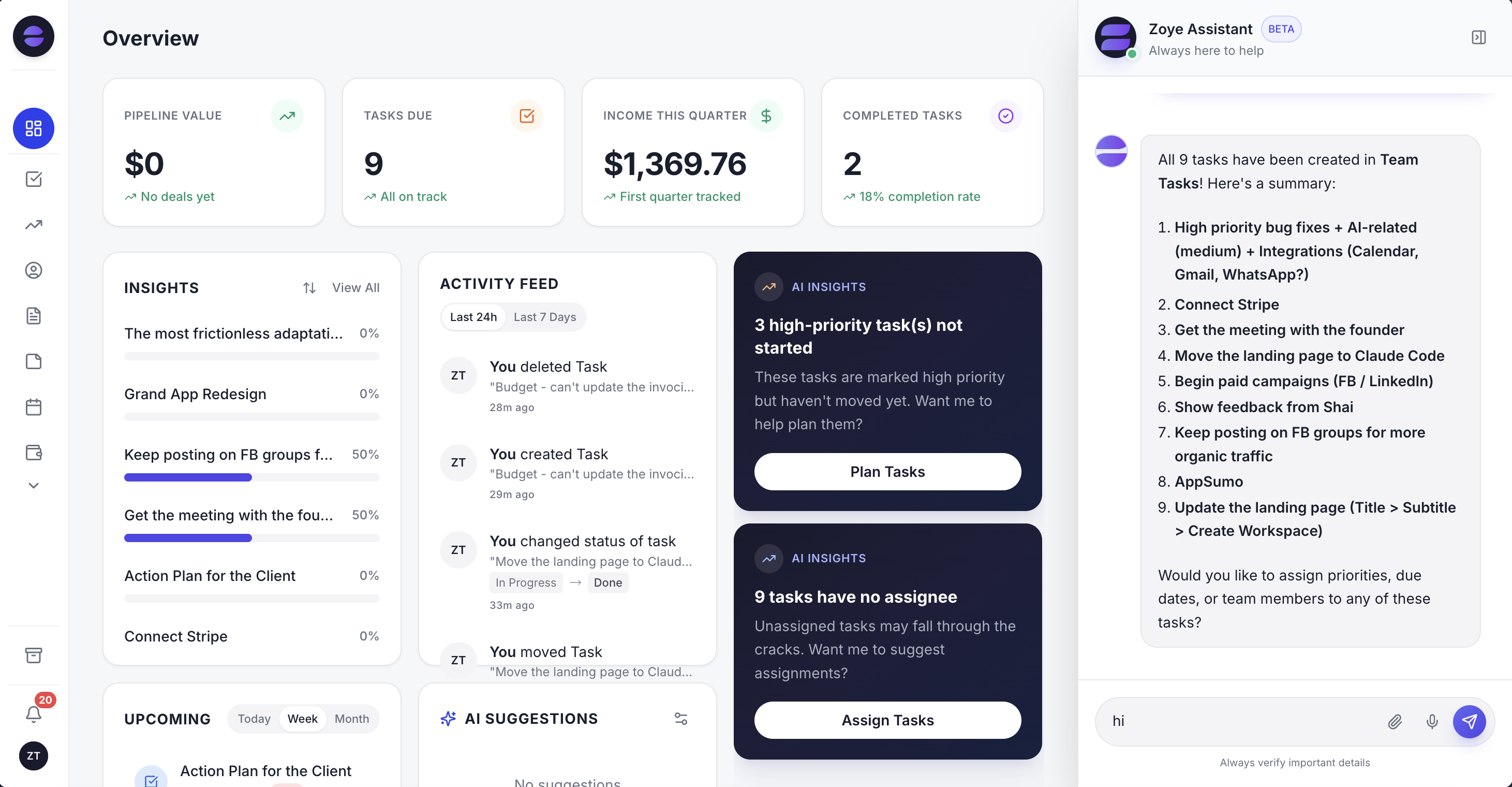
Zoye keeps the client, the conversation, and the next step in one place, so the follow-up after a video does not depend on somebody remembering.
Here is the honest framing. If your problem is "I need a better recorder", pick one of the seven tools below. If your problem is "I record great walkthroughs and half of them go nowhere", the recorder was never the bottleneck. A recorded proposal walkthrough is worth nothing until someone writes the summary, files it against the right client, offers three times for the follow-up call, and nudges the prospect who went quiet. That sequence is identical every single time, and it is done by hand almost everywhere.
Zoye runs it. You describe the routine in plain language, the same way you would explain it to a new hire: when I send a proposal video to a client, send them a short recap message with the link, log it on their record, offer three slots for a follow-up call this week, and if nobody replies in three days, chase once by WhatsApp and once by email. That sentence becomes a live automation. It runs on the next video and every one after it, without a builder canvas, a trigger tree, or a developer.
The rest of the workspace exists so the operator has something to operate on. Every client and lead has a record with the full conversation history, so the video you sent in March is attached to the same person who replies in May. Bookings go straight into the calendar with reminders that go out on their own. Tasks, deals, and follow-ups all sit in one place rather than being scattered across a recorder, an inbox, a spreadsheet, and a notes app that nobody opens twice.
It works where your customers actually are. Zoye operates over WhatsApp and Slack as well as email, so the recap of a video can land in the thread the client is already using, and the assistant can draft or send the reply from there. For a small business, this is usually the difference between a follow-up system that exists and one that exists on paper.
What it is not: a screen recorder, a video editor, or a hosting platform. Keep Loom, Screen Studio, or OBS for the recording. Zoye covers the part they leave on you.
Pricing: Almost Free at $5 per month for 1 member, 1GB storage, full platform including AI. Starter $29 per month (10 members, 5GB). Growth $59 per month (20 members, 10GB, 24/7 support). Scale $119 per month (100 members, 25GB). A Customize tier covers custom limits and dedicated support.
Best for: Small businesses whose recorded videos are part of a sales, onboarding, or support process that currently depends on someone remembering to follow up.
2. Loom - the category default, judged fairly
Loom deserves its position. The capture flow is the smoothest in the category, the share link works instantly, viewers can react and comment inline without an account, and the transcript and AI summary features genuinely save time on longer recordings. For quick internal explanation, it is still the tool most people should use.
The limits are the ones described above: shallow editing, a free tier that runs out fast, and per-creator pricing that grows with the number of people who record rather than the value you get. And the follow-through stays entirely on you.
Pricing: Free plan with limits on video length and library size. Business around $15 per creator per month billed annually, with an AI tier around $20 and custom enterprise pricing.
Best for: Teams that want the fastest possible record-and-share loop for internal updates.
3. Vidyard - the sales-focused video platform
Vidyard is the strongest choice if your videos are aimed at prospects rather than colleagues. It leans into the go-to-market use case with viewer analytics, in-player calls to action, custom thumbnails for cold outreach, and integrations designed to slot into a prospecting sequence.
The trade-off is weight. For a two-person consultancy that just wants to explain a spreadsheet to a client, Vidyard is more platform than the job requires, and the pricing reflects a sales-team buyer. It also still stops at the view: it will tell you the prospect watched to the end, and then the follow-up is your problem.
Pricing: Free plan available. Paid plans from around $19 per user per month, with higher tiers quoted for teams.
Best for: Sales teams using video in outbound and deal cycles.
Want to see it in action?
Watch how Zoye automates your daily workflow - from lead management to team collaboration.
See How It Works4. Screen Studio - the most polished output
Screen Studio produces the best-looking screen recordings available without editing skill. Automatic zoom on click, smoothed cursor motion, generous padding and backgrounds, and clean exports mean a raw take comes out looking produced. For product demos, launch videos, and anything a customer sees before they trust you, the quality gap is obvious.
Two honest caveats. It is macOS only, so a mixed-hardware team cannot standardise on it. And it is a local editor that exports a file rather than a share-link platform, so hosting, distribution, and any viewer tracking are handled elsewhere.
Pricing: Paid licence, around $89 per year per seat; check the current published rate.
Best for: Mac users producing customer-facing demo and marketing videos.
5. Zight - the capture tool for screenshots and short clips
Zight, previously CloudApp, covers the wider capture job: screenshots, annotated images, GIFs, and short screen recordings, all with an instant share link. If a lot of your explaining is "here is the button, circled in red" rather than a five-minute walkthrough, it fits better than a video-first tool and is faster to use.
The trade-off is depth on video specifically. Recording quality and editing are adequate rather than impressive, and it is a weaker fit for long-form training content.
Pricing: Free tier with limits. Paid plans from around $10 per user per month.
Best for: Support and internal teams whose explaining is mostly annotated screenshots and short clips.
6. OBS Studio - the free and unlimited option
OBS Studio is free, open source, and has no limits on length, resolution, quality, or number of recordings, with no watermark and no account. It handles multiple sources, scenes, and simultaneous streaming, and it runs on Windows, macOS, and Linux. If cost is the reason you are reading this list, this is the answer.
The trade-off is everything Loom does for you. There is no share link, no hosting, no transcript, no comments, no viewer analytics. You get a video file. Setup is genuinely technical the first time, and the interface assumes you know what a scene and a source are.
Pricing: Free, open source.
Best for: Cost-sensitive users and anyone who needs unlimited recording and full control of quality.
7. Descript - editing video by editing text
Descript is a video editor with a screen recorder attached rather than the other way round. It transcribes what you recorded and lets you cut the video by deleting words in the transcript, remove filler words in one click, and produce captions that read properly. For anyone who talks their way through a recording and hates timeline editing, it is the fastest path to a tidy result.
The trade-off is that it is a production tool. It is heavier and pricier than a quick-share recorder, and using it for a 90-second internal answer is overkill.
Pricing: Free tier with limits. Paid plans from around $19 per user per month, rising for higher export quality and team features.
Best for: Teams producing edited tutorials, training content, and podcasts alongside screen recordings.
8. Zoom clips - the tool you may already pay for
If your business already pays for Zoom, its clips feature records a short screen or camera video and gives you a share link, in the app people already have open. For teams whose main objection to a new tool is another subscription and another login, this is the pragmatic answer, and it is often good enough for internal updates.
The trade-off is that it is a secondary feature of a meetings product. Editing, viewer insight, and the sharing experience are all a step behind the specialists, and availability depends on your Zoom plan.
Pricing: Included with paid Zoom plans; the entry paid tier is around $16 per user per month.
Best for: Teams already standardised on Zoom that want to avoid adding another subscription.
Best Loom alternative for customer-facing teams
For anything a customer sees, the shortlist is short. Screen Studio if you are on Mac and the video is a demo or a launch asset, because the polish difference is visible to a buyer. Vidyard if the video is part of a sales sequence and you need to know who watched what.
Both leave the same gap. Knowing a prospect watched your demo right to the end is only useful if something happens next, and in most small businesses the something is a person remembering. Pairing either recorder with Zoye closes that: the view becomes a logged event on the client record, the recap goes out, the booking link or three suggested slots follow, and the silent prospect gets chased without anyone adding it to a list.
Best Loom alternative for internal communication
Internally, the calculation is different, because nobody needs polish to understand a status update. Loom itself is usually still right. If budget is the constraint, OBS Studio plus any shared drive does the job for nothing. If your explaining is mostly annotated screenshots, Zight is faster than any video tool.
The internal trap is different too. Async video quietly replaces meetings, which is good, and it quietly replaces written decisions, which is not. A decision explained in minute seven of a recording is effectively lost. Keep the decision and the next action out of the video and in the workspace where the work lives, so the recording is the explanation and not the record.
See what Zoye can do for you
From CRM and deal tracking to AI-powered task management - explore everything Zoye offers in one workspace.
Explore FeaturesWhat actually happens after you send the video
Watch what a recorded client walkthrough really costs. Recording it takes six minutes. Writing the message that goes with it takes three. Logging it against the right client takes two, if it happens at all. Offering times for the follow-up call takes another few minutes and usually two rounds of replies. Chasing the person who never opened it takes another five, three days later, assuming anyone notices they went quiet.
The recording is the six-minute part. Everything else is fifteen to twenty minutes per video, spread across a week, and it is the part that gets dropped first when the week gets busy. Multiply by the number of proposals, onboarding sessions, and support explanations a small business sends in a month and the follow-up work is several times the recording work.
No screen recorder on this list addresses that, and it would be unfair to expect them to. It is not what they are for. It is exactly what an operator is for: Zoye takes the routine you would otherwise do by hand, runs it on every video, and tells you what came back. The recorder makes the explanation. The operator makes sure the explanation leads somewhere.
How to choose the right Loom alternative
Four questions settle it.
1. Who watches these videos? Colleagues can watch a raw take. Customers compare you with produced content. Internal means Loom, OBS, or Zight. External means Screen Studio or Vidyard.
2. How much editing will you actually do? Be honest. If the answer is none, a polished recorder beats an editor you will never open. If you genuinely cut and caption, Descript pays for itself in time.
3. What is your hard constraint? Budget points to OBS. Mac-only polish points to Screen Studio. Already paying for Zoom points at clips. Cross-platform simplicity points back at Loom.
4. Does anything have to happen after the video? If the video is just information, any recorder works. If it is a proposal, an onboarding step, or a support answer that needs a reply, decide now who owns the follow-up. If the answer is "whoever remembers", that is the thing to fix, not the recorder.
Why teams pick Zoye alongside their recorder
A few themes come up consistently.
It fixes the expensive half. The recording was never the bottleneck. The recap, the record, the booking, and the chase were, and those are now automatic.
It is instructed in a sentence. Describe the routine in plain language and it becomes a live automation, with no builder canvas and no developer.
It works where the customer is. Follow-ups go out over WhatsApp, Slack, or email, in the thread the client is already using.
It replaces the software you bought and stopped using. One place holds the client, the conversation, the next step, and the reminder, instead of four tools that each hold a quarter of it.
Try Zoye alongside whichever recorder you like. The entry plan is Almost Free at $5 per month.
For more context, see the best team collaboration software, the best Slack alternatives, and the best Evernote alternatives.