The Best CRM for Veterinary Clinics in 2026
A veterinary practice does not usually lose money on medicine. It loses money in the diary: the 2pm that nobody confirmed, the booster due in March that nobody chased, the owner who messaged on Saturday about a limping dog and got a reply on Tuesday by which point they had called the practice down the road.
None of that is a clinical problem, which is why clinical software rarely fixes it. Practice management systems are built to record what happened to the animal. They are not built to make sure the owner comes back.
This guide covers what a veterinary clinic actually needs on the commercial side, where the line sits between a practice management system and a CRM, what the recall list really costs you when nobody works it, and how an AI operator changes the arithmetic for an independent practice.
What a veterinary clinic actually needs
Strip away the feature lists and the commercial job comes down to six things.
| Need | What it looks like on a normal week |
|---|---|
| A full diary | Empty slots get filled from the waiting list rather than staying empty |
| Reminders that send | Every appointment gets confirmed and reminded on a channel the owner reads |
| Vaccination and booster recalls | The animal due in March is contacted in March, and chased if nobody replies |
| Fast reply to owner messages | The Saturday WhatsApp about a limp gets answered before the owner calls elsewhere |
| Post-procedure follow-up | The dog that had surgery on Monday gets checked on by Thursday |
| One owner and pet record | Conversation, appointment, reminder, and history sit together |
Notice that none of these are clinical. Your practice management system handles medicine correctly and should keep doing so. The gap is everything that happens between appointments, which is where the revenue quietly leaks.
Where the line sits: practice management versus CRM
This is the single most useful distinction for a practice owner, and getting it wrong is expensive in both directions.
Practice management software (PIMS) is the clinical record. Patient history, vaccinations administered, prescriptions, lab results, often billing and stock control. This is a medical and regulatory necessity and nothing here suggests replacing it. ezyVet, Provet Cloud, IDEXX Neo, Covetrus and their peers exist for good reason.
A CRM is the relationship record. Who enquired and never booked, who has not been seen in fourteen months, who needs a booster reminder, which owner message is still unanswered, and which follow-up is overdue.
The mistake small practices make is assuming the first covers the second. It rarely does, and when it does the reminder module is usually an email that goes to spam. A clinical system tells you the booster is due. It does not usually notice that nobody sent the reminder, and it almost never sends a second one.
The reverse mistake is rarer but worse. A CRM is not a place to record what drug was given at what dose. If a product markets itself as covering both, ask precisely how it handles controlled drug records and regulatory retention, and be prepared for a vague answer.
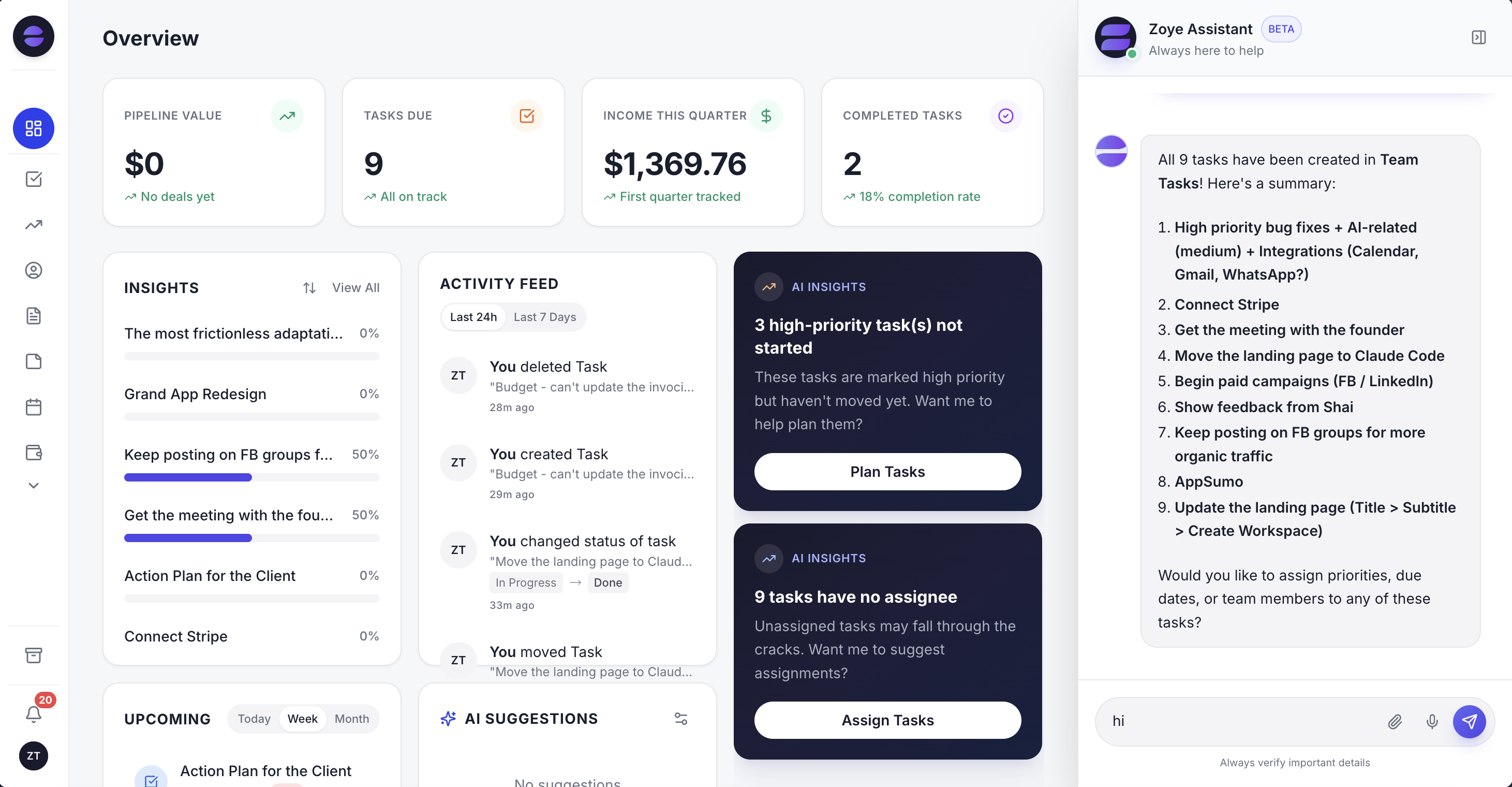 The Zoye dashboard: your whole business at a glance, with proactive AI Insights and Zoye Assistant always available on the right
The recall list nobody works
Every practice has one. It sits in the clinical system, it is technically accurate, and it is the single largest pool of recoverable revenue most clinics own. It also almost never gets worked, and the reason is worth stating plainly: working it is a phone job, phone jobs need uninterrupted time, and reception does not have uninterrupted time.
The arithmetic is unforgiving. An animal overdue for a booster is not just a missed vaccination appointment. It is usually also a missed annual health check, a missed opportunity to catch something early, a missed parasite prevention sale, and eventually a client who quietly belongs to another practice. The value of a recall is never the price of the vaccine.
What separates practices that recover this from practices that do not is rarely effort or intent. It is whether the chase happens without a human deciding to make it happen. A list that requires someone to be free is a list that stays unworked in any clinic busy enough to need it.
The pattern that works is unglamorous: contact on the due date, contact again a week later if there is no reply, and flag the ones still silent after that for a human to look at. That third step matters, because the animals whose owners ignore two contacts are the ones most likely to have drifted, and they are worth a real conversation rather than a third automated message.
The Saturday message problem
Owners message now. They send a photo of a limp, a rash, a lump they have just found, and they ask whether it needs an appointment. This is the single biggest change in how veterinary clients behave, and most practices have no system for it at all.
Two things go wrong. The first is speed: a message sent Saturday afternoon and answered Tuesday morning has usually already been answered by somebody else, because a worried owner does not wait. The second is that the conversation lives on whatever phone received it, so when the animal is presented on Wednesday the vet has no idea what was discussed.
There is a boundary here worth being explicit about. Nothing in a CRM should be offering clinical advice on a photograph, and no automation should be deciding whether a limp is urgent. What it should do is acknowledge fast, capture the message against the right owner and animal, offer an appointment, and get a human involved when the content warrants it. The failure mode to design against is silence, not a missed diagnosis.
With Zoye the assistant answers quickly, books the appointment against your real calendar, and attaches the exchange to the owner's record so it is visible when they walk in. Anything that reads as urgent is surfaced to a person rather than handled automatically.
Why owners leave without ever complaining
Client loss in veterinary practice is almost never dramatic. Very few owners announce that they are going elsewhere. They simply do not rebook, and eighteen months later somebody notices that a name has not appeared in the diary for a while.
This matters because it changes what you should be watching. A complaints log tells you about the small number of owners who were angry enough to say something. It tells you nothing about the much larger number who drifted, and drift is where the revenue goes. The usual causes are mundane: they called twice and could not get through, they were not reminded and felt embarrassed to come back late, or their message went unanswered for three days and they quietly found somebody more responsive.
The practical consequence is that retention in a veterinary practice is mostly an admin problem wearing a clinical disguise. The medicine is usually fine. What went wrong is that nobody noticed a regular client had gone quiet, because noticing requires somebody to be looking, and no one in a full clinic is looking.
A system that flags "this owner has not been seen in fourteen months and has an animal of an age where that is unusual" is doing something no clinical record does on its own. It is not a marketing feature. It is the difference between finding out now and finding out never.
What the front desk actually has time for
Any assessment of practice software should start from an honest picture of the front desk on a bad Tuesday. The phone is ringing, there is a queue, one of the animals in the waiting room is distressed, a rep has arrived, and a vet needs something urgently from the back.
In that environment, a task list is not a plan. Every reminder that requires a person to stop, read, decide and act is competing with an animal in front of them, and the animal wins every time, correctly. This is why so much practice software produces excellent reports about work that never happened.
| The job | What most systems do | What actually needs to happen |
|---|---|---|
| Reminder for tomorrow | Show it on a list | Send it, on the channel the owner reads |
| Booster due this month | Add it to a recall report | Contact the owner, then contact them again |
| Yesterday's no-show | Mark the slot as missed | Offer a new appointment the same day |
| Unanswered owner message | Leave it in an inbox | Reply quickly and attach it to the record |
| Client not seen in a year | Nothing | Surface it to a human while it is still recoverable |
The right question to ask any vendor is not whether the system tracks these things. They all track them. It is which of them the system will do when nobody has a free hand, because that is the normal state of a working clinic rather than the exception.
Where generic tools fall short for clinics
Three patterns come up repeatedly.
The practice management system's built-in reminders. These exist in most platforms and they are better than nothing. They are also typically email-only, fire once, and have no concept of chasing someone who ignored them. In a species of business where the customer is busy and the appointment is easy to postpone, one unanswered email is not a recall system.
Spreadsheets and a whiteboard. Plenty of independent practices run the commercial side this way and it holds until it does not. It breaks in three predictable places: the recall list nobody had time to work through, the no-show nobody rebooked, and the enquiry that came in while reception was on the phone.
General CRMs. Pipedrive, HubSpot, and Zoho give you a clean pipeline and per-user pricing. The problem is the one every clinic hits: they store the reminder and do none of the sending. The task appears, reception is holding a cat in one arm, the task gets dismissed, and the booster is never chased. A tool that displays what should have happened is not the same as a tool that does it.
How Zoye runs the commercial side for you
Zoye approaches this from the other direction. It is not a tidier place to store your recall list. It is an AI Business Operator: you message it the way you would brief a good practice manager, and it executes.
On a normal clinic week that looks like this. An owner messages on Saturday about a limping dog and gets a fast, sensible reply that books them in rather than leaving them waiting until Tuesday. Every appointment is confirmed at booking and reminded the day before on the channel the owner actually reads. The animals due for boosters this month are contacted, and the ones who ignore the first message are chased a week later. The dog that had a procedure on Monday gets a check-in on Thursday. The no-show from yesterday gets a rebooking offer without anyone deciding to send one.
You build those routines by describing them. Telling the assistant to remind every owner the day before, to chase booster recalls again after a week of silence, and to follow up two days after any surgery is enough. It builds and runs those automations from the sentence. There is no workflow canvas to maintain and no administrator role to fill, which matters in a practice where the person configuring software is usually also the person holding the dog.
Behind the assistant sits a complete workspace: CRM with owner and enquiry records, tasks in list, board, calendar, and timeline views, a shared calendar, budget tracking, and reports that pull from all of it.
See what Zoye can do for you
From CRM and deal tracking to AI-powered task management - explore everything Zoye offers in one workspace.
Explore FeaturesMapping the needs to the features
| What a clinic needs | How Zoye handles it |
|---|---|
| A full diary | Enquiries become tracked records and empty slots get offered to the waiting list |
| Reminders that send | Confirmation at booking plus a reminder the day before, on WhatsApp |
| Vaccination and booster recalls | Due dates tracked per animal, contacted on time, and chased when ignored |
| Fast reply to owner messages | The assistant drafts and sends the first reply without waiting for a free nurse |
| Post-procedure follow-up | Automatic check-in after surgery, with anything concerning flagged to a human |
| One owner and pet record | Conversation, appointment, and reminder history on the same owner |
| Reporting | Rebooking rate, recall response, and activity pull from work that already happened |
What to measure after thirty days
Practice software gets judged on how it feels rather than on what changed, which is why so much of it survives without earning its cost. Four numbers settle the question.
| What to check | What good looks like | What it tells you |
|---|---|---|
| No-show rate | Meaningfully lower than before, especially on afternoon slots | Whether reminders reach owners on a channel they read |
| Recalls contacted on time | Close to the number that came due | Whether the chase happens without someone being free |
| Second-contact rate | A real number, not zero | Whether anyone follows up the owners who ignored the first message |
| Lapsed clients returning | A slow but visible trickle | Whether the recall list is being worked at all |
That third row is where most clinics discover the truth. Almost every system sends a first reminder. Very few send the second one, and the second one is where the recovered appointments actually come from.
Independent practice or multi-site group?
The split is worth stating, because it decides your shortlist.
Multi-site groups and referral hospitals need their clinical platform to do the heavy lifting, with proper integration between sites, and should expect to pay for it. The commercial layer still matters, but procurement and IT will drive the decision and there is usually someone whose job includes administering software.
Independent practices, single-vet clinics, and mobile vets are a different case. The bottleneck is not record-keeping, it is that the practice owner is also the clinician, the manager, and the person who was supposed to work through the recall list on Wednesday. For this group the highest-value software is whatever makes the reminder, the recall, and the follow-up happen without a human remembering.
Mobile and house-call practices sit closer to the second group again, with an added constraint: everything has to be workable from a phone between visits, which rules out anything that needs a desk.
Mixed practices with a farm or equine caseload sit somewhere of their own. The small animal side behaves like an independent clinic, while the large animal work runs on relationships, visit scheduling, and seasonal routines that look more like field service than appointments. If that describes you, judge any system on whether it handles the diary from a vehicle as well as it handles it from reception.
What it costs
Pricing in this category splits sharply by who the product was built for.
| Option | Typical monthly cost for a 5-person clinic |
|---|---|
| Zoye | $29 flat (up to 10 members, AI included) |
| Spreadsheet and whiteboard | $0, plus the recalls and no-shows nobody worked through |
| General CRM (Pipedrive, Zoho, HubSpot) | ~$70 to $125, per user, before add-ons |
| Veterinary practice management platform | Quote-based, commonly $200 and up, plus setup |
Pricing reflects published rates as of September 2026; veterinary platforms are typically quoted rather than listed. Check each vendor's pricing page for current figures.
On the entry Almost Free plan a solo vet pays $5 per month, or $4 monthly on annual billing, which carries one member and the whole platform with the assistant included. Starter takes you to 10 members at $29 and Growth to 20 at $59, so a practice that keeps adding nurses and reception cover does not watch the bill climb with every hire.
Worth stating plainly: this sits alongside your practice management system rather than replacing it, so the honest comparison is what the commercial layer costs you on top, not whether you can drop your clinical software. Against a single recovered booster course a month, the arithmetic is not close.
Four mistakes that cost the most
Assuming the clinical system's reminder module is a recall system. It sends one email. The revenue is in the second contact, which it does not make.
Letting owner messages live on personal phones. The conversation is the relationship. When it sits on a nurse's handset, the practice cannot see it, cannot cover it on a day off, and loses it entirely when that person leaves.
Buying per-seat software for a growing team. Practices add part-time nurses and weekend reception cover constantly. Per-user pricing turns every rota change into a billing decision.
Automating the clinical judgement rather than the admin. Automate the reminder, the rebooking, the recall, and the post-op check. Do not automate the assessment of whether something is urgent, and be wary of any vendor happy to.
Ready to streamline your business?
Zoye brings AI-powered CRM, task management, and automation into one workspace.
Get StartedThe takeaway
Veterinary clinics do not lose money because their clinical notes are disorganised. They lose it in the gaps: the booster nobody chased, the no-show nobody rebooked, and the Saturday message answered on Tuesday.
The software that fixes that is not the one with the most clinical features. It is the one that does the chasing itself, works where owners already message you, and can be run from a phone between consults. Zoye's entry Almost Free plan is $5 per month, or $4 per month billed annually, with the full platform and AI included, so you can cancel or upgrade at any time.
And judge it after a month on the number that matters: not how tidy the recall list looks, but how many animals on it were actually contacted twice. That second contact is the whole return, and it is the step every busy practice drops first.
For more context, see the CRM for dentists, the WhatsApp CRM for clinics, the guide to WhatsApp appointment reminders, AI appointment scheduling, and the rest of the Zoye blog.