
Most marketing agencies do not lose clients because their work is bad. They lose them because the pipeline leaks. A proposal sits unanswered because nobody chased it. A new client waits two weeks for onboarding because the account manager was heads-down on a campaign. A monthly report goes out late, and a retainer quietly lapses because nobody flagged the renewal date. The common thread is not talent. It is follow-through.
A CRM is supposed to fix this. In practice, most agency CRMs are just an expensive place to write down the work you already know you should be doing. They store the pipeline, then wait for a busy human to actually move it. Within a quarter, the fields go stale, the reminders get snoozed, and the tool becomes another subscription nobody opens. Software you bought and stopped using is worse than no software at all, because it created the illusion that the problem was handled.
This guide ranks the seven best options for small and mid marketing agencies in 2026. The top pick is not a better place to log things. It is a system that does the chasing for you.
Pricing reflects published rates as of July 2026; check each vendor's pricing page for current figures.
Why marketing agencies are rethinking their CRM in 2026
Four shifts are pushing agencies away from the old database-and-hope model.
The bottleneck is follow-through, not storage. Every agency already has somewhere to write down leads, whether it is a spreadsheet, a project tool, or a real CRM. The deals that die do so in the gap between logging them and acting on them. The proposal that needed a nudge on day five. The onboarding checklist that needed sending. The renewal that needed a conversation a month before the contract ended. Storage was never the missing piece.
Agencies run on client comms, and those comms are scattered. New business comes in through web forms, referrals, DMs, and increasingly WhatsApp. Client approvals and questions land in personal inboxes and phones. A CRM that only tracks a sales pipeline ignores the messy, real-time conversation layer where agency relationships actually live and die.
Thin margins cannot absorb admin overhead. Small agencies are lean by design. Every hour an account manager spends copying notes into a CRM, formatting a status update, or manually chasing an invoice is an hour not spent on billable work or new business. The tool is supposed to remove admin, not add a data-entry chore.
AI changed what a tool can be expected to do. Until recently, the best a CRM could offer was a reminder. Now an AI operator can read the thread, draft the follow-up, send it on schedule, update the record itself, and escalate only what needs a human. Agencies are no longer asking which CRM stores their pipeline best. They are asking which system runs it.
The 7 best CRMs for marketing agencies in 2026
1. Zoye - the operator that runs your agency pipeline
Zoye is the strongest pick for marketing agencies because it is not a CRM you have to feed. It is an AI Business Operator that runs the pipeline itself: it captures new-business enquiries, chases outstanding proposals, onboards new clients, keeps the reporting cadence moving, and follows up on retainer renewals, mostly over email and WhatsApp, without waiting for you to remember.
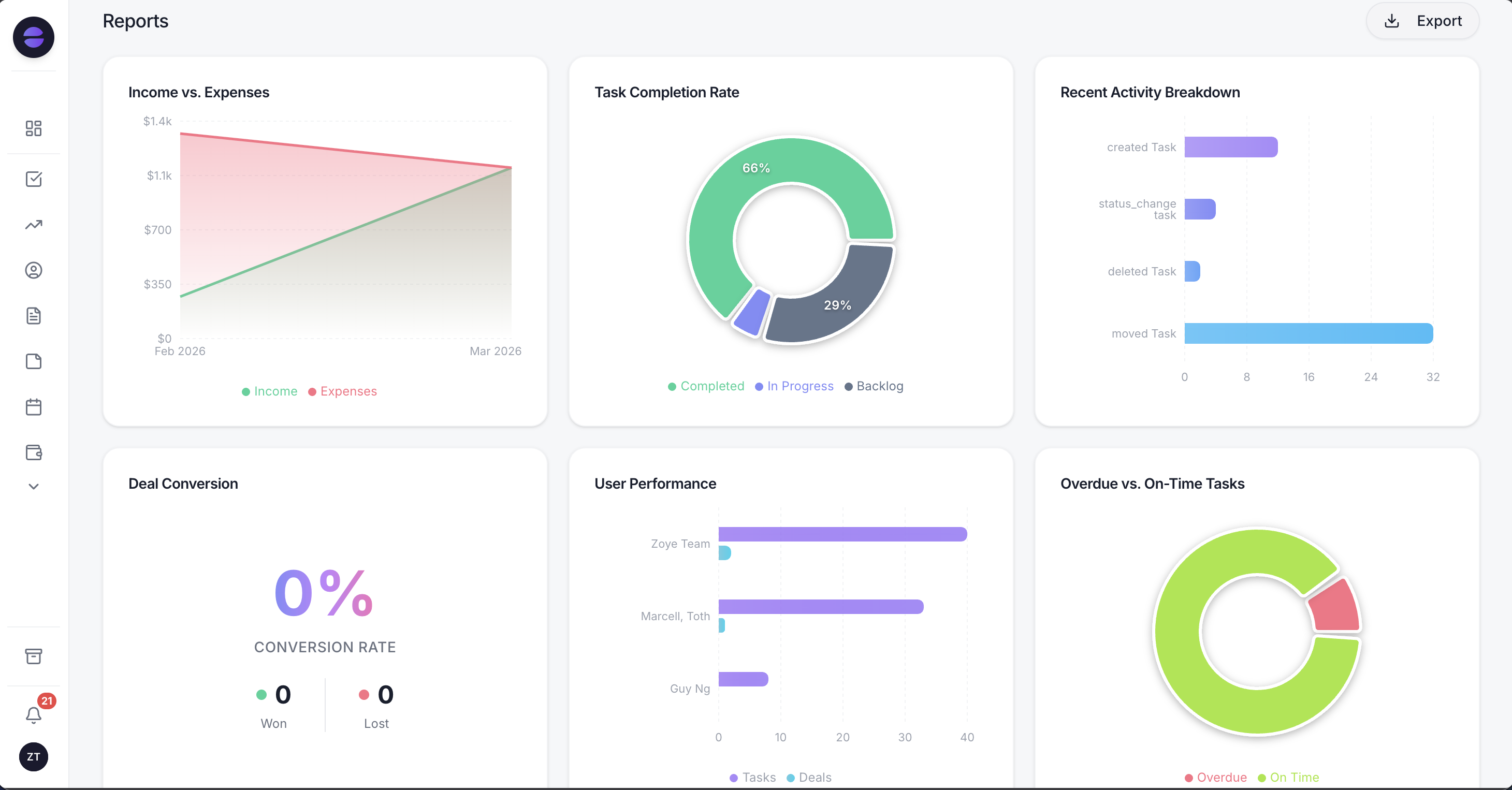 Zoye Reports pulls pipeline, client activity, revenue, and team output into one live view, so agency owners stop stitching updates together by hand.
The difference shows up in the daily work. A traditional agency CRM gives you a deal card and a reminder to follow up. Zoye does the follow-up. You say what you want once, the way you would brief an account manager, for example chase any proposal open more than five days and remind me of every retainer renewing in the next 30 days, and Zoye builds that automation. It sends the messages on schedule, logs the replies, updates the deal stage itself, and surfaces only the conversations that genuinely need an account manager. Nothing sits and rots because a person got busy.
For agencies, the operator model maps cleanly onto the real workflow. New-business enquiries from your site, referrals, or WhatsApp are captured and qualified automatically, so no lead slips through a cracked inbox. Proposals get chased on a cadence you set once. New clients get onboarding forms, kickoff scheduling, and welcome sequences without an account manager driving each step. Monthly reporting stays on schedule because the assistant assembles and prompts it. Retainer renewals get raised before they lapse, not after a client has already drifted.
Underneath the operator sits the full workspace an agency needs to run: a client and deal CRM, tasks and project boards, a shared calendar, budget and revenue tracking, and reporting that pulls from all of it. Client conversations, including WhatsApp, are centralised in one place instead of trapped on individual phones, and the assistant can draft and send replies so no approval or question waits days for an answer. It is one system that both holds the information and acts on it, rather than a database plus a pile of manual habits.
Agencies that run social and lead flow for clients also get agency client accounts. Each client has their own workspace, with their own connected Instagram, Facebook and WhatsApp accounts, one-click starter flows and their own reply voice, so one client's leads and tone never bleed into another's. Facebook and Instagram lead ads are routed per Page to the client's workspace you choose, and every commenter becomes one contact with the whole conversation on their card. Inside each workspace, Zoye can run Instagram and Facebook automations (comment replies with a private DM, automatic answers to DMs and story replies) and WhatsApp automations (an instant first message to every new lead and a Lead Bot that qualifies and books). To set one up for a client, just ask: "For the FutureNow workspace, reply to every comment that says OFFER with a DM and the booking link."
Pricing: Almost Free at $5 per month for 1 member with the core tools. Starter from 29 dollars per month (10 members). Growth from 59 dollars per month (20 members).
Best for: Small and mid agencies that want the pipeline and client comms run for them, not just stored.
Want to see it in action?
See Zoye catch a new lead, answer on WhatsApp and set up the follow-up, all from one message.
See How It Works2. HubSpot - the heavyweight platform
HubSpot is the most capable marketing-and-sales platform on this list, and plenty of larger agencies build their whole operation on it. The pipeline management, marketing tools, and reporting are genuinely deep. The trade-off is that it is a big system to learn, configure, and maintain, and it is still fundamentally a place where you record and manage the work rather than a system that does the chasing for you. Costs also climb fast once you move past the starter tiers and your contact list grows.
Pricing: Free CRM tools with limits; paid Marketing and Sales hubs billed per seat and per contact tier that rise steeply. Check the current pricing page.
Best for: Larger agencies with the time and budget to run a full platform.
3. GoHighLevel - the agency all-in-one
GoHighLevel is built specifically for agencies, and for teams that want to resell marketing services under their own brand it offers a lot: funnels, pipelines, campaigns, and white-label client sub-accounts in one place. The honest catch for a small owner is complexity. It is powerful but heavy, with a real learning curve, and the model assumes you will build and maintain the funnels and automations yourself. You are still the one wiring everything together and driving it. Smaller agencies often find they use a fraction of what they pay for.
Pricing: Tiered monthly plans starting in the low hundreds of dollars per month, rising for agency and white-label tiers. Check the current pricing page.
Best for: Agencies that resell software and have time to build out the platform.
4. Pipedrive - the simple sales pipeline
Pipedrive is a clean, easy-to-learn sales CRM, and for an agency that mainly wants a visual deal pipeline it does that job well. The interface is friendly and the pipeline view is genuinely good. The limitation is scope. Pipedrive is built around sales stages, so client onboarding, project delivery, reporting cadence, and the wider client-comms layer live in other tools. It also reminds rather than acts, so the chasing is still on you.
Pricing: Per-seat monthly tiers from the mid-teens of dollars per user. Check the current pricing page.
Best for: Agencies that want a straightforward sales pipeline and little else.
5. Zoho CRM - the budget-friendly suite
Zoho CRM is inexpensive and part of a very broad software suite, which appeals to cost-conscious agencies that want a lot of modules under one vendor. The value is real if you commit to the ecosystem. The downside is that Zoho can feel dated and fiddly to configure, the modules do not always feel like one seamless product, and, like the others here, it is a system of record that waits for you to act rather than one that runs the follow-ups itself.
Pricing: Per-seat monthly tiers from the low tens of dollars per user, with a limited free tier. Check the current pricing page.
Best for: Budget-focused agencies already invested in the Zoho ecosystem.
6. monday.com - the work platform with a CRM layer
monday.com started as a flexible work-management platform and added a CRM product on top. For agencies that already run projects on monday, keeping the pipeline in the same environment is convenient, and the boards are highly customisable. The trade-off is that the flexibility means setup work, the CRM layer is less mature than dedicated sales tools, and the automations are rule-based recipes you build and maintain rather than an assistant that acts on its judgement.
Pricing: Per-seat monthly tiers with a small free plan; the CRM product is priced separately by seat. Check the current pricing page.
Best for: Agencies already running delivery on monday who want the pipeline nearby.
7. A shared spreadsheet - the honest baseline
Plenty of small agencies still run new business on a shared spreadsheet, and it deserves an honest mention because it is free, flexible, and everyone already knows how to use it. For a very early agency it can genuinely be enough. The problem arrives with scale: a spreadsheet has no reminders, no client-comms layer, no reporting, and above all no ability to chase anything. Every follow-up depends entirely on a human remembering to open the file. It is the tool most likely to quietly leak deals as the agency grows.
Pricing: Free with your existing office suite.
Best for: Brand-new agencies testing whether they need a real system yet.
Best CRM for agency new business and proposals
For the part of the job that actually pays the bills, winning new work and closing proposals, the ranking is not about which tool has the prettiest pipeline. It is about which one keeps deals moving when the team is busy delivering. That is exactly where storage-only CRMs fall down, because a proposal that needs a nudge on day five does not chase itself in HubSpot, Pipedrive, or a spreadsheet.
Zoye is the clearest pick here because chasing is the default behaviour, not a manual task. Set the cadence once and every open proposal gets a timely, personalised follow-up over email or WhatsApp, replies get logged, stages update themselves, and the account manager is pulled in only when a real conversation is needed. GoHighLevel can be configured to do some of this if you invest in building the funnels; the difference is that you tell Zoye what should happen and it builds the automation, instead of you wiring it up.
See what Zoye can do for you
CRM, deals, tasks and your Instagram, Facebook and WhatsApp automations in one workspace. Just ask Zoye and it sets any of it up for you.
Explore FeaturesBest AI-powered CRM for agencies
Almost every tool on this list now advertises AI, so the useful question is what the AI actually does. In HubSpot, Zoho, monday, and Pipedrive, AI mostly means suggestions: it drafts a line of copy, summarises a record, or recommends a next step, then leaves the doing to you. That is helpful, but it does not move the pipeline automatically.
Zoye is built the other way around. The assistant is the worker, not a sidebar. It captures and qualifies incoming leads, chases proposals and invoices on schedule, onboards new clients through their welcome sequence, keeps the monthly reporting cadence, raises retainer renewals before they lapse, and updates the CRM records itself as it goes. Crucially, you set these automations up just by asking Zoye for them, so an agency owner who cannot spare a day configuring workflows still gets a system that runs. That is the practical dividing line in 2026: AI that suggests versus AI that operates.
How to choose the right CRM for your agency
Three questions settle it for most agencies.
1. Do you need a place to store the pipeline, or a system to run it? If your team genuinely has the discipline and capacity to chase every proposal, onboarding, and renewal by hand, a storage CRM like Pipedrive or HubSpot will hold the data neatly. If the leak is follow-through, which for most lean agencies it is, you want an operator like Zoye that does the chasing itself.
2. Where do your client conversations actually happen? If a lot of new business and client comms run through WhatsApp and scattered inboxes, prioritise a system that centralises those conversations and can reply, not just a sales pipeline that ignores them. This is a real weakness of the classic sales-first CRMs.
3. How much setup can you realistically absorb? GoHighLevel and monday reward heavy configuration; if you have someone to build and maintain funnels and boards, they pay off. If you do not, a tool you set up by telling it how you work gets you running this week instead of next quarter.
Migrating your agency to a system that runs itself
Switching agency CRMs is usually less about moving data and more about changing a habit. Most small agencies are not migrating from a pristine, fully populated CRM. They are migrating from a half-abandoned one, plus a spreadsheet, plus a lot of follow-up that only ever lived in one person's head. The goal of the move is to stop relying on that head.
The pragmatic path is to bring across only what is live: current clients, open proposals, and active deals. Anything cold from more than 90 days ago can be archived rather than dragged along. Then, instead of rebuilding a set of empty fields you will have to keep filling in, describe the recurring workflows you want run: chase open proposals, onboard new clients, send monthly reports, flag renewals. With Zoye the assistant helps translate those into live automations interactively, so within an hour or two you have a system that is already doing the chasing rather than another database waiting for attention. The measure of a successful migration is simple: a month later, is the tool still being used, and are fewer deals slipping? An operator that works automatically passes that test far more often than a CRM that depends on your team's memory.
Why agencies pick Zoye
A few reasons come up again and again.
It runs the pipeline instead of storing it. Proposals get chased, clients get onboarded, reports go out, and renewals get raised without an account manager driving each step by hand.
It lives where the client conversations are. New business and client comms, including WhatsApp, are centralised in one place, and the assistant can draft and send replies so nothing waits days in a personal inbox.
It keeps clients apart. Each client gets their own workspace, accounts, starter flows and reply voice, and lead ads land in the right workspace per Page.
Setup is a conversation. You tell Zoye the follow-up or workflow you want and it builds the automation, so a lean agency gets a working system without a configuration project.
It is one system, not a stack. CRM, tasks, calendar, budget, reporting, and the assistant all live together, which suits an agency that cannot afford to babysit five separate subscriptions.
Try Zoye with your team. The entry plan is Almost Free, with the core tools.
For more context, see the best CRM for small business, our honest take on GoHighLevel for small business, and the best CRM for consultants.