Most software sold to cleaning companies solves half the problem. A generic CRM will happily store your clients and their addresses, but it will not send the quote, will not put the recurring clean on the calendar, and certainly will not chase the client who is three weeks late paying for last month's office deep-clean. A field-service app will dispatch a crew, but it treats the customer conversation as an afterthought, when for a cleaning business the conversation on WhatsApp is where the booking, the reschedule, and the payment reminder all actually happen.
The result is the tool most cleaning owners know too well: software you bought, set up over a weekend, and quietly stopped opening because it added admin instead of removing it. The jobs that matter, quoting a new enquiry, confirming tomorrow's crew, and getting paid, still land back on the owner's phone.
This guide compares the seven best CRM and management tools for cleaning businesses in 2026, ranked for owners who want the software to actually run the repetitive work rather than just file it. Whether you are a two-van residential crew or a small commercial janitorial company, the right tool should quote, schedule, and chase payment with almost no input from you.
Pricing reflects published rates as of July 2026; check each vendor's pricing page for current figures.
Why cleaning businesses are rethinking their software in 2026
Four things have changed for cleaning companies, and together they make the old "store your contacts" CRM feel obsolete.
The customer conversation moved to WhatsApp. New enquiries, "can you come Thursday instead", and "did you get my payment" all arrive as messages now, not phone calls or emails. Software that lives in a separate web dashboard, disconnected from where clients actually talk to you, means double-entry and dropped threads. The tools winning in 2026 meet the client on WhatsApp and keep the record updated automatically.
Recurring revenue lives or dies on follow-through. A cleaning business is a subscription business in disguise: the weekly, fortnightly, and monthly regulars are the whole economy. One forgotten rebooking or one uncomfortable payment chase that never gets sent is real money gone. Owners want a system that never forgets the follow-up, because they cannot personally remember every slot across dozens of clients.
Chasing money is the job nobody wants to do. Late payment is endemic in cleaning, especially commercial contracts on 30-day terms. Owners hate nagging good clients, so reminders slip, and cash flow suffers. The demand now is for software that sends the polite reminder on schedule automatically and stops the instant the invoice is paid.
AI turned software from a filing cabinet into a worker. The biggest shift is that the best tools no longer wait for you to type. They take action: draft the quote, book the recurring clean, message the client, and chase the balance. For a time-poor owner cleaning alongside the crew, an assistant that does the admin is worth more than any dashboard.
The 7 best CRM tools for cleaning businesses in 2026
1. Zoye - the operator that quotes, schedules, and chases payment itself
Zoye is the strongest pick for cleaning businesses because it does not just store your clients, it runs the repetitive work: it captures the enquiry, sends the quote, books the recurring clean, assigns the crew, and chases the invoice, mostly over WhatsApp, with you approving rather than typing.
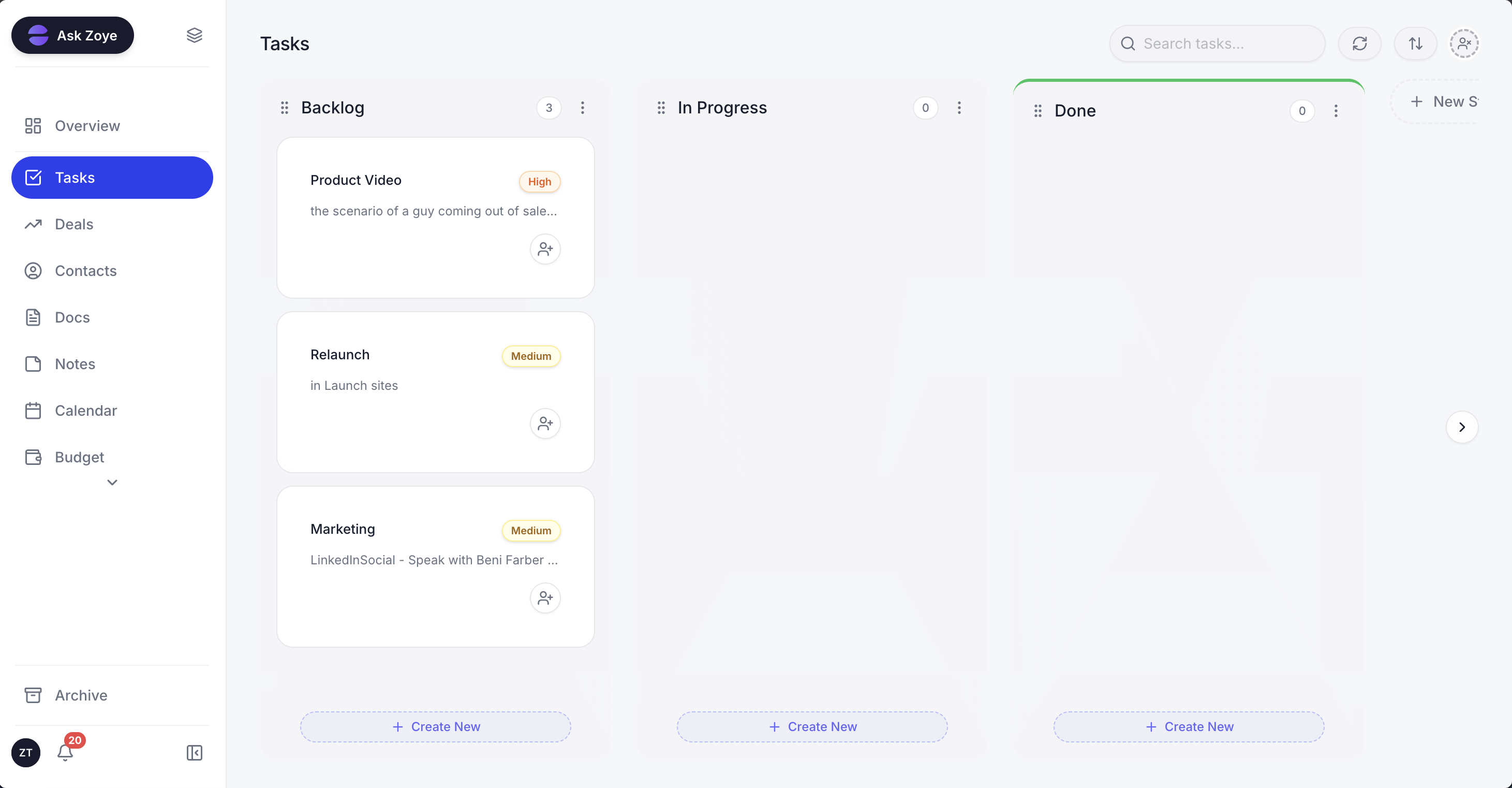
A Zoye board turns every clean into a card you can see at a glance: who is assigned, what stage the job is at, and what still needs chasing.
Think of Zoye less as a CRM you maintain and more as an operator you delegate to. When a new enquiry comes in through WhatsApp or your website, the assistant captures it, replies to ask the details a cleaning quote needs (property size, frequency, one-off or recurring), and drafts the quote for you to send. Once the client says yes, it books the clean, adds it to the calendar, and puts the recurring slot on repeat so the fortnightly regular never quietly falls off the schedule.
The Zoye Assistant does the chasing for you
The difference that matters to a cleaning owner is the payment follow-up. Where an ordinary CRM shows you an "unpaid" label and leaves the awkward reminder to you, Zoye chases it. Tell it your terms once, and it sends a polite WhatsApp nudge when an invoice goes past due, follows up again on the cadence you set, and stops the moment the client pays. The same goes for rebookings: if a monthly deep-clean client has not booked their next visit, the assistant reaches out before the gap becomes a lost month. You tell Zoye what you want, "remind anyone who is more than 7 days late paying, twice, three days apart", and it builds that automation itself.
One workspace for the whole operation
Beyond the customer work, Zoye is a full workspace. The tasks and Kanban board track every job through its stages. The CRM holds each client with their cleaning frequency, access notes, and history. The calendar shows the crew's day. Budget tracking watches income against supplies and wages. Reports pull it all into one exportable picture so you can see which clients, crews, and services actually make money. It is the whole back office, not a single-purpose booking app, and the assistant reaches across all of it.
Pricing: Almost Free at $5 per month for 1 member with the core tools. Starter from $29 per month (10 members). Growth from $59 per month (20 members). Flat-rate, so adding a cleaner does not multiply your bill per seat.
Best for: Residential and commercial cleaning owners who want the software to quote, schedule, and chase payment itself instead of adding admin.
Want to see it in action?
See Zoye catch a new lead, answer on WhatsApp and set up the follow-up, all from one message.
See How It Works2. Jobber-style field-service tools - strong dispatch, weaker conversation
Field-service platforms in the Jobber mould are built for the dispatch side of a cleaning business: scheduling crews, routing jobs, generating invoices, and taking card payments. For a company that thinks in terms of work orders and technicians, they are capable and well established.
The trade-off is the customer conversation. These tools treat messaging as a bolt-on notification rather than a two-way thread, so the WhatsApp back-and-forth where cleaning clients actually book and reschedule lives outside the system. They also expect you to drive the follow-up; the software tracks status but does not proactively chase a late payer or an overdue rebooking the way an AI operator does.
Pricing: Tiered per-user monthly plans, typically starting around $25 to $30 per month for a solo plan and rising with crew size; check the vendor's pricing page for current figures.
Best for: Cleaning companies that prioritise crew dispatch and routing over conversational follow-up.
3. Generic CRMs (HubSpot, Pipedrive style) - built for sales pipelines, not cleaning
Mainstream CRMs are designed for sales teams tracking deals through a pipeline. You can bend one to a cleaning business by treating each client as a contact and each quote as a deal, and the contact management is genuinely good.
The problem is everything a cleaning business needs beyond the pipeline. There is no native crew scheduling, no recurring-clean calendar, and no built-in way to chase an unpaid invoice. You end up bolting on a scheduling tool, an invoicing tool, and a messaging tool, then paying to integrate them. The CRM stores the relationship but does none of the operational work.
Pricing: Free entry tiers exist; paid plans commonly run from around $15 to $25 per user per month and climb quickly with features. Per-seat pricing adds up as you add cleaners.
Best for: Cleaning companies with a heavy new-business sales motion who mainly need pipeline tracking.
4. Spreadsheets plus a calendar - free, until it breaks
Plenty of cleaning businesses run on a shared spreadsheet for clients and a phone calendar for jobs. It is free, familiar, and flexible, and for a solo cleaner with a handful of regulars it can genuinely work for a while.
The trade-off arrives with growth. A spreadsheet does not remind anyone, does not message clients, and does not know an invoice is late. Every follow-up depends on the owner remembering, which is exactly what stops happening once there are more clients than one person can hold in their head. It is the cheapest option and the one most likely to leak money silently.
Pricing: Free, or included with an existing office suite.
Best for: Solo cleaners with a small, stable client list who are not yet feeling the admin strain.
5. Housecall Pro-style home-service apps - polished but rigid
Home-service platforms like Housecall Pro package scheduling, invoicing, and payments for trades and cleaners in a polished mobile app. For an owner who wants an all-in-one dispatch-and-invoice tool with a clean interface, they are a reasonable fit.
The limitation is flexibility and conversation. These apps impose their own workflow, which can feel rigid for a cleaning business with unusual recurring patterns, and like other field-service tools they lean on push notifications rather than the natural WhatsApp thread cleaning clients prefer. The follow-up is still manual: the app will not decide to chase a late client unprompted.
Pricing: Tiered monthly plans, typically from around $49 per month for a basic plan and up; check current figures on the vendor site.
Best for: Home-service and cleaning owners who want a polished mobile dispatch-and-invoice app and accept its fixed workflow.
6. ServiceM8-style job management - good for job tracking, thin on CRM
ServiceM8 and similar job-management tools focus tightly on the job lifecycle: quote, schedule, complete, invoice. For very small field teams that want a lightweight, job-first tool, they are efficient and affordable at entry level.
The trade-off is a thin customer layer. These tools are organised around jobs, not relationships, so the ongoing client history, the recurring-booking view, and proactive follow-up are limited. They handle the job in front of you well but do less to grow and retain the client base over time.
Pricing: Usage-based or tiered plans, often starting low for small job volumes and scaling with usage; check the vendor's current pricing.
Best for: Very small cleaning teams that want lightweight, job-by-job tracking over relationship management.
7. Booking-page tools (Calendly, Acuity style) - great for slots, blind to the rest
Online booking tools let clients pick a slot from your availability, which removes some back-and-forth for one-off cleans. For a business whose main friction is scheduling, they are simple and cheap.
The trade-off is that a booking page is only the front door. It does not hold client history, does not manage recurring commercial contracts, does not assign crews, and does not chase payment. It solves one narrow step and leaves the rest of the cleaning operation to other tools or to you.
Pricing: Free tiers with limits; paid plans commonly from around $10 to $16 per user per month.
Best for: Cleaning businesses that only need a self-service booking link for one-off jobs.
Best software for recurring cleaning bookings
Recurring revenue is the heart of a cleaning company, so the deciding question is which tool protects those repeat slots without manual effort. Field-service apps can schedule a repeating job, but they wait for you to set it up and rarely chase a lapsed regular. Zoye is the clearest pick here because it treats the recurring clean as a living commitment: it keeps the fortnightly and monthly slots on the calendar, confirms with the client before each visit, and flags any regular who has drifted so you can win them back before the slot is gone for good. The owner stops being the human alarm clock for every recurring client.
Best tool for chasing late cleaning payments
For commercial cleaning especially, getting paid on time is the difference between a healthy month and a stressful one. Most tools on this list will show you an outstanding balance; almost none will do anything about it. Zoye is the exception, because the assistant sends the reminder itself. You set the tone and cadence once, and it chases every late invoice politely over WhatsApp, escalates on your schedule, and goes quiet the moment payment lands. For a deeper walkthrough of how to do this without annoying good clients, see our guide to WhatsApp payment reminders.
See what Zoye can do for you
CRM, deals, tasks and your Instagram, Facebook and WhatsApp automations in one workspace. Just ask Zoye and it sets any of it up for you.
Explore FeaturesHow to choose the right cleaning business CRM
Three questions cut through the options.
1. Where do your clients actually talk to you? If the answer is WhatsApp, and for most cleaning businesses it is, choose a tool that works inside that conversation rather than one that forces clients to a separate portal. A disconnected dashboard means you copy messages by hand.
2. Do you want software that files the work or does it? A generic CRM or spreadsheet files. A field-service app dispatches but waits for your input. Zoye acts, sending quotes, booking recurring cleans, and chasing payment itself. Decide how much admin you want to keep doing personally.
3. How will the price scale as you add cleaners? Per-seat tools quietly get expensive as your crew grows. Flat-rate pricing like Zoye's means hiring your fifth or tenth cleaner does not multiply the software bill.
What changes when the software runs the admin
Cleaning owners who move from a store-it CRM or a spreadsheet to an operator-style tool describe the same shift. The mental load of remembering every rebooking and every unpaid invoice lifts, because the assistant holds it. The awkward payment chases go out on time, every time, without the owner steeling themselves to send them, so cash flow steadies. New enquiries get a fast, professional reply even when the owner is up a ladder, because the assistant answers and captures the details. And the recurring slots stop leaking, because a lapsed regular is flagged and re-engaged instead of silently disappearing.
The through-line is that the software stops being another app to maintain and starts being staff. That is the bar a cleaning business should hold any tool to in 2026: not "does it store my clients" but "does it do the work I keep forgetting".
Why cleaning businesses pick Zoye
A few themes come up again and again.
It does the chasing. Late payments and overdue rebookings get followed up automatically over WhatsApp, so money and slots stop slipping.
It works where clients talk. The enquiry, the reschedule, and the reminder all happen in the WhatsApp thread, and the record updates itself.
It is the whole back office. Tasks, CRM, calendar, quoting, budget, and reports live together, so you are not stitching five apps into a workflow.
It scales without punishing growth. Flat-rate pricing means your tenth cleaner does not come with a bigger software bill, and the entry plan, Almost Free, starts at $5 per month for one member.
Start with Zoye at $5 per month ($4 per month billed annually): 1 member and the core tools, the most affordable way to get quoting, scheduling, and payments organised in one place. Cancel or upgrade anytime.
Ready to hand off the busywork?
Zoye brings AI-powered CRM, task management, and automation into one workspace.
Get StartedFor more context, see our guides to CRM for small business, field service management software for small business, and WhatsApp payment reminders.