
Best CRM for Private Clinics in 2026: 7 Tools That Fill the Diary
A private clinic does not usually lose money because the treatments are not good. It loses money in the gaps: the WhatsApp message that arrived at 22:40 and was answered at 11:00 the next morning, by which point the client had booked somewhere else. The Tuesday afternoon that emptied out because two people cancelled and nobody offered the slot to anyone. The client who was supposed to come back in six weeks and never did, because the reminder depended on a human remembering.
This is the shape of the problem in almost every aesthetics studio, dental practice, physiotherapy clinic, and alternative medicine practice. The diary is the business. Every hour that goes unfilled is revenue that cannot be recovered later, and the work that keeps the diary full is unglamorous, constant, and always the first thing to be dropped when the practitioner is with a client. In a small clinic the practitioner is often also the receptionist, the billing department, and the person who chases the client who did not show up.
Software has not solved this as well as it should have. Dedicated clinic management systems give you a solid diary and a client file, then hand the messages, the chasing, and the recall list straight back to you. Generic CRMs give you a tidy database of clients and do nothing about the booking. Both categories share the same assumption: that a person will be available to operate them. In a two room clinic, that person is treating someone.
This guide covers the seven best CRM and client management options for private clinics in 2026, why WhatsApp sits at the centre of the job, and how to keep the diary full without hiring a second receptionist.
Pricing reflects published rates as of August 2026; check each vendor's pricing page for current figures.
Why clinics are looking beyond diary software in 2026
Four shifts are pushing clinic owners away from tools that only store appointments.
Clients book on WhatsApp, at every hour. Booking requests do not arrive between nine and five on a web form. They arrive at 23:00, on a Saturday, in the middle of a treatment, in the same thread where the client asked about parking last month. A tool whose reminders live in email or SMS is simply not present in the conversation where the appointment is actually agreed.
Speed of reply decides who gets the client. Someone looking for a physiotherapist or an aesthetics appointment messages two or three clinics at once. The one that answers within minutes usually gets the booking, regardless of who is better. When the only person who can reply is holding a needle or a pair of scissors, the fast answer is structurally impossible without help.
No shows and late cancellations are the quiet killer. A cancelled slot two hours before the appointment is a total loss unless somebody offers it to the next person. Almost no small clinic has a real waiting list process, because maintaining one by hand is more work than the slot is worth. So the hour just evaporates.
Follow up and recall is where the real revenue is, and it never happens. Returning clients are the economics of a clinic. A treatment plan that says six sessions, a client due for a check up in six months, a package with three sessions left unused: each of these is booked revenue waiting for someone to make contact. When contact depends on human memory, most of it never gets made.
The 7 best CRM and client management tools for private clinics in 2026
1. Zoye - the AI operator that runs the front desk
Zoye is the strongest pick for a small private clinic because it does not just store your clients and appointments, it does the front desk work that keeps the diary full. It is an AI Business Operator: rather than another system for you to operate between clients, it is an assistant you message the way you would message an excellent receptionist, and it acts on what you say.
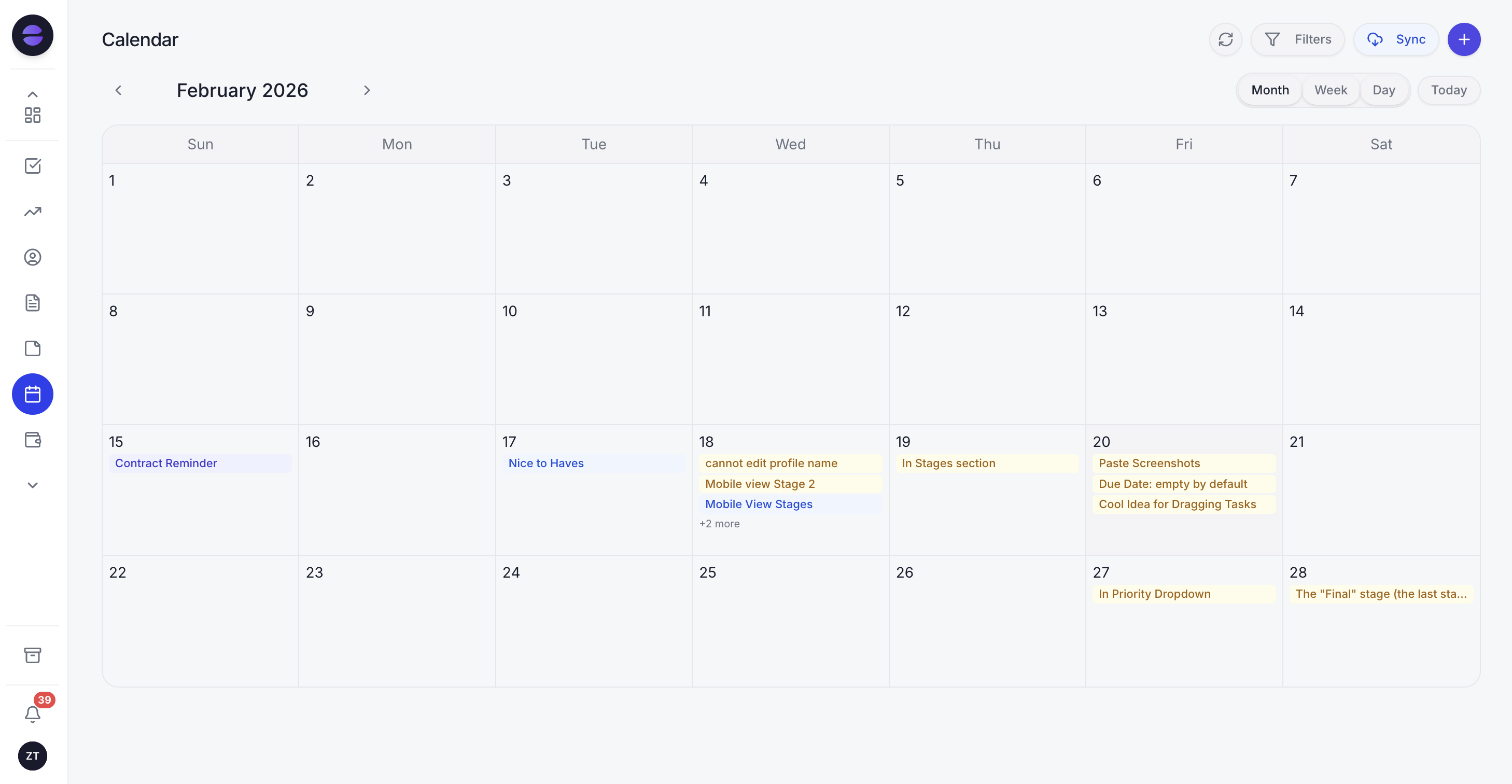 The Zoye calendar: every appointment, reminder, and follow up in one place, with the assistant booking and rebooking on its own.
In a clinic, that looks like this in practice. A booking request lands on WhatsApp at eleven at night. The assistant answers immediately, offers the actual free times from your calendar, books the appointment, and saves the client with the treatment they asked about, so the enquiry never becomes an unread message you find in the morning. The day before the appointment it sends a reminder on WhatsApp and asks the client to confirm. If the answer is a cancellation, the assistant offers the freed slot to the people who wanted that time, so the hour gets refilled instead of lost. If someone simply does not turn up, it follows up the same day to rebook rather than leaving it to a note you meant to write down.
The follow up work is handled the same way. When a treatment plan calls for a return visit, the assistant reaches out at the right time and books it. When a treatment package has sessions left, it reminds the client before they drift away. When a balance or an instalment is outstanding, it sends a polite payment reminder on WhatsApp and only escalates to you if the client needs a real conversation. You set any of this up by describing the outcome in one sentence, for example "remind every client the day before, offer a cancelled slot to whoever is waiting for that day, and chase anyone who has not rebooked within a month". The assistant builds the automation from that sentence. There is no flowchart, no third party automation tool, and nothing to maintain.
Because the clinic, the diary, the clients, the tasks, and the money all live in one workspace, you also get the picture that actually runs the business: which hours are still open this week, who is overdue for a return visit, which packages are unused, and what is unpaid. The assistant surfaces it rather than waiting for you to go looking, and because it works over WhatsApp, you can run the whole thing from between treatments instead of from a desk.
A note on scope, because it matters in a clinical setting: Zoye is a business operations tool. It runs the booking, the reminders, the client relationship, and the money. It is not a medical records system, it makes no clinical claims, and it gives no medical guidance. Keep clinical documentation in whatever system your practice already uses for it.
Pricing: Almost Free at 5 dollars per month for 1 member, 1GB storage, with the full platform including AI. Starter 29 dollars per month (10 members, 5GB). Growth 59 dollars per month (20 members, 10GB, 24/7 support). Scale 119 dollars per month (100 members, 25GB), plus a Customize tier for larger practices.
Best for: Solo practitioners and small clinics that want the booking, the reminders, and the chasing done for them, on WhatsApp.
2. Dedicated clinic management systems - the purpose built diary
The category of dedicated clinic management systems, including the local Israeli products built specifically for aesthetics, dental, and therapy practices, is genuinely strong at what it was designed for. You get a proper treatment diary, per practitioner schedules, treatment histories, and often invoicing and receipts tied to local requirements. For a clinic with several practitioners and complex scheduling rules, that structure is worth a lot.
The trade off is that these are systems you operate. They will show you today's schedule beautifully and still expect a human to answer the WhatsApp message, phone the person who did not show, work through the recall list, and offer the cancelled slot to somebody else. The diary is excellent; the front desk labour is unchanged.
Pricing: Varies widely by vendor, usually a monthly fee per practitioner or per clinic; check the vendor's current pricing.
Best for: Multi practitioner clinics that need deep, treatment specific scheduling and local invoicing.
3. Online booking and scheduling apps - the self service diary
Booking apps built around a public scheduling link solve one specific problem very well: the client picks a free slot themselves without a conversation. They usually include automated reminders and a simple client list, and for a clinic where the service is standard and the durations are predictable, self service booking removes a real chunk of admin.
The trade off is that they only cover the clients who are willing to use the link. Many clinic clients still want to describe their situation first and be told what is appropriate, which means a conversation, which means someone answering. And a booking app has no view of the treatment relationship, so recall, unused packages, and unpaid balances are all outside its scope.
Pricing: Typically a modest monthly fee per calendar or per practitioner; free tiers are common with limits.
Best for: Clinics with standardised services whose clients are happy to self book.
4. HubSpot - the polished generic CRM
HubSpot is a genuinely good general purpose CRM. The interface is clean, the free tier is usable, the customisation is deep, and the reporting is far better than most small businesses need. If you want a well built client database with a pipeline and email tooling, it delivers.
The trade off for a clinic is twofold. It is not built for a treatment diary, so appointments, practitioner schedules, and packages have to be improvised through custom objects and properties. More importantly, it is a system you operate: it will remind you to follow up, it will not follow up. The clinic ends up with a much tidier database and the same empty Tuesday afternoon.
Pricing: Free CRM tier. Paid Sales Hub and Marketing Hub plans scale up per seat.
Best for: Clinics that want a familiar, flexible generic CRM and have someone to run it.
5. Zoho CRM - the configurable budget option
Zoho CRM is inexpensive and unusually configurable. With enough setup you can shape it into something close to a clinic pipeline: custom modules for treatments, workflows for reminders, and a client record that holds what you need. For an owner who enjoys building their own tooling, it goes a long way for the money.
The trade off is the setup burden followed by the operating burden. Somebody has to design it, and then somebody has to feed it every day. In a small clinic, the person with both the knowledge and the time to do that is usually the practitioner, and the configuration slowly rots the first busy month.
Pricing: Free tier for very small use. Paid editions scale up per user per month.
Best for: Clinic owners who want a low cost, configurable CRM and have time to build it.
6. monday.com - the visual work platform
monday.com is a flexible work management platform that a clinic can turn into a client board, a treatment pipeline, and a task tracker with colourful, easy to read views. Small teams often find it the most approachable way to see everything at once, and its automation recipes handle simple internal reminders well.
The trade off is that it is a general work platform, not a clinic tool. There is no native treatment diary, no client facing booking flow, and its automations are internal notifications rather than a conversation with the client. It organises the team's work; it does not run the front desk.
Pricing: Paid plans per seat per month with a minimum seat count; check the current pricing page.
Best for: Clinics that want a highly visual internal board and will handle client contact separately.
Want to see it in action?
Watch how Zoye automates your daily workflow - from lead management to team collaboration.
See How It Works7. Spreadsheets, a paper diary, and WhatsApp - the honest default
It is worth saying plainly, because it is what most small clinics genuinely use: a paper appointment book or a shared spreadsheet, plus WhatsApp for everything else. The advantages are real. It costs nothing, everyone understands it, it never has an outage, and it bends to any way of working.
The trade off shows up as soon as the clinic is busy. Nothing reminds anybody. Nothing follows up. The client history lives in a chat thread you have to scroll to reconstruct. Cancelled slots are lost because there is no waiting list anyone maintains, and the recall list exists only as a vague feeling that a few people are overdue. The cost is invisible, which is exactly why it goes on for years.
Pricing: Free.
Best for: A brand new practice with a handful of clients, and only until it fills up.
Best option for a solo practitioner
For a practitioner who is also the receptionist, the honest question is not which tool has the most features. It is which tool removes work rather than adding it. Every option on this list except one assumes a person will be free to operate it, and in a one room clinic, that person is with a client for most of the working day.
A dedicated clinic system gives a solo practitioner a better diary and the same message backlog. A booking app removes the easy bookings and leaves the conversations. A generic CRM gives a clean client list nobody has time to update. Zoye is the clear pick here because it is the only one that answers the message, books the appointment, sends the reminder, refills the cancellation, and chases the return visit without a person driving it. A clinic of one runs like a clinic with a full time receptionist.
Best WhatsApp native option for clinics
Most systems treat WhatsApp as an integration: messages get forwarded into some inbox, and a human still answers each one. For a clinic that is the wrong way round, because WhatsApp is not a side channel, it is where the booking actually happens.
Zoye puts the conversation at the centre. The assistant answers a booking request the moment it arrives, offers real availability from the live calendar, confirms, reminds the day before, offers a cancelled slot to whoever wanted that time, and follows up on the return visit and the outstanding balance, all in WhatsApp, in the same thread the client already uses. Setting it up means describing what should happen in ordinary language rather than building a flow. That is the difference between a system that has a WhatsApp integration and an operator that works the WhatsApp conversation on your behalf.
The empty slot problem, and what actually fixes it
Every clinic owner knows the feeling of looking at tomorrow and seeing two holes that were full yesterday. Three things fix it, and all three are boring and constant.
The first is confirmation. A client who has actively confirmed the day before is far more likely to arrive than one who booked three weeks ago and heard nothing since. The second is the waiting list. A cancelled slot is only a loss if nobody is offered it, and there is almost always somebody who wanted that time. The third is same day follow up on a no show, because a client who is contacted that afternoon usually rebooks, and one contacted next week usually does not.
None of this is complicated. It is simply relentless, which is why it does not survive a busy week when it depends on a person. That is the argument for having an operator rather than a diary: not that it does something clever, but that it does the obvious thing every single time.
See what Zoye can do for you
From CRM and deal tracking to AI-powered task management - explore everything Zoye offers in one workspace.
Explore FeaturesHow to choose: four questions before you commit
1. After setup, who does the chasing, the tool or you? Be honest about how many free minutes you have between treatments. If the answer is close to none, you need something that does the work, not something that reminds you to do it.
2. Does it live where your clients actually message you? If your bookings arrive on WhatsApp and the tool's reminders go out by email, they will not be read. Match the tool to the channel the conversation happens in.
3. Can it protect the diary, not just display it? Confirming, reminding, refilling a cancellation, and rebooking a no show are four different jobs. A calendar that only shows appointments does none of them.
4. Will it still be used in three months? The tool that survives is the one that does not need managing. If operating it feels like a second job, it will quietly be abandoned in the first busy month, and you will be back to the chat thread and the paper book.
Why clinics pick Zoye
A private clinic rarely fails because of the quality of the treatment. It leaks money in the hour that went unfilled, the message answered nine hours too late, the client who was due back in six weeks and was never contacted, and the package that quietly expired unused. None of that is fixed by a better database or a prettier diary. It is fixed by having something that does the front desk work every day without being asked.
That is what makes Zoye the strongest pick on this list for a solo practitioner or a small clinic. Not the longest feature list, but the only one that operates the clinic's daily routine for you while you are treating someone.
Try Zoye in your clinic. The entry plan is Almost Free at 5 dollars per month, with the full platform including AI.
For more context, see WhatsApp CRM for clinics, the CRM para clinicas, the CRM for real estate agents in Israel, and the CRM for coaches and mentors.