The 7 Best CRMs for Clinics in 2026 (Medical, Dental, Aesthetic, Physio)
Most clinic software sells you an agenda. You get an appointment calendar, a patient file, and sometimes a billing module. That is genuinely useful, and it is also where most tools stop. The agenda handles the patient who already decided to come in. It does almost nothing about the two moments that decide whether a clinic grows: the enquiry that arrives from an ad or a WhatsApp message and never gets answered fast enough, and the patient who was treated once, meant to come back, and quietly disappeared.
That is where clinics lose the most money. A dental, aesthetic, physiotherapy, or medical practice spends real budget on ads to make the phone ring, then loses a large share of those enquiries because no one replied in time or followed up. On the other side, the patients already treated are the cheapest to bring back, yet most of them drift away in silence because nothing in the software notices or reaches out. A practice-management tool has no opinion about a lead that went cold or a patient who has not been seen in eight months.
A CRM is meant to close both gaps. In practice, most clinic "CRMs" are really agenda and records apps with a light contact list attached. This guide ranks the seven best options for clinics and consultorios in 2026, across medical, dental, aesthetic, and physiotherapy practices, and it leads with the one category that actually does the patient-facing work for you rather than just showing you a schedule. To be clear from the start: the pick below is not an electronic health record and does not store clinical histories or manage health-data compliance. It is the operator that captures, books, reminds, and reactivates patients, and it pairs with whatever clinical system you already trust.
Pricing reflects published rates as of July 2026; check each vendor's pricing page for current figures.
Why clinics are looking beyond practice management software in 2026
Four shifts are pushing clinic owners past the plain agenda app.
The money leaks before the first visit. Clinics pay for ads on Google, Instagram, and Facebook to generate enquiries, then lose a big share of them because the reply came hours late or never came at all. The practice tool books the patients who call at the perfect moment and ignores everyone else. Owners increasingly want a system that catches every enquiry the instant it arrives and answers it, because that is where the ad budget actually turns into patients.
No-shows are a tax the agenda cannot fix on its own. An empty slot at 4pm is pure lost income, and it never comes back. Reminders cut no-shows dramatically, but only if they go out reliably, on the right channel, without anyone remembering to send them. Owners want that on autopilot, not as a front-desk chore that slips on a busy day.
Patients live on WhatsApp, not in a portal you asked them to install. A confirmation email sits unread. A WhatsApp message gets opened in minutes. The clinics keeping their agendas full in 2026 reach patients where they already are, and in most markets that is overwhelmingly WhatsApp. Any tool that keeps conversations trapped inside its own portal is fighting the way patients actually communicate.
Owners bought software and stopped using it. This is the quiet truth of the category. Most clinic owners have signed up for something capable, poked at it for a week, and gone back to the phone and the notebook because the software wanted to be maintained. The winning tool in 2026 is not the one with the most modules. It is the one you can just talk to, that does the work itself, and that a busy non-technical owner never has to manage.
The 7 best CRMs for clinics in 2026
1. Zoye - the operator that captures, books, and reactivates patients
Zoye is the strongest pick for clinics because it is not another agenda you have to run. It is the AI operator that runs the patient side of your practice for you: it catches every enquiry from your ads and WhatsApp, replies in seconds, books and confirms the appointment, sends the reminders that keep the no-show rate down, and reaches out to patients who have lapsed, all without you opening a dashboard to make it happen.
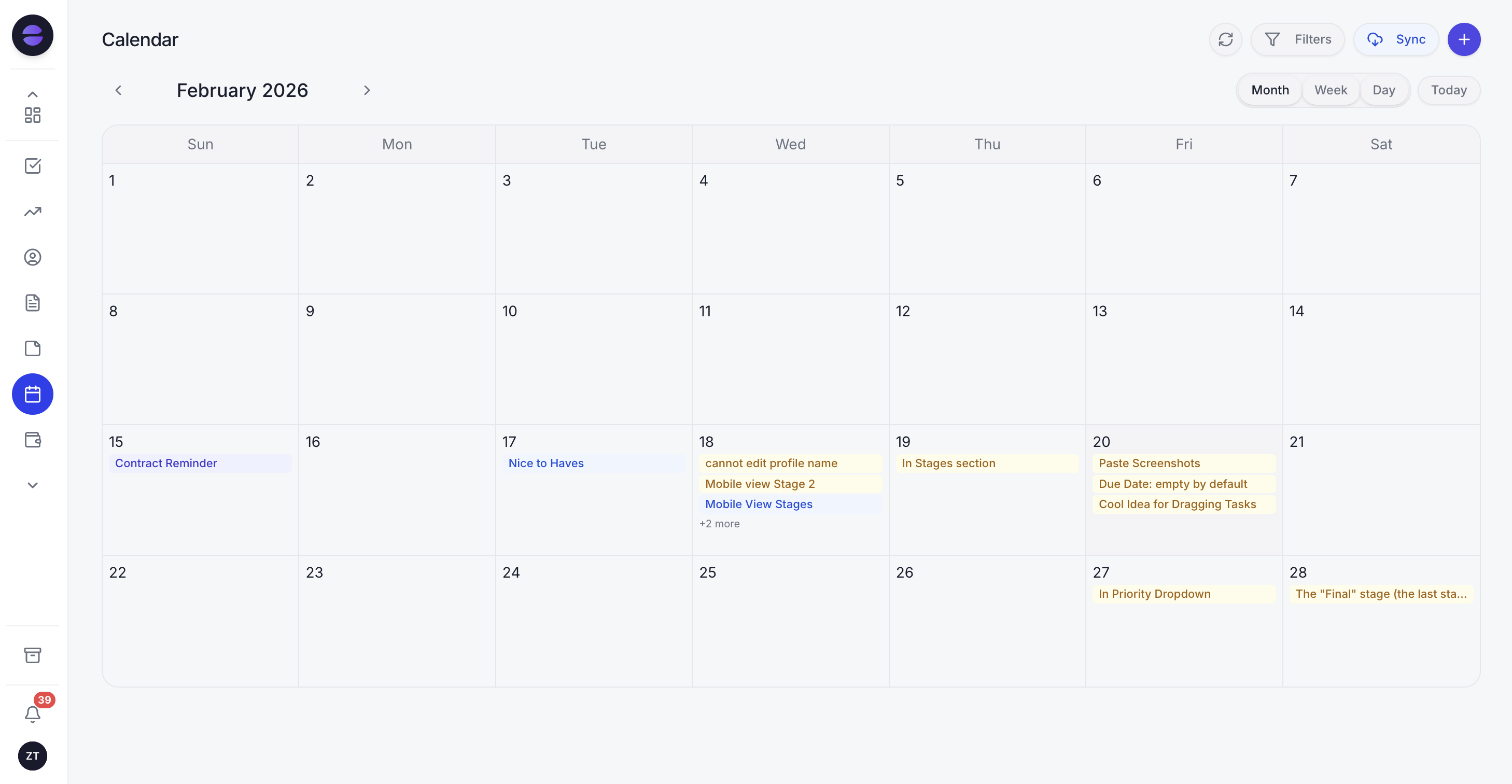 Zoye's shared calendar keeps every appointment, reminder, and follow-up in one place, so the agenda stays full without manual chasing
Here is the difference in plain terms. A practice-management tool waits for the patient to call. Zoye acts first. When someone clicks your ad or sends a WhatsApp message at 10pm, Zoye replies right then, answers the common questions, and offers a time, so the enquiry becomes a booking instead of a missed call. When tomorrow has a gap, Zoye can flag it and suggest which lapsed patients to invite back into it. When a patient completes a treatment and should return in six months, Zoye is the one that remembers and follows up, so the front desk does not have to.
The Zoye Assistant does not just suggest, it executes. Tell it, in a plain sentence, "remind every patient the day before their appointment and message me if a treatment patient has not rebooked in six months," and it builds that automation itself. There is no workflow canvas to wire up and no separate reminder tool to maintain. You describe the outcome and Zoye runs it. You can do all of this by talking to Zoye, including over WhatsApp from your own phone, which means the owner who treats patients all day never has to sit at a computer to keep it running.
Underneath the assistant is a genuine operating workspace for the patient relationship. Every patient is a contact with their full enquiry and visit history, notes, and preferences. Appointments and follow-ups live on a shared calendar. Treatment plans and packages (a course of physiotherapy, an aesthetic programme, an orthodontic case) track as they progress. Reports show which campaigns, services, and slots actually bring patients in, and the assistant can generate that summary on demand. One important honesty note: Zoye is not a clinical records system and does not manage medical histories or health-data compliance. It runs acquisition, booking, reminders, and reactivation, and sits alongside your clinical or practice-management software rather than replacing it.
Pricing: Almost Free at $5 per month for 1 member with the full platform including AI. Starter from $29 per month (10 members). Growth from $59 per month (20 members).
Best for: Clinics that want the patient capture, booking, reminder, and reactivation work done for them, paired with their existing clinical system.
2. Doctoralia - the patient-acquisition marketplace and agenda
Doctoralia, part of the Docplanner group, is one of the best-known platforms for clinics in Spanish-speaking markets, combining an online agenda with a marketplace where patients discover and book professionals. For visibility and self-booking, it is a genuinely useful tool that brings new patients to your profile.
The trade-off is that Doctoralia is a booking and directory platform first. It can send reminders and manage the agenda, but it does not act on your own leads from ads and WhatsApp or reason about which lapsed patients to bring back. You still drive the acquisition and the follow-up yourself.
Pricing: Subscription plans for professionals and clinics; check Doctoralia's pricing page for current figures.
Best for: Clinics that want marketplace visibility and online self-booking from a well-known directory.
3. Clinic Cloud - the Spanish clinic management software
Clinic Cloud is a widely used clinic management platform in Spain and Latin America, covering the agenda, patient records, billing, and clinical documentation. For the operational and clinical side of running a practice, it is a solid, purpose-built system.
The trade-off is that it is management and records first. Its strength is the clinical file and the day-to-day admin, not capturing enquiries from ads and WhatsApp or proactively reactivating patients. It runs the clinic; it does not fill it. Many clinics pair a system like this with an operator that handles acquisition and follow-up.
Pricing: Monthly subscription tiers; check Clinic Cloud's pricing page for current figures.
Best for: Clinics that need clinical records, billing, and agenda management in one purpose-built tool.
4. Agenda Pro - the booking and management tool for clinics and aesthetics
Agenda Pro is a popular option in Latin America and Spain for clinics, aesthetic centres, and wellness businesses, bundling online booking, an agenda, point of sale, and basic marketing. For a clinic that wants scheduling plus payments in one place, it covers a lot of the daily workflow.
The trade-off is depth versus breadth. Agenda Pro's marketing and reminder features exist, but the relationship layer is still oriented around the appointment, not around proactively capturing leads and retaining patients. Setup and add-ons can also stack up as you switch features on.
Pricing: Subscription plans that scale with staff and features; check Agenda Pro's pricing page.
Best for: Aesthetic centres and clinics that want booking plus point of sale in one platform.
5. SimplyBook.me - the flexible online booking system
SimplyBook.me is a flexible booking system used across many service industries, including clinics and therapists. It offers a customisable booking page, reminders, and a wide set of integrations, which makes it adaptable to different clinic workflows.
The trade-off is that it is fundamentally a scheduling tool. It fills the calendar well, but it is not a CRM that owns the patient relationship, captures leads from your ads, or reasons about who to reactivate. You get booking and reminders, not an operator working your patient base.
Pricing: Free tier with limits; paid plans by feature and booking volume. Check SimplyBook.me's pricing page.
Best for: Small clinics and independent therapists that want a flexible, low-cost booking page.
6. HubSpot - the general CRM adapted for clinics
HubSpot is a well-built general-purpose CRM that some clinics adopt when they want a real pipeline for enquiries and a marketing toolkit. As a CRM it is genuinely capable, with clear contact management, forms, and automation, and a free tier to start.
The trade-off is that it is not built for clinics. There is no native clinical agenda, no patient-specific workflow, and you will spend time bending a generic sales tool into a clinic shape. It also gets expensive quickly as you add the marketing and automation features that make it worthwhile.
Pricing: Free CRM tier; paid Marketing and Sales hubs priced per feature and contact volume (costs scale as you grow). Check HubSpot's pricing page.
Best for: Larger clinics with a marketing team that want a full general-purpose CRM and are prepared to configure it.
7. Pipedrive - the general sales CRM for higher-value cases
Pipedrive is a clean, well-liked sales CRM that some clinics use when they want a real pipeline for higher-value work like aesthetic programmes, orthodontic cases, or treatment courses. As a pipeline tool it is genuinely capable, with clear stages and solid automation.
The trade-off is that it is a sales CRM, not a clinic system. There is no booking agenda, no patient file, and no native WhatsApp acquisition; you will adapt a sales tool to a clinical context. It gives you pipeline discipline for big cases but not an out-of-the-box clinic workflow.
Pricing: Per-user monthly plans; check Pipedrive's pricing page for current figures (per-seat pricing means costs scale with team size).
Best for: Clinics that sell higher-value treatment programmes and want a serious sales pipeline for them.
Want to see it in action?
Watch how Zoye automates your daily workflow - from lead management to team collaboration.
See How It WorksPractice management software versus a real patient operator
It helps to be honest about the split in this category, because it explains why so many clinic owners feel underserved.
Doctoralia, Clinic Cloud, Agenda Pro, and SimplyBook.me are, at heart, booking and management software. They are good at the moment a patient decides to book and at running the clinical day: showing availability, taking the appointment, keeping the file, processing the payment. Their acquisition and retention features are real but secondary, and they generally wait for you to press the button.
Zoye comes at it from the other side. The booking moment matters, but the money is in everything around it: the instant reply that turns an ad click into a patient, the reminder that stops the no-show, the nudge that brings a treated patient back. Zoye treats that ongoing relationship as the main job and does it for you. If your agenda is already full and your enquiries all get answered in minutes, a booking tool may be all you need. If you suspect leads are going cold and patients are slipping away, you need the operator, not just the calendar. And because Zoye is not a clinical records system, it works best alongside the practice-management or health-record tool you already use.
How a CRM cuts no-shows and fills empty slots
No-shows and quiet days are the two most expensive problems in a clinic, and both respond to the same thing: proactive, well-timed contact.
For no-shows, the fix is a reliable reminder on a channel patients actually read. A WhatsApp confirmation a day or two before the appointment, with a one-tap way to confirm or reschedule, cuts no-shows sharply. The key word is reliable: it has to go out every time without a person remembering. Zoye sends these automatically and can flag the higher-risk bookings (a first-time patient, someone who has no-showed before, a peak slot) so the front desk confirms those by hand.
For empty slots, the fix is a warm list of patients to invite back. Every clinic has patients who finished a treatment and simply never rebooked. Zoye keeps that list current on its own and can reach out with a personal nudge when there is a gap to fill, turning a quiet afternoon into a booked one. That is the difference between software that shows you an empty slot and an operator that fills it.
See what Zoye can do for you
From CRM and deal tracking to AI-powered task management - explore everything Zoye offers in one workspace.
Explore FeaturesBest clinic CRM for WhatsApp and patient messaging
If your patients live on WhatsApp, and in most markets they do, the tool has to meet them there. Zoye centralises patient conversations and the assistant can draft and send confirmations, reminders, and reactivation messages over WhatsApp, so the channel your patients prefer is the channel you run the clinic on. You can also operate Zoye by talking to it from WhatsApp yourself, which suits an owner who is with patients all day and rarely at a desk.
The booking-first tools can send WhatsApp or SMS reminders too, but the conversation and the reasoning about who to message stays basic. With Zoye, the messaging is driven by an assistant that knows the whole patient history and acts on it, not by a template that fires on a fixed rule. Capturing the enquiry the instant it lands and holding the conversation until it becomes a booking is exactly the part that most clinic software leaves to your front desk.
How to choose the right clinic CRM for your practice
Three questions narrow it down fast.
Are you filling the agenda from ads, or is it already full? If you are fully booked and every enquiry gets answered in minutes, a booking-first tool like Doctoralia or Agenda Pro may be plenty. If you spend on ads and suspect enquiries are going cold, or patients are lapsing after treatment, you need something that captures and reactivates for you, which points to Zoye.
Do you need clinical records, or patient acquisition? If your priority is the clinical file, billing, and documentation, a purpose-built system like Clinic Cloud is the right base. If your priority is bringing patients in and keeping them, add an operator like Zoye alongside it. Most growing clinics need both, and it is worth being clear which problem you are solving.
Where do your patients actually communicate? If the answer is WhatsApp (and for most clinics it is), prioritise a tool that treats WhatsApp as a first-class channel and can converse there, not just fire a reminder.
Why clinics pick Zoye
A few themes come up again and again.
It does the patient-facing work for you. The instant reply to an ad enquiry, the reminder, the reactivation of a lapsed patient: Zoye handles the parts that quietly decide whether your agenda stays full, so nobody at the front desk has to remember.
You run it by talking to it. Describe what you want in a sentence and Zoye builds the automation and runs it, including over WhatsApp. There is no dashboard to maintain and nothing to manage, which matters when the owner is also the person treating patients.
It pairs cleanly with your clinical system. Zoye does not try to be your electronic health record. It runs acquisition, booking, reminders, and reactivation, and works alongside the practice-management or records tool you already trust, so you add patient growth without disrupting how you keep clinical data.
Try Zoye with your clinic. The entry plan, Almost Free, is $5 per month, with the full platform including AI, so you can start capturing and reactivating patients today.
For more context, see the best CRM for real estate, the WhatsApp CRM for clinics, the CRM for insurance agents, and the best CRM for real estate agencies.