
Most freelancers who go looking for a CRM have tried one already. It is still sitting in a browser tab somewhere, half set up, with a few stale contacts and a lot of empty fields. The problem was never that it lacked features. The problem was that for it to help, someone had to keep it filled in, and when you are the whole business, that someone is you, and you were busy shipping the actual work you get paid for.
That is the quiet failure of nearly every CRM sold to solo pros: it only helps if you feed it, and admin is exactly what slips first when a deadline is looming. A proposal goes out and never gets chased. A deposit is agreed on a call and then forgotten. An invoice goes overdue for three weeks because you were heads-down on the next project. A freelancer does not lose income because they have no CRM. They lose it because the CRM they have needs work nobody has time to do.
This guide looks at client management for freelancers honestly: what a solo designer, writer, developer, or VA actually needs, why classic CRMs and even freelancer-focused tools disappoint people who are already stretched thin, and which 2026 option is built to do the chasing itself instead of adding one more chore to your evening.
Pricing reflects published rates as of July 2026; check each vendor's pricing page for current figures.
What a freelancer actually needs from a CRM
Before comparing tools, it helps to be clear about what genuinely matters when you are a business of one, because most of what gets sold as "CRM features" was built for sales teams, not for a solo creative juggling three clients.
Every lead in one place, even the ones from DMs. Freelance work rarely comes through a tidy web form. It arrives as an Instagram DM, a WhatsApp message, a referral text, a reply to a post. If some enquiries live in your inbox, some in social apps, and some in your memory, you do not have a pipeline, you have a leak. You need one place where every enquiry lands so nothing gets buried.
Follow-up that actually happens. The money in freelancing is in the follow-up. Most proposals that go unanswered were never chased even once, and most late invoices simply never got a reminder. You need a system that makes sure every proposal gets a nudge, every deposit gets requested, and every overdue invoice gets a polite chase, even when you are buried in delivery.
Real simplicity, not just a clean screen. "Easy to use" is measured not by the first screen but by how much work is left after setup. A tool that looks simple but requires you to log every lead, build every workflow, and send every reminder by hand is not simple. It has just moved the work onto you, which is the one resource a freelancer has least of.
No admin that becomes a second job. If a tool needs template-building, workflow wiring, or a weekly tidy-up, it has recreated the exact problem it was meant to solve. For a freelancer, the only interface that survives a busy month is a conversation, ideally in a channel you already check all day.
Why freelancers abandon their CRMs
The admin never fit into the day. A freelancer is the salesperson, the project manager, the accountant, and the person doing the billable work, all at once. A classic CRM assumes there is a dedicated admin person to keep it current. There is not. So it slowly goes stale and becomes one more subscription you feel guilty about.
The follow-up math became impossible. One person cannot chase every proposal, every deposit, and every unpaid invoice while also delivering the work that pays the bills. A traditional CRM shows you the gap; it does not close it. What is missing is not another to-do list, but something that actually does the chasing.
Clients moved to WhatsApp and DMs, the CRMs did not. Freelance clients reply in WhatsApp, Instagram, and text, not in a CRM portal. A tool that does not live in those channels forces you to copy every conversation in by hand, and that is exactly the step that gets dropped under a deadline.
The technology crossed from demo to dependable. A couple of years ago, an AI that takes action was a neat demo, not something you would trust with a client relationship. In 2026, mature permission systems, confirmation steps, and safe execution mean an assistant can hold real write-access to your business responsibly. The category quietly moved from "interesting" to "genuinely useful for a business of one."
Want to see it in action?
See Zoye catch a new lead, answer on WhatsApp and set up the follow-up, all from one message.
See How It WorksThe best CRMs for freelancers in 2026
The honest way to map this market is not a list of interchangeable tools; it is one AI Business Operator that does the work, alongside capable client-flow tools and CRMs that still require you to operate them yourself.
1. Zoye - the AI Business Operator that chases the money for you
Zoye is the first AI Business Operator: an assistant with real write-access across your whole business workspace, built for owner-operated businesses rather than developers or big sales teams. Instead of you filling in the system, the Zoye Assistant executes. It captures leads from your DMs and messages, chases deposits and invoices, keeps client records current itself, and rebooks past clients, mostly over WhatsApp.
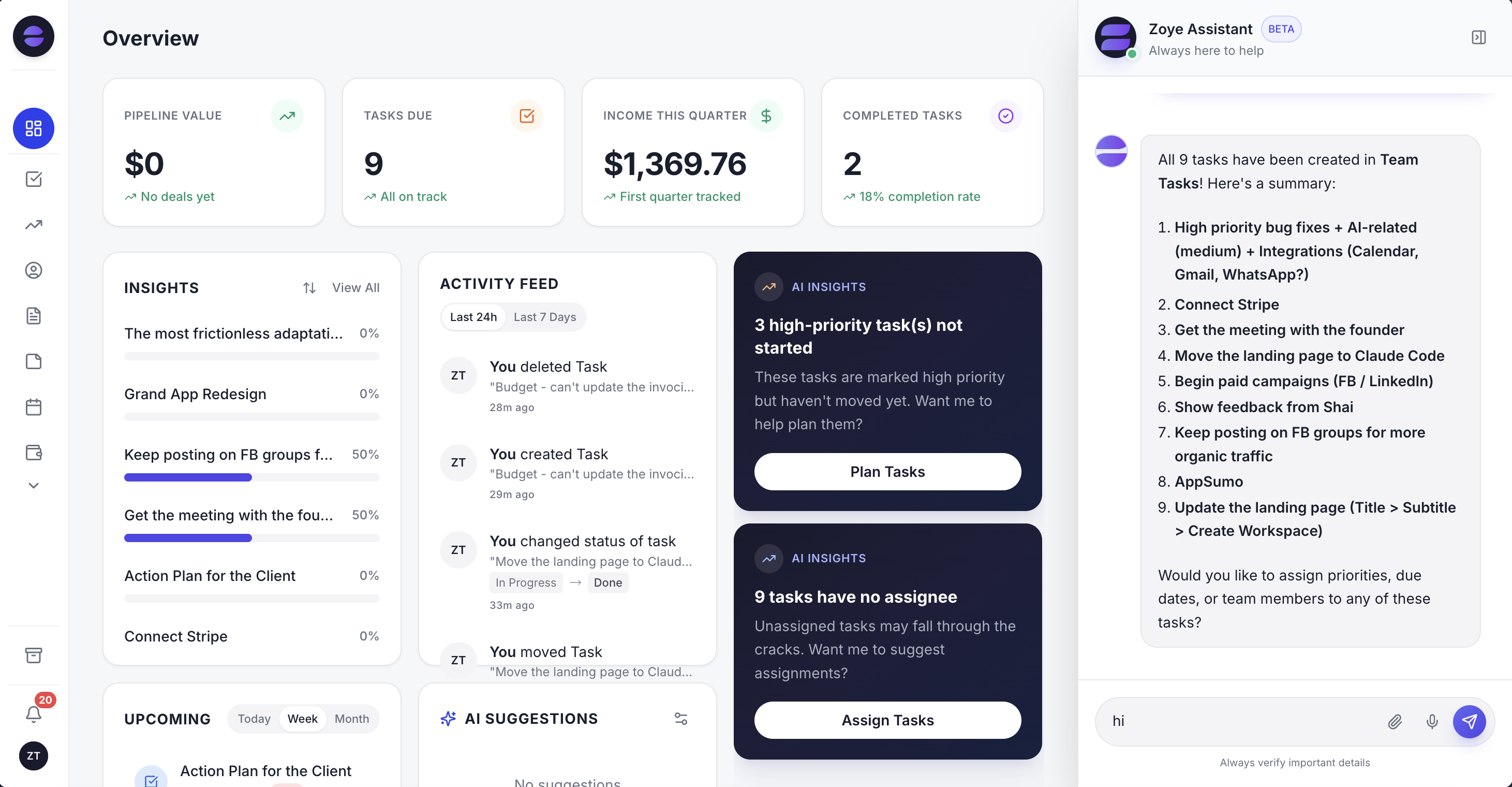 Zoye's dashboard: the operator keeps leads, clients, and follow-ups current, so nothing depends on you remembering to update it between projects
The interface is a conversation. Say "new lead from Instagram, wants a logo, budget around a thousand" and the lead exists, with a follow-up scheduled. Say "chase everyone who hasn't replied to a proposal this week" and the nudges go out. Say "remind me about any invoice more than fourteen days overdue and send a polite chaser" and the assistant builds and runs that routine itself; there is no workflow canvas to learn, because describing the outcome is the whole setup. It works the same on WhatsApp, so you run the business from the same app your clients already message you on.
Underneath the assistant sits a complete workspace: client and lead management, tasks with list, board (Kanban), calendar, and timeline views, a shared calendar, budget tracking, and reports, so the assistant's write-access covers your whole operation rather than one slice of it. The safety layer is what makes that trustworthy: destructive actions ask for confirmation, the assistant respects your permissions, and it never invents a record or claims it sent something it did not. As a solo freelancer you never have to "maintain" any of it; you talk, it runs.
Pricing: Almost Free at $5 per month for 1 member with the core tools. Starter from $29 per month (10 members). Growth from $59 per month (20 members). Most solo freelancers run their whole business on that entry plan.
Best for: Freelancers who want the admin, follow-up, and chasing done for them instead of adding it to their day.
2. HoneyBook - the client-flow tool for creatives
HoneyBook is a well-known client-management platform for creative freelancers, covering enquiries, proposals, contracts, and payments in one branded flow. The templates are polished and the client-facing experience looks professional.
The trade-off is that HoneyBook stores and structures your process, but you still drive every step. It shows you a pipeline; it does not chase the quiet proposal or the overdue invoice for you unless you set up and trigger each reminder yourself.
Pricing: Paid tiers, typically starting around $19 to $36 per month depending on plan and billing; check the current pricing page.
Best for: Creative freelancers who want branded proposals and contracts and are happy to run the workflow themselves.
3. Bonsai - the freelancer all-in-one suite
Bonsai bundles proposals, contracts, invoicing, time tracking, and light CRM into one suite aimed squarely at freelancers. For solo pros who want their contracts and billing in the same place, it is a tidy toolkit.
The trade-off is the same operating burden: Bonsai gives you the forms and the invoices, but the chasing, the follow-up, and the rebooking are still manual tasks on your list. It is a filing cabinet with billing, not something that acts on your behalf.
Pricing: Paid plans, commonly starting around $21 to $25 per month; check the current pricing page.
Best for: Freelancers who want contracts, invoicing, and time tracking bundled together.
4. Dubsado - the customizable client-management tool
Dubsado is a client-management platform popular with creatives who want deep customization of forms, workflows, and client portals. Once configured, it can automate parts of the client journey.
The trade-off is setup. Dubsado is powerful but fiddly, and the automation only runs if you invest the hours to build every workflow first. For a freelancer short on time, the configuration can become the project that never quite gets finished.
Pricing: Paid tiers, typically around $20 to $40 per month; check the current pricing page.
Best for: Freelancers who enjoy configuring their own workflows and have time to build them.
See what Zoye can do for you
CRM, deals, tasks and your Instagram, Facebook and WhatsApp automations in one workspace. Just ask Zoye and it sets any of it up for you.
Explore Features5. HubSpot - the free generic CRM
HubSpot offers a genuinely capable free CRM tier with contact management, deal pipelines, and email tracking. For a freelancer who mainly wants a clean contact database, the free plan is generous.
The trade-off is that HubSpot is built for sales teams, so a lot of it is overkill for a business of one, and it still expects you to log activity and send follow-ups by hand. The freelancer-specific flow, from DM to deposit to rebooking, is not what it was designed around.
Pricing: Free CRM tier. Paid Starter plans begin around $15 to $20 per seat per month; check the current pricing page.
Best for: Freelancers who want a free, sales-oriented contact database and will operate it themselves.
6. Pipedrive - the simple sales pipeline
Pipedrive is a lightweight, visual sales CRM that freelancers sometimes adopt for its clean pipeline view. It is easy to grasp and good at showing where each deal stands.
The trade-off is that Pipedrive is a pipeline tracker, not a client-flow tool. There are no native proposals or invoices aimed at freelancers, and every stage move, note, and follow-up is manual data entry you have to remember to do.
Pricing: Paid plans typically starting around $14 to $24 per seat per month; check the current pricing page.
Best for: Freelancers who want a simple visual pipeline and do not need proposals or invoicing built in.
7. Spreadsheets and Notion - the DIY option
Many freelancers run their client tracking in a spreadsheet or a Notion database, and for a very small book of clients it can work. It is free, flexible, and yours to shape.
The trade-off is that a spreadsheet does nothing automatically. It cannot capture a DM, send a reminder, or chase an invoice. Every update is manual, and the moment you get busy, the sheet stops reflecting reality, which is precisely when you needed it most.
Pricing: Free with existing tools.
Best for: Brand-new freelancers with only a couple of clients who want the cheapest possible start.
The best CRM for freelancers who live on WhatsApp
Most freelance clients do not want a portal login; they want to message you where they already are. If most of your enquiries and client chat happen on WhatsApp and Instagram, the right tool is one that lives in that channel rather than one you copy conversations into afterward.
Zoye is built for exactly this. You capture a lead straight from a DM, send and chase a deposit, remind a client about an overdue invoice, and rebook a past client, all by messaging Zoye on WhatsApp the way you would text a colleague. The assistant drafts replies for you and only escalates what genuinely needs your personal touch. HoneyBook, Bonsai, and Dubsado can send client-facing messages, but you are still the one initiating and chasing each one. For a freelancer who runs their day from their phone, that difference is the whole point.
How to choose the right CRM for your freelance business
Three questions narrow it down fast.
1. Where do your leads and clients actually talk to you? If it is mostly DMs and WhatsApp, choose a tool that operates in that channel, not one that expects clients to log into a portal. Zoye runs from WhatsApp; most others expect you to work inside their app.
2. Do you want to store your process, or have it run for you? HoneyBook, Bonsai, and Dubsado store and structure your workflow beautifully, but you drive every step. Zoye is the option that actually does the capturing, chasing, and rebooking itself.
3. How much admin time do you honestly have? If the answer is "almost none," rule out anything that needs heavy setup or manual upkeep. A freelancer's best CRM is the one that still works during your busiest week, which means it has to run without you babysitting it.
Getting started without losing a weekend
The good news for freelancers is that switching is light, because you are not migrating a giant database, just your active clients and open leads. Take only what is live: your current clients, the proposals still in play, and any unpaid invoices. Anything older than ninety days that is genuinely dead can be left behind.
With Zoye specifically, you do not rebuild anything by hand. Tell Zoye who your active clients are and what you are waiting on from each, and it sets up the records and the follow-ups for you. Point it at your unpaid invoices and it starts chasing them on a schedule you approve. The whole move usually takes an afternoon, not a weekend, and from that point the system maintains itself instead of waiting for you to update it.
Why freelancers pick Zoye
A few things come up again and again.
It does the chasing you never get to. Proposals, deposits, and overdue invoices get followed up automatically, so the money that used to slip through the cracks actually comes in.
You never have to keep it running. There is no workflow canvas to wire together and no template library to curate. You tell Zoye what you want, on WhatsApp if that is easiest, and it stands up the routine and keeps it going.
It replaces the admin burden, not just a tool. Clients, leads, tasks, calendar, budget, and invoicing reminders live in one workspace the assistant can act across, so you stop being the glue between five apps and get your evenings back.
And it is built to be handed real responsibility: it checks with you before anything irreversible, respects your permissions, and never reports a result it did not actually produce. That guardrail is what lets a business of one genuinely let go of the busywork.
Try Zoye with your freelance business. The entry plan is Almost Free, with the core tools.
Ready to hand off the busywork?
Zoye brings AI-powered CRM, task management, and automation into one workspace.
Get StartedFor more context, see the best CRM for small business, the easiest CRM for small business, AI for solopreneurs, and the rest of the Zoye blog.