
Most CRMs sold to accountants are really just filing cabinets with a search box. They store the client, the contact details, and maybe a list of what is outstanding, and then they wait for you to do the work. The problem is that the work in an accounting or bookkeeping practice is rarely the numbers. It is the chasing. Chasing the missing bank statements, the signed engagement letter, the receipts a client swears they already sent, the approval you need before a deadline. A database that lists what is overdue does not lighten that load. It just makes the pile easier to look at.
That gap matters most for solo accountants and small firms, where the same person who prepares the return is also the one sending the third reminder email at 9pm. Tax season turns that into a crisis: dozens of clients, each missing something, all due at once, and a growing list of follow-ups that only get sent if you personally remember to send them. The tools in this guide take different approaches to that problem. Some manage the workflow, some track the pipeline, and one actually does the chasing for you.
This guide compares the seven best CRMs for accountants and bookkeepers in 2026, ranked for solo practitioners and small firms who want less admin, not another database to keep updated by hand.
Pricing reflects published rates as of July 2026; check each vendor's pricing page for current figures.
Why accounting firms are rethinking their client tools in 2026
Four shifts are pushing firms to look past the traditional CRM.
The bottleneck is chasing, not tracking. For a small practice, the constraint is not knowing which documents are missing. It is finding the hours to chase every client who has not sent them. A tool that only surfaces the gap leaves the most tedious part of the job exactly where it was: on you. Firms increasingly want software that closes the loop, not one that reopens it every morning.
Clients live on WhatsApp and email, not in your portal. Many clients will never log into a portal to upload a file, but they will reply to a WhatsApp message or an email. The tools that actually get documents in are the ones that meet clients where they already are, and follow up in the same thread, rather than sending them to a login screen they forget about.
Onboarding and renewals leak revenue quietly. Every new client needs the same intake, the same document request, the same kickoff. Every recurring engagement needs a renewal nudge before it lapses. These are predictable, repeatable moments, and they are exactly the moments that slip when one person is running everything manually. Firms want that cadence handled automatically.
Practice tools do workflow, not relationships. Purpose-built accounting practice tools are strong at internal task management and document handling, but they are built around your process, not around the client conversation. Small firms often end up stacking a practice tool for the work and a separate CRM for the pipeline, then updating both by hand. The appetite now is for one place that runs the client side end to end.
The 7 best CRMs for accountants in 2026
1. Zoye - the operator that chases documents and books calls itself
Zoye is the strongest choice for solo accountants and small firms because it does not just store your clients. It runs the client work: it captures new enquiries, chases the documents you are waiting on, reminds clients of deadlines, and books calls itself, mostly over email and WhatsApp.
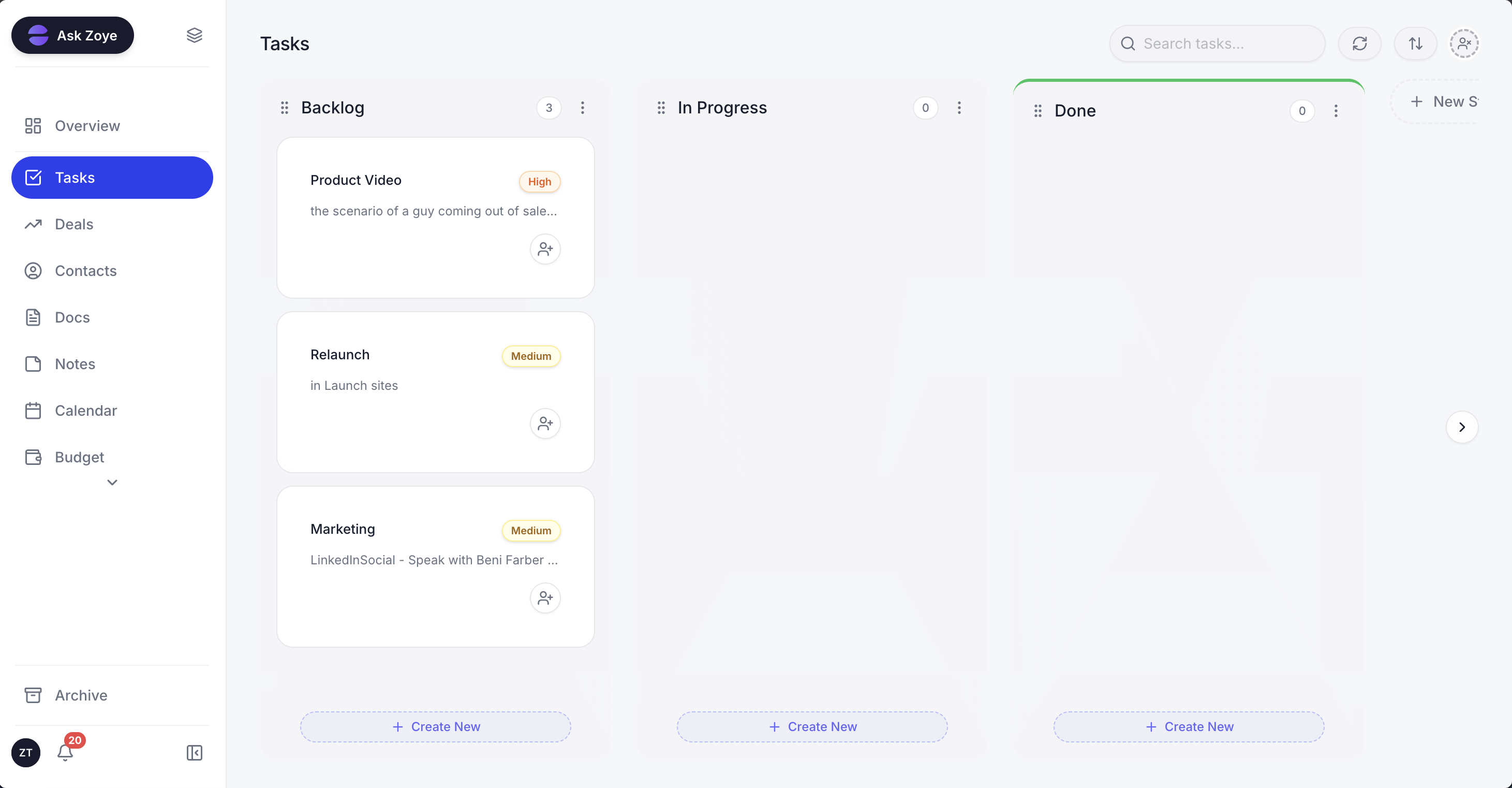 A single board keeps every client, document request, and deadline visible, while Zoye does the chasing in the background
Where a normal CRM waits for you to send the reminder, Zoye is an AI Business Operator that takes the action. You tell Zoye what you need, for example that you are waiting on last year's accounts and a signed engagement letter from a set of clients before month end, and Zoye sends the requests, follows up with the clients who go quiet, and tells you who is still outstanding. When a prospective client messages you, it captures the lead, answers the first questions, and offers times to book an intake call. When a filing deadline approaches, it reminds the client automatically rather than waiting for you to notice.
The assistant is the difference. It is not a suggestion panel that lists what is overdue. It creates and updates the client records itself, drafts and sends the follow-up messages, and keeps chasing until the client responds or the item is done. That means the CRM stays current without you typing anything into it, which is the exact opposite of the software most firms bought and then stopped updating.
Around that assistant sits a full workspace so a small practice does not need a separate stack. You get a client CRM, tasks and boards for the work, a calendar for calls and deadlines, budget and reports for the numbers behind the practice, and one shared place for client conversations. Because the same assistant works across all of it, describing an automation once, such as chasing every client who has not sent their documents two days before a deadline, sets it running for good. You can set that automation up just by asking Zoye, including over WhatsApp.
One honest note: Zoye is the operator that runs your client relationships and admin, not a tax-filing or accounting-compliance product. It sits alongside the software you use to actually prepare and file, and takes the chasing, booking, and follow-up off your plate.
Pricing: Almost Free from 5 dollars per month (4 dollars per month billed annually) for 1 member with the core tools. Starter from 29 dollars per month (10 members). Growth from 59 dollars per month (20 members).
Best for: Solo accountants and small firms that want the client chasing, onboarding, and deadline reminders handled for them, not just tracked.
Want to see it in action?
See Zoye catch a new lead, answer on WhatsApp and set up the follow-up, all from one message.
See How It Works2. TaxDome - the all-in-one accounting practice platform
TaxDome is a well-established practice platform built specifically for accounting and tax firms, covering client portals, document management, e-signatures, and workflow automation. For firms that want everything oriented around tax and accounting processes, it is a serious option and clients get a branded portal.
The trade-off is that TaxDome is built around your internal workflow and its own portal. It expects clients to log in, and it expects you to build out pipelines and templates before it hums. The setup and learning curve are real, and much of the client-facing chasing still runs on templated automations you configure rather than an assistant that acts when you ask.
Pricing: Per-user annual subscription; check TaxDome's pricing page for current per-seat figures.
Best for: Established tax and accounting firms that want a portal-centric practice platform and will invest in setup.
3. Karbon - the practice management and workflow hub
Karbon is a practice management tool focused on internal workflow, team collaboration, and a shared email triage inbox for accounting firms. Its strength is coordinating work across a team: assigning tasks, tracking jobs, and keeping client emails visible to everyone who needs them.
The trade-off is that Karbon is aimed at team workflow and pricing that suits larger firms more than a solo practitioner. It organises the work beautifully, but the client-side chasing and onboarding still depend on your team following the process, rather than an operator that carries out the follow-ups itself.
Pricing: Per-user monthly subscription, typically positioned for multi-person firms; check Karbon's pricing page for current figures.
Best for: Multi-person accounting firms that want a shared workflow and email hub.
4. Financial Cents - the lightweight practice tracker
Financial Cents is a simpler, more affordable practice management tool aimed at small bookkeeping and accounting firms. It handles client tasks, deadlines, and document requests without the heavier setup of the larger platforms, which makes it approachable for a small team.
The trade-off is scope. Financial Cents keeps your work organised and reminds you what is due, but it is a tracker rather than an operator. The reminders and requests still go out because you or a teammate send them, and there is no assistant that captures new enquiries or books calls on your behalf.
Pricing: Per-user monthly subscription; check Financial Cents' pricing page for current figures.
Best for: Small bookkeeping firms that want simple task and deadline tracking.
See what Zoye can do for you
CRM, deals, tasks and your Instagram, Facebook and WhatsApp automations in one workspace. Just ask Zoye and it sets any of it up for you.
Explore Features5. HubSpot - the generic CRM with a free tier
HubSpot is a widely used CRM with a capable free tier and strong marketing and sales tooling. For an accounting firm that wants a pipeline for new-client enquiries and a tidy contact database, HubSpot's free CRM covers the basics without cost.
The trade-off is that HubSpot is built for sales teams, not accounting practices. It has no concept of a tax deadline, an engagement letter, or a document request, so you bend a generic sales pipeline to fit accounting work. The useful automation and follow-up features sit in the paid Marketing and Sales tiers, and even then the assistant suggests rather than runs the chasing.
Pricing: Free CRM tier. Paid Marketing and Sales Hubs scale up quickly from there; check HubSpot's pricing page for current figures.
Best for: Firms that mainly want a new-business pipeline and are comfortable adapting a sales CRM.
6. Pipedrive - the simple sales pipeline
Pipedrive is a clean, easy-to-learn sales CRM focused on moving deals through a visual pipeline. For an accounting firm that wants a straightforward way to track prospective clients from first enquiry to signed engagement, it is one of the friendliest tools to adopt.
The trade-off is the same category limitation as HubSpot: Pipedrive is a sales pipeline, not a practice tool. It is excellent at tracking a deal but has nothing native for recurring engagements, document chasing at tax time, or client onboarding. Once a client is signed, Pipedrive has little to offer the ongoing relationship.
Pricing: Per-user monthly subscription across several tiers; check Pipedrive's pricing page for current figures.
Best for: Firms that want a simple pipeline for converting enquiries into clients.
7. Zoho CRM - the configurable budget option
Zoho CRM is a highly configurable, low-cost CRM that can be shaped to fit almost any workflow, including an accounting practice, especially if you already use other Zoho apps. Its flexibility and price make it attractive to firms willing to build.
The trade-off is that flexibility means work. Getting Zoho to model accounting workflows, deadlines, and document requests takes configuration and maintenance, and the more you customise, the more there is to keep updated. The automation is capable but rule-based, so it runs the sequences you build rather than acting when you ask, the way an AI operator does.
Pricing: Free tier for up to 3 users, then affordable per-user monthly tiers; check Zoho's pricing page for current figures.
Best for: Technically comfortable firms that want a low-cost, highly customisable CRM.
The best CRM for tax season document chasing
If the part of the year that hurts most is tax season, the deciding question is simple: does the tool chase the documents, or does it just list them? Every option here can show you a checklist of what is outstanding. Only Zoye actually sends the requests, follows up with the clients who go quiet, and reports back who is still missing what, over email and WhatsApp, without you sending each message.
Practice platforms like TaxDome and Financial Cents help here through templated requests and reminders, which is a real step up from a spreadsheet, but the cadence still depends on your setup and your team keeping it running. The generic CRMs offer the least for this specific pain, because chasing client paperwork is simply not what they were built for. For a solo accountant drowning in follow-ups in March, an operator that does the chasing is worth more than a prettier list of what is late.
Ready to hand off the busywork?
Zoye brings AI-powered CRM, task management, and automation into one workspace.
Get StartedThe best CRM for onboarding new clients
New-client onboarding is the other repeatable moment where firms leak time and, occasionally, clients. The ideal tool collects the intake details, requests the standard documents, books the kickoff call, and chases anything missing, all without you steering each step.
TaxDome and Karbon are strong on structured onboarding once you have built the templates and pipelines, which suits firms with the time to configure them. Zoye takes the opposite approach: you walk Zoye through the onboarding steps once and it runs them, collecting details, requesting documents, booking the call, and following up on gaps automatically. For a small firm that wants consistent onboarding without becoming a workflow administrator, that is the lower-effort path to the same result.
How to choose the right CRM for your accounting firm
Three questions narrow the field quickly.
1. Do you want the tool to track the work or do the work? If you are happy to send the reminders yourself and just want them organised, a practice tracker or a generic CRM is enough. If you want the chasing, booking, and follow-ups handled for you, an AI operator like Zoye is the only option here that acts rather than lists.
2. Where do your clients actually respond? If your clients ignore portals but reply to WhatsApp and email, prioritise a tool that reaches them in those channels and follows up in the same thread. Portal-first platforms assume a login habit many clients never form.
3. Are you solo, or a growing team? Team-focused platforms like Karbon shine for multi-person firms but can feel heavy for one person. Zoye scales from a solo practitioner on the low-cost entry plan up to a growing firm on the same workspace, so you are not forced to migrate as you add people.
Why firms pick Zoye
A few reasons come up again and again for small accounting and bookkeeping practices.
It does the chasing. Zoye sends the document requests, follows up with quiet clients, and reminds people of deadlines automatically, which is the single biggest time sink a small firm faces.
It meets clients where they are. The follow-ups go out over email and WhatsApp and continue in the same thread, so documents actually come in instead of sitting behind a portal login.
It keeps its own records. Because the assistant creates and updates the client data itself, the CRM stays current without becoming another thing you have to fill in, unlike the software most firms bought and stopped using.
It runs the whole client side in one place. Enquiries, onboarding, tasks, calendar, and client conversations all live together, and you can set up a new automation just by telling Zoye what should happen, including over WhatsApp.
Try Zoye for your firm. The entry plan, Almost Free, starts at just 5 dollars per month (4 dollars per month billed annually), the price of a cup of coffee, covering 1 member with the core tools, and you can cancel or upgrade anytime.
For more context, see the best CRM for small business, the easiest CRM for small business, and the best CRM for consultants.