
Dubsado is one of the most capable client management tools a freelancer or small service business can buy. Under the hood it can model almost any client process: proposals, contracts, invoices, forms, canned emails, and multi-step workflows that fire off automatically. For owners who love a fully templated back office, that depth is real and worth respecting.
The problem is not what Dubsado can do. It is what it asks of you first. Client-flow tools in this category share one structural gap: they are containers for your process, not operators of it. You still have to build every workflow branch, write every canned email, connect every form, and then, day to day, you are the one who triggers the send, watches for the reply, and chases the client who went quiet. The software holds your process; it does not run it.
That gap is exactly why so many owners search for a Dubsado alternative in 2026. Some want a lighter tool they can set up in an afternoon. A growing number want the opposite of "one more thing to configure": a system that captures the enquiry, sends and chases the proposal, books the call, and chases the deposit itself. This guide compares the six best Dubsado alternatives for freelancers and small service businesses, ranked for owners who would rather have the work done than have another dashboard to maintain.
Pricing reflects published rates as of July 2026; check each vendor's pricing page for current figures.
Why owners are looking beyond Dubsado in 2026
Four trends drive the move.
Setup cost is the real price. Dubsado's headline pricing is friendly, but the true cost is the weekend you spend wiring workflows, form logic, and canned-email chains before it does anything for you. Solo owners increasingly count that setup time as part of the price, and it is where most Dubsado trials quietly die.
You are still the engine. Even a perfectly built Dubsado runs on your attention. The workflow reminds you to follow up; it does not follow up. The invoice sits there; it does not chase itself. For a one-person business already stretched across sales, delivery, and admin, "the tool that reminds me to do the thing" is not the same as "the tool that does the thing".
Client conversations moved to chat. A large share of enquiries and back-and-forth now happens on WhatsApp and social DMs, not email. Traditional client-flow tools are email-and-form shaped, so the messages where deals actually close never make it into the system, and the follow-ups never go out on the channel clients actually read.
AI raised the bar from "automation" to "operation". Rule-based automation still needs you to design the rules. The new expectation is an assistant you can simply talk to, one that captures leads, drafts and sends the follow-up, and updates its own records without you building a single workflow branch.
The 6 best Dubsado alternatives in 2026
1. Zoye - the operator that runs your client workflow itself
Zoye is the strongest Dubsado alternative for owners who want the client workflow handled rather than built. Where Dubsado gives you a workshop to construct automations, Zoye is the operator that runs the work: it captures enquiries, sends and chases proposals, books calls, and chases deposits and invoices automatically, once you describe what you want, with no workflow diagram to draw.
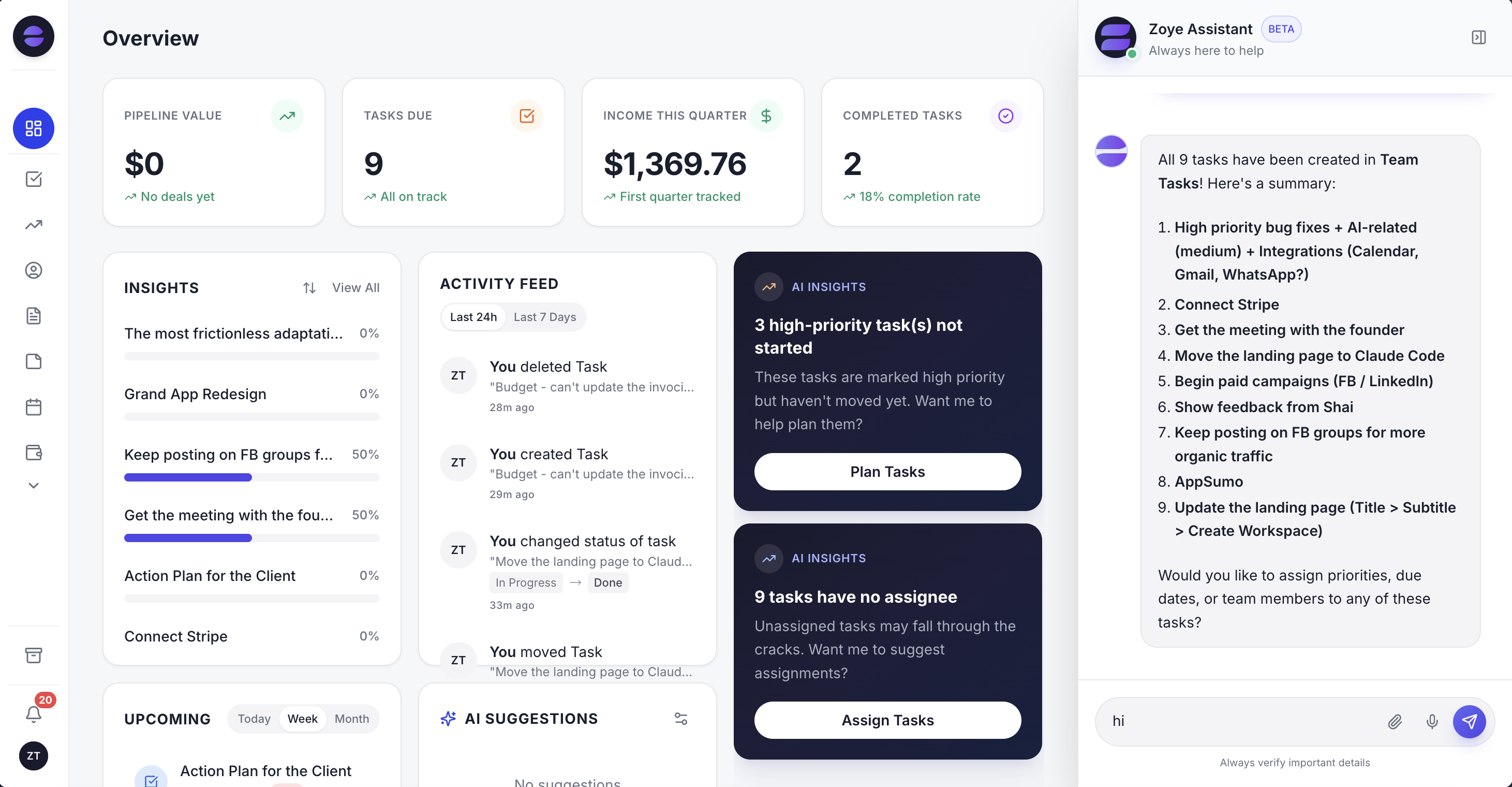 The Zoye dashboard brings enquiries, clients, tasks, and follow-ups into one view, with the assistant ready to run the next step
The setup difference is the headline. In Dubsado you build the workflow. In Zoye you describe it. Tell Zoye "when a new enquiry comes in, send my intro and pricing, then follow up in three days and again after a week if they go quiet" and it stands up that flow and starts running it. There is no branch logic to wire, no canned-email library to pre-build before anything happens. You change the process by telling Zoye what is different, not by rebuilding a diagram.
The operator does the chasing that owners usually drop. It watches proposals that have gone unanswered and follows up on schedule. It reminds clients of deposits and invoices that are due, in your voice, and stops the moment they pay or reply. When an enquiry lands from your website, WhatsApp, or a social DM, it captures the lead, replies fast, and books the discovery call onto your calendar. Because it works across WhatsApp too, the follow-ups go out on the channel your clients actually read, not just email.
Underneath the assistant is a full workspace, so you are not stitching a client-flow tool to five other apps. Zoye includes a native CRM for clients and enquiries, tasks with list, board, calendar, and timeline views, a shared calendar for bookings, budget tracking for deposits and invoices, and reports that pull it all together. The assistant keeps its own records: it logs the conversation, updates the client's stage, and creates the next task, so your CRM stays current without you doing data entry. That is the difference between software you bought and stopped updating and a back office that maintains itself.
Pricing: Almost Free at $5 per month for 1 member with the core tools. Starter from $29 per month (10 members). Growth from $59 per month (20 members). Scale from $119 per month (100 members).
Best for: Freelancers and small service businesses that want the client workflow run for them, over email and WhatsApp, instead of built and babysat by hand.
Want to see it in action?
See Zoye catch a new lead, answer on WhatsApp and set up the follow-up, all from one message.
See How It Works2. HoneyBook - the polished client-flow tool
HoneyBook is the most popular direct alternative to Dubsado and the easier of the two to get started with. The templates for proposals, contracts, and invoices are well-designed, the client-facing experience is clean, and the onboarding is gentler than Dubsado's. For owners who want a good-looking, structured client flow, HoneyBook is a reasonable pick.
The honest trade-off is the same structural gap: HoneyBook stores and templates your process, but you still drive each step, and its automation is rule-based rather than an assistant that acts for you. It is also email-and-form centric, so chat-first client conversations live outside it.
Pricing: Paid tiers typically from around $16 to $66 per month depending on plan and billing; check HoneyBook's pricing page for current figures.
Best for: Service owners who want a polished, easier-to-start client-flow tool and are happy to run the steps themselves.
3. Dubsado (the incumbent, kept honest)
It is worth being clear about when Dubsado is still the right answer. If you genuinely enjoy building detailed, templated workflows and want fine-grained control over forms, contracts, and canned emails, Dubsado is deep and capable, and its flat pricing is friendly to a solo business with unlimited projects on the paid tier.
The trade-off is the one this whole guide is built around: the setup is a real time investment, and once it is built you remain the engine that runs every workflow. Powerful, yes; hands-off, no.
Pricing: Starter and Premier tiers, commonly around $20 and $40 per month (lower on annual billing); check Dubsado's pricing page for current figures.
Best for: Owners who want maximum templated control and do not mind investing setup time to get it.
4. Bonsai - the freelancer all-rounder
Bonsai bundles proposals, contracts, invoicing, time tracking, and light client management into one tool aimed squarely at freelancers. For a solo creative or consultant who wants contracts and invoices handled in the same place as basic client records, Bonsai is convenient and quick to start.
The trade-off is depth and direction. Bonsai is broad but shallow on workflow automation compared with Dubsado, and like the others it waits for you to drive each step rather than chasing automatically.
Pricing: Plans commonly from around $21 to $32 per month depending on tier and add-ons; check Bonsai's pricing page for current figures.
Best for: Solo freelancers who want contracts, invoices, and light CRM in one simple tool.
5. A generic CRM (HubSpot, Pipedrive, Zoho)
Some owners leave Dubsado for a general-purpose CRM like HubSpot, Pipedrive, or Zoho. These are strong at pipeline tracking and reporting, and the free or low tiers can be enough to organise contacts and deals.
The trade-off is that a generic CRM is not built for the service-business client lifecycle. There is no native proposal-to-contract-to-invoice flow, so you bolt on other tools, and the CRM is still a database you have to keep updated by hand rather than one that maintains itself.
Pricing: Free tiers available; paid plans commonly from around $15 to $20 per user per month and up; check each vendor's pricing page for current figures.
Best for: Owners who mainly need pipeline and contact tracking and will assemble the rest of the client flow elsewhere.
6. Spreadsheets and manual tools
Plenty of owners run their entire client flow on a spreadsheet, a documents folder, and calendar reminders. It is free, flexible, and fully under your control, and for a brand-new business with a handful of clients it can genuinely be enough.
The trade-off shows up as you grow. Nothing is captured automatically, nothing chases the client for you, and the moment you get busy the follow-ups that make you money are the first thing to slip. A spreadsheet is a record of intentions, not a system that acts on them.
Pricing: Free with tools you already have.
Best for: Brand-new solo owners with very few clients who want zero cost and total manual control.
Best Dubsado alternative for freelancers who hate setup
If the thing that put you off Dubsado is the hours of configuration, the choice comes down to two moves. You can pick a gentler client-flow tool like HoneyBook or Bonsai, which start faster but still leave you running every step. Or you can skip the build entirely with Zoye, where you describe the process and Zoye stands it up and runs it. For an owner who wants to be doing client work instead of building workflow branches, describing instead of building removes the exact tax that Dubsado is known for.
See what Zoye can do for you
CRM, deals, tasks and your Instagram, Facebook and WhatsApp automations in one workspace. Just ask Zoye and it sets any of it up for you.
Explore FeaturesBest Dubsado alternative for chasing money automatically
The follow-ups that actually protect your income, chasing the unanswered proposal, the unpaid deposit, the overdue invoice, are precisely the ones a busy solo owner drops. Dubsado, HoneyBook, and Bonsai can remind you to send them; they do not send them automatically. Zoye is the only pick here that chases the money itself: it watches what is outstanding and follows up on schedule, in your voice, across email and WhatsApp, and stops the moment the client pays or replies. If unchased revenue is your real leak, that is the difference that pays for the tool.
How to choose the right Dubsado alternative for your work
Three questions narrow it down.
1. Is your problem setup, or is it follow-through? If you just want an easier start, HoneyBook or Bonsai are gentler. If your real problem is that things do not get chased once you are busy, you want an operator, not another tool to configure, which points to Zoye.
2. Where do your clients actually talk to you? If most of your enquiries and back-and-forth happen on WhatsApp and DMs, an email-and-form tool will always miss the conversations that close deals. Choose something that works where your clients already are.
3. Do you want just client flow, or the whole back office? If proposals and invoices are all you need, a focused tool is fine. If you are tired of stitching a client-flow app to a separate CRM, calendar, and budget, a single workspace like Zoye consolidates the stack and keeps its own records.
Migrating from Dubsado without losing momentum
Leaving Dubsado is less a data export and more a chance to drop the complexity you built up. Most owners find their Dubsado is over-engineered: workflow branches they never use, forms that duplicate each other, canned emails that went stale. The migration is a good moment to keep only the client process that actually earns money and let go of the rest.
The pragmatic approach is to write down your real client journey in plain English, enquiry, qualify, proposal, booking, deposit, delivery, invoice, review, rebook, then rebuild only those steps in the new tool. Bring your active clients and open proposals across; archive the long-dead leads instead of importing them. For owners moving to Zoye specifically, this is where describing instead of building earns its keep: you walk Zoye through that journey and it builds and starts running the follow-ups, so the reorganisation usually takes an afternoon rather than a weekend of workflow wiring.
Ready to hand off the busywork?
Zoye brings AI-powered CRM, task management, and automation into one workspace.
Get StartedWhy teams pick Zoye as their Dubsado replacement
A few themes come up consistently.
It runs the work instead of storing it. Every other tool here holds your process and waits for you to act. Zoye captures the enquiry, sends and chases the proposal, books the call, and chases the deposit and invoice itself.
Setup is a conversation, not a weekend. You walk Zoye through your client flow and it stands it up, so you skip the configuration tax that sends people looking for a Dubsado alternative in the first place.
It works where clients talk. The assistant chases and replies over WhatsApp as well as email, so the conversations that close deals finally live inside your system.
It keeps its own records. The CRM, calendar, budget, and reports stay current because the operator updates them as it works, so you never fall back into the "bought it, stopped using it" trap.
Try Zoye with your business. The entry plan is Almost Free at $5 per month for 1 member, with the core tools.
For more context, see the best CRM for small business, the best CRM for freelancers, and the best HoneyBook alternatives.