
Quick answer: the best ActiveCampaign alternative depends on which half of the product you use. For newsletters alone, MailerLite and Brevo cost a fraction of the price at small list sizes. For the CRM, follow-up and pipeline half, Zoye fits small teams that want the automations built for them, priced on people rather than contacts. Online stores should look at Klaviyo or Omnisend.
Key takeaways (October 2026)
- ActiveCampaign starts at $15 a month billed yearly for 1,000 contacts on Starter, but the Plus plan, the first that can add a CRM, is $49, and the Pipelines CRM add-on is another $39 a month on top.
- Contact tiers jump fast: Plus goes from $49 to $95 a month (billed yearly) when a list grows from 1,000 to 2,500 contacts, and Pro goes from $79 to $375 between 1,000 and 10,000 contacts.
- For accounts opened on or after 3 November 2025, every contact counts toward the limit, including unsubscribed and bounced ones, according to ActiveCampaign's help center.
- Cheaper email-first options start at $9 a month (Brevo Starter) and $12 a month (MailerLite Comfort); Zoye Growth, the plan that includes the WhatsApp and Meta automations, is $59 a month for up to 20 members ($47 billed yearly) with no contact pricing.
- Going over ActiveCampaign's monthly send limit costs $0.005 per extra email, and sending stops for the month if the overage reaches three times the limit.
Why small teams look for ActiveCampaign alternatives
Small teams leave ActiveCampaign for three documented reasons: the price follows the contact list rather than the value you get, the CRM costs extra on top of the marketing plan, and a lot of the automation power sits unused because someone has to design every workflow. ActiveCampaign is a strong product; the fit is the problem.
It is worth being fair first. ActiveCampaign has one of the most capable visual automation builders in email marketing, A/B testing on every plan, a long list of integrations and a mature sales CRM add-on. A business with a full-time marketer who lives in the automation canvas often gets excellent value from it. The reasons below are about the small team that bought it for that power and is now paying for capacity it does not use.
The automation you pay for but never built
Open your Automations list and count the workflows that are switched on and still doing something useful. In many small businesses the number is low: a welcome sequence built in week one, a lead magnet delivery, perhaps an abandoned-cart flow. The rest of the plan's power goes unused, because every automation in ActiveCampaign is a diagram somebody has to design, test and maintain.
That is not a criticism of the builder. It is a question of who operates it. If nobody on the team has three spare hours a week to build and repair workflows, the most sophisticated automation engine on the market still produces a welcome email and nothing else. The bill, meanwhile, is set by your contact count.
Contact tiers that jump as your list grows
As of October 2026, ActiveCampaign's pricing page prices every plan by contact tier. The page loads its figures through a price calculator; the numbers below are what it returns in US dollars, billed yearly, with monthly billing in brackets:
- Starter: $15 a month for 1,000 contacts ($19 monthly), $39 for 2,500 ($49), $149 for 10,000 ($189). Starter is capped at 25,000 contacts and two user seats, has no landing pages and cannot add the CRM.
- Plus: $49 for 1,000 ($59), $95 for 2,500 ($119), $189 for 10,000 ($239). One user seat included.
- Pro: $79 for 1,000 ($99), $149 for 2,500 ($189), $375 for 10,000 ($469). Three user seats included.
- Enterprise: $145 for 1,000 ($179), $255 for 2,500 ($319), $589 for 10,000 ($739). Five user seats included.
The jump is the part that surprises people. A team on Plus that grows from 1,000 to 2,500 contacts almost doubles its bill without adding a single feature. ActiveCampaign does not raise your contact limit automatically unless you switch on auto-upgrade, according to its help center, so a growing list also means someone keeping an eye on the limit.
Every contact counts, and sends have a ceiling
ActiveCampaign's help center states that for accounts created on or after 3 November 2025, all contacts count toward the contact limit, regardless of whether they are active, unsubscribed, unconfirmed or bounced. Accounts created on or before 2 November 2025 still count only active contacts. On a newer account, a list you never clean is a list you keep paying for.
Email sends are capped too. The help center lists the monthly send limit as 10 times your contact limit on Starter and Plus, 12 times on Pro and 15 times on Enterprise. Above the limit, ActiveCampaign charges $0.005 per email, and if the overage reaches three times the limit, sending is switched off until the next month.
The CRM is a separate purchase
ActiveCampaign's sales pipeline, called Pipelines, is an add-on rather than part of the marketing plan, as of October 2026. On Plus it costs $39 a month billed yearly ($49 monthly) with one seat, and $15 a month for each extra CRM seat billed yearly. On Pro it is $68 ($85) with three seats; on Enterprise $95 ($119). The bigger Pipelines and Sales Engagement add-on runs $68 ($85) on Plus and $111 ($139) on Pro. WhatsApp and SMS are add-ons as well.
Put together, a two-person team on Plus with 2,500 contacts and the CRM pays about $95 + $39 + $15 = $149 a month billed yearly before any WhatsApp or SMS. That is a reasonable price for a team that uses all of it, and a steep one for a team that mostly sends a monthly newsletter and tracks deals in a spreadsheet anyway.
Who should stay on ActiveCampaign: a business with a dedicated marketer, a list of tens of thousands, complex multi-branch nurture programs and real use of split testing and AI send optimization. For that team, switching costs more than it saves.
What to look for in an ActiveCampaign alternative
Choose an alternative by the job you actually run every week, not by the longest feature list. Ask how the price grows, who builds the automations, whether the CRM is included, and where a reply or a new lead ends up. Those four answers decide most of the cost and most of the value.
Use this checklist when you compare the options below:
- How does the bill grow? By contacts, by emails sent, by active profiles, by seats or by sub-accounts. Model your list at today's size and at twice that size.
- Who builds the automations? A visual builder you design yourself, prebuilt recipes, or an assistant that builds the rule when you describe the outcome.
- Is the CRM included? If you track deals, check whether the pipeline is in the plan or sold as an add-on with its own seats.
- What happens to replies? An email reply or a WhatsApp message should land on the contact's record with an owner and a next step, not in a separate inbox nobody checks.
- Which channels matter? Email only, email plus SMS, or WhatsApp and Instagram too. Price the channel add-ons you will really use.
- Do unsubscribed contacts cost money? Ask the vendor how contacts are counted and whether suppressed contacts are billed.
- How hard is the move? CSV export and import, consent records, and how long the old and new tools need to run in parallel.
If you want a deeper look at turning these rules into running workflows, our guide to CRM automation covers the follow-up patterns that matter most for small teams.
The 8 best ActiveCampaign alternatives in 2026
These eight cover the realistic exits from ActiveCampaign for a small business: an operator that runs the CRM and follow-up side, four email-first platforms, two ecommerce specialists and an agency-style all-in-one. Each entry starts with its limitation, then gives the October 2026 price from the vendor's own page and the team it suits.
1. Zoye: the operator for teams that never built the automations
The honest limitation first: Zoye is not an email marketing platform. There is no newsletter designer and no bulk email sending, so if your main ActiveCampaign job is a weekly newsletter to 20,000 subscribers, keep a dedicated email tool for that. Where Zoye replaces ActiveCampaign is everything around the newsletter: leads, the pipeline, follow-ups, tasks and the conversations that turn into revenue.
Zoye is an AI Business Operator: one workspace with thirteen tools that already link to each other (CRM and contacts, deals, tasks, calendar, documents, team, budget and invoices, reports, workflow automations, WhatsApp automations, Facebook and Instagram, email tracking and an AI Notetaker), plus an AI that operates them for you. A deal knows its contact, its tasks, its files and its invoices.
The difference from ActiveCampaign is who builds the automation. You describe what should happen, in the app, on WhatsApp or in Slack. Zoye turns it into a real trigger, conditions and actions, shows you the finished rule in plain English, and waits for your approval before anything runs. A visual builder exists, but you are never forced to open it. Triggers and actions reach across 8 tools, and every run is logged with what fired, what changed and what it sent, and can be reversed. Ready recipes cover the follow-ups small teams usually mean to build and never do: instant lead follow-up, a deal that has gone stale for 7 days, won-deal onboarding and an overdue-invoice chase.
The conversation side is where Zoye goes beyond an email tool. Six WhatsApp automations run on the official WhatsApp Business Platform, all off by default and all confirming before anything sends: a new-lead auto-message you can switch on source by source, a qualifying bot that fills CRM fields from the answers people give, audiences that refresh as records change, scheduled broadcasts that personalise each message and pace the sending, Meta template approval taken care of, and capture of every click-to-chat. Chats gives one inbox for Instagram and Facebook messages and comments plus the WhatsApp conversations Zoye has with your leads, with every chat saved on the contact's card. Connecting your own business WhatsApp number is coming soon. The full list is on the features page.
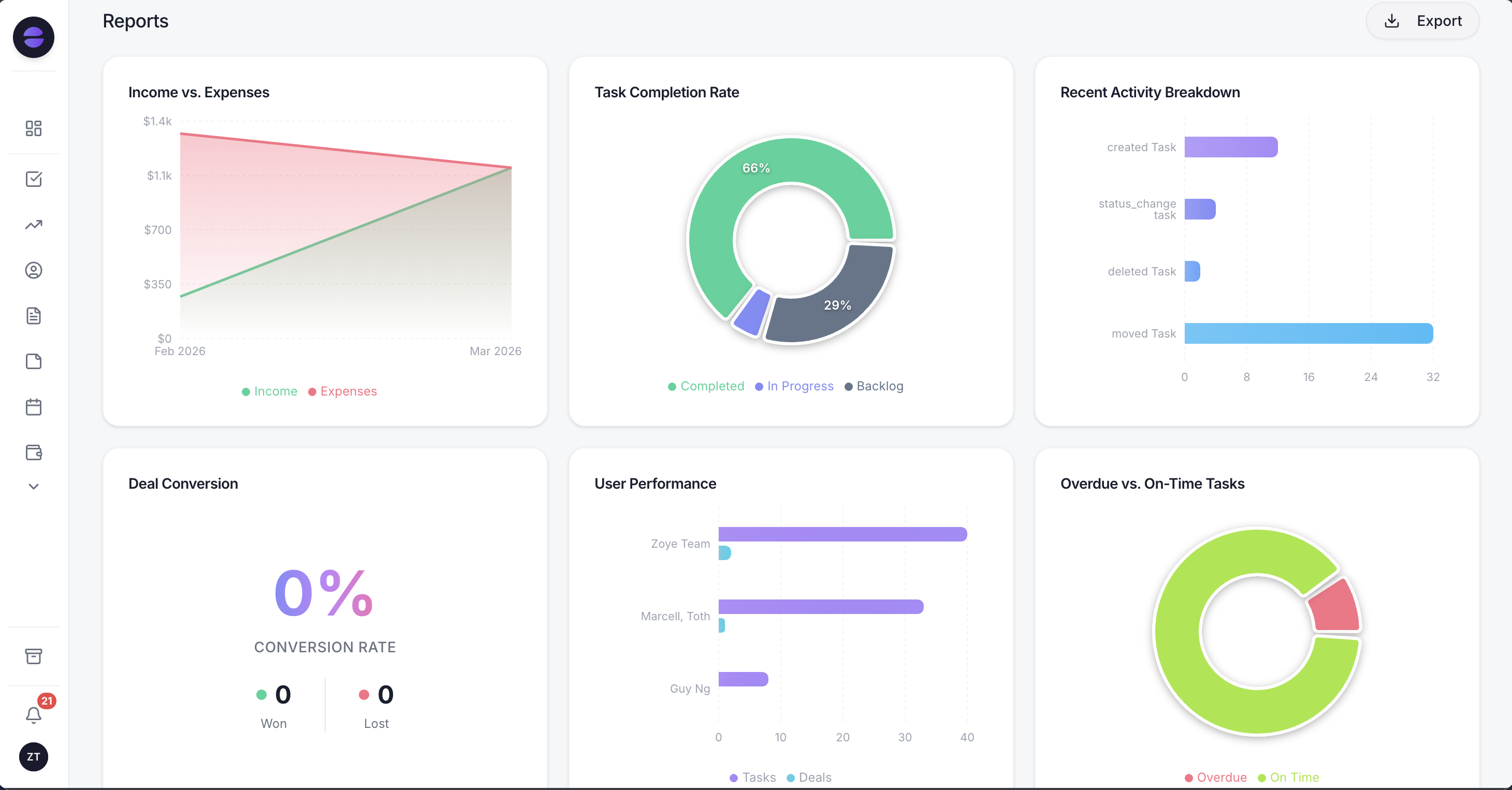
Zoye reports read the same records your automations and conversations update, so you see deals won rather than open rates.
The other honest limits: Zoye is not a helpdesk ticketing suite, not an accounting ledger, and it does not run ads; it captures and works the leads ads produce.
Pricing (as of October 2026): Zoye charges for the people in your workspace, never for contacts. Almost Free costs $5 a month, or $4 a month paid yearly, and covers one member with the core tools, 15 AI prompts each month and the Google integrations, but no automations. Starter is $29 a month ($23 yearly) for up to 10 members with 5GB; Growth is $59 ($47) for 20; Scale is $119 ($95) for 100; Customize is quoted. See the pricing page.
Best for: small teams whose ActiveCampaign account is really a CRM and follow-up system with a newsletter attached, and who want the follow-ups built and running without a marketing operations hire.
2. Brevo: low entry prices tied to email volume
Brevo's limitation is the jump to its upper tier: WhatsApp campaigns, multi-user access and the advanced sales features sit on Professional, which is a big step from the entry plans. Below that, it is one of the most affordable ways out of ActiveCampaign, because its paid plans are priced on monthly email volume. Each email tier also caps stored contacts, though (as of October 2026: 500 contacts at 5,000 emails a month, 1,500 at 10,000 and 2,500 at 15,000), so a growing list pushes you up a tier even if you rarely send.
Pricing (as of October 2026): a Free plan (300 emails a day), Starter from $9 a month and Standard from $18 a month, with Sales Essentials for a basic pipeline as a $31-a-month add-on on either, Professional from $499 a month with 10 seats, 150,000 emails and WhatsApp (Sales Advanced adds $65 per user there), and Enterprise on quote. Yearly billing saves 10%.
Best for: teams with a small list and a modest sending rhythm, who want email and SMS at a low entry price and can add a basic CRM when they need one.
3. MailerLite: the simplest low-cost email platform
MailerLite's limitation is scope. It is an email marketing tool with automations, landing pages, sites and digital products, and its plan list includes no sales pipeline, so deal tracking has to live somewhere else. Within that scope it is fast to learn and inexpensive, and its October 2026 plans were renamed Comfort and Power.
Pricing (as of October 2026): Free for up to 250 subscribers, 2,500 emails a month and 2 seats. Comfort from $12 a month for 500 subscribers ($19 at 1,000, $33 at 2,500) with 3 seats. Power from $25 a month ($39 at 1,000, $49 at 2,500) with unlimited seats, unlimited emails under fair use and multiple automation triggers. Yearly billing saves 10%.
Best for: creators and small businesses whose ActiveCampaign use was mostly newsletters and a few sequences.
4. HubSpot: a free CRM first, a steep ladder later
HubSpot's limitation is the ladder. Its free CRM and low Starter seats are a gentle entry, but the marketing automation most ActiveCampaign users rely on sits in Marketing Hub Professional, which costs many times more and carries an onboarding fee.
Pricing (as of October 2026): free tools for up to 2 users. Marketing Hub Starter from $20 per seat a month at list (about $7 a seat on some annual or promotional offers), with 1,000 marketing contacts. Professional from $800 a month billed yearly with 3 core seats and 2,000 marketing contacts, extra core seats at $45 a month, plus a $3,000 onboarding fee. Enterprise from $3,600 a month with a $7,000 onboarding fee. Our AI CRM alternatives to HubSpot guide covers the ladder in detail.
Best for: teams that want a polished free CRM today and have budget for Professional once automation becomes central.
5. Keap: CRM and automation for service businesses
Keap's limitation is the entry price. It is a single platform with CRM, automation, invoicing and appointments, a real step up for service businesses, but it starts well above ActiveCampaign's lower plans and requires paid implementation.
Pricing (as of October 2026): $299 a month billed monthly or $2,988 a year (about $249 a month), with 2 users included, $39 a month for each extra user, contact-based tiers on top, and required implementation services priced separately. Our Keap alternatives guide covers who outgrows it.
Best for: established service businesses that want CRM, automation and payments in one vendor and have budget for guided setup.
6. Klaviyo: the ecommerce specialist
Klaviyo's limitation is that it is built for online stores. Its strength is deep store data (orders, browsing, product catalogs) driving email and SMS, which a service business or a B2B team will rarely use, and it bills on active profiles.
Pricing (as of October 2026): a Free plan for up to 250 active profiles and 500 email sends a month, Email from $20 a month for 251 to 500 active profiles, and Email and SMS from $35 a month. Larger lists are priced through a calculator on Klaviyo's pricing page.
Best for: Shopify and other ecommerce brands where revenue per email is the main metric.
7. GoHighLevel: flat platform pricing with a learning curve
GoHighLevel's limitation is complexity and usage charges. It packs CRM, funnels, booking, email, SMS and workflows into one agency-oriented platform with unlimited contacts, but owners have to build most of it, and email, SMS and premium AI are billed on usage on top of the plan.
Pricing (as of October 2026): Starter $97 a month ($970 a year), Unlimited $297 ($2,970 a year) and Agency Pro $497 ($4,970 a year), Enterprise on quote. WhatsApp is a $10 a month add-on per sub-account. Our GoHighLevel alternatives guide goes deeper.
Best for: agencies and owners who want one flat-price platform and have time to configure funnels and workflows.
8. Omnisend: ecommerce email and SMS at a lower entry price
Omnisend's limitation is the same as Klaviyo's: it is designed around online stores, with no sales pipeline for a service team. For a smaller store it is often cheaper, with prebuilt ecommerce automations that work without heavy setup.
Pricing (as of October 2026): Free for 250 contacts and 500 emails a month. Standard $16 a month for 251 to 500 contacts, with 30% off the first three months when paid upfront. Pro $59 a month for 2,500 contacts with unlimited email under fair use; SMS credits are bought separately.
Best for: small online stores that want ecommerce automations without Klaviyo's price at scale.
Want to see it in action?
See Zoye catch a new lead, answer on WhatsApp and set up the follow-up, all from one message.
See How It WorksActiveCampaign alternatives compared
The table puts ActiveCampaign next to the eight alternatives on what decides value for a small team: the entry price that fits a real business, how the bill grows, whether a sales CRM is included, and who builds the automations. All prices are as of October 2026, from each vendor's own page.
| Tool | Entry price for a small team (Oct 2026) | Bill grows with | Sales CRM | Who builds automations |
|---|---|---|---|---|
| ActiveCampaign | $49/mo yearly, Plus, 1,000 contacts | Contact tier, seats, add-ons | Add-on from $39/mo | You, in a visual builder |
| Zoye | $59/mo Growth, 20 members | People in the workspace | Included | Zoye builds, you approve |
| Brevo | $9/mo Starter | Emails sent, contact cap, plan tier | Add-on from $31/mo | You, in a visual builder |
| MailerLite | $12/mo Comfort, 500 subscribers | Subscribers | Not offered | You, in a visual builder |
| HubSpot | $20/seat/mo Starter at list | Seats, contacts, tier | Included | You; depth needs Professional |
| Keap | $249/mo yearly, 2 users | Users, contacts | Included | You, plus paid implementation |
| Klaviyo | $20/mo, 251 to 500 profiles | Active profiles | Not offered | You, with ecommerce templates |
| GoHighLevel | $97/mo Starter | Plan tier, usage | Included | You, in a visual builder |
| Omnisend | $16/mo, 251 to 500 contacts | Contacts | Not offered | You, with ecommerce templates |
One thing the table cannot show: "who builds the automations" decides whether the automations exist at all. A visual builder is a strength for a team with a marketer, and an unused line item for a team without one.
What 2,500 contacts and a CRM really cost
Take a 3-person team with 2,500 contacts that sends two newsletters a month and tracks about 40 open deals. On ActiveCampaign the CRM, the seats and the contact tier all add up; on the alternatives, the cost depends on whether you need one tool or two. The figures below use each vendor's October 2026 prices.
- ActiveCampaign Plus with Pipelines: $95 for 2,500 contacts, plus $39 for Pipelines, plus two extra CRM seats at $15 each, billed yearly. That is $164 a month before any WhatsApp or SMS add-on, and the marketing plan itself includes one user seat.
- ActiveCampaign Pro with Pipelines: $149 for 2,500 contacts with three user seats, plus $68 for Pipelines with three seats, so about $217 a month billed yearly.
- MailerLite Comfort plus Zoye Growth: $33 for 2,500 subscribers, plus $59 for Zoye covering up to 20 members, so $92 a month. Newsletters go out from MailerLite; leads, deals, follow-ups and WhatsApp run in Zoye.
- Brevo Starter plus Zoye Growth: $9 and up for Brevo depending on email volume and list size, plus $59 for Zoye, so from about $68 a month.
- HubSpot Starter: three seats at $20 at list is $60 a month with 1,000 marketing contacts; a list of 2,500 marketing contacts and serious automation push you toward Professional at $800 a month billed yearly plus onboarding.
The pattern is simple. If the CRM and follow-ups are the work and the newsletter is a side job, splitting them across a low-cost email tool and an operator like Zoye is usually cheaper than one contact-priced suite. If complex email nurturing is the core of your revenue, ActiveCampaign Pro can still be the better deal.
See what Zoye can do for you
CRM, deals, tasks and your Instagram, Facebook and WhatsApp automations in one workspace. Just ask Zoye and it sets any of it up for you.
Explore FeaturesHow to switch from ActiveCampaign without losing your list
A clean move takes about two weeks: export everything with consent data, rebuild only the automations that earn money, import into the new tools, and run old and new side by side for one sending cycle before you cancel. The riskiest part is consent, not data, so carry unsubscribes across first.
- Audit what actually runs. List the automations that are active and sent something in the last 90 days. That short list is your migration scope; the rest stays behind.
- Export contacts with their status. Export your contacts to CSV, including tags, custom fields, and subscription status. Export unsubscribed and bounced contacts as a separate suppression file so nobody who opted out is ever mailed again.
- Export deals if you use Pipelines. Pull deals with stage, value, owner and contact so the pipeline can be rebuilt as it is.
- Import into Zoye. Upload the CSV as a spreadsheet import, or send the file to the assistant, which extracts records from a CSV, a PDF or even a screenshot. Zoye also imports from Trello and Monday.com if parts of your work live there. Jira, Notion and ClickUp imports are coming soon.
- Describe the follow-ups you need. "When a new lead comes in from the website form, create a task for the owner and send the welcome message" becomes a rule Zoye shows you in plain English before you approve it. Our guide on how to automate follow-ups has more patterns worth copying.
- Move the newsletter if you keep one. Import the subscribed segment into MailerLite, Brevo or your chosen email tool, with the suppression list loaded first.
- Run in parallel, then cancel. Keep ActiveCampaign for one cycle, compare results, then downgrade. Downgrades go through ActiveCampaign's Customer Experience team, according to its help center, so plan the timing before renewal.
Which ActiveCampaign alternative fits your team
Pick by the work that pays your bills. A newsletter-first business needs a cheap email platform; a pipeline-and-follow-up business needs an operator; a store needs ecommerce automation; an agency needs a configurable platform. Most small teams that leave ActiveCampaign are in the second group without realising it.
- A solo creator with a growing list: MailerLite Comfort or Brevo Starter. Low price, simple automations, nothing you will not use.
- A 3 to 10 person service business that sends a monthly newsletter but earns its money from leads, quotes and follow-ups: Zoye Growth ($59 a month, $47 billed yearly, for up to 20 members) for the pipeline, tasks, follow-ups and WhatsApp, paired with a low-cost newsletter tool if the newsletter stays.
- A B2B team that wants a free CRM to start: HubSpot, with Professional pricing in the forecast.
- An established service business that wants invoicing and appointments with one vendor: Keap, with implementation budgeted.
- An online store: Klaviyo for depth, Omnisend for a lower entry price.
- An agency or a builder at heart: GoHighLevel, with usage charges priced in.
- A marketing team with a dedicated operator and a list in the tens of thousands: stay on ActiveCampaign Pro, where its builder earns its price.
Ready to hand off the busywork?
Zoye brings AI-powered CRM, task management, and automation into one workspace.
Get StartedThe bottom line
ActiveCampaign is an excellent tool for teams that use its depth. For a small team, the October 2026 pricing (contact tiers that nearly double between 1,000 and 2,500 contacts, a CRM sold separately and every contact counted on new accounts) makes the question of fit expensive to ignore. Start by counting the automations you really run.
If that count is short and your real work is leads, deals and the follow-up nobody has time for, try the split: a low-cost email tool for the newsletter and Zoye for everything after the reply. Describe the three follow-ups you always mean to build, approve the rules Zoye shows you, and judge it on the deals that move in the first two weeks. Book a Zoye demo and bring your ActiveCampaign export with you.