Quick answer: WhatsApp wins for conversations, rich media and sales in countries where nearly everyone uses it, while SMS wins for reaching any phone, for US-first audiences and for short one-way alerts. As of October 2026, SMS is billed per 160-character segment and WhatsApp per delivered message by category and country, so the cheaper channel depends on who you message and what you send.
Key takeaways (October 2026)
- WhatsApp has more than 3 billion monthly users worldwide (Meta, April 2025), but only 32% of US adults use it, according to Pew Research Center's 2025 survey.
- In the UK, Ofcom found WhatsApp reached 90% of online adults in May 2025, and in Brazil 72% of smartphone users told Panorama Mobile Time/Opinion Box they never or almost never send SMS.
- Twilio lists US SMS at $0.0083 per segment plus carrier fees; an emoji drops a segment from 160 to 70 characters, so a long friendly text can cost three times as much.
- Meta bills WhatsApp per delivered message by category and country, and gives each business number 1,000 service messages a month at no charge since 1 October 2026.
- Both channels need consent for marketing: TCPA in the US (statutory damages of $500 per violation), GDPR and e-privacy rules in the EU, and Meta's own opt-in rule on WhatsApp.
Most small businesses do not choose between WhatsApp and SMS once. They choose every time they send something: a booking reminder, a quote follow-up, a promotion, a code to log in. The right answer for a reminder to a customer in a WhatsApp-first country is different from the right answer for a login code sent to a customer in the US, and a guide that names one winner for everyone is selling something.
This comparison takes the nine differences that decide the choice in practice: reach, what you can measure, cost, consent, rich media, two-way conversation, automation, verification codes and fallback. Each section uses public sources we opened in October 2026, and none of the open-rate or reply-rate percentages you see on vendor blogs, because we could not trace them to published research. If you have already decided that WhatsApp is your main channel, our WhatsApp automations page shows what the business side can look like.
WhatsApp vs SMS at a glance
WhatsApp is an internet messaging app with business features on top. SMS is the text layer built into every mobile network. That one difference explains most of the table below: WhatsApp needs the app and a data connection but carries rich content and conversations, while SMS reaches any phone number but carries short plain text.
| WhatsApp (Business Platform) | SMS | |
|---|---|---|
| Who can receive it | People with the WhatsApp app and a data or Wi-Fi connection | Any mobile number, including basic phones |
| Reach | Over 3 billion monthly users; very uneven by country | Every mobile subscriber |
| Message length | Up to 4,096 characters of text per message | 160 characters per segment (70 with emoji or non-Latin script) |
| Rich media | Images, video, documents, buttons, lists, catalogs | Plain text; MMS adds media in some countries |
| Pricing model (October 2026) | Meta charges per delivered message by category and country, plus your provider's fee | Per segment sent, plus carrier fees and number costs |
| Status you can see | Sent, delivered and read | Usually delivered or failed |
| Business identity | Business profile with name and details | A number or short code |
| Rules on first contact | Opt-in, plus an approved template outside the 24-hour window | Opt-in rules by country; US A2P 10DLC registration |
| Best at | Conversations, sales, support, rich reminders | Universal alerts, US audiences, fallback |
The rest of this guide explains each row and where the simple version breaks.
Reach: who actually uses WhatsApp, country by country
Reach is the first filter. WhatsApp is close to universal in much of Europe, Latin America, Africa and South Asia, and a minority channel in the US. SMS reaches every mobile number but is fading as a personal habit in WhatsApp-first countries. Check your own customer base before you trust any global average.
The global numbers are large. Mark Zuckerberg told investors on Meta's first-quarter 2025 results call that WhatsApp has more than 3 billion people using it every month, as reported by TechCrunch. DataReportal's Digital 2026 Global Overview Report, using GWI survey data from the second quarter of 2025, puts WhatsApp fourth among social platforms, with 54% of internet users aged 16 and over saying they used it in the past 30 days, and names it the most popular favourite platform at 17.4%.
Global averages hide the split that matters to a business:
- United States. Pew Research Center's 2025 survey of 5,022 adults found that 32% of US adults use WhatsApp, up from 23% in 2021. Pew notes that Black and Hispanic adults are more likely than White adults to use platforms such as WhatsApp. For most US small businesses, that means two in three customers may not have the app.
- United Kingdom. Ofcom's Online Nation 2025 report found that 90% of UK online adults used WhatsApp in May 2025, up from 87% in 2024.
- Brazil. WhatsApp sat on the home screen of 64.8% of Brazilian smartphones in the June 2026 Super Panorama Mobile Time/Opinion Box survey, up from 53% a year earlier. A January 2025 edition of the same survey, with 2,099 smartphone users, found 30% never send SMS and 42% almost never do.
- India. TechCrunch reported in June 2026 that India is WhatsApp's largest market, with more than 500 million users.
SMS has no equivalent table because it does not need one: any working mobile number can receive a text, including basic phones without internet. That is its whole advantage, and it is a real one.
The practical step is to look at your own data. Count the phone numbers in your customer list by country code. If most are in a WhatsApp-first country, WhatsApp is the default and SMS the backup. If most are in the US, SMS is the default and WhatsApp is the upgrade for the customers who ask for it.
Open and reply behaviour: what you can actually measure
You will find confident open-rate claims for both channels on vendor blogs. We could not trace them to published studies, so we do not repeat them. What you can verify is what each channel lets you measure: WhatsApp reports sent, delivered and read statuses, while SMS usually reports only delivery.
On the WhatsApp Business Platform, Meta's developer documentation describes status webhooks for each outgoing message: one when it is sent, one when it is delivered and one when it is read. That gives you a real read signal per message, per customer, which you can compare across reminders, follow-ups and offers.
SMS gives you less. Providers return delivery reports from the carrier (delivered, undelivered, failed), but standard SMS has no read receipt. The only engagement signal is what the customer does next: a reply, a click on a tracked link, a booking.
Usage habits are measurable too. DataReportal's report cites Similarweb data from August 2025 showing that the typical Android WhatsApp user opens the app more than 20 times a day and spends about 59 minutes a day in it. That explains why WhatsApp messages tend to be seen quickly, but it is not a reply rate, and nobody should sell you one based on it.
The honest way to compare the two for your business is a small test:
- Pick one message type you send often, such as an appointment reminder.
- Send it on WhatsApp to customers who opted in there, and by SMS to a similar group.
- Compare what matters: confirmations, reschedules, no-shows, replies, payments.
- Run it for a month, then decide.
Want to see it in action?
See Zoye catch a new lead, answer on WhatsApp and set up the follow-up, all from one message.
See How It WorksCost: SMS per segment vs WhatsApp per message
SMS is billed per segment, so length and characters change the price. WhatsApp is billed per delivered message by Meta, by category and recipient country, plus your provider's fee. As of October 2026, a short plain SMS in the US is cheap, while long, emoji-rich or international messages often favour WhatsApp.
How SMS pricing works. Twilio's US SMS pricing page, labelled current as of October 2026, lists outbound and inbound SMS at $0.0083 per segment on long code, toll-free and short code numbers, with carrier fees passed through on top (for example $0.0035 per outbound SMS on AT&T and $0.0045 on T-Mobile for long codes). A long code number costs $1.15 a month, and MMS is $0.022 per outbound message. Messages that end in a failed status carry a $0.001 processing fee.
The catch is the segment. Twilio's documentation explains that one SMS segment holds 160 characters in the standard GSM-7 encoding, and a longer message is split into segments of 153 characters. Add a single emoji, or write in a non-Latin script such as Hebrew, Arabic or Russian, and the message switches to UCS-2 encoding: 70 characters for a single segment, 67 per segment once it splits.
Here is an illustrative example. A 200-character appointment reminder in plain English is two segments, so $0.0166 in Twilio's base fee. Add one emoji and the same reminder becomes three UCS-2 segments, $0.0249 before carrier fees. Send it 2,000 times a month and the emoji alone costs about $17 extra in base fees.
US business texting also has a registration layer. Twilio's documentation says anyone sending application-to-person SMS over a standard 10-digit number to the US must register for A2P 10DLC, and that unregistered traffic incurs additional carrier fees. Registration has one-time and monthly fees that vary by brand and campaign type, so check your provider's current list.
How WhatsApp pricing works. Meta's pricing documentation, checked in October 2026, says businesses are charged only when a message is delivered, per message, by category (marketing, utility, authentication, service) and by the recipient's country. Meta has charged per message since 1 July 2025. The rules that matter here:
- Since 1 October 2026, each business phone number gets 1,000 delivered service messages a month at no charge (replies inside the 24-hour customer service window); unused ones do not roll over.
- Utility templates sent inside an open customer service window are charged again; they were not charged from July 2025 to 30 September 2026.
- A conversation that starts when someone taps a click-to-WhatsApp ad on the Android or iOS app opens a free entry point window of up to 7 days, in which marketing, utility, authentication and service messages are not charged.
- Meta may change rates only on the first day of a quarter, so always read the current rate card instead of a figure in an article.
Your provider adds its own fee. Twilio, for example, lists $0.005 per WhatsApp message, inbound or outbound, on top of Meta's charge. Other providers charge monthly plans instead. Our WhatsApp Business API pricing guide breaks the categories down further.
One WhatsApp message can carry up to 4,096 characters of text, according to Meta's documentation, plus an image or a document. So the cost comparison is not per character, it is per job: one WhatsApp message versus however many SMS segments the same job takes.
| Cost factor | SMS (Twilio US, October 2026) | WhatsApp (Platform, October 2026) |
|---|---|---|
| Unit | Per 160-character segment (70 with emoji) | Per delivered message |
| Base fee example | $0.0083 per segment | Twilio $0.005 per message plus Meta's rate |
| Extra fees | Carrier fees, number rental, 10DLC registration | Varies by provider plan |
| Replies from customers | Inbound SMS also billed per segment | Meta does not charge for messages customers send you |
| Customer service replies | Billed like any SMS | 1,000 per number per month at no charge, then billed |
| Price changes | Provider may change at any time | Meta may change only on the 1st of a quarter |
Consent and compliance: TCPA, GDPR and Meta's own rules
Both channels require permission before you send marketing, and both punish businesses that skip it. In the US, the TCPA governs texts; in the EU, GDPR and national e-privacy rules govern both; and on WhatsApp, Meta adds its own opt-in requirement on top of the law. This is general information, so check with a lawyer for your situation.
SMS in the US. The Telephone Consumer Protection Act generally requires prior express consent for automated texts, and prior express written consent for marketing texts. The statute lets a person recover $500 for each violation, and a court can raise that to three times the amount for willful or knowing violations. With messages sent in batches of hundreds, that arithmetic is why US businesses take texting consent seriously. Every marketing text should also tell people how to stop, and a STOP reply has to be honoured.
Messaging in the EU. Under GDPR and the e-privacy rules each member state applies, marketing messages to individuals generally need consent, with a clear record of when and how it was given, and an easy way to withdraw it. Some countries allow a narrow "soft opt-in" for existing customers buying similar products. The rules apply to WhatsApp and SMS alike, because the law cares about the message, not the app.
WhatsApp's own layer. Meta requires a business to have opt-in before messaging someone on WhatsApp, and it enforces that through the platform itself: outside the 24-hour customer service window you can only send approved templates, your number carries a quality rating, and a messaging limit caps how many people you can start conversations with in a rolling 24 hours. A business that sends unwanted messages sees its rating drop and its limits shrink. Our guide to WhatsApp message templates covers how approval works.
In practice, keep three things on every customer record: which channel they agreed to, when they agreed, and whether they have opted out. If a customer says STOP on one channel, the safe default is to stop marketing to them everywhere.
See what Zoye can do for you
CRM, deals, tasks and your Instagram, Facebook and WhatsApp automations in one workspace. Just ask Zoye and it sets any of it up for you.
Explore FeaturesRich media, two-way chat and automation
WhatsApp is built for conversation: long text, photos, documents, buttons and lists in a threaded chat with a named business profile. SMS is built for short notices, with MMS adding media in some markets. For anything that needs a back-and-forth, such as a quote, a booking or a support question, WhatsApp usually gives the customer the easier experience.
Rich media. A WhatsApp message can carry an image, a video, a PDF invoice, a location, quick-reply buttons or a list of options. SMS carries plain text; MMS adds an image or short video in markets that support it, and Twilio's US pricing allows up to 1,600 characters of text in an MMS without multi-segment billing. RCS, the richer successor to SMS, is spreading on Android and iPhone, but support still depends on the carrier and the handset, so it is not yet a reliable universal channel.
Two-way conversation. Customers can reply to an SMS, but the thread is a number and a stream of short texts. On WhatsApp, the customer sees your business name and profile, can send a voice note or a photo of the problem, and the whole conversation stays in one place. For a support exchange, that difference is large. Our guide to WhatsApp for customer service shows how teams use it.
Automation. SMS automation is simple: send a text when something happens, and no one has to approve the wording in advance. WhatsApp automation has more rules but more depth. Inside the 24-hour window, an automated reply can answer the actual question; outside it, the message must be an approved template. Meta's terms bar general-purpose AI chatbots from the Business Platform since 15 January 2026, while business-specific AI that serves your own customers (answering, qualifying, booking, handing over to a person) is allowed. The difference between a scripted bot and an agent that works from your data is covered in our AI agent vs chatbot guide.
Verification codes: where SMS has been the default
SMS has long been the default for one-time codes because it reaches any phone. WhatsApp now has a dedicated authentication template category for codes, billed per delivered message. Many services offer WhatsApp first and keep SMS as the fallback for customers without the app or without data.
Meta's pricing documentation adds a detail worth knowing before you move codes to WhatsApp: since 1 October 2026, businesses may be charged higher authentication-international rates in up to 18 markets, with 30 days' notice before those charges begin. If you send codes to customers abroad, compare the current rate card with your SMS price for those countries before you switch. Codes are also the one place where speed and certainty matter more than richness, so a fallback is not optional.
When SMS still wins
SMS is still the better first channel in four situations: audiences that may not have WhatsApp, US-first customer bases, short alerts that must reach any phone, and messages where you cannot wait for a template approval. Choosing SMS in those cases is not old-fashioned, it is matching the channel to the audience.
- No-smartphone or no-WhatsApp audiences. Some older customers, people who keep mobile data switched off and anyone on a basic phone can receive a text but not a WhatsApp message. If missing one person has real consequences, SMS reaches them.
- US-first audiences. With 32% of US adults on WhatsApp per Pew, a US business that switches reminders to WhatsApp only will miss most customers. Offer WhatsApp to those who prefer it and keep SMS as the default.
- Short, urgent, one-way alerts. "Your order is out for delivery" or "The office is closed today due to weather" needs no conversation. SMS arrives without the app, without Wi-Fi and without a template review.
- Content that changes at the last minute. A WhatsApp template outside the 24-hour window must be approved before use. An SMS can be rewritten and sent in seconds, as long as consent and content rules are followed.
When WhatsApp wins
WhatsApp is the better first channel when your customers already live in it, when the message starts a conversation, and when a picture, a document or a button makes the answer clearer. That covers most sales, support and booking messages in WhatsApp-first countries.
- WhatsApp-first markets. In the UK, Brazil, India and much of Europe and Latin America, customers expect a business to be on WhatsApp, and in Brazil most smartphone users barely send SMS at all.
- Sales conversations. A lead who asks about a price wants an answer, a photo and a follow-up question, not three disconnected texts. Click-to-WhatsApp ads also open the free entry point window described above. See our guide to click-to-WhatsApp ads.
- Reminders that need a reply. A WhatsApp reminder with "Confirm" and "Reschedule" buttons turns a notice into an action. Our WhatsApp appointment reminders guide has timing and wording.
- Long or international messages. A detailed quote or a message to a customer abroad is one WhatsApp message, not a string of segments at international SMS rates.
Decision table: which channel for which message
Choose the channel per message type and per customer, not once for the whole business. The table below is a starting point for a small business with customers in more than one country. Adjust it after a month of your own results.
| Message | Customers mainly in WhatsApp-first countries | Customers mainly in the US | Fallback |
|---|---|---|---|
| New-lead first reply | SMS, or WhatsApp if they came from WhatsApp | The other channel after no delivery | |
| Appointment reminder | WhatsApp with buttons | SMS | SMS if WhatsApp undelivered |
| Quote follow-up | SMS or email | ||
| Promotion or newsletter | WhatsApp marketing template, opted-in only | SMS, opted-in only | None: do not chase opt-outs |
| One-time code | WhatsApp authentication template | SMS | SMS |
| Urgent operational alert | Both, if both consented | SMS | Phone call |
| Support conversation | SMS to start, then call or email |
Ready to hand off the busywork?
Zoye brings AI-powered CRM, task management, and automation into one workspace.
Get StartedRunning both channels from one customer record
The businesses that get this right do not run "a WhatsApp list" and "an SMS list". They keep one customer record with the preferred channel, the consent for each channel and the full message history, then let each message pick the right channel and stop when the customer replies or opts out.
Four fields do most of the work:
- Preferred channel. Ask once, at sign-up or the first booking, and store it. "WhatsApp or text?" is a one-tap question.
- Consent per channel, with a date. Marketing consent on WhatsApp is not consent for SMS, and the reverse is true too.
- Opt-out status across channels. One STOP should end marketing everywhere, which is only possible if both channels read the same field.
- One timeline. Every message, on either channel, should appear on the same record, so nobody sends a "just checking in" by SMS an hour after the customer replied on WhatsApp.
Then set simple rules. Send on the preferred channel. If a WhatsApp message is not delivered within a set time, fall back to SMS for messages that matter, such as reminders and codes, never for promotions. Never send the same message on both channels unless it is urgent and the customer agreed to both. For a playbook on the WhatsApp side, see our guide to WhatsApp marketing for small business.
Where Zoye fits
Zoye is an AI Business Operator: thirteen connected tools, including CRM and contacts, deals, tasks, calendar, invoices, reports and WhatsApp automations, plus an AI assistant that operates them for you in the app, on WhatsApp, in Slack and through the Claude connector. On the messaging side, Zoye works on WhatsApp. It does not send SMS.
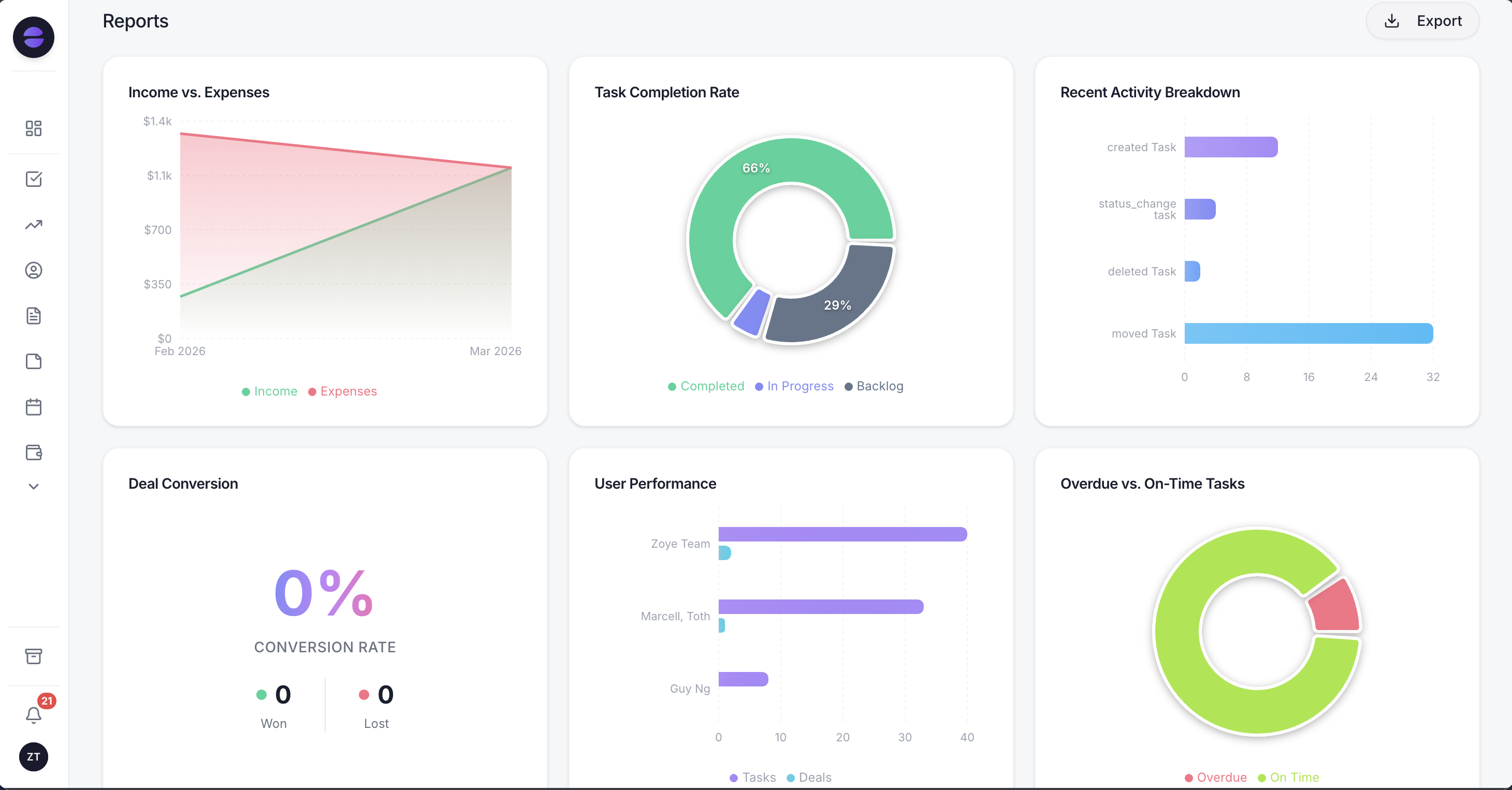
Reports show how leads and deals move after each conversation, so you can judge a channel by results instead of guesses.
What Zoye does today. Zoye runs on the official WhatsApp Business Platform. Today Zoye holds WhatsApp conversations with your leads: a new-lead message with per-source switches and one message per person, a qualification bot that writes answers straight into CRM fields, live audiences, scheduled broadcasts with merge fields and pacing, and template approval handled for you. All six WhatsApp automations are off by default and confirm before sending. Those conversations land in Chats, one inbox with your Instagram and Facebook messages and comments, where your team assigns chats, leaves notes for each other and uses quick replies, and every conversation is saved on the contact's card. Connecting your own business WhatsApp number is coming soon.
Compliance built in. First messages, and anything sent more than 24 hours after the customer's last reply, use an approved template automatically. Every outbound message carries an opt-out, STOP is honoured across the workspace, and nobody gets the same message twice. If Meta rejects a send, you are told why.
One record for the decision. Because every chat sits on the contact card next to deals, tasks and invoices, you can store the preferred channel and consent on the record and see in reports which leads converted. If you also text customers, keep SMS in your SMS provider and the customer record in Zoye.
Pricing: Almost Free is $5 a month, or $4 a month billed annually, for 1 team member with 1GB, the core tools, 15 AI prompts a month and Google integrations, without automations. Starter is $29 ($23 annually) for 10 members and 5GB, Growth $59 ($47) for 20 members and 10GB, and Scale $119 ($95) for 100 members and 25GB. Customize is quoted. See pricing for what each plan includes.
Best for: small teams whose customers already use WhatsApp and who want every conversation tied to the lead, deal or booking it belongs to.
Choose by audience, not by hype
WhatsApp is not "the new SMS" everywhere, and SMS is not dead anywhere. Look at your customers' country codes, ask them which channel they prefer, and match each message type to the channel that gets the job done.
A good first week looks like this: count your customers by country, add a preferred-channel field, check your consent records for both channels, and pick one message to test on WhatsApp against SMS. After a month, you will have your own numbers instead of someone else's averages.
See pricing for the plan that fits, and let every WhatsApp conversation with a lead land on the record where the next step happens.