Voice Notes to CRM: How Spoken Updates Keep Customer Records Current
There is a specific moment where most customer data is lost, and it is not a moment anyone designs for. It is the ninety seconds after a conversation ends. The client has walked back inside, the van door is still open, the next appointment is in eleven minutes, and the thing that was just agreed exists in exactly one place: someone's short-term memory. By the evening it has decayed into a rough gist. By the next morning the number has gone, the date has gone, and what is left is "they seemed keen".
This is the last mile of business data, and it fails for a reason that has nothing to do with discipline. The people who hold the most valuable information are the ones least able to sit down and type it. Between meetings, in a car, on a site, in a stairwell, at an airport gate. The system of record is designed for a desk, and the truth is generated somewhere else entirely. Every guide about keeping a CRM up to date is really a guide about closing that gap.
Voice is the obvious closer, because speaking is the one input method that works while your hands and eyes are busy with something else. But "just talk to your CRM" is a demo, not a system. This piece is about what actually happens between a spoken sentence and a saved record, what the process reliably gets wrong, why the fix is a confirmation step rather than a better transcription model, and what changes in a business when an update costs eight seconds instead of eight minutes.
Why the last mile is where records die
It is worth being precise about the failure, because it is usually described as laziness and it is not.
A customer record has a half-life. The moment a conversation ends it is at its most accurate and most detailed, and it degrades quickly from there. The specific figure discussed, the objection raised, the name of the person who will actually sign, the date they said they would be back from leave: all of it is sharp for a few minutes and blurry within hours. Capture is a race against that decay.
The problem is that the capture window and the typing window almost never overlap. Typing requires a stable surface, two hands, attention, and usually a network connection. The capture window happens in exactly the environments where none of those are available. So the update gets deferred to the end of the day, which is the point at which it competes with invoicing, family, and exhaustion, and loses.
What follows is the familiar spiral. A few missed updates make the pipeline slightly wrong. A slightly wrong pipeline stops being worth checking. A system nobody checks stops getting fed at all, and now it is another piece of software you bought and stopped using. Nobody made a decision to abandon it. The record simply lost a race against a schedule, over and over, until it was too far behind to catch up.
The interesting consequence is that the size of the capture cost matters far more than the quality of the software around it. A CRM with a mediocre feature set and a five-second capture path will hold more truth than an excellent one with a five-minute path, because it is the only one that gets used at the moment the truth exists.
What actually happens between the voice note and the record
"Voice CRM" gets sold as one feature. It is really four distinct stages, and knowing where each one can fail is the difference between trusting it and being burned by it.
1. Transcription: audio becomes text
The first stage converts what you said into words. Modern speech recognition is very good at this for ordinary conversational sentences, in clear conditions, in the speaker's first language. It is markedly less good the moment any of those conditions break, which is covered in detail below.
The important thing to understand is that transcription has no idea what it is transcribing. It does not know that a particular sound is a company name rather than an ordinary noun, so it will confidently produce whichever ordinary noun is more common in general speech. It is optimising for plausible English, not for your customer list.
2. Intent: text becomes meaning
This is the stage that people underestimate, and it is the one that actually creates value. A paragraph of transcribed text is not a record. Something has to read it and work out what it refers to and what should change.
That means resolving "them" and "the job" and "the usual price" against real entities in your workspace. It means recognising that "Wednesday" is a date, and which Wednesday. It means noticing that a sentence about a person who is not in your contacts is probably a request to create one. It means separating the part that is a note from the part that is an instruction, because "he was annoyed about the delay" is history and "send him the revised quote tomorrow" is a commitment.
A system that skips this stage and simply attaches the transcript to a record has not saved you anything. You still have to read it later and do the work, except now the work is buried in an audio file's text dump rather than sitting on a task list.
3. Action: meaning becomes changes to live data
Stage three is where the intent is executed against your actual records: the contact created, the deal moved, the note attached, the task scheduled with a real due date on a real calendar.
The critical property here is that it runs against live data, not against a model's recollection. If you ask what was agreed with a customer last month, the answer has to be read from the record at the moment you ask. An assistant that answers from memory will occasionally produce a fluent, confident, entirely invented figure, and a confident wrong number is more dangerous than no answer at all, because people act on it.
4. Confirmation: changes become visible
The final stage shows you what was understood and what was done, in a form you can check in a couple of seconds and correct in one message. Three contacts were not created; one was. The follow-up went on Wednesday the 20th, not the 13th. The figure recorded was the one you actually said.
This is the stage most often cut, because it makes the demo less magical. It is also the stage that makes the whole thing usable in real life, for reasons worth spelling out.
Want to see it in action?
Watch how Zoye automates your daily workflow - from lead management to team collaboration.
See How It WorksWhat voice reliably gets wrong
Being honest about the failure modes is the only way to design around them. Four categories cover almost everything.
Proper names. This is the largest single source of error, and it gets worse the less common the name is. Surnames, company names, product names, street names, and anything from a language other than the one being spoken are all much more likely to be transcribed as some phonetically adjacent ordinary word. The system is guessing at plausible language, and your customer's surname is by definition not the most plausible thing to appear in that slot. Ironically, the more distinctive and memorable your client's business name is, the more likely a transcript is to mangle it.
Numbers. Prices, quantities, dates, phone numbers, reference codes. Two problems compound here. Spoken numbers are ambiguous in ways written ones are not, and a single-token error changes the meaning completely rather than slightly. A wrong word in a note is noise. A wrong digit in a quoted price is a commercial problem that surfaces weeks later in a conversation nobody enjoys.
Background noise. The environments where voice capture is most useful are exactly the environments where audio is worst: a moving vehicle, a busy site, a street, a room with three other conversations in it. Wind on a phone microphone is particularly destructive. This is not a solvable inconvenience; it is a permanent property of doing this work in the field.
Accents, code-switching and multilingual speech. Recognition accuracy is not uniform across accents, and it degrades further when a speaker switches languages mid-sentence, which is completely normal in a lot of markets. A sentence that mixes English business vocabulary into another language, or drops a client's name from a third one, is a hard case even for good models.
Several requests in one note. A useful voice note is usually a recap: what happened, what changed, what happens next. That is three or four separate operations delivered in one unstructured stream, often out of order, sometimes with a detail attached to the wrong subject. The risk is not that the system misses a request, it is that it attaches the right instruction to the wrong record, which is the error class hardest to spot later.
Notice what is not on this list. The general narrative of a conversation, the sentiment, the sequence of what was discussed: these transcribe well. Voice is strong at the prose and weak at the specifics. That asymmetry is what the design has to respond to.
Why the fix is a confirmation step, not better transcription
The instinctive response to the list above is to wait for the technology to improve. It will, incrementally. It will not solve the problem, for three reasons.
The errors that matter are concentrated, not spread. If a system is right about most of what you say, the residual errors sit almost entirely in names and numbers, because those are the tokens with the least contextual redundancy. Ordinary sentences have enough surrounding structure to be self-correcting. A price does not. So the error rate that matters barely improves in step with the headline error rate.
Some of the loss happens before the model. Wind, a passing lorry, a hand over the microphone, a word swallowed halfway through. The information was not captured, so no amount of processing recovers it. A better model produces a more confident guess at the missing word, which is arguably worse.
Confidence is not calibrated to importance. A transcription system does not know that this particular number is the thing the entire deal depends on. It renders it with exactly the same certainty as the word "and". Nothing in the pipeline can tell you which of its outputs deserve scrutiny.
A confirmation step answers all three at once, and it is cheap in a way that is easy to underestimate. Reading back four short items, "created this contact, logged this note against this deal, moved it to this stage, set this task for this date", takes about two seconds to scan. Fixing one of them takes one more message. Meanwhile the ninety percent that was correct is not slowed down at all, because you are checking rather than typing.
There is a second reason confirmation matters, and it is about trust rather than accuracy. People do not adopt tools they have to worry about. If a voice note might silently do something wrong to your customer records, you will start hedging: sending shorter notes, avoiding the important ones, checking the app afterwards. The checking is the cost you were trying to remove. Visible confirmation is what lets someone send a note while walking and genuinely stop thinking about it.
The same logic applies with more force to anything destructive or wide-reaching. Creating a task from a misheard sentence is a minor annoyance. Deleting or bulk-updating records from one is not, which is why anything irreversible should be read back and explicitly approved before it happens, without exception, regardless of how clear the audio was.
See what Zoye can do for you
From CRM and deal tracking to AI-powered task management - explore everything Zoye offers in one workspace.
Explore FeaturesWhere voice is simply the wrong tool
An honest treatment has to include the cases where you should not use it, because the failure mode of an over-sold input method is that people stop trusting the good parts too.
Long lists of figures. A quote with eleven line items, a stock count, a set of measurements, a batch of reference numbers. Speech is linear and unstructured, has no columns, and offers no way to glance back at item four while you are saying item nine. This is the worst possible payload for voice and the best possible payload for a photograph of the piece of paper it is already written on, or a spreadsheet.
Anything you would want to re-read before sending. A sensitive message to an unhappy customer, a contract clause, a formal commitment. If the wording matters, write it.
Precise identifiers. Email addresses, domain names, IBANs, VAT numbers, part codes. These have no linguistic redundancy at all, which is exactly what makes them useless to dictate.
Structured configuration. Setting up permissions, mapping import fields, building a complex automation. These want a screen and an undo history. Approving something an assistant has drafted is a different matter and works fine in a message.
The rule that survives contact with reality: use voice for the narrative and the intent, use typing or a photo for the data. "We agreed to move ahead, they want it before the end of the month, send the revised quote" is perfect voice material. The revised quote itself is not.
The eight-second effect
Here is where it gets more interesting than a convenience feature.
The value of a CRM is not linear in how complete it is. It is closer to a step function. Below a certain freshness threshold the records are treated as a rough guide, which means every real decision gets made by asking a person instead, and the system's actual function becomes storage rather than truth. Above that threshold it becomes the thing people check first, and a whole set of behaviours become possible that were not before.
Which side of the threshold you land on is decided by the per-update cost, because that cost is paid dozens of times a week by people under time pressure. At eight minutes, an update happens when someone has decided it is important enough to justify a session at a desk, which means the boring three quarters of your customer activity never gets recorded. At eight seconds, it happens by default, because deferring it is more effort than doing it.
The compounding shows up in ordinary places rather than dramatic ones. A pipeline number that is worth quoting in a meeting without caveating it. A colleague picking up a client without a handover call, because the last four interactions are actually on the record. A follow-up that happens because it became a dated task in the car park rather than an intention. A quiet deal surfacing while it is still recoverable, because the system knows the last contact was three weeks ago rather than guessing.
None of these are voice features. They are all consequences of the record being true, and the record is true because updating it stopped requiring a decision. That is the whole argument for taking the last mile seriously, and it explains why a small reduction in capture friction produces a change in behaviour out of proportion to the size of the improvement.
How Zoye handles a voice note
Zoye's agent on WhatsApp is built around exactly this path, and it is the same assistant as the one in the web app, with the same tools and the same permissions rather than a reduced mobile version.
You send a voice note the way you would send one to a colleague. It is transcribed and acted on rather than filed as an audio attachment nobody plays back. A single note can carry several requests, so a recap that creates a contact, logs what was discussed, moves a deal and sets a follow-up is handled as one message. The assistant can create and update contacts, companies, leads, deals, tasks, meetings, notes, documents and invoices, and it can answer questions from live data, so "how much is in the pipeline this month" or "who has gone quiet" is read from the records at the moment you ask.
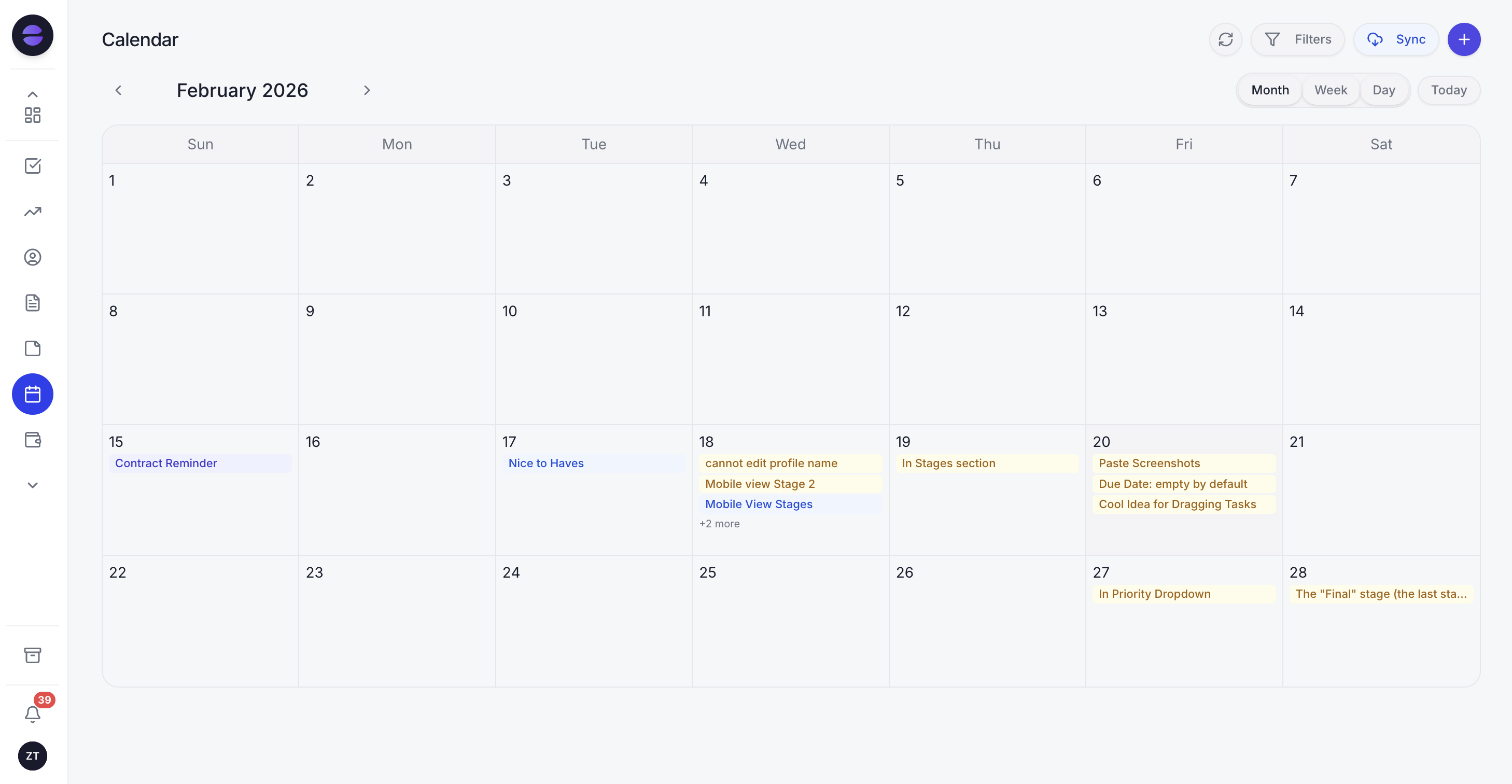 A follow-up dictated in a car park arrives as a dated item on the calendar, not as a sentence somebody has to read and act on later.
Anything destructive or bulk asks for confirmation before it runs, which is the guardrail that turns voice input from nerve-wracking into routine. Files work alongside speech for the cases where dictation is the wrong tool: a photo of a business card becomes a contact, and a PDF or a spreadsheet becomes records, which covers the list-of-figures problem without asking anyone to read numbers aloud.
Because every record in the workspace is already linked, a deal knows its contact, its tasks, its files and its invoices, one spoken update lands correctly in several places at once with nobody reconciling anything afterwards. And because there is no app to install, the people who never adopted the old system, the technician, the part-time bookkeeper, the associate who started last month, can contribute to the record from day one. Nobody needs training to send a voice note.
The honest boundary: Zoye does not pretend a phone is a laptop. Heavy configuration, careful reporting and bulk cleanup still belong on a big screen. What the spoken channel is for is the part that decays if it waits.
Getting it to actually stick
Three habits separate teams where this works from teams where it is a novelty for a fortnight.
Say the name first, then the update. Leading with the customer or deal gives the intent stage an anchor for everything that follows, and it makes a mis-resolution obvious in the confirmation rather than subtle. "Riverside job: they want the revised quote by Friday" is more reliable than the same information in reverse order.
Say dates as dates. "Wednesday the twentieth" survives transcription better than "the day after tomorrow", and it removes an entire class of off-by-one error that is genuinely hard to notice in a read-back.
Actually read the confirmation once. Not forever, but for the first week or two, until you have a feel for what the system gets right and what it fumbles with your particular customer names. Most people find the failure modes are narrow and predictable, and adjust their phrasing without thinking about it after that.
One more, for teams rather than individuals: agree that the voice note is the record, not a message to a colleague who will then type it in. The moment a human transcription step is reintroduced, the eight seconds becomes eight minutes again, just paid by someone else.
Ready to streamline your business?
Zoye brings AI-powered CRM, task management, and automation into one workspace.
Get StartedThe point of all this
Nobody wants to talk to their software. What people want is for the thing they just learned to be somewhere other than their own head before it fades, and for that to cost so little that it is not a decision.
Voice is the closest thing to that, not because speaking is pleasant but because it fits the geometry of the moment: hands busy, no surface, ninety seconds, one bar of signal. It is bad at precision and good at narrative, which is a fine trade as long as the system is designed around that shape rather than pretending otherwise, and as long as it shows you what it understood before you walk away.
Do that, and the record stops being a thing people maintain and starts being a by-product of the work. That is what a current CRM actually is: not a better database, just one that nobody had to make time for.
Try Zoye and send it a voice note about your next call. The entry plan is Almost Free at $5 per month, and the full range is on the pricing page.
For more context, see CRM without data entry, mobile CRM for small business, the best WhatsApp CRMs, and the rest of the Zoye blog.