Mobile CRM for Small Business: What Actually Has to Work on a Phone
The gap between where small business work happens and where the CRM lives is mostly a gap between a phone and a desk. The call happens in a car park. The site visit happens on someone else's premises. The referral arrives as a voice note at nine in the evening. The quote gets discussed at a coffee shop. Almost none of it happens in front of the twenty-seven-inch monitor where the CRM was designed to be used.
So the record gets written later, or in practice, it does not get written at all. Not because the owner is lazy, but because by the time there is a laptop open, the day has moved on and the detail has gone fuzzy. This is the single biggest reason small business CRMs drift out of date, and it is a mobile problem long before it is a software-selection problem.
This guide is about what a mobile CRM for small business actually has to get right. Not the feature grid, which every vendor wins on paper, but the three jobs that genuinely have to work on a phone, the jobs a phone will never be good at, and the argument that is quietly reshaping the category: that the best mobile CRM might not be an app you install at all, but the messaging app that is already open.
Why most CRM mobile apps are unusable in the field
There is a specific reason mobile CRM apps feel bad, and it is not laziness on the vendor's part. It is inheritance.
The form was designed for a big screen. A desktop contact record has thirty fields laid out in three columns, and you scan the whole thing in one glance. Squeeze that onto a phone and it becomes a vertical scroll with thirty labelled boxes. Nothing has been removed, so nothing is faster. The mobile app is the desktop app with a smaller viewport and a hamburger menu.
Everything costs a tap. On a laptop, moving between fields is a keystroke you do not notice. On a phone, every field is a tap, a keyboard appearing, a keyboard dismissing, a scroll to find the next thing, and a date picker that wants you to spin a wheel. A note that takes twenty seconds to type at a desk takes a minute and a half standing in a doorway, and the difference between twenty seconds and ninety is the difference between doing it and not.
The load time lands on the wrong network. Field work happens on one bar of mobile data in a basement, a lift, or a rural road. An app that assumes a stable connection either spins or, worse, silently loses what you typed. Once a CRM has eaten one update, a user never fully trusts it again.
Read paths are optimised for browsing, not for the ninety seconds before a meeting. What you need outside a client's office is a compressed answer: who is this, what did we last agree, what is outstanding, what am I supposed to be asking for. What most mobile apps give you is the same navigation tree as the desktop, three levels deep, so you arrive at the meeting still swiping.
Approval and admin flows assume a desk. Changing a permission, fixing an import, adjusting an automation, editing a template: all of these are genuinely fiddly on a phone, and vendors often ship them anyway, which pads the feature list without improving the experience.
Put these together and you get the familiar pattern. The mobile app gets installed during onboarding, used enthusiastically for a fortnight, then relegated to a lookup tool, and finally to an icon on the third home screen. The desktop CRM stays the system of record, and the field work stays outside it.
If you want the fuller version of that failure mode, we wrote about why owners quietly abandon their systems in the easiest CRM for small business. The mobile version of the story is just the same story with less patience.
The three jobs a mobile CRM has to do
Almost everything a CRM can do is irrelevant on a phone. Three things are not. If a tool nails these three and does nothing else well on mobile, it is a good mobile CRM. If it does forty things adequately and misses one of these, it is not.
1. Log the call you just had, while you still remember it
This is the whole ballgame. The value of a customer record is a function of how fresh it is, and freshness is a function of how little effort capture costs in the two minutes after a conversation ends.
What "good" looks like: from a locked phone to a saved note attached to the right contact, with a follow-up date, in under thirty seconds, without a network round trip you have to wait on. What it usually looks like: unlock, open app, wait, search contact, tap contact, tap activity tab, tap add note, tap into the field, type, scroll, find the date control, spin the wheel, save, hope.
Voice matters enormously here, and not as a gimmick. Speaking a forty-word summary takes about fifteen seconds and can be done while walking to the car. Typing the same forty words takes over a minute and cannot be done while walking anywhere safely. Any mobile CRM that cannot accept spoken input is asking for the slowest possible version of its most important job.
2. Check the state of things in the ninety seconds before you walk in
The second job is read, not write, and it has a hard time budget: the walk from the car to the door.
What you need in that window is not the record. It is the answer. Who am I meeting, what did we last agree, what is outstanding on their side, what is outstanding on mine, what is this deal worth and how long has it been sitting. On a desktop you assemble that yourself from four tabs in a few seconds because everything is visible at once. On a phone, assembling it from four screens takes longer than the walk.
The same applies to the pipeline view. "What is closing this month and what has gone quiet" is a question an owner asks constantly, and it is a genuinely reasonable thing to want on a phone, as long as the answer arrives as a summary rather than as a spreadsheet you have to pinch and pan around.
3. Move a deal forward
The third job is the small, decisive action taken in the moment: change the stage, set the next step, book the follow-up, assign the task to whoever is doing the work, send the quote you promised in the meeting.
These are the actions most likely to be deferred, and deferral is expensive. A deal that stalls does not usually stall because someone decided against it. It stalls because the next step was never set, and nothing was scheduled to make anyone look at it again. A phone is the right place to close that gap because it is the device that is present at the exact moment the next step is agreed.
Want to see it in action?
Watch how Zoye automates your daily workflow - from lead management to team collaboration.
See How It WorksWhat a phone is genuinely bad at, and pretending otherwise helps nobody
An honest mobile CRM guide has to include the other half of the argument, because the vendors who promise "full functionality on mobile" are selling a worse product, not a better one.
Bulk work. Reassigning forty leads, merging duplicates after an import, tidying up field values across a segment, cleaning tags. All of this is precise, repetitive, multi-select work, and multi-select on a touchscreen is a bad idea. It is also the work where a mistake is expensive and hard to see, because you cannot survey what you just changed.
Reporting you actually read. A chart on a phone can tell you a direction. It cannot support the kind of reading where you compare this quarter to last, notice one channel behaving oddly, and drill into why. Skim on the phone, analyse on a laptop. A weekly summary delivered as a few sentences is far more useful on mobile than a dashboard shrunk to fit.
Building things. Designing an automation, mapping import fields, setting up permissions, writing a message template you will use a thousand times. These deserve a big screen and an undo history. Approving an automation someone else drafted, or that an assistant drafted for you, is different, and is perfectly reasonable on a phone.
Long-form writing. A proposal is not a mobile task. A three-line follow-up is.
The rule of thumb worth adopting: capture and decide on the phone, configure and analyse at the desk. A tool that makes capture excellent and is relaxed about the rest will get used. A tool that ports every screen to mobile will get abandoned on both.
The chat-as-interface argument
Here is the observation that reframes the whole category. The one app that is genuinely, reliably usable on a phone for everyone, including the least technical person on your team, is the messaging app. It works on one bar. It handles voice notes natively. It requires no training. It is already open.
So instead of asking how to squeeze a CRM into a phone-sized screen, ask a different question: what if the interface were a conversation, and the CRM sat behind it?
In that model you do not navigate to a record. You say what happened. "Just finished with the Riverside job, they want the revised quote by Friday, set me a reminder Wednesday morning." There is no form, no field, no stage picker, no date wheel. The structure that a CRM needs, the contact, the deal, the task, the date, is derived from the sentence rather than typed into boxes. Capture stops being data entry and becomes something closer to telling a colleague.
The same holds for the read side. "What is the state of the Riverside deal" is a faster question than four taps, and the reply can be shaped to be read in a doorway rather than studied at a desk.
Three things have to be true for this to be more than a demo, and they are the questions to ask any vendor selling it:
It has to act on live data, not remember. An assistant that answers from a stale snapshot or an approximation is worse than no assistant, because a confident wrong number gets acted on. The answer has to be read from the actual records at the moment you ask.
It has to confirm before anything destructive or bulky. Voice input in a noisy car park will occasionally mishear a name or a figure. That is tolerable when the system reads back what it is about to do for anything irreversible or wide-reaching, and intolerable when it just does it.
It cannot be a cut-down edition. If the chat interface can create a contact but not move a deal, or can log a note but not answer a question about the pipeline, you are back to carrying two systems and choosing between them under time pressure.
Where this genuinely changes behaviour is with the people who never adopted the CRM in the first place: the installer, the field technician, the part-time bookkeeper, the associate who joined last month. Nobody needs to be trained to send a message.
See what Zoye can do for you
From CRM and deal tracking to AI-powered task management - explore everything Zoye offers in one workspace.
Explore FeaturesHow Zoye handles the phone
Zoye's approach to mobile is the chat-as-interface argument taken seriously. The agent on WhatsApp is the same assistant as the one in the web app, with the same tools and the same permissions. It is not a lightweight companion edition with a subset of features.
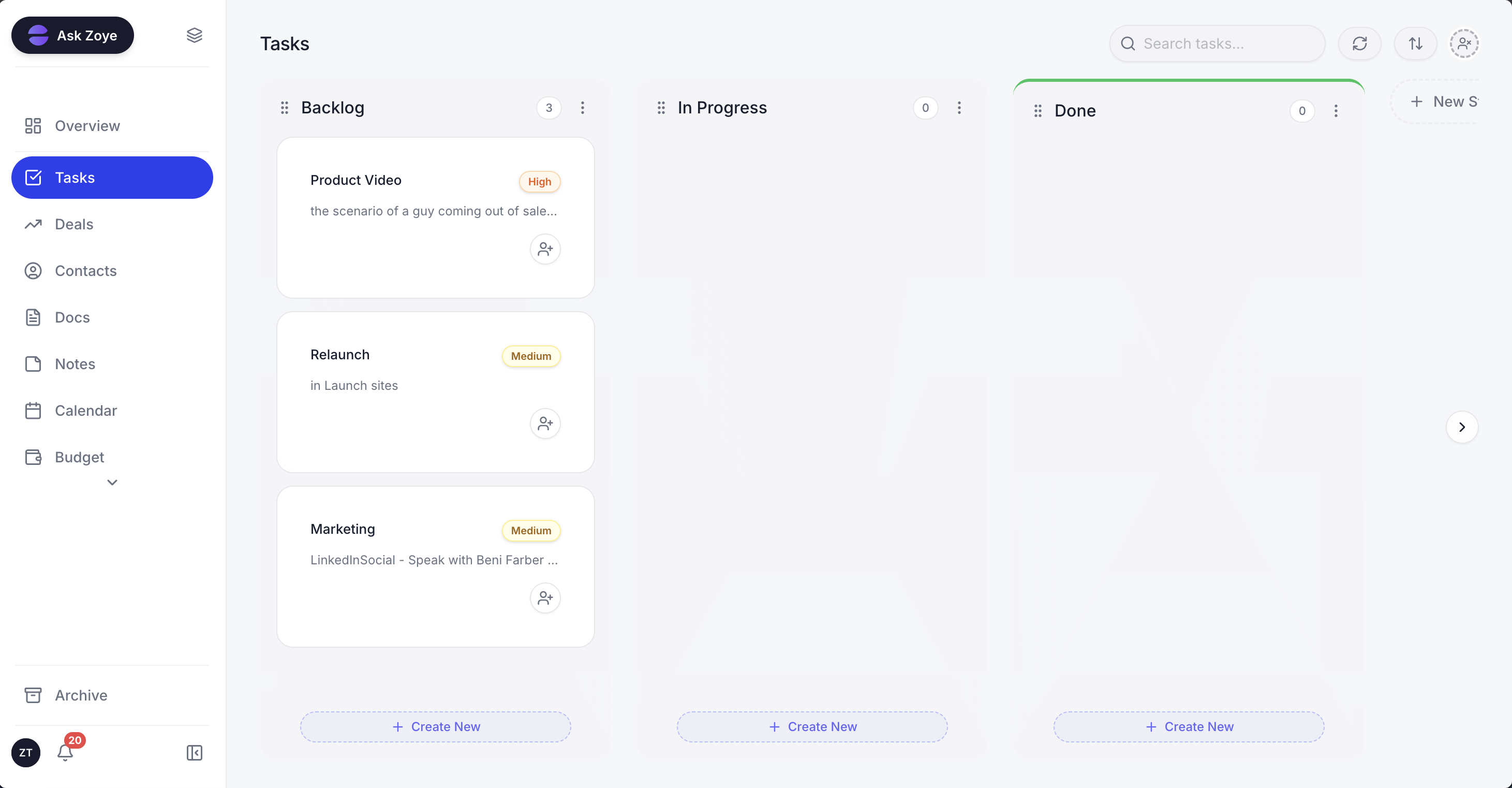 The work you capture from a phone lands in the same board the rest of the team is looking at, no separate mobile silo.
In practice that means the three jobs are handled without opening an app. You can message or send a voice note to create and update contacts, companies, leads, deals, tasks, meetings, notes, documents and invoices. You can ask for real figures from live data: what the pipeline looks like, who is overdue, what is on this week, what a given customer's history is. A voice note can carry several requests at once, and it gets transcribed and acted on rather than filed as an audio attachment nobody plays back. Photos and files work too, so a business card photographed at an event becomes a contact, and a PDF or spreadsheet sent from a phone becomes records.
Anything destructive or bulk asks for confirmation before it runs, which is the guardrail that makes voice input safe rather than nerve-wracking. Nothing has to be installed, which quietly solves the onboarding problem for everyone who was never going to install anything.
The same assistant is reachable in the web app, in Slack, and through the Claude connector, so the phone is one door into the workspace rather than a parallel universe. And because every record in Zoye is already linked to the others, a deal knows its contact, its tasks, its files and its invoices, an update captured in thirty seconds from a car park lands in the right place in all of them at once, without anyone reconciling anything later.
The honest boundary: the heavy configuration work still belongs on a laptop, and Zoye does not pretend otherwise. Building out a workspace, mapping an import, and reading a report carefully are desk activities. What the phone gets is the part that decays if it waits.
If your customer conversations mostly happen in messaging already, the companion piece on the best WhatsApp CRMs covers that side of the category in more depth.
A short evaluation drill for any mobile CRM
Feature lists will not tell you which tool survives the field. Two timed exercises will, and both take five minutes on a trial account.
The capture drill. Go outside. Use mobile data, not office wifi. Pretend you have just finished a call and log it: a two-line note, attached to the right customer, with a follow-up date next Tuesday. Time it from unlocking the phone to seeing it saved. Under thirty seconds and you will keep doing it. Over a minute and you will stop within a month, whatever you intend today.
The pre-meeting drill. Pick a customer you have some history with. Give yourself ninety seconds to answer four questions from the phone alone: what did we last agree, what is outstanding, what is the deal worth, and how long has it been sitting. If you cannot get all four in the walk from a car park, the read side is not ready for the field.
Then three questions for the vendor. Does it work when the connection is poor, and does it hold what I typed if it drops. Can I do this by speaking rather than typing. And does everything I can do on the phone stay in the same records everyone else is working from, or is mobile its own island.
Why small business owners end up here
The pattern that repeats is not a preference for one interface over another. It is that the record only stays true if updating it costs almost nothing at the moment the truth changes, and that moment is nearly always mobile.
The tools that lose are the ones asking an owner standing in a doorway to interact with a form built for a desk. The tools that win are the ones that let the update arrive in whatever form the moment allows: a sentence, a voice note, a photo. The rest, the structure, the linking, the follow-up, is the system's job, not the owner's.
That is the case for treating chat as the mobile interface rather than as a side channel, and for being blunt about the fact that a phone is a poor place for bulk work and careful analysis. A mobile CRM that is excellent at capture and honest about its limits will be current in six months. One that ports every desktop screen to a small screen will be accurate for about a fortnight.
Try Zoye and run the capture drill on your own customers. The entry plan is Almost Free at $5 per month, and the full range is on the pricing page.
Ready to streamline your business?
Zoye brings AI-powered CRM, task management, and automation into one workspace.
Get StartedFor more context, see the easiest CRM for small business, the best WhatsApp CRMs, the best CRM for small business, and the rest of the Zoye blog.