Instagram Comment to DM Automation: How It Really Works in 2026
You have seen the post. A carousel about pricing, or a reel about a service, and at the end a line that says "comment PRICE and I will send it over". Under the post sit four hundred comments, all saying PRICE, and every one of those people got a direct message within a few seconds.
It looks like a trick. It is not. It is a documented feature of Meta's Instagram Messaging API called a private reply, and the reason it works has almost nothing to do with cleverness and almost everything to do with where the conversation ends up. A link in a caption asks someone to leave Instagram. A comment asks them to type six letters and stay exactly where they are. One of those is a much smaller favour to ask.
What follows is how the mechanic actually functions, what Meta's rules genuinely permit as of August 2026, how to write the public reply and the private message so the pattern does not feel robotic, and the piece that almost nobody builds: the commenter turning into a real contact, so that when the same person comments on a different post next month, you recognise them instead of starting over. This article sits under our Facebook and Instagram automations page, which covers the wider set of Meta automations Zoye handles.
Why "comment PRICE" beats "link in bio"
The comparison people usually make is open rate. Direct messages get read; email frequently does not. That is true, and it is also the least interesting part of the explanation.
The real reason is friction and context. Asking someone to visit a link in your bio is a four step request: leave the post, tap the profile, find the link, then land on a page that has to re-explain everything they just watched. Every one of those steps loses people, and the ones who survive arrive cold, on a page with no memory of which reel sent them.
Asking for a comment is a one step request performed with a thumb that is already on the screen. It costs the reader nothing, it happens inside the app they chose to be in, and the reply arrives in a place where a conversation is the normal next move. Nobody has ever replied to a landing page.
There is a second effect worth naming honestly, because it is the one that gets over-claimed. Comments are a public engagement signal, and a post with a lot of comments tends to travel further. That is real, but it is not free reach and it is not a growth hack. Meta's own guidance on engagement bait says posts that explicitly ask for comments, shares or reactions for the sake of engagement can have their distribution reduced, with a carve-out for a specific call to action. Asking people to comment a word so you can send them the thing you promised is a specific call to action. Asking people to comment for no reason other than to inflate the count is the thing that gets demoted. Keep your asks in the first category and you have nothing to worry about. Lean on the second and the platform will quietly take back the reach you thought you had won.
What Instagram actually permits, as of August 2026
This is the part where most guides get vague, and where being wrong costs you a working automation. Everything in this section comes from Meta's own Instagram Platform and messaging policy documentation, checked in August 2026. Meta revises these rules regularly, so treat the dates as load-bearing.
You must be on a professional account. The Instagram Messaging API works only with Business or Creator accounts, and message access for connected tools has to be enabled in Instagram's message settings. A personal account cannot send private replies, which is the single most common reason a freshly connected tool sits there doing nothing.
A private reply has a 7 day window. Meta's documentation states that a private reply can be sent within 7 days of the creation time of the comment, for comments on posts, ads posts and reels. Comments on an Instagram Live broadcast are much tighter: the private reply can only be sent while the broadcast is still running. Once the window closes, that comment can no longer open a DM, ever.
You get exactly one message per comment. Meta permits only one private reply to be sent to the person who commented. Not one per day, not one per campaign. One. This single constraint should reshape how you write the message, and we come back to it below.
Where the DM lands depends on whether they follow you. Meta documents that the private reply arrives in the recipient's Inbox if they follow the professional account, and in their message Requests folder if they do not. That second case is important and rarely mentioned: a large share of the strangers your best-performing reel reaches will receive your carefully written message in the folder people check least.
Continuing the conversation requires them to reply first. After your single private reply, you cannot keep messaging. When the person responds, the standard messaging window opens and you have 24 hours to respond freely, promotional content included. Meta's messaging policy allows promotional content inside that 24 hour window.
The human agent tag is not an escape hatch. Meta's policy describes a human agent tag that lets a business respond manually within a 7 day period. It exists for real support situations that a person needs to handle, such as an issue raised over a weekend. It is not a mechanism for extending an automated sequence, and treating it as one is a fast route to losing API access.
Some Messenger features simply do not exist on Instagram. Meta's messaging policy states that Sponsored Messages, One-time Notifications and News messaging are not available for the Instagram Messaging API. If a tool promises you scheduled re-engagement blasts to past Instagram commenters, ask exactly which documented mechanism it uses.
Read together, these rules describe something quite specific. Instagram gives you one very well-timed opening line to a person who has just raised their hand, and then hands the initiative to them. It is not a broadcast channel wearing a disguise.
Want to see it in action?
Watch how Zoye automates your daily workflow - from lead management to team collaboration.
See How It WorksThe public reply plus private DM pattern
The strongest setups do two things at once, and the reason is social rather than technical.
The private message does the work. The public reply does the proof. When someone scrolls the comments and sees four hundred people saying PRICE and no visible response from the account, the natural conclusion is that nothing happens. When each of those comments has a short reply underneath saying "sent, check your DMs", the offer becomes credible to everyone who reads the thread later, including the people who have not commented yet.
A few things to get right in the public half:
Keep it short and vary it. Four hundred identical replies reading "Sent!" look exactly like what they are. Two or three rotating variants, each under six words, read like a person clearing a backlog.
Do not put the offer in the public reply. If the answer is visible under the post, nobody needs the DM, and you have converted a conversation into a broadcast with no way to follow up.
Point at the Requests folder when it matters. For accounts whose reach is mostly non-followers, a public reply of "sent, check your message requests" measurably reduces the number of people who never see the DM at all, because Meta places messages from accounts they do not follow in that folder.
Handle the near misses. Some people will comment "price please", some will comment "prcie", and a few will comment "how much?" without the trigger word at all. A rule that only matches an exact string leaves those people with nothing. Matching on a contained keyword rather than an exact comment, and adding two or three obvious variants, recovers a surprising share of them.
Writing the trigger word and the first DM
Because you get one message, the first DM is not an icebreaker. It is the whole delivery.
Pick a trigger word people can type without thinking. One word, no spaces, no punctuation, six letters or fewer if you can manage it. PRICE, GUIDE, DEMO, LIST. Avoid words that appear naturally in ordinary comments, or you will DM everyone who happens to use the word "info" in a sentence about something else.
Deliver in the first message. Whatever you promised in the post goes in that DM in full: the price range, the link, the PDF, the availability. Sending a message that says "hey! saw your comment, what would you like to know?" wastes the only guaranteed message you have, and it asks the person to do work they did not sign up for.
Then ask exactly one question. The point of the question is to trigger a reply, because their reply is what opens the 24 hour window and turns a broadcast into a conversation. One question, answerable in a few words, tied to what they already asked for. "Is this for a team or just yourself?" outperforms "let me know if you have any questions", which is not a question at all.
Say who you are and how to stop. A line naming the business and a plain way to opt out costs you nothing and prevents the most common report reason, which is a stranger receiving a message they cannot place.
Write it for a phone. Three short paragraphs maximum, no wall of text, no formatting that only renders on desktop.
See what Zoye can do for you
From CRM and deal tracking to AI-powered task management - explore everything Zoye offers in one workspace.
Explore FeaturesThe part almost nobody builds: the commenter becomes a contact
Here is where most comment to DM setups stop, and where the interesting value actually starts.
In a typical stack, the automation lives in a chat tool. A comment fires a flow, the flow sends a DM, and the record of what happened is a conversation thread inside that tool. It works, and for a single campaign it feels complete. The problem shows up on the second campaign.
Someone comments PRICE on your March reel. In April they comment GUIDE on a carousel. In June they comment on a post about a workshop. Three separate flows fired, three separate threads exist, and nothing anywhere in the system knows that these are the same human being who has now raised their hand three times without ever being called. Worse, if the chat tool prices by contact, you may be paying three times to store one person.
The alternative is that the commenter becomes a contact record on first contact, and every later comment is matched back to it. What that changes:
Recognition instead of repetition. The second comment lands on a person you already know, with their previous interest, previous questions and previous owner attached. Your reply can acknowledge history rather than starting from zero.
No duplicates. One person, one record, regardless of how many posts they engage with. This matters more than it sounds, because duplicate contacts are what makes reporting untrustworthy and makes two people follow up on the same lead.
Evidence on the record. Keeping the comment text and the permalink of the comment on the contact means anyone picking up the conversation later can see what the person actually said and which post they said it on. "Commented on the pricing reel" is context; "Instagram lead" is not.
The lead behaves like every other lead. Once the commenter is an ordinary contact, everything you already do for leads applies: owner assignment, a follow-up task, a WhatsApp welcome, inclusion in the right audience, appearing in the pipeline report. The Instagram commenter stops being a special case living in a separate app.
A real answer to attribution. With the post and the comment attached, you can eventually tell which content produces people who buy, rather than which content produces the most comments. Those are frequently different posts.
Where comment to DM goes wrong
Four failure modes account for almost all of the disappointment, and three of them are self-inflicted.
An unanswered DM is worse than no DM. This is the one to take seriously. A person who commented and received nothing simply forgets. A person who received an automated message, replied to it with a real question, and heard nothing back has been actively let down by your business, in a private channel, with the evidence sitting in their phone. Automating the opening line commits you to answering what comes back. If nobody is going to watch that inbox during the campaign, the honest move is to not run the campaign.
The message that stalls. Because you get one private reply, a first DM that does not deliver anything leaves the conversation dependent on a stranger's curiosity. If they do not reply, you have no second attempt. Front-load the value.
The Requests folder gap. Non-followers receive your message in the folder they rarely open. If a campaign's numbers look strange, check the follower composition of the people who commented before you blame the copy.
Volume mistaken for progress. Four hundred comments and four hundred delivered DMs is a satisfying number that says nothing about revenue. The numbers that matter are how many replied, how many became qualified, and how many bought. Comment counts are an input, not an outcome.
There is also a limit worth stating plainly rather than working around. This mechanic reaches people who already saw your content. It does not create demand, it captures it. If a post is not landing with anyone, adding a keyword to the caption changes nothing. Comment to DM is a conversion layer on top of content that already works.
Ready to streamline your business?
Zoye brings AI-powered CRM, task management, and automation into one workspace.
Get StartedA setup checklist you can run this week
Nine steps, in order, and none of them require a developer.
- Switch the Instagram account to Business or Creator if it is not already, and enable message access for connected tools in the message settings.
- Connect the account to the tool that will run the automation, through the official Meta connection rather than a login-and-scrape service.
- Choose one post that already performs, rather than building the mechanic on a post nobody sees.
- Pick one trigger word. Add two or three misspelling and phrasing variants.
- Write the private reply: deliver in full, one question, business name, opt-out line.
- Write three short public reply variants that confirm without revealing.
- Decide where the person lands afterwards. Which contact record, which owner, which follow-up task, within what timeframe.
- Test with your own second account, from a phone, as both a follower and a non-follower, so you see both the Inbox and the Requests behaviour.
- Decide who is watching the inbox for the next 48 hours, and say so out loud to that person.
Step nine is the one that gets skipped and the one that decides whether any of the other eight mattered.
How Zoye handles comment to DM
Zoye is an AI Business Operator: one workspace with thirteen tools that already link to each other, plus an assistant that operates them for you. Facebook and Instagram automation is one of those tools, and it is built around the idea that a commenter is a person, not an event.
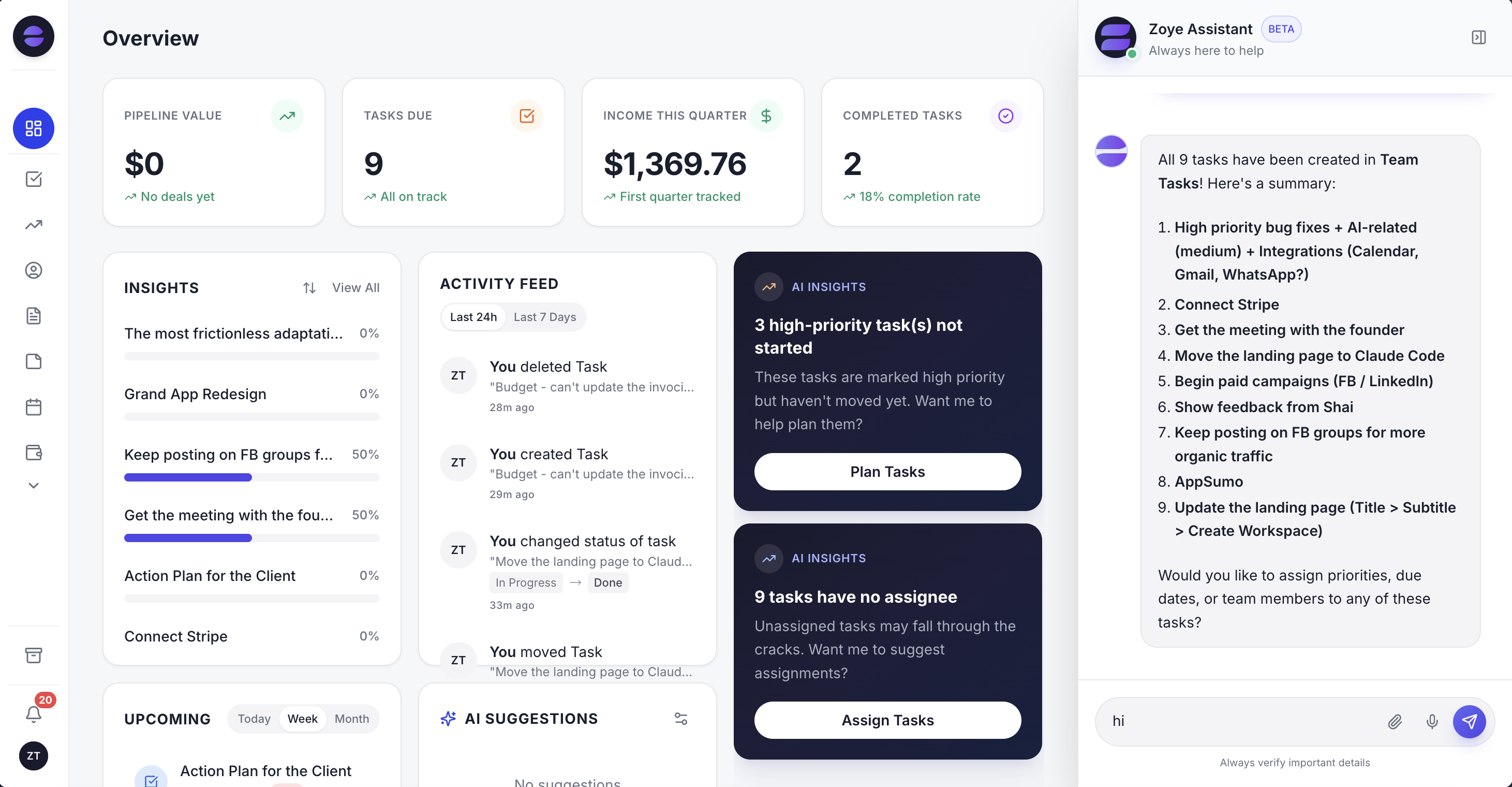
One Page connection covers both Instagram and Facebook, and the commenter lands in the same workspace as everything else you already run.
One Page connection covers both Instagram and Facebook. A rule can fire on a specific keyword, on one post, or on every comment, and it sends the public reply plus the private DM within seconds. Per-Page routing means an agency or a multi-brand operator can send each Page's comments into the right workspace.
The part that differs from a pure chat tool is what happens next. The commenter becomes an ordinary Zoye contact, matched to an existing record if they have engaged before rather than duplicated, with the comment text and its permalink kept on the record. From that point the person is simply a lead: the WhatsApp welcome can fire, the qualifying questions can write their answers onto real fields, an owner can be assigned, a follow-up task can be created, and the person appears in your pipeline reports alongside every other source. Lead ad Instant Form submissions arrive the same way, with campaign and ad names attached, which is covered in more depth in our guide to Facebook lead ads and your CRM.
You describe the rule in a sentence, in the app, on WhatsApp or in Slack. Zoye turns it into a real trigger with conditions and actions, shows you the finished rule in plain English, and nothing runs until you approve it. Every run is logged with what fired and what it sent.
To be straight about the boundaries: Zoye does not run your ads and it will not make a weak post perform. It captures and works the interest your content already produces, and it makes sure that interest becomes something you can follow up next quarter rather than a chat thread you lose.
See what Instagram comments look like when they land as real contacts. Explore Zoye's Facebook and Instagram automations and connect your Page in a few minutes.
For more context, see our guides to Facebook lead ads and your CRM, WhatsApp automation, and how to stop losing leads.