Guesty Alternatives in 2026: The Right Pick for Your Door Count
Most searches for a Guesty alternative do not start with a feature complaint. They start with an invoice. A season went well, the commission line went up with it, and somebody sat down to work out what the platform actually costs per door and could not produce a number they trusted. Others arrive here after a support thread that took four days to reach someone who understood the problem, or after realising that a large share of what they are funding was designed for a company several times their size.
Before the alternatives, the fair part. Guesty is one of the strongest platforms in this category for a reason. Its channel coverage is mature and wide, multi-unit and room-type mapping is handled properly, and it owns more of the stack natively than almost anyone else: accounting with owner-facing reporting, revenue management, CRM-style contact handling, and an operational toolset built for teams rather than for a single person with a laptop. If you run several hundred keys across multiple markets with a finance function in-house, that native breadth removes an entire category of reconciliation work, and paying a percentage for it can be perfectly rational.
The problem is that the same design decisions that make Guesty excellent at three hundred units make it awkward at fifteen. This guide is organised around that observation. Rather than ranking eight products against each other, it sorts them by the size of portfolio they genuinely suit, because the honest answer to "what should I use instead of Guesty" changes completely between a host with three cabins and a management company with forty doors and two staff.
Pricing below is described as published, as quote-only, or as commonly reported by independent reviewers, as of August 2026. Guesty does not publish a straightforward public price list, so any specific figure attached to it anywhere online is a third-party estimate. Verify current numbers on each vendor's own pricing page before you sign.
What actually pushes operators off Guesty
Four triggers come up again and again, and they are worth naming precisely, because each one points at a different replacement.
A bill you cannot forecast. Guesty's model blends a commission on booking revenue with fixed fees, and the mix varies by plan and portfolio. That is not deceptive, and some operators genuinely like the alignment, but it makes budgeting hard in a specific way: to project next year's software cost you have to project next year's bookings, and then accept that beating your forecast makes the bill bigger. A per-listing subscription behaves differently. It moves when you add doors, which is a decision you control.
Cost that scales with success rather than with usage. This is the same mechanism seen from the owner's chair. Push your average nightly rate up by fifteen percent through better photography and smarter pricing, and a revenue-linked fee quietly claims a share of that improvement even though you are not using more software than you were in January. At a thin management margin, that is the part people find hardest to stomach.
Escalation on the hard tickets. Reviews are mixed rather than damning, and plenty of customers are satisfied, but there is a persistent pattern in operator feedback: first-line responses that restate documentation, and a wait for second-line help that feels long when a guest is standing outside a door. Support levels also differ by plan, which is worth pinning down in writing rather than assuming.
Enterprise depth you are funding but not opening. Multiple legal entities, layered permission structures, deep financial reporting modules, complex approval flows. These are real assets to a large operator. At fifteen doors they are unopened tabs, and the onboarding time spent configuring them is time you did not spend signing owners.
There is a fifth frustration that gets blamed on Guesty and is not really its fault. The homeowner you met at a viewing and never called back. The enquiry that landed on Instagram late on a Sunday and got a reply on Monday afternoon, by which point the guest had booked somewhere else. Management agreements living in an email thread. No property management system covers that work, and switching to a different one changes nothing about it. That gap is what a vacation rental CRM exists for, and it gets its own section further down.
The alternatives at a glance
| Tool | Best door count | Pricing model | Its strongest claim | The honest trade-off |
|---|---|---|---|---|
| Smoobu | 1 to 15 | Published plans | Live in an afternoon, European strength | Owner reporting and analytics thin out as you grow |
| Hospitable | 1 to 20 | Published, per listing | Stay-lifecycle messaging done extremely well | Narrower than a full PMS on purpose |
| Beds24 | 1 to 40, if technical | Published, low for the category | Bends further per pound than anything else | Dated interface, nothing is guided |
| Lodgify | 3 to 20 | Published; the cheapest plan adds a per-reservation fee | Fastest route to a real direct booking site | Booking fee bites at volume; lighter management depth |
| OwnerRez | 5 to 40 | Published flat rates, scaling with property count | Owner statements and configurable control, no revenue share | Real learning curve, distinctly US-first |
| Hostfully | 5 to 40 | Published tiers by property count | The best known digital guest guidebooks | Two products in one brand; check the tier for your features |
| Hostaway | 15 to 100 plus | Quote-only, priced on listing count | Automation depth and a huge integration marketplace | No public price, and a one-time onboarding fee is commonly reported |
| Zoye | 5 to 40, alongside a PMS | Flat monthly plans for the whole workspace | Runs the owner pipeline and back office, and chases follow-ups itself | Not a PMS and does not replace one |
Solo hosts and two or three units: you were oversold
If you are managing your own handful of properties and ended up on Guesty, the most likely explanation is that a demo was impressive at a moment when a spreadsheet had just failed you. At this size almost none of Guesty's differentiating strength applies, and the fix is not a smaller enterprise platform. It is a published price and a shorter setup.
Smoobu is the pragmatic European answer. Rates are on a page you can read in under a minute, setup is an afternoon rather than a project, and the things that must work do work: two-way channel synchronisation, one combined calendar, guest messaging, a guest guide and a serviceable website builder. It does not pretend to be an enterprise system, which is exactly why people who felt oversold find it a relief. The ceiling is real though. As you start managing homes for other people, its reporting and owner-facing depth run out before OwnerRez or Hostaway would.
Hospitable suits you if the part of Guesty you actually used every day was the messaging. It is built around stay-lifecycle communication: rules across the whole booking arc, review handling, an AI-assisted reply layer, team access, and per-listing pricing published openly. It is deliberately narrower than a property management system, and many operators run it beside a lighter platform precisely because its messaging is easier to configure than a native equivalent. What it will not do is answer somebody who has not booked yet, because a stranger asking about availability has no reservation to attach a rule to.
Beds24 deserves a mention here for the cost-driven and technically confident. It is API-first, configurable to an unusual degree, connects broadly, and costs remarkably little for what it does. In exchange, the interface is dated, the vocabulary is its own, and you learn it by reading documentation rather than following a wizard. If part of why you are leaving Guesty is that you want things simpler, skip it. If the reason is purely price and rigidity, it may be the best value on this page.
Where this group fits: published pricing, quick setup, no percentage of your revenue, and a bill you can predict on a slow month.
Want to see it in action?
Watch how Zoye automates your daily workflow - from lead management to team collaboration.
See How It WorksFive to fifteen doors: the awkward middle, and where Guesty fits worst
This is the size band where the mismatch is sharpest. You are past a spreadsheet and probably managing at least some homes on behalf of owners, so you need owner reporting, task coordination and reliable channel sync. You are nowhere near needing multi-entity accounting or a permissions hierarchy. And on a commission model, every improvement you make to revenue per door raises your software cost without adding a single new capability.
Lodgify is the pick when your growth plan is your own brand. Its site builder puts a presentable, bookable property website live in days, with payment collection and a booking engine, no developer and no agency. For a villa collection, a cabin brand or a boutique portfolio where guests should be booking with you rather than through a listing site, nothing else on this list gets you there as fast. Two caveats. The least expensive plan charges a fee on each reservation, removed by moving up a tier, so compare your genuine reservation count against the tier gap instead of the headline monthly figures. And on pure management depth, particularly running homes for other owners, it is lighter than what you are leaving. There is a fuller treatment in our Hostaway vs Lodgify comparison.
OwnerRez is the most complete answer to the pricing complaint that brought you here. It publishes flat rates that scale with property count, with no share of your revenue anywhere in the model, so you can calculate your annual cost before speaking to a salesperson. Underneath that, it is unusually strong on the things small management companies ask for and rarely get: owner statements, accounting integration, quoting, damage protection, and rule and template configuration exposed at a level most competitors hide. Direct booking sites, hosted or WordPress-based, are part of the picture too. The costs are honest ones. The interface is built for function rather than for a product tour, your first week is a learning week, and it is clearly North America first, so tax handling, payment processing and the integration set are strongest there. It is set against Lodgify directly in Lodgify vs OwnerRez.
Hostfully is worth a look if guest experience is your differentiator. Its digital guidebooks are the best known in the category and genuinely cut the volume of late-evening questions about parking and heating, and the management platform behind them covers the expected ground for a small operator. Be deliberate about which of the two products you are buying, and map the features you need to a specific tier before comparing its price with anybody else's, because plan tiers scale by property count and some capabilities sit higher up.
Where this group fits: you want predictable published costs, real owner-facing output, and a platform sized for the company you are rather than the one a sales deck imagined.
Fifteen to forty doors: growing, and still not enterprise
Here the requirements get serious. Multiple owners expect statements on time, cleaners need a rota that survives a busy Saturday, and channel sync failures are now a commercial risk rather than an inconvenience. This is Guesty's lower edge and Hostaway's core market, and it is where most switching decisions in this cluster actually get made.
Hostaway is the usual destination. Its automation is a common reason operators pick it: conditional messaging across the stay, auto-generated cleaning and maintenance tasks on checkout, review handling, and templates scoped per property, with a builder approachable enough that a non-technical owner can maintain it. Channel sync is well regarded for reliability on the major listing sites, and the integration marketplace is genuinely large, so if your market has a niche requirement it probably already connects. Two honest cautions. It is quote-only and demo-gated, priced against your listing count, so you cannot self-serve a budget any more than you could with Guesty. And independent reviewers consistently report a one-time onboarding charge alongside the subscription as of August 2026, which changes first-year maths. What you gain is a bill that tracks doors rather than revenue. Our Guesty vs Hostaway comparison goes through the differences properly, and there is a parallel roundup of Hostaway alternatives if you end up shopping in that direction.
OwnerRez stays relevant at this size for US operators, and for some it is the better answer than Hostaway. If your owners are the demanding part of your business and statements, expenses and revenue splits are what eat your month-end, its owner-facing machinery is stronger than its price suggests. If your bottleneck is instead guest messaging volume and turnover coordination across forty doors, Hostaway's automation is the more direct fix.
Hostfully can carry a portfolio in this band too, and is worth quoting alongside the others if the guest-facing polish matters commercially to you. Just resolve the tier question early.
Where this group fits: operational muscle for a real team, at a cost that moves with door count instead of with your best month.
See what Zoye can do for you
From CRM and deal tracking to AI-powered task management - explore everything Zoye offers in one workspace.
Explore FeaturesPast forty doors: the honest answer is that Guesty may still be right
It would be convenient to claim everyone should leave. That is not true. Once you cross into multi-market operation, several legal entities, mixed property types and an in-house finance function, native accounting and owner reporting inside the same system as the reservations stops being a luxury and starts saving a headcount. At that size the percentage is buying something real.
Two things to do before you either renew or leave. First, get the commission percentage, the fixed components, the onboarding charge and the renewal terms written into a single document, then model them against your projected revenue rather than last year's, because that is where the surprise lives. Second, if the CRM was part of the reason you bought Guesty, test that specific workflow hard rather than accepting the demo. Reviewers frequently describe the built-in CRM as clunky, and it is designed around guests and bookings rather than around prospective homeowners, so it will store an owner contact but will not run an acquisition pipeline the way a sales tool does.
If the answer after that exercise is still Guesty, keep it. Then read the next section, because the gap it leaves is the same one at four hundred doors as at fourteen.
The half of the business no alternative on this list runs
Whichever platform you land on, one part of the company will still be operating out of spreadsheets and memory, because none of these products was built for it.
It is everything that is not attached to a reservation. The homeowners you talked to at a viewing last month, one of whom has already signed with the manager two streets away because nobody rang in week three. The late-night enquiry that got a reply at lunchtime the next day. Management agreements existing in three versions across two inboxes and one laptop. A cleaning rota only one person can open, and owner invoices that go out four days late every single month. There is no booking ID on any of that, so no PMS rule fires for it.
Zoye is built for that half, and the boundary needs saying plainly. Zoye is not a property management system and is not the top item on this list, because it is not competing for the same slot. Nothing inside it talks to a listing site: no Airbnb, Booking.com or Vrbo connection in either direction. It carries no nightly rates and no availability calendar, gives a guest nowhere to book, never opens the OTA message thread, and does no trust accounting against owner payouts. Keep Guesty, Hostaway, Lodgify, OwnerRez, Smoobu, Hostfully or Beds24 for every one of those jobs.
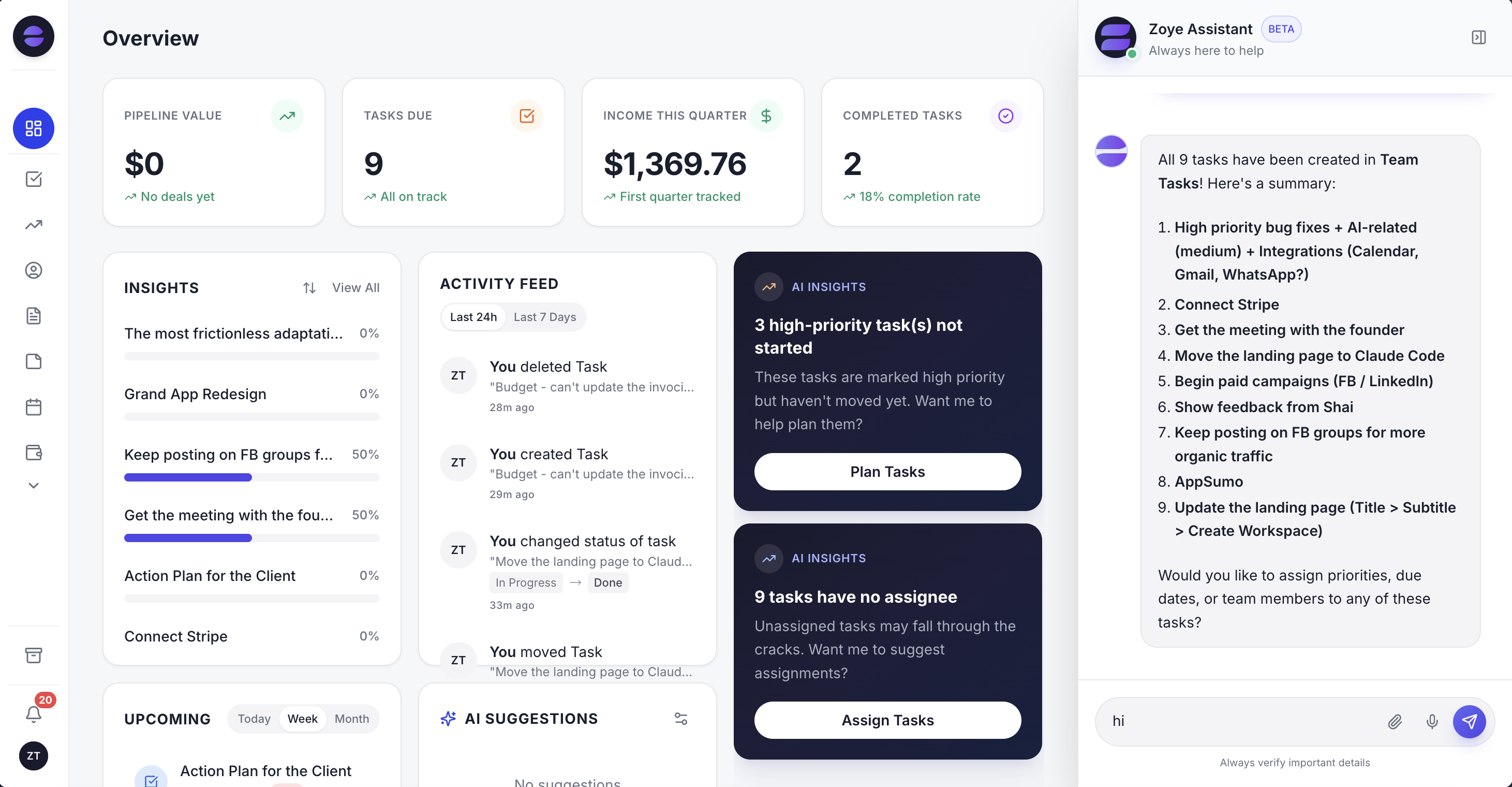 The owner pipeline, enquiry follow-up and back office in one workspace, while your PMS keeps the calendars and the channels
What it does is act rather than store. You instruct it in ordinary language: say that you met an owner with three chalets at a viewing and want a nudge on Thursday, and both the record and the reminder exist without a form. Ask which owner conversations have gone quiet for over ten days, get the list, tell it to message them, and it sends them. An enquiry from a website form, an inbox or WhatsApp arrives as a lead with its source attached, and the follow-up sequence runs on schedule rather than depending on you being at a desk. Since you can drive it from WhatsApp, none of that needs a laptop, which matters when your day is spent inside properties.
Underneath sit the things the spreadsheets were carrying. Management agreements and owner paperwork filed against the owner they belong to. Turnover and maintenance jobs assigned to cleaners, chased automatically, visible as a board or a calendar. Per-property expenses and owner invoicing. Reports you ask for in a sentence instead of rebuilding by hand each month. Plans are flat for the whole workspace rather than per seat, so adding a cleaner or a virtual assistant does not move the bill: $5 per month for 1 member, $59 for 10, $99 for 20, $199 for 100, and a Customize tier for larger portfolios. Current figures are on the pricing page.
Best for: short-term rental managers looking after somewhere between five and forty homes, co-hosting operations, and small villa or chalet brands that have settled the PMS question and now want the owner acquisition and administrative side out of spreadsheets for good.
Commission versus per-door: how to compare the two models
The reason Guesty is hard to benchmark is that you are comparing two different mathematical shapes, and headline numbers will mislead you in both directions. Do this instead, on one page.
Work out your commission cost as a per-door figure. Take last year's booking revenue, apply the percentage from your written quote, add the fixed components, divide by doors. Now you have a number in the same units as everyone else's pricing page.
Model next year, not last year. Add the doors you plan to sign and the rate improvement you are actually working toward. On a revenue-linked model both increases raise the bill. On a per-listing model only the first one does. The gap between those two projections is the real decision.
Price the whole stack, not the PMS line. Dynamic pricing, cleaning operations, guest screening and accounting are part of your true software cost, and platforms differ in how much they cover natively versus through partners billed separately. A cheaper subscription with four integrations behind it is not cheaper. Our breakdown of what a Hostaway stack really costs walks through the arithmetic, and the category map of vacation rental software explains which pieces you genuinely need at your size.
Include the switching cost honestly. Onboarding fees, a month of parallel subscriptions, and roughly two weeks of somebody's attention. If the annual saving is smaller than that, the right move is to renegotiate rather than migrate.
Which alternative fits which operator
| Your situation | The pick | Why |
|---|---|---|
| Two or three of your own units, oversold on Guesty | Smoobu, or Beds24 if you are technical | Published price, quick setup, nothing you are not using |
| Messaging automation was the only part you used | Hospitable | Stay-lifecycle communication done properly, published per-listing rates |
| Direct bookings and brand are the growth story | Lodgify | Fastest route to a bookable website, once the per-reservation fee is modelled |
| US management company, owners expect statements | OwnerRez | Owner statements, accounting and flat published pricing, no revenue share |
| Guest experience is your differentiator | Hostfully | Category-leading guidebooks, with a competent PMS behind them |
| 15 to 40 doors, automation and turnover volume | Hostaway | Deepest automation at this size, priced on doors rather than revenue |
| Multi-market, several entities, in-house finance | Stay on Guesty | Native accounting and owner reporting genuinely earn the percentage |
| Calendars are fine, but no owners are signing | Zoye next to your PMS | The pipeline, follow-up, documents and back office no PMS runs |
Leaving without damaging a season
A migration between property management systems is not technically hard. It is operationally unforgiving, because a mistake surfaces as a double booking with a real guest attached.
Get your data out before you shortlist. Reservations, guest records, rate and fee structures, saved messages, owner data. Seeing the true shape of it usually changes which alternative looks right, and it reveals what a vendor's import will and will not accept.
Choose the quiet window on purpose. Your slowest four to six weeks, not the month before peak. If there genuinely is no quiet window, run both systems together for a full cycle and accept one duplicated bill.
Prove it on a single property and a single channel. Connect one listing, then watch an availability change and a rate change travel in both directions with your own eyes. Create a test booking, cancel it, confirm the calendar recovers. That afternoon is the cheapest insurance in the project.
Move in batches and keep the old subscription breathing. Migrate in groups, and do not cancel Guesty until a real reservation has flowed end to end in the new platform and one owner report has come out correct.
Rebuild fewer automations than you had. Most operators find that a good share of their old message rules and task triggers were workarounds for problems that no longer exist. Start with the essential ones and add back only what you actively miss.
Decide where enquiries land before go-live. Leads get dropped during migrations, because everybody is watching the calendar instead of the inbox. Sort the capture path first and you will not spend the next quarter wondering why a strong month looked flat.
Ready to streamline your business?
Zoye brings AI-powered CRM, task management, and automation into one workspace.
Get StartedFrequently asked questions
Rarely because the platform failed them. The recurring triggers are financial and structural. Guesty prices with a mix of commission on booking revenue and fixed fees, so the monthly number moves with your season and is difficult to forecast a year out. That model also means a good year raises your software bill at the same moment it raises your payouts, which stings when you are trying to protect per-door margin. Alongside that, operators report slow escalation on genuinely complex tickets, and a large amount of enterprise-grade depth that a fifteen-door company never opens but still funds. None of that makes it a weak product. It makes it a mismatch at certain sizes.
Guesty does not publish a simple public price list, so there is no honest single figure to quote. Its model is widely described as a percentage of booking revenue combined with fixed components, with the balance shifting by plan and portfolio. Every dollar amount you will find on a comparison page is a third-party estimate rather than a vendor rate, and as of August 2026 that is still the case. The useful move is to request a written quote that states the commission percentage, the fixed elements, the onboarding charge, the contract length and what happens to the rate when you add ten units.
Under roughly five units, Guesty was probably never the right shape and the answer is a published-price platform: Smoobu if you are in Europe and want the essentials working quickly, Hospitable if guest messaging automation is the job to be done, Beds24 if you are cost-driven and comfortable configuring things yourself. Between five and fifteen doors, Lodgify suits a brand that sells direct, and OwnerRez suits a US operator who owes owners real statements. Above fifteen doors and still growing, Hostaway is the most common landing spot.
Often yes at a mid-sized portfolio, but neither vendor lets you verify that without a sales conversation, because both are quote-only. The meaningful difference is the shape of the bill rather than the size of it. Hostaway prices against your listing count, so the cost tracks doors, which you plan for anyway, and independent reviewers consistently note a one-time onboarding charge on top as of August 2026. Guesty ties part of the cost to booking revenue, so a strong season is also an expensive one. If your revenue per door is high, a per-listing model usually wins on maths.
Treat it as an operations project rather than a data export. Pull your reservations, guest records, rate structures, fees, saved messages and owner data out first, then pick your quietest four to six week stretch. Bring up the new platform on one property and one channel, watch a rate change and an availability change travel in both directions, make and cancel a test booking, and confirm the calendar recovers cleanly. Then migrate the rest in batches. Keep the Guesty subscription running for one full billing cycle after the last property moves, and only cancel once a genuine reservation and a correct owner report have both come through the new system.
No. Zoye is not a property management system and does not pretend to be one. There is no channel manager inside it, no link to Airbnb, Booking.com or Vrbo, no calendar of available nights, nothing that sets a nightly rate, nowhere for a guest to book, no OTA inbox, and no trust accounting behind owner payouts. Whichever platform you choose from this list keeps all of that. Zoye runs the commercial and administrative half instead: the homeowner pipeline you are trying to grow, enquiry capture and follow-up from every channel, management agreements and owner documents, cleaner and staff coordination, and owner invoicing.
The bottom line
Guesty is not a product with a flaw you need to escape. It is a product with a shape, and the shape suits a larger, more complex company than the one most people searching for an alternative are running. So the question worth answering is not which alternative is best overall. It is how many doors you have and what your bill should be tied to.
Two or three units point at Smoobu, Hospitable or Beds24. Five to fifteen point at Lodgify if you sell direct and OwnerRez if your owners want statements. Fifteen to forty point at Hostaway, with OwnerRez a strong alternative in the US. Past forty, with several entities and a finance team, Guesty may well be the correct decision, and the honest move is to negotiate the quote rather than to migrate.
Then look at the work none of these platforms will pick up: the owner leads nobody chased, the enquiry that sat overnight, the agreements nobody can find, the rota in one person's head. Changing property management system does not touch a single item on that list. Zoye runs that half, beside whichever platform keeps your calendars, and it does the chasing instead of merely filing the record.
For more context, see the vacation rental CRM for property managers, the parallel roundup of Hostaway alternatives, our Guesty vs Hostaway head to head, the category guide to vacation rental software, and the rest of the Zoye blog.