CRM vs Project Management Software: Do You Need Both?
Almost every growing business hits this question in the same week. Someone in sales asks for a place to keep track of leads. Someone in delivery asks for a place to keep track of work. And whoever holds the budget looks at both requests and asks the reasonable question: is this not the same tool twice?
It is not. But the difference is not the one most comparison pages describe. It is not about features, and it is certainly not about which one has better Kanban boards. The difference is about how long a record is supposed to live, and who it belongs to when the current job is over.
This article answers the practical question first: do you need both, and if you only get one, which one. Then it covers the specific ways each tool fails when you force it to do the other's job, and a third arrangement that makes the choice mostly irrelevant.
The short answer, before the detail
If your customers come back, you need a CRM. If your work has more than three steps and more than one person, you need project management. Most businesses eventually need both, but almost nobody needs both on day one.
The order matters more than the choice. Start with whichever side of the business is currently losing you money. A lead that never got a second call is a real loss you can name. A project that shipped two weeks late is also a real loss you can name. Whichever one you can name faster is the one to fix first.
The mistake is buying both at once, before you know how work actually moves between them, and then discovering six months later that the same client exists in two systems with two different phone numbers and nobody knows which one is right.
| CRM | Project management software | One tool that does both | |
|---|---|---|---|
| Built around | The person you sell to | The work you deliver | The person AND the work they bought |
| Core record | Contact, lead, deal | Task, project, milestone | A contact whose deals carry their own tasks |
| Answers | Who owes us a reply? | What ships this week? | Both, without exporting anything |
| Falls down when | Delivery has real steps | The client relationship outlives the project | Either side needs deep specialist tooling |
| Typical cost | Per seat, per month | Per seat, per month | One subscription instead of two |
| Handover risk | Work lives elsewhere | Customer lives elsewhere | None, it is one record |
Read that table honestly and the decision usually makes itself. If every row in the third column describes a problem you actually have, you are not choosing between two categories, you are looking for one tool that already joined them.
What a CRM is actually for
A CRM is a memory system for relationships. That is the whole idea, and every feature it has is downstream of it.
The unit of a CRM is a person or a company, and its defining property is that the record does not end. A contact you added in your first month is still the same contact three years later, carrying every conversation, every quote, every complaint and every renewal in between. Nothing about that record is supposed to be archived when a particular job is done, because the job is not the point. The person is.
What that memory actually buys you is specific:
- Context on the second conversation. You know what you quoted, what they objected to, and what they eventually chose, without asking them to repeat it.
- A pipeline that reflects reality. Deals sit in stages with a value and an expected close date, so you can see next month before it happens rather than after.
- Ownership. Every lead has a name attached, which is the only reliable cure for the lead that nobody followed up because everyone assumed someone else had.
- Decay detection. Because the CRM knows when something last moved, it can tell you a deal has been quiet for two weeks. A task list cannot tell you that, because a task with no due date is not late, it is simply sitting there.
- The reason you won or lost. This is the piece almost everyone skips and the piece that pays for the software. Twenty closed-lost deals with a reason attached is the cheapest market research you will ever do.
If you want a longer treatment of the fundamentals, our guide to what a CRM is goes deeper into the record model and what to expect from a first implementation.
What project management software is actually for
Project management software is a sequencing system. Its unit is a piece of work, and its defining property is the opposite of the CRM's: the record is supposed to end.
A project exists to be finished. Its value while it is open is that everyone can see what is next, what is blocked, who owns which piece, and whether the whole thing will land on the promised date. Its value when it closes is close to zero, which is exactly why project tools are built to archive cleanly and why nobody minds.
The concrete jobs it does:
- Order. Task B cannot start until task A is done, and the tool shows that rather than leaving it in someone's head.
- Capacity. Who has fourteen open items and who has three. This is invisible until it is shown, and it is the main reason work quietly lands on the same two people.
- The critical path. Which delay actually moves the delivery date and which delay does not matter at all.
- A shared definition of done. Half of all missed deadlines are disagreements about what "done" meant, not about effort.
- Visible blockage. A task waiting on a client file for nine days should be loud. In a task tool it can be. In a spreadsheet it never is.
If you are choosing a dedicated tool for this side, our roundup of project management software covers where the main platforms differ in practice.
Want to see it in action?
Watch how Zoye automates your daily workflow - from lead management to team collaboration.
See How It WorksWhere they genuinely overlap
The overlap is real, which is why the confusion is reasonable rather than silly. Three things appear in both categories and look nearly identical:
Boards and stages. A sales pipeline drawn as Kanban and a project drawn as Kanban are visually the same object. Columns, cards, drag to advance. This surface similarity is responsible for most of the "why do I need two tools" arguments.
Tasks. Both systems have them. A CRM task is usually a nudge attached to a relationship: call this person back, send the revised quote. A project task is a unit of delivery: build the page, review the copy. They have the same shape and different weight.
Files and notes. Both hold documents, both hold comments, and in both cases someone will eventually attach the same contract to both.
Reporting. Both produce charts. The CRM's charts are about money that has not arrived yet. The project tool's charts are about time that has already been spent.
Because of these four, a small team can absolutely run one side of the business inside the other tool for a while. The question is what breaks when they scale, and it breaks in a predictable way.
The failure mode: forcing one tool to do the other's job
There are two versions of this, and they fail differently.
Deals as Kanban cards with no history
This is the more common one. Someone builds a project board called "Sales" with columns for New, Contacted, Proposal Sent, Negotiating and Won. It is fast to set up and it genuinely works for a while, because the board answers the only question you have at the start, which is what is happening right now.
It stops working the day you need the past. A task card holds a current state, not a sequence of events. When a client comes back in eleven months and asks whether the previous quote still stands, the board has no answer, because the card was moved to Won, archived with the board, and the quote lived in an email thread nobody can find. The same gap shows up when you try to understand why deals die. You have the outcome and none of the reasons.
There is a second, quieter cost. Task boards are not built to be complete, they are built to be current, so nobody minds a card with an empty description. A CRM record with an empty description is a customer you know nothing about, and nobody notices until the person who did know leaves.
Clients tracked in a task list
The reverse mistake is subtler. Here the CRM is doing fine and the delivery work lives as CRM tasks attached to contacts: "build website for Harper", "second revision for Harper", "final handover for Harper".
Attached to a person, that list has no order, no dependencies and no capacity view. You cannot see that the second revision cannot start until the client returns feedback, and you cannot see that the same designer is holding eleven of these across nine clients. The work looks fine right up until three deliverables collide in the same week.
The tell is simple. If you find yourself writing dates into task titles so you can sort them, you have outgrown the CRM's task list and you need real sequencing.
The decision test: does the record outlive the work?
Here is the single question that resolves nearly every case. Take any record in your business and ask: when this job is finished, does this record still matter?
If yes, it belongs in a CRM. A customer, a supplier, a partner, an ongoing account. Finishing a job does not finish the relationship, and archiving the record loses something you will want later.
If no, it belongs in project management. A launch, a build, a migration, a campaign. When it ships, its job is done and archiving it is correct rather than lossy.
Run that test across everything you currently track and you get a clean split within about ten minutes. Then run the second question on the split: how often does something have to move from one side to the other? Every won deal that becomes a delivered project is one crossing. Every delivered project that produces a renewal conversation is another. Count the crossings per month. That number, more than any feature list, tells you how much a connected setup is worth to you.
A related exercise: if you are already running more than a handful of tools, our piece on tool sprawl in small businesses has an audit method for counting the hops a single record makes across your whole stack.
If you run both, the handover is the whole problem
Plenty of businesses legitimately need a dedicated CRM and a dedicated project tool. Specialist industries in particular: if your delivery work needs construction scheduling or engineering resource planning, a general workspace will not match a tool built for that job, and you should not pretend otherwise.
But when both exist, one moment carries almost all of the risk: the handover from won deal to live project.
In a two-tool setup, that moment is a human copying information across. What gets copied is whatever fits the project template, and what gets lost is everything that did not have a field: the discount you agreed to, the date you promised verbally, the fact that the client hates phone calls, the reason they chose you over the cheaper option. Delivery then starts from a partial picture and the client experiences it as a company that does not talk to itself.
Three things make that handover survivable:
- A single direction of truth. The customer record lives in one system and one system only. The other holds a reference to it, never a copy of it.
- A written handover payload. Agree the exact list of fields that must travel, including the soft ones. If the promised date and the reason for winning are not on the list, they will not travel.
- Someone who owns the crossing. Automated or human, but named. Handovers that belong to "the team" happen at the speed of nobody.
If you are building this yourself with integrations, expect maintenance. Syncs break quietly, usually after a field rename, and you generally find out from a customer rather than from an alert.
See what Zoye can do for you
From CRM and deal tracking to AI-powered task management - explore everything Zoye offers in one workspace.
Explore FeaturesThe third answer: when the deal and its tasks are the same object
There is a way to make the handover problem disappear rather than manage it, and it is worth understanding even if you decide against it: keep the relationship and the work in the same workspace, on records that already know about each other.
That is what Zoye is built around. It is an AI business operator rather than a CRM or a project tool, and the practical consequence is that a deal, its contact, its tasks, its files, its calendar events and its invoices are not separate records in separate systems that need syncing. They are one connected object viewed from different angles. Moving a deal to Won does not require anyone to re-type it into a project, because the tasks were already hanging off the deal.
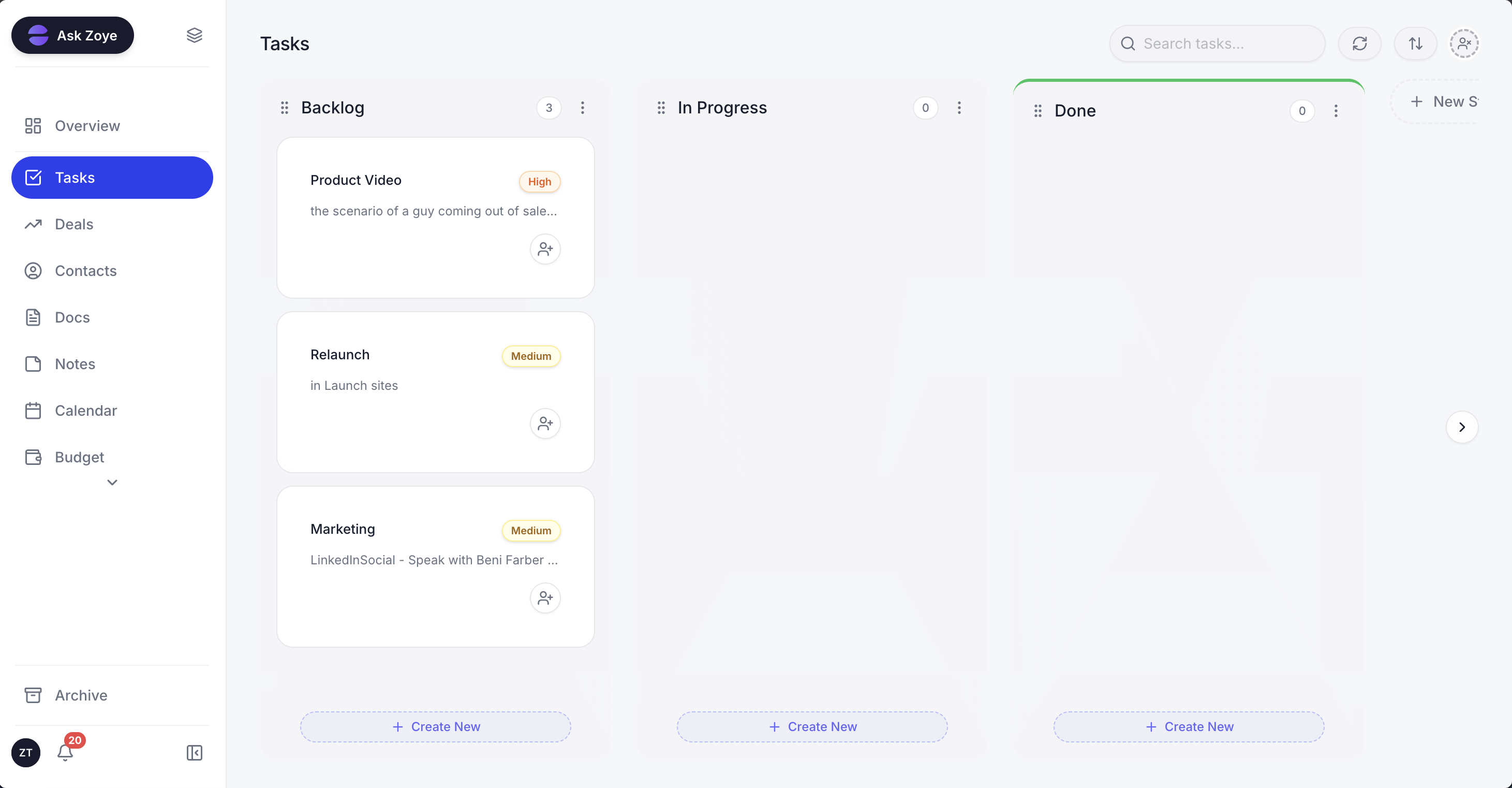 Tasks on a board, with each card still attached to the deal and the customer it came from
What that changes in daily use:
- The Kanban board you use for delivery and the pipeline you use for sales are different views over the same connected data, so a client's history and their live work are one click apart.
- The rules you would otherwise script between two tools are described in a sentence and confirmed before they run. Won deal creates the onboarding tasks. Deal quiet for seven days surfaces itself. Overdue invoice chases itself. Every run is logged and reversible.
- The same assistant works in the web app, on WhatsApp, by voice note and in Slack, which matters more than it sounds when the person who knows what was promised is standing on a site rather than sitting at a desk.
- Records arrive from wherever they already are. Existing projects can be imported from Trello, Monday.com or a spreadsheet, and the assistant can pull contacts out of a CSV, a PDF or a photo. Jira, Notion and ClickUp imports are coming soon.
To be straight about the limits: this is not a substitute for a specialist scheduler, an accounting ledger or a helpdesk ticketing suite, and if your delivery work genuinely needs one of those, keep it and connect it. The claim is narrower and more useful than "replaces everything". It is that the customer record and the work that serves it should not live in two places, because the space between them is where things get lost.
Pricing is published in full on the pricing page if you want to compare it against a two-tool stack.
Ready to streamline your business?
Zoye brings AI-powered CRM, task management, and automation into one workspace.
Get StartedHow to decide, by the shape of your business
| If this sounds like you | Start with | Why |
|---|---|---|
| One-off projects, clients rarely return | Project management | The work is the whole relationship |
| Repeat clients, light delivery | CRM | The relationship outlives any single job |
| Repeat clients AND multi-step delivery | One tool that does both | The handover between two systems is where things get dropped |
| Solo or very small team | One tool that does both | Two subscriptions and two logins is overhead you feel immediately |
| Specialist delivery (construction, engineering) | Both, deliberately integrated | Your delivery side needs tooling a CRM will never match |
One-off work for strangers. Cleaning, single-project trades, one-time installs. Project management first. The relationship rarely repeats, so the CRM earns less. Keep a contact list you can search and revisit in a year.
Repeat clients, simple delivery. Consultants, coaches, most B2B services. CRM first. The work is a handful of steps you can hold in your head; the relationship is the asset and it needs a memory.
Repeat clients, complex delivery. Agencies, studios, systems integrators. You need both, which means the handover is your risk. Either connect them properly or use one workspace where they are already connected.
Long sales cycles, short delivery. Enterprise software, capital equipment. Heavily CRM-weighted. Most of the value is in tracking a nine-month conversation across five stakeholders.
Short sales cycles, long delivery. Construction, custom manufacturing, large builds. Project-weighted, with a light CRM for the pipeline and the post-delivery relationship.
Whichever bucket you are in, the same rule applies at the end: buy for the leak you can name, not for the org chart you hope to have.
Frequently asked questions
No. A CRM organises information around a person or a company and keeps it for as long as the relationship lasts. Project management software organises information around a piece of work and is designed to be finished and archived. They look similar because both show cards on a board, but the underlying record has a different lifespan and a different owner.
It depends on whether the same people appear in your business more than once. If you sell one-off work to strangers and never see them again, project management alone may be enough. If customers come back, refer others, or buy again, you need somewhere the history lives that is not tied to a finished project. That is a CRM, whether it is a separate tool or a module inside the workspace you already use.
You can, and many small teams start that way. It works until you need history. A task board records the current state, not the sequence of events that got you there, so the moment you ask why a deal was lost or what you quoted eight months ago, the board has no answer. Kanban stages are a fine visual for a pipeline; a task record is a poor container for a relationship.
Buy for the side of the business that is currently leaking money. If leads go cold because nobody follows up, start with the CRM. If work is delivered late because nothing is sequenced, start with project management. If both hurt equally, choose a workspace where the customer record and the work are already connected, so you are not choosing at all.
In a two-tool setup, someone re-types the deal into a project. That re-typing is where scope, promised dates, agreed price and the reason the client bought get lost, because only part of it fits into the project template. It is the single most common failure point in a CRM plus project management stack and the strongest argument for keeping both in one system.
Sometimes, and it is worth being honest about it. A dedicated construction scheduler or a specialist engineering tracker will beat a general workspace on its own ground. The trade is depth in one category against the record travelling for free between categories. For most small and mid-sized businesses the hops between tools cost more than the missing features.
The bottom line
CRM and project management are not competitors. They answer different questions about different objects with different lifespans. The CRM answers who this is and everything that has happened with them. The project tool answers what is next and whether it will land on time.
You will probably need both eventually. What you should resist is treating that as an argument for two subscriptions and a sync between them, because the sync is not the hard part. The hard part is that a customer and the work you do for them are the same story, and every boundary you draw through the middle of that story costs you a piece of it.
Decide with the outliving test, buy for the leak you can name, and keep the crossing between sales and delivery as short as you can make it.
Related reading: what a CRM actually is, choosing project management software, the real cost of tool sprawl, and the full feature set in one workspace.