How to Sell on WhatsApp in 2026: Guide for Mexico, LatAm and Spain
In Spain, Mexico and most of Latin America, WhatsApp is not one more channel. It is where the customer already lives. People ask for a price, argue over the delivery date, send a photo of the broken part, and pay, all in the same thread they use to talk to their family. A small business that answers well on WhatsApp does not need a website, a funnel, or an ad budget to start selling.
The problem is never the channel. It is that WhatsApp rewards exactly the two things a busy owner cannot sustain by hand: answering in minutes and following up without fail. The message that arrived at 9pm while you were closing the shop, the quote you promised on Tuesday and remembered on Friday, the buyer who asked "is it still available?" and got silence. None of those are lost because the product was wrong. They are lost because nobody replied in time.
This guide is the practical playbook: how to set up WhatsApp Business properly, how to make people write to you, how to reply, qualify, quote and close inside the chat, how to follow up so the sale does not die, and what Meta's rules actually allow. Then it covers the part most guides skip: how an AI operator runs that entire routine for you, in Spanish, so the playbook still happens on the days you are too busy to run it.
Pricing reflects published rates as of August 2026; check each vendor's pricing page for current figures.
Why WhatsApp sells so well in Spanish-speaking markets
Three things make the channel different from anything else a small business uses.
The customer is already there and already replies. An email sits unopened for days. A WhatsApp message gets read in minutes and answered in the same conversation. In Mexico, Colombia, Argentina and Spain, asking a business a question by WhatsApp is the normal, expected behaviour, not a novelty. You are not asking the buyer to learn anything new.
The whole sale fits in one thread. Question, photo, price, objection, payment link, confirmation, delivery. Everything happens in a chat the buyer already trusts, with no jumping between a website, an email and a phone call. That continuity is why WhatsApp closes faster than almost any other channel a small business can run.
It works without a website. A complete WhatsApp Business profile with a catalogue and a payment method is a working storefront. Thousands of businesses across Latin America run every sale through it and never send a buyer to a site. It is the cheapest sales channel a new business can open.
The weakness is human, not technical. WhatsApp punishes slowness harder than any other channel, because the buyer is writing to you and to two competitors at once. Fix the speed and the follow-up, and it becomes the best performing channel you have.
Step 1: Set up WhatsApp Business properly
Start with the free WhatsApp Business app if you are one person or a very small team. It exists precisely for this and takes an afternoon to set up well.
Complete the business profile. Name exactly as customers know you, category, a one line description that says what you sell and where, address or coverage area, opening hours, and a link to your Instagram or site. An empty profile makes a stranger hesitate before writing.
Build the catalogue. Add every product or service with a clear photo, a short description written as a benefit, and the price. A buyer who can see the item and the price without asking decides much faster than one who has to wait for a quote. If prices move, quote ranges or "from" prices rather than leaving the field blank, and keep stock current. Nothing damages trust like asking about a listed item and hearing that it ran out months ago.
Write your quick replies. These are the answers you type twenty times a week: delivery times, payment methods, coverage area, warranty, how to place an order. Save each as a shortcut and you will reply in one second instead of one minute.
Set the greeting and away messages. Someone writing at 11pm should get an instant, human sounding acknowledgement with a real piece of information, not just "we will get back to you". Tell them when you answer and what you need from them meanwhile.
Use labels. New lead, quoted, waiting on payment, closed, lost. Labels are the poor man's pipeline, and they are the difference between remembering who owes you an answer and guessing.
If several people need to answer the same number, or you want conversations connected to customer records, that is where the WhatsApp Business Platform (the API, contracted through a provider) comes in. More on the rules of that below.
Step 2: Make people write to you
A perfect setup sells nothing if nobody messages. The job is to put a reason to chat everywhere your buyer already looks, one tap away.
Publish your click to chat link. A wa.me link opens the conversation with a single tap. Put it in the Instagram and TikTok bio, as a floating button on your site, in your Google Business Profile, in your email signature, on the shop window as a QR code, and in every ad. If you run ads, click to WhatsApp campaigns send the buyer straight into a chat rather than into a form nobody fills.
Give a concrete reason to start. Nobody writes to "find out more". They write for a price, availability, a catalogue, a booking, or a discount. Lead with the specific offer: "Write to us and we will send you the price list today", "Ask us if we deliver to your area", "Message us to book this week".
Prefill the first message. A click to chat link can open with text already written, such as "Hi, I want a quote for ...". It removes the awkwardness of the blank chat and tells you immediately what the person wants.
Step 3: The first reply decides the sale
This is the single highest leverage thing in the whole playbook. The buyer who asks about a price is asking two or three businesses at the same time, and the first useful answer usually takes the conversation.
Useful is the operative word. "Hello, how can I help you?" is not a reply, it is a delay. A good first reply does three things in one message: answers the actual question, adds the piece of information they were going to ask next, and proposes a concrete next step. For example: the price, whether it is in stock, and a question about when they need it.
Answer in the tone the market expects. In Mexico and most of Latin America a warm, courteous register works, and using "usted" or "tú" should match how the customer wrote to you. In Spain the tone is more direct and "tú" is standard for most consumer businesses. Match the customer instead of writing like a corporate letter.
If you genuinely cannot answer in minutes during the day, that is not a discipline problem to feel guilty about, it is an operating problem to solve. Either someone else covers the number, or something automatic answers first. Both are better than a lead reading your away message and writing to a competitor.
Want to see it in action?
Watch how Zoye automates your daily workflow - from lead management to team collaboration.
See How It WorksStep 4: Qualify without interrogating
Not every message is a customer, and treating them all the same wastes the hours you should spend on the ones ready to buy. But an interrogation kills the conversation. Two or three questions, asked naturally, are enough:
What exactly do they need? Model, size, quantity, service, problem to solve.
When do they need it? This separates "I am comparing" from "I am buying today" better than any other question.
Where are they? Delivery, coverage, whether they can come to you.
Ask them one at a time, conversationally, and record the answer somewhere that is not your memory. If you are still on the WhatsApp Business app, that is what labels are for. As soon as you have more than a handful of open conversations a week, a label stops being enough and you need each lead as a real record with a next step and a date.
Step 5: Quote and close inside the chat
Do not move the buyer out of WhatsApp to close. Every extra step you add loses people.
Send the price clearly, in the chat. A photo, the price, what it includes, and the delivery or start date. If you send a PDF quote, write the key number in the message too, because a lot of people never open the attachment.
Anticipate the two objections you always get. Price and time. Put the answer in the same message: the payment options, the guarantee, the delivery date, the reason your price is what it is. Answering an objection before it is raised removes a whole round trip.
Make paying easy. A payment link, transfer details, or whichever local method your customers actually use. The fewer steps between "I want it" and "it is paid", the more sales survive the gap.
Always close with a next step and a date. "I will send you the invoice today and confirm delivery for Thursday" beats "let me know". A conversation that ends without an agreed next step is a conversation you will forget.
Step 6: Follow up, because this is where the money is
Most WhatsApp sales are not lost at the quote. They are lost in the silence after it. The buyer read the price, got distracted, and nobody came back.
A simple rhythm works: a check the day after the quote, another three or four days later with something new (availability, a slot opening, a related option), and one final polite message a week or two on. Three touches, each adding something rather than asking "any news?".
The same applies after the sale. A message a week later asking if everything went well produces reviews, referrals and repeat orders at a rate no advertising can match, and it costs one minute.
The reason almost nobody does this is that follow up is invisible work with no deadline. It is always the first thing dropped on a busy day. That is exactly why it should not depend on a human remembering.
The mistakes that kill sales on WhatsApp
Replying hours later. The most expensive mistake, and the most common. By hour three, the buyer has usually bought elsewhere.
Using your personal number. No business profile, no catalogue, no labels, and your customers mixed into your family chats. Separate them from day one.
Answering with a question instead of an answer. "How can I help you?" when they already said what they wanted reads as if you did not read the message.
Losing the conversation. Once the chat scrolls away, the lead is gone. Whatever you use, every conversation must leave behind a record with a next step.
Mass messaging strangers. Sending promotions to people who never wrote to you is the fastest way to get reported and lose the number. Grow the list from people who contacted you.
Broadcasting the same message every week. Even with people who opted in, repetitive promotions get you muted and blocked, which quietly destroys your reach.
No follow up. The quote you sent and never chased is the single largest source of lost revenue in most small businesses.
See what Zoye can do for you
From CRM and deal tracking to AI-powered task management - explore everything Zoye offers in one workspace.
Explore FeaturesWhat Meta's rules actually allow
Selling on WhatsApp works long term only if you stay inside the rules. The important ones, in plain language:
The customer starts the relationship. People must give consent before you send them marketing messages, and that consent has to be genuine, not a list you bought. Practically, your best list is people who already wrote to you.
The 24 hour window. When someone messages you, you can reply freely for 24 hours. After that window closes, on the WhatsApp Business Platform you can only open the conversation again with a pre approved template message. Template categories such as marketing, utility and authentication are billed per message, and marketing templates need approval before you can use them.
Broadcast lists on the free app have limits. They only reach people who have your number saved in their contacts, and the audience per list is capped. They are a courtesy tool for existing customers, not a mass marketing channel.
Reports and blocks have consequences. If enough people mark your messages as unwanted, your quality rating drops and your ability to send template messages gets restricted. Relevance is not a nicety here, it is what keeps the channel working.
Anyone promising unlimited mass messaging, scraped numbers, or automation that ignores the window is selling you a banned number. A serious tool works with these rules, not around them.
The shift: an operator that sells on WhatsApp for you
Everything above is doable. The honest problem is that it is doable on a good week. On a normal week you are serving customers, delivering, invoicing and answering the phone, and the first reply slips to two hours while the follow-up never happens at all.
Zoye is an AI Business Operator: instead of another app you have to maintain, it is something that does the work. It answers the first WhatsApp message with a real answer, qualifies the buyer, books the appointment on your calendar, creates the customer record itself, and chases the follow-up on schedule, in Spanish, at whatever hour the message arrives.
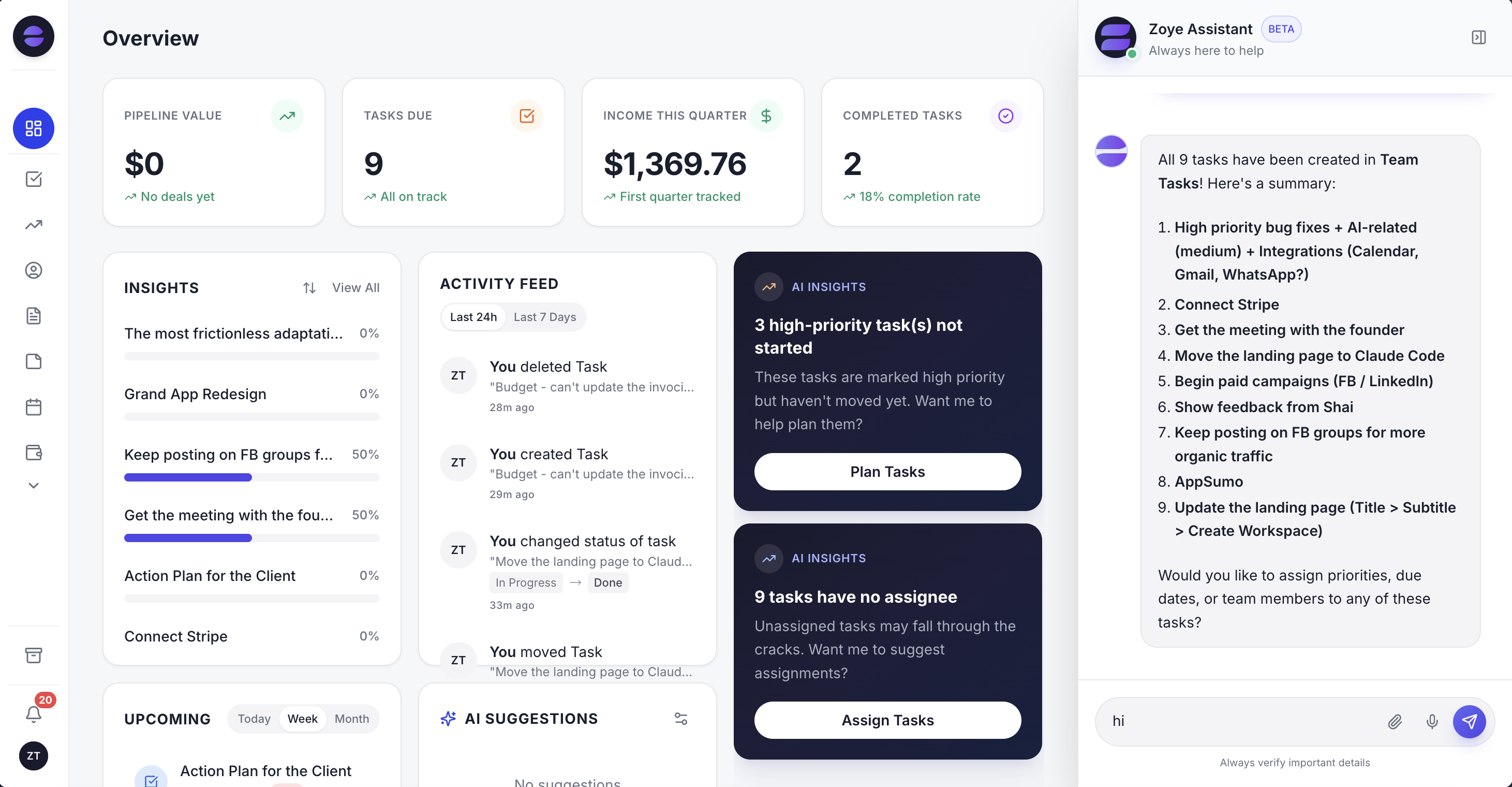 Zoye keeps conversations, leads, appointments and follow-ups in one workspace and runs the WhatsApp routine for you.
The part that changes how a small business works is that you instruct it in a plain sentence. Type "when someone asks about a price on WhatsApp, send them the catalogue and remind me in two hours if they do not reply", and Zoye builds and runs that automation. There is no canvas of nodes to learn and no consultant to hire. If you want to change it later, you say so in another sentence.
Because it operates over WhatsApp, you can also run the business from the same chat you are already in. Ask it who has not answered this week and it lists them and drafts the messages. Tell it about a call you just finished and it records the customer, opens the opportunity, and sets the follow-up. Behind that, everything lands in one workspace: customers and opportunities, tasks in list, board, calendar and timeline views, a shared calendar for appointments, budget tracking and reports. To be clear about scope, Zoye works inside Meta's rules like any serious tool: it makes you fast and consistent, it does not let you message strangers in bulk.
Pricing: the entry plan is Almost Free at 5 US dollars per month for 1 member, 1GB of storage, with the full platform including AI. Starter is 29 US dollars per month (10 members, 5GB). Growth is 59 US dollars per month (20 members, 10GB, 24/7 support). Scale is 119 US dollars per month (100 members, 25GB), plus a Customize tier with custom limits and dedicated support.
Best for: shops, clinics, agencies, trades and service businesses in Mexico, Latin America and Spain that sell over WhatsApp and lose sales to slow replies and missing follow-up.
How to start this week
You do not need a project. Four steps, in this order:
1. Fix the profile and catalogue. One afternoon. Photos, prices, description, hours, quick replies, greeting and away messages.
2. Publish the link everywhere. Instagram bio, site, Google Business Profile, signature, shop window QR. Same day.
3. Fix the first reply. Decide who answers, in what time, with what message. If that cannot be guaranteed by hand, automate the first answer so nobody waits.
4. Make the follow-up automatic. Every quote gets a next step and a date, and something other than your memory holds it. This is the step that pays for the other three.
Do these in order and the difference shows up in the first two weeks, because most of what you were losing was never a product problem.
Why businesses pick Zoye for WhatsApp
Three reasons come up again and again.
The first reply stops depending on who is free. Someone answers in seconds, at any hour, with a real answer and a proposed next step, so the buyer who wrote at night is still there in the morning.
The follow-up happens without anyone remembering it. Every quote leaves a record with a date, and the operator chases it, which is where most of the recovered revenue comes from.
You describe what you want in a sentence. No workflow builder, no consultant, no migration project. You say it in Spanish and it is running.
Try Zoye for your business. The Almost Free plan starts at 5 US dollars per month with the full platform including AI, and you can upgrade or cancel whenever you want.
Ready to streamline your business?
Zoye brings AI-powered CRM, task management, and automation into one workspace.
Get StartedFor more context, see how to sell on WhatsApp, how to automate WhatsApp for your business, and the Leadsales alternatives.