
How to Automate WhatsApp for Your Business in 2026
For most small businesses in 2026, WhatsApp is not a marketing channel. It is the business. The first enquiry arrives there, the price question arrives there, the appointment is agreed there, and the customer who never came back went quiet there too. And almost all of it is still done by hand, by an owner who reads the same three questions forty times a week and answers them from a phone between other jobs.
That is why "automating WhatsApp" is the most requested and most misunderstood project in small business software. Half the tools sold under that name are unofficial scripts that log into a normal account, send hundreds of messages, and get the number banned within a month. The other half are real, official, and perfectly safe, but they are sold as a builder you have to design, connect, and maintain before anything useful happens.
This guide is the practical version. It covers what can genuinely be automated on WhatsApp, what Meta's rules actually allow (opt-in, the 24-hour window, message templates), the difference between a bot that answers and an operator that acts, and how to start without a developer. If what you want is the selling playbook rather than the automation one, the companion guide on how to sell on WhatsApp covers that side.
Pricing reflects published rates as of August 2026; check each vendor's pricing page and Meta's current rate card for up-to-date figures.
What can actually be automated on WhatsApp
Before choosing any tool, it helps to be precise about what "automation" means here. These are the routines that genuinely work, in roughly the order most businesses should adopt them.
The first reply. The highest-value automation on WhatsApp is also the simplest one: nobody waits. A message that gets an answer in seconds keeps the customer in the conversation, while a reply two hours later reaches someone who already wrote to two competitors. An automated first reply confirms you received the message, answers the obvious question, and buys you the time to answer properly.
Qualification. Two or three questions asked automatically (what do you need, for when, in what area or budget range) turn a raw enquiry into something you can act on. Done well it feels like a normal conversation, not a form. Done badly it feels like an interrogation, which is why short beats thorough.
Appointment booking and reminders. Offering available slots, confirming the one the customer picks, and sending a reminder the day before is the automation with the clearest financial return, because every no-show you prevent is money you already earned. Reminders sit in the utility template category and are among the best-performing messages any small business sends.
Order, delivery, and status updates. Anything the customer would otherwise call to ask about is a good candidate: your order shipped, your document is ready, the technician is on the way. These are informational, expected, and rarely annoy anyone.
Payment reminders. A polite, automatic nudge on an overdue invoice recovers money that most owners are simply too uncomfortable to chase manually. It also removes the awkwardness, because it is the system reminding, not you asking.
Post-sale follow-up. The check-in a week later, the reorder reminder at the right interval, the review request after a good job. This is the routine everyone knows they should do and almost nobody does consistently, which is exactly what automation is for.
Reactivating quiet conversations. The enquiry that stopped answering three weeks ago is your cheapest lead. A single well-timed follow-up recovers a meaningful share of them, but it has to respect the rules covered in the next section.
What is not on this list matters just as much. Cold outreach to people who never contacted you, bulk sending to a purchased list, and pretending an automated reply is a human are not automation, they are the fastest way to lose the number your entire business runs on.
What Meta's rules actually allow
WhatsApp is not email. You do not own the channel and you cannot send whatever you like, and the businesses that get burned are the ones that learn the rules after building the automation instead of before. Four rules shape everything.
1. You need opt-in before you message first. Meta requires businesses to obtain an explicit opt-in before sending a customer the first message, through any channel you like: a checkbox at checkout, a website form, a reply on another channel, an in-person confirmation. The opt-in has to make clear that the person is agreeing to receive WhatsApp messages from your business by name. Keep the record of it. If a customer messages you first, that is the cleanest opt-in there is.
2. The 24-hour customer service window governs free-form messages. When a customer sends you a message, a 24-hour window opens in which you can reply with anything, including automated replies, media, and buttons. Once it closes, free-form messages are blocked. This one rule explains almost every design decision in a good WhatsApp automation: fast, useful replies inside the window, and templates outside it.
3. Outside the window, only approved templates. To reopen a closed conversation you send a message template that Meta has reviewed and approved in advance, in one of the permitted categories: utility (order updates, appointment reminders, account notifications), marketing (promotions, offers, re-engagement), or authentication (one-time codes). Templates support variables, so the content adapts, but the structure is fixed and approved. Marketing templates carry stricter expectations, and Meta can pause them for a number whose quality rating drops.
4. Quality rating and messaging limits are real constraints. Every business number carries a quality rating driven by how recipients react: blocks and reports push it down, replies push it up. Numbers also start with a messaging limit on unique customers per rolling 24 hours and climb through tiers as they send well-received messages. Send unwanted volume and you do not just annoy people, you lose the ability to send at all.
Two more practical notes. Meta charges per template message sent, by category, and replies you send inside the 24-hour service window are generally not billed as template messages, so an automation designed around fast replies is also the cheaper one. Rates change and vary by country, so check Meta's current pricing rather than a blog figure. And every automated flow must offer an obvious way to reach a human and an easy way to stop receiving messages. That is both a policy expectation and the difference between an automation customers tolerate and one they block.
Want to see it in action?
Watch how Zoye automates your daily workflow - from lead management to team collaboration.
See How It WorksWhatsApp Business app or WhatsApp Business Platform?
There are two official products, and choosing the wrong one is the most common false start.
The WhatsApp Business app is the free phone app. It gives you a business profile, a catalogue, labels, quick replies, a greeting message, and an away message. That is genuine automation, and for a solo operator it may be enough for a while. Its ceiling is low, though: the automations are static text, they cannot ask a question and act on the answer, the account is tied to one phone, and it does not connect to your customer records.
The WhatsApp Business Platform (the Cloud API) is the official route for real automation. It runs on Meta's servers, supports templates, multiple agents, and integrations, and is what every legitimate WhatsApp automation product is built on. You do not use it directly; you connect through a provider, and in 2026 the good ones handle verification and template approval for you rather than handing you documentation.
What you must not use is any tool that automates by logging into a normal WhatsApp or Business app account, however cheap or convenient it looks. Those are unauthorised, they breach Meta's terms, and the risk they carry is the loss of the number your customers already have. If a vendor cannot tell you plainly that they operate on the official Platform, that is your answer.
A reasonable rule of thumb: if you are one person answering a few messages a day, start with the Business app and its away and greeting messages. The moment you have more messages than you can answer, more than one person answering them, or you want booking and follow-up handled automatically, move to the official Platform through a provider.
A bot that answers versus an operator that acts
Most of what is sold as WhatsApp automation is a chatbot: a decision tree you draw on a canvas, where a message matches a branch and the branch replies. Chatbots are useful, and they solved the first-reply problem for a lot of businesses. But they have a ceiling that anyone who has run one knows well.
A bot answers and then stops. It replies "sure, what day suits you?", the customer says Thursday, and then the transcript lands in your lap for the actual work: opening the calendar, checking the slot, writing it down, remembering the reminder, adding the person to your customer list, and following up if they go quiet. The typing was automated. The operation was not. And every branch you did not anticipate becomes a dead end where the customer is left talking to a wall.
An AI operator is a different model. It reads the message the way a person would, without needing a branch for every phrasing, and then it does the downstream work: it creates the contact, opens the opportunity, books the slot on the real calendar, sends the confirmation, schedules the reminder, updates the record after the appointment, and chases the customer who never replied. The measure is simple. After a bot handles a conversation, you still have work to do. After an operator handles one, the work is done and you have a record of it.
This matters more in a small business than in a large one, because in a small business the person the transcript lands on is the same person doing everything else.
See what Zoye can do for you
From CRM and deal tracking to AI-powered task management - explore everything Zoye offers in one workspace.
Explore FeaturesHow to start without a developer
You do not need an integration project. This is a sensible order that works for a business of any size.
1. Write down your five most repeated messages. Not what you imagine customers ask, what you actually typed last week. Prices, opening hours, location, availability, "do you do X". Those five are your automation backlog, and they usually cover most of the volume.
2. Decide what a good first reply looks like. One message, in your voice, that acknowledges the enquiry and moves it forward with a question. This is the piece that earns the most and takes the least effort to get right.
3. Get your opt-in in order. Add the consent line to your website form, your checkout, and your intake sheet, and keep the record. Do this before you build anything, because it is what makes everything after it permitted.
4. Connect an official provider. Pick a tool that runs on the WhatsApp Business Platform and handles the business verification and template approval on your behalf. Confirm that before anything else.
5. Automate one routine, not seven. Start with the first reply, or with appointment reminders if no-shows are your bleeding wound. Run it for two weeks, read the actual conversations it produced, and fix what reads badly.
6. Keep the handover to a human obvious. One clear escape hatch in every flow. Customers forgive an automation that hands them over quickly; they do not forgive one that traps them.
7. Then expand. Add qualification, booking, payment reminders, and reactivation one at a time, checking the quality rating as you go.
Zoye: describe the automation, do not build it
Zoye is an AI Business Operator, not a bot builder. It runs the business routine on WhatsApp instead of handing you a canvas to draw one: it answers the first message, qualifies the enquiry, books the appointment, updates the customer record itself, and chases the follow-up that would otherwise be forgotten.
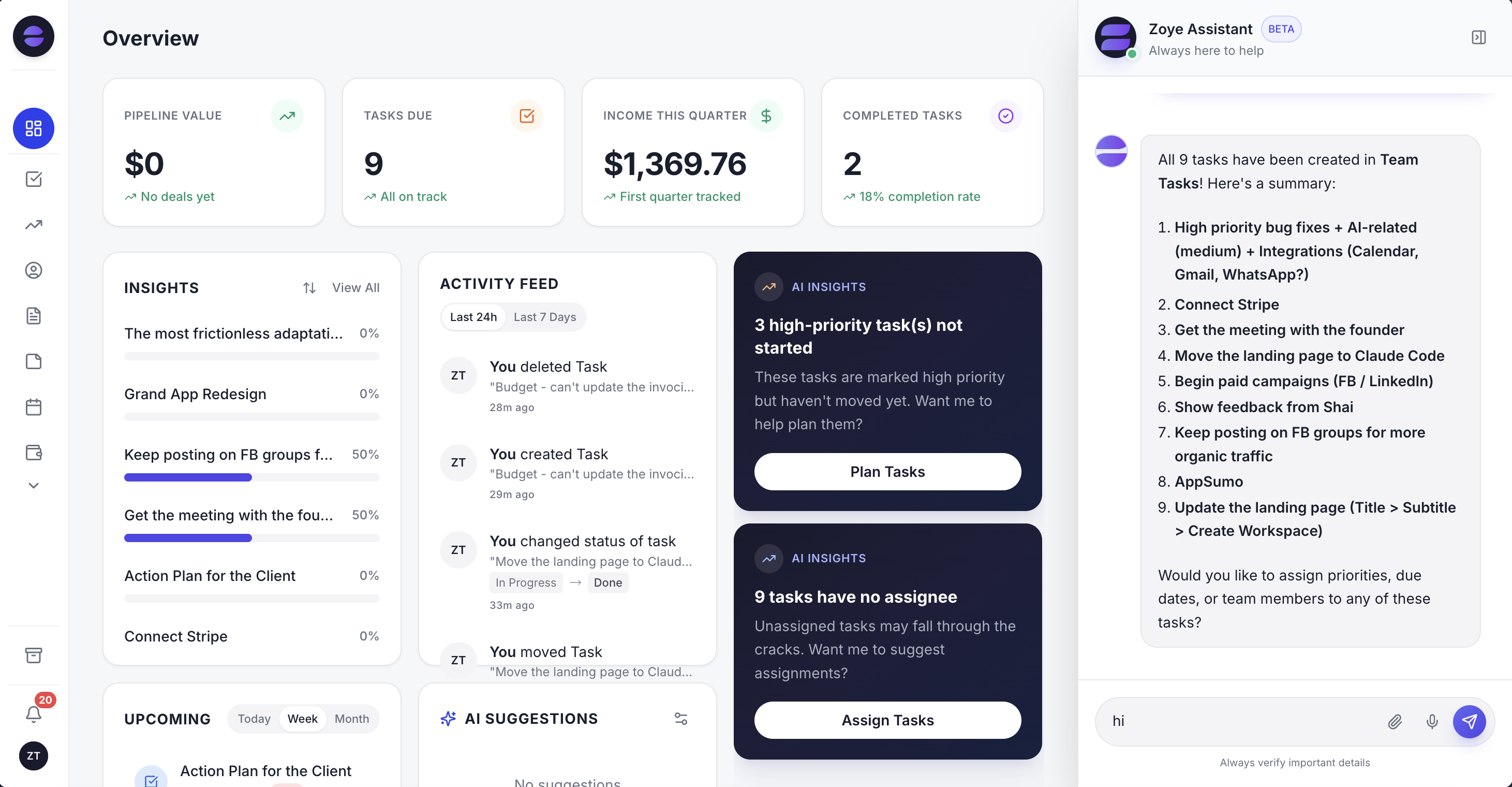 Zoye keeps conversations, contacts, appointments, and follow-ups in one workspace and runs the WhatsApp routine for you.
The part that changes how automation feels is how you set it up. Instead of dragging nodes across a builder, you type the outcome you want in one plain sentence, in English or in Spanish: "when someone writes asking for prices, send them the price list and offer me two slots this week", or "remind every client with an unpaid invoice three days after the due date". Zoye builds and runs that automation, and it takes care of the machinery underneath: which message can be sent free-form inside the 24-hour window, which one needs an approved template, and when the follow-up should fire.
Because the operator sits on top of a real workspace rather than a chat widget, the conversation does not end at the reply. The enquiry becomes a contact and an opportunity, the appointment lands on the shared calendar, the reminder is scheduled, and the whole thing appears in the reports alongside your tasks, your pipeline, and your budget. You can run it from the app, from Slack, or from WhatsApp itself, and instruct it in the same language you would use with an assistant. Zoye operates through the official WhatsApp Business Platform, so opt-in, templates, and the 24-hour window are respected rather than worked around.
Pricing: Almost Free from 5 USD per month for 1 member with 1GB storage and the full platform including AI. Starter 29 USD per month (10 members, 5GB). Growth 59 USD per month (20 members, 10GB, 24/7 support). Scale 119 USD per month (100 members, 25GB), plus a Customize tier with custom limits and dedicated support.
Best for: small businesses whose customers live on WhatsApp and who want the operation handled rather than a builder to maintain.
Ready to streamline your business?
Zoye brings AI-powered CRM, task management, and automation into one workspace.
Get StartedThe mistakes that get results, and numbers, killed
Five failure modes account for most of the bad outcomes.
Using an unofficial tool. The cheap ones that automate a normal account are the reason so many business numbers disappear. There is no volume of savings that justifies losing the number your customers already have saved.
Sending without opt-in. Messaging people who never agreed to hear from you produces blocks, blocks produce a falling quality rating, and a falling quality rating produces paused templates. The channel punishes it faster than email ever did.
Automating the wrong thing first. Businesses often start with a promotional broadcast, which is the highest-risk and lowest-trust automation available. Start with the reply and the reminder, which customers actively want.
Building a maze with no exit. A flow that cannot understand an unexpected message and cannot pass to a person converts an interested customer into an irritated one. Always leave a door.
Automating the typing and keeping the work. The most common disappointment is not a policy problem at all. The bot answers, and the owner still opens the calendar, still types the contact into a spreadsheet, still forgets the follow-up. If nothing downstream changed, the automation did not really happen.
Why teams pick Zoye
Three things come up repeatedly.
Nobody has to build a flow. You describe the routine in one sentence and the operator builds and runs it, so automation stops being a project you postpone.
The work gets done, not just the reply. The contact, the appointment, the reminder, and the follow-up are handled, so the conversation does not turn into a to-do list for you.
It is one workspace, not another tool. WhatsApp conversations sit next to contacts, deals, tasks, calendar, and reports, so nothing is copied by hand between apps and nothing is lost between them.
Try Zoye with your team. The entry plan is Almost Free at 5 USD per month, with the full platform including AI.
For more context, see WhatsApp automation, automated WhatsApp customer service, and how to sell on WhatsApp.