The 7 Best OKR Software Tools in 2026
OKRs (Objectives and Key Results) are one of the most effective ways to keep a team focused on what matters. An Objective is the ambitious thing you want to achieve this quarter. The Key Results are the two to four measurable outcomes that prove you got there. Done well, OKRs keep everyone pointed at the same handful of targets instead of scattering across a hundred small to-dos.
The problem is rarely the framework. It is the tooling. Most dedicated OKR software tracks goals in a silo, completely disconnected from the daily tasks and the CRM, revenue, and budget where progress actually happens. You set a key result like "close 20 new customers," then update the progress number by hand, in a separate app, while the real deal data lives somewhere else. The OKR tool becomes one more thing to maintain rather than a live picture of where the company stands. By mid-quarter the dashboard no longer reflects reality, and the quarterly review turns into an afternoon of assembling spreadsheets.
This guide compares the seven best OKR software tools in 2026, ranked for teams that want goal tracking tied to the work, not stranded in a separate scorecard. If you are an early-stage company specifically, the companion guide on the best OKR software for startups goes deeper on the cost and simplicity questions.
Pricing reflects published rates as of June 2026; check each vendor's pricing page for current figures.
OKR software at a glance
| Tool | Category | Where OKRs live | Best for | Pricing from |
|---|---|---|---|---|
| Zoye | All-in-one workspace with AI | Alongside the actual work: tasks, deals, calendar, reports | Startups and small teams that want goals connected to delivery | $5/mo (1 member), then $29/mo (10 members) |
| Weekdone | Dedicated OKR and check-ins | Separate OKR system | Teams wanting structured weekly check-ins | ~$9/user/mo |
| Perdoo | OKR and strategy execution | Separate OKR system | Companies formalising strategy | ~$9/user/mo |
| Lattice | People platform with OKRs | Inside HR performance tooling | HR-led performance and review cycles | ~$11/user/mo |
| 15Five | Performance and engagement | Inside HR performance tooling | Manager-employee cadence and engagement | ~$10/user/mo |
| Quantive | Enterprise OKR platform | Separate enterprise OKR system | Large organisations with dedicated OKR owners | Free tier, then enterprise quotes |
| Profit.co | Deep, configurable OKR | Separate OKR system | Teams wanting heavy configuration and methodology | ~$7/user/mo |
Pricing reflects published rates at the time of writing. Check each vendor's page for current figures.
What OKR software actually costs
Nearly every dedicated OKR tool charges per user per month, which produces a specific problem: OKRs only work when the whole company can see them, so you are pushed to buy a seat for everyone, including people who will open it twice a quarter.
Here is how that math lands:
| Tool | 10 people | 25 people | 50 people |
|---|---|---|---|
| Zoye | $29/mo | $59/mo | $119/mo |
| Profit.co | ~$70/mo | ~$175/mo | ~$350/mo |
| Weekdone | ~$90/mo | ~$225/mo | ~$450/mo |
| Perdoo | ~$90/mo | ~$225/mo | ~$450/mo |
| 15Five | ~$100/mo | ~$250/mo | ~$500/mo |
| Lattice | ~$110/mo | ~$275/mo | ~$550/mo |
Illustrative figures based on published per-user rates; actual pricing varies by plan and contract.
Two conclusions follow.
Per-seat pricing works against the point of OKRs. Transparency is the whole mechanism. A pricing model that makes each additional viewer cost money quietly pushes teams toward limiting access, which is exactly how OKRs become a leadership document nobody else reads.
You are often paying twice for the same information. A dedicated OKR tool holds the goal. Your project tool holds the work that moves the goal. Someone then manually updates the first from the second every week or two. That manual reconciliation is the actual reason most OKR rollouts die in quarter two, and it is a structural problem rather than a discipline problem.
Free OKR software: what is actually available
"Free OKR software" and "best free OKR tools" are common searches. Here is the honest state of it.
Quantive offers a genuine free tier for small teams, which is the most capable free option in the category and a reasonable place to start if you want a dedicated OKR system at no cost.
Most others offer trials, not free plans. Weekdone, Perdoo, Lattice, and 15Five are trial-and-then-paid. Some have small free tiers capped at a handful of users.
A spreadsheet is the most-used free OKR tool in the world. This is not a joke and not necessarily wrong. A shared sheet with objectives as rows, key results underneath, and a confidence column updated weekly outperforms an expensive tool nobody opens. It fails in one specific way: nothing reminds anyone to update it, so it goes stale by week six and quietly stops being the source of truth.
The real cost of free is staleness. Every free option in this category shares the same weakness. The OKRs are only as current as the last time a human remembered to update them. That is the problem worth paying to solve, and it is worth noting that it is an automation problem rather than a features problem.
How to write OKRs that survive the quarter
Most OKR failures are authoring failures, not tooling failures. Four rules cover the majority of it.
Objectives are qualitative and directional. "Become the obvious choice for independent travel agents in Spain" is an objective. "Increase revenue 20%" is not; it is a key result wearing an objective's clothes.
Key results are measurable outcomes, not tasks. "Ship the new onboarding flow" is a task: it is done or not done and it tells you nothing about whether it worked. "Increase week-one activation from 34% to 50%" is a key result. If your key results can all be completed by a person diligently ticking boxes, you have written a project plan.
Three objectives, three key results each, maximum. The most common cause of OKR abandonment is a company setting eleven objectives, discovering in week three that nobody can hold eleven priorities in their head, and quietly reverting to whatever was already urgent.
Set the check-in cadence before the quarter starts. Weekly is right for most teams. The cadence matters more than the tool: an OKR that is reviewed every Monday shapes decisions, and an OKR reviewed at quarter end is a report card.
A practical worked example for a small B2B team:
- Objective: Make onboarding something customers finish without help.
- KR1: Raise week-one activation from 34% to 50%.
- KR2: Cut median time-to-first-value from 6 days to 2 days.
- KR3: Reduce onboarding support tickets per new account from 1.8 to 0.7.
Notice that no individual task appears. The work that moves those numbers is discovered during the quarter, which is the point.
OKRs vs KPIs: the distinction that prevents most confusion
These get used interchangeably and should not be.
KPIs are the instruments on your dashboard. Monthly recurring revenue, churn, gross margin, support response time. They run continuously, they have no end date, and healthy is usually "steady or gradually improving". You monitor them.
OKRs are the deliberate push. They pick one or two of those instruments and say: this quarter, we are going to move this specific number by this specific amount, and it will require changing something. They are temporary, ambitious, and they end.
The practical rule: if a metric should simply stay healthy, it is a KPI and it belongs in a dashboard. If a metric needs to move, and moving it will require the team to do things differently, it belongs in a key result. A company that turns all its KPIs into OKRs ends up with a quarterly reporting ritual and no strategic focus at all.
Why teams are looking beyond spreadsheets and point OKR tools in 2026
Four trends are reshaping how teams pick an OKR tool.
Goals disconnected from work do not get updated. The single biggest failure mode of OKR software is the stale scorecard. Key results sit in one app while the tasks, deals, and numbers that move them sit in three others. Updating progress is manual, so it slips, and by mid-quarter the dashboard is fiction. Teams increasingly want OKRs where the work already lives, so key results pull from real data automatically rather than from a number someone forgot to refresh.
Spreadsheets break the moment more than one person owns a goal. Plenty of teams still run OKRs in a shared spreadsheet. It works for a single founder, but the moment several people own different key results, the formulas break, versions diverge, and nobody trusts the numbers. A real tool adds ownership, history, and a single source of truth, which is exactly why teams graduate off spreadsheets in the first place.
Per-seat OKR pricing is hard to justify. A standalone OKR platform at roughly $7 to $15 per user per month is a real line item, on top of project management, CRM, and everything else. For a 20-person team that is a separate annual bill purely for goal tracking. More teams are questioning why goal tracking needs its own per-seat license when the work it measures already lives in other tools.
AI should surface progress, not just store it. Most OKR tools are passive databases of goals. The shift in 2026 is toward AI that actively tells you which key results are slipping, why, and what to do next, instead of waiting for someone to open the dashboard and notice. A scorecard that flags its own risks is worth far more than one you have to interrogate.
The 7 best OKR software tools in 2026
1. Zoye - the all-in-one workspace where OKRs live with the work
Zoye is the strongest OKR software because it solves the core problem with the category: goals stop being a disconnected scorecard and become a live picture tied to the actual work. Objectives are tracked as goals and tasks, key results are measured in Reports that pull real numbers, and the AI assistant surfaces progress automatically.
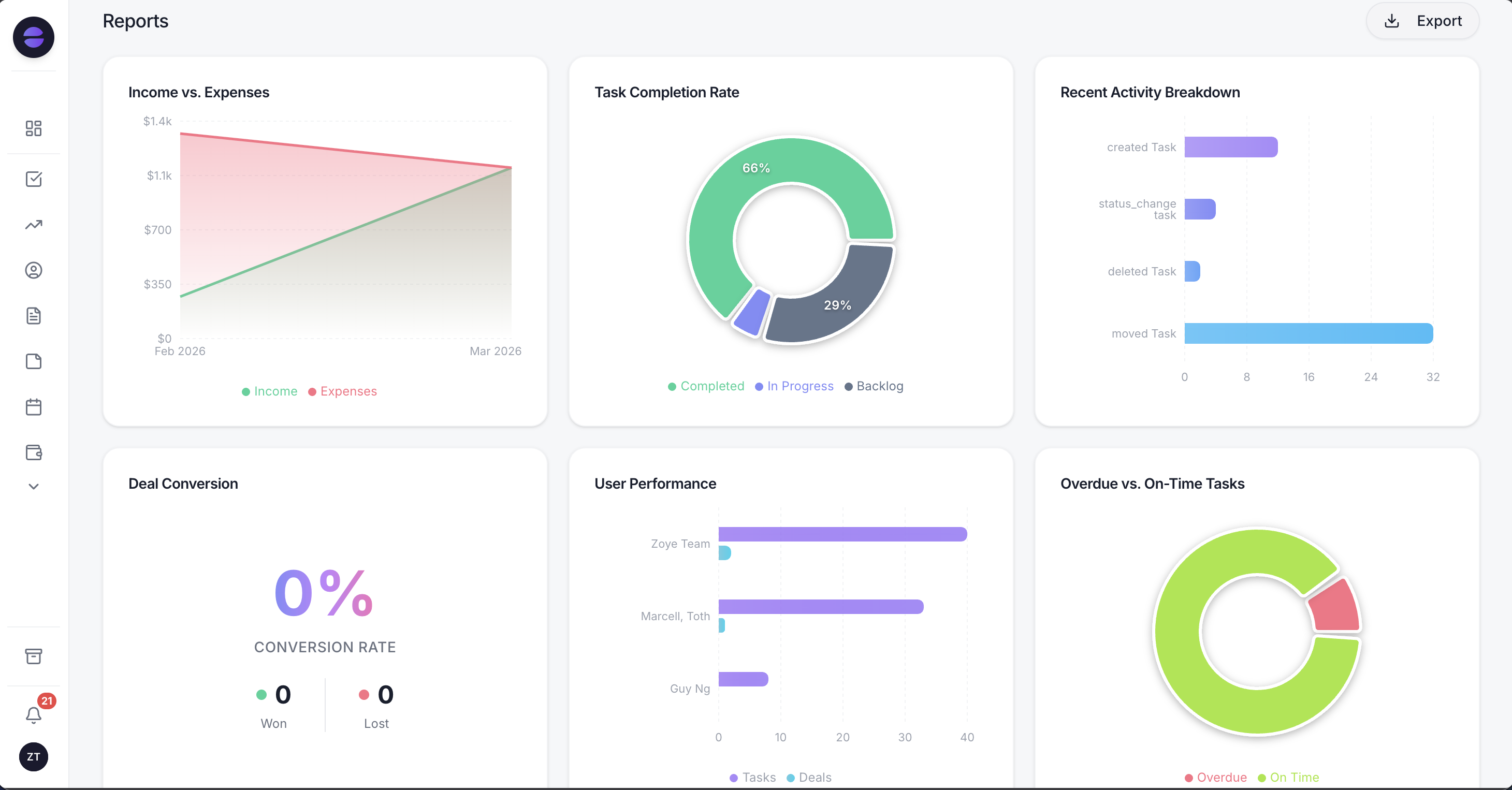 Zoye turns goals and progress into live reports the assistant can summarise on demand.
Walk through a single quarter and the mechanics become clear. You write the Objective as a goal that Zoye tracks, then attach the tasks that actually push it forward, so the ambition and the work sit in one record instead of two. Each Key Result is wired to something the platform is already measuring: a count of shipped tasks, a sum of closed deals, a revenue figure, a spend line, or a measure of team activity. Take a key result such as "grow quarterly bookings to $40k." Its number comes directly out of the deals pipeline, recalculated every time a deal moves, so there is nothing to type and nothing to forget. The result is a scorecard that cannot drift away from the truth, because it was never a copy of the data in the first place; it is the data.
The Zoye Assistant is where the platform separates from a passive OKR database. The assistant takes action across the workspace: it tells you which key results are on track and which are slipping, explains why (for example, the deals supporting a revenue key result have stalled in one stage), drafts the follow-ups to unstick them, and generates a quarter-to-date OKR progress summary on demand. Where dedicated OKR tools wait for someone to update the dashboard, the assistant proactively flags the goal that is drifting before the review.
The broader value is that OKRs are not bolted onto an isolated tool. Zoye is an all-in-one business workspace: tasks (with list, board, calendar, and timeline views), a native CRM, a shared calendar, budget tracking, and Reports, all in one place. Objectives connect to the tasks that deliver them. Key results connect to the deals, budget, and activity that prove them. A team runs its goals, its customer pipeline, its schedule, and its finances in a single workspace instead of paying for an OKR tool, a project manager, a CRM, and a BI dashboard separately. To be clear, Zoye is an all-in-one workspace with strong goal tracking, not solely a dedicated OKR suite with every advanced ritual feature like weighted scoring trees or confidence-history charts. The trade is deliberate: you give up some OKR ceremony and gain goals that never drift from reality.
Pricing: Almost Free at $5 per month for 1 member with the full platform including AI. Starter from $29 per month (10 members). Growth from $59 per month (20 members). All tools and reports included on every plan.
Best for: Teams that want OKRs tied to real work, not a separate scorecard, plus the broader workspace to run the whole business.
2. Weekdone - the dedicated OKR and weekly check-in tool
Weekdone keeps its scope deliberately narrow: set quarterly objectives, then run a weekly PPP check-in (plans, progress, problems) on top of them. That single-minded focus is its appeal. If what you want is a tidy, no-frills OKR tracker with a fixed weekly ritual baked in, Weekdone delivers exactly that and little else.
Where it falls short is connection. The goals it holds live apart from the tasks people are doing and the revenue they are generating, which means every progress figure is hand-entered. It also lands on your invoice as one more tool next to the project and CRM apps you already pay for. The weekly cadence keeps people honest, but a number is only ever as current as the last person who remembered to log in and revise it.
Pricing: Free for very small teams; paid plans scale per user. Check the vendor pricing page for current figures.
Best for: Small teams that want a dedicated OKR tool with a strict weekly check-in rhythm.
3. Perdoo - the OKR and strategy execution tool
Perdoo positions itself around strategy execution, linking OKRs to a longer-term strategic vision and ongoing KPIs. The visual strategy maps and the clear distinction between time-bound OKRs and continuous KPIs are genuinely useful for teams thinking about the bigger picture.
The trade-off is the same category limitation: it is a standalone tool that sits beside your actual work rather than being part of it, with per-seat pricing on top of your existing stack. The data that proves your key results still lives in your CRM and task tools, not in Perdoo.
Pricing: Free tier available; paid per-user plans. Check the vendor pricing page for current figures.
Best for: Teams that want to connect OKRs to a longer-term strategy and KPI layer.
4. Lattice - the people platform with OKRs attached
Lattice is primarily a performance and people management platform that includes goal and OKR tracking. For organizations that already want performance reviews, engagement surveys, and one-on-ones in one HR suite, having OKRs in the same place is convenient.
The trade-off is that OKRs are a feature of an HR platform, not the core, and the pricing reflects a people-platform license rather than a lightweight goal tracker. For a team that mainly wants OKR tracking tied to operational data, it is more platform (and cost) than the job requires.
Pricing: Per-seat, sold as part of the broader people platform; check the vendor pricing page for current figures.
Best for: Companies that want OKRs bundled with performance management and HR.
5. 15Five - the performance and engagement tool with OKRs
15Five blends OKR and goal tracking with continuous performance management: weekly check-ins, one-on-ones, recognition, and engagement surveys. For HR and people teams that want goals living alongside the performance conversation, it keeps everything in one place.
The trade-off mirrors Lattice. OKRs are one module inside a people-management suite, so the tool is priced and shaped around HR rather than around connecting key results to revenue, tasks, and budget. The goal data and the operational data stay in different systems.
Pricing: Per-seat plans; check the vendor pricing page for current figures.
Best for: People teams that want OKRs woven into a continuous performance and engagement process.
6. Quantive (formerly Gtmhub) - the enterprise OKR platform
Quantive is one of the most established enterprise OKR platforms, with deep alignment, extensive integrations to pull in metrics, and the configurability large organizations expect. For a company running OKRs across many departments, it is built for that scale.
The trade-off is exactly that scale. The configuration, integration setup, and feature surface are more than most smaller teams need, and the enterprise pricing follows suit. It connects to your data sources, but wiring those integrations is itself a project.
Pricing: Free tier for small teams; paid enterprise plans for the full platform. Check the vendor pricing page for current figures.
Best for: Larger organizations that need formal, enterprise-grade OKR alignment across many teams.
7. Profit.co - the deep, configurable OKR platform
Few dedicated platforms pack in as much as Profit.co. Weighted scoring, alignment cascades, task linking, and a sizeable library of ready-made templates all ship in the box, which makes it a natural fit for organizations that run OKRs as a formal, ceremony-heavy practice.
That richness is also the catch. Most teams will never touch the bulk of those settings, and all that configuration is overhead before the first objective is even written. And like every standalone OKR product, it lives at a distance from the day-to-day work, so however sophisticated the machinery, somebody still has to feed it the underlying numbers by hand.
Pricing: Free tier for small teams; paid per-user plans for the full feature set. Check the vendor pricing page for current figures.
Best for: Process-mature organizations that want deep, formal OKR management.
Best OKR software for startups
For an early-stage company watching every dollar, the calculus is different from a large org. A dedicated OKR platform means another login, another per-seat bill, and another place where goals sit disconnected from the tasks and revenue that actually move them. Most startups do better with OKRs inside the workspace where the work already happens, so objectives map to tasks and key results pull from live data.
Zoye is the strongest startup pick here because the entry plan, Almost Free, covers 1 member with the full platform including AI for $5 per month ($4 per month billed annually), so a solo founder can run real OKRs (objectives as tasks, key results in Reports, AI progress summaries) for the price of a coffee. The deeper point is total cost: a free dedicated OKR tool still leaves you paying separately for project management, CRM, and reporting, while one flat low fee that includes OKR tracking alongside those tools is dramatically more useful to a cash-conscious team. For the full startup-specific breakdown, see the dedicated guide on the best OKR software for startups.
Best AI-powered OKR tracking
The typical OKR tool is a filing cabinet for goals: it holds them, but it never lifts a finger to move them. Zoye is the one entry here built the other way around, with an AI-native core in which the assistant actively works your OKRs. Ask it where things stand and it points to the key results that are falling behind, explains the cause, writes the messages needed to restart stalled work, and assembles a quarter-to-date progress summary on request, every answer drawn from the workspace's live data.
The dedicated platforms are layering AI on too, but in practice it shows up as a sidebar of suggestions sitting above a scorecard humans still update by hand. The gap is architectural rather than cosmetic. An assistant can only report honest progress if it can see the actual work, and a walled-off OKR tool sees nothing beyond the figures someone keyed in. Zoye's key results draw straight from real tasks, deals, and budget, so when the assistant tells you a goal is on or off track, that read mirrors what is genuinely happening rather than the last version of a spreadsheet. That is what you gain by putting the intelligence inside the workspace instead of strapping it onto a standalone goal database.
Why OKR rollouts fail, and what to do about it
The pattern is remarkably consistent across companies, and it has almost nothing to do with which tool was chosen.
Quarter one goes well. There is a kickoff, everyone writes objectives, the tool gets configured, and there is genuine enthusiasm.
By week six, updates are late. Someone has to open a separate system and manually enter a number that already exists somewhere else. It is nobody's actual job. It slips.
By quarter two, the OKRs are stale. They no longer reflect reality, so people stop trusting them, so they stop opening them, so they get staler. This is a doom loop and it is fast.
By quarter three, OKRs are "something we tried". The tool is still being paid for. Nobody has logged in for a month.
Three things break this cycle.
Put the goals where the work already is. If updating an OKR means opening a second system, it will not happen reliably. If the key result reads from the tasks, deals, and reports your team already touches daily, staleness stops being a discipline problem.
Make the reminder automatic and specific. Not "please update your OKRs" to the whole company on a Friday. A specific nudge to a specific owner about a specific key result that has not moved in two weeks.
Assign one owner per key result. Shared ownership means nobody owns it. A key result with two owners has zero.
This is precisely where an operator model differs from a tracker model. Zoye's assistant sits on the same workspace as the tasks, deals, and reports, so the numbers behind a key result come from work that is already being recorded. It can chase the owner of a stalled key result, prepare the weekly check-in summary, and flag the objective that has quietly not moved in three weeks, without anyone remembering to run a review process.
OKR software by company size
Solo founders and teams under five. You do not need a dedicated OKR platform, and buying one is usually a way of feeling organised rather than being organised. A shared document works, or better, goals kept alongside the actual work so they stay current. Zoye's Almost Free plan at $5 per month covers this without adding a system to maintain.
Startups from five to thirty. This is where OKRs start earning their keep, because the team is now large enough that priorities genuinely diverge. It is also where per-seat pricing starts to bite and where the "second system" problem does the most damage. Prioritise a tool that connects goals to delivery over one with the deepest OKR methodology features.
Companies from thirty to a few hundred. Dedicated tooling starts to make sense. Perdoo and Quantive handle cascading, alignment mapping, and multi-level ownership properly. Expect to appoint someone as the OKR owner, because at this size the process needs a human steward regardless of the software.
Enterprise. Quantive and Profit.co are built for this: deep configuration, methodology enforcement, integrations, and audit trails. The buying decision usually involves HR and strategy functions rather than the team actually doing the work.
How to choose OKR software: five questions
1. Where will the numbers come from? If a human has to type them in from another system every week, plan for the rollout to decay. Ask specifically how a key result gets updated, and how much of that is automatic.
2. What happens when someone forgets? Every OKR system depends on updates. The ones that survive have something that actively chases, not just a dashboard that displays how stale things are.
3. What does it cost when everyone can see it? OKRs need transparency. Price the tool for your whole company, not for the leadership team.
4. Is this a goals tool or a work tool? A separate goals tool means reconciling two systems forever. Goals attached to the work stay current by default.
5. Who administers it? If the answer is "nobody has time", choose the option that requires no administration.
How to choose OKR software
Three questions narrow the decision.
1. Are your key results measured by data you already track? If your key results are things like deals closed, revenue, tasks shipped, or budget spent, choose a tool that reads that data automatically. A workspace like Zoye, where the CRM and tasks live alongside the goals, removes manual updates entirely. A siloed OKR tool means you will be retyping numbers all quarter, and the scorecard will drift the moment you stop.
2. Do you need a dedicated OKR platform, or OKRs inside your workspace? Most teams do better with OKRs inside the tool where work happens. A standalone platform like Quantive or Profit.co earns its place once a larger org needs formal scoring, alignment trees, and structured check-in ceremonies across many departments. For everyone else, OKRs inside the workspace keep goals honest with far less overhead.
3. What does it cost across the whole stack? Compare the true total: a per-seat OKR license on top of your existing tools, versus an all-in-one workspace where OKR tracking is included. For most teams, the all-in-one is both cheaper and less fragmented, because you are not paying a separate subscription to track goals that depend on data living in three other apps. If you also run project work, the best project management software guide covers the same consolidation question from the task-management angle.
Why teams pick Zoye
A few themes come up consistently.
OKRs stay honest because they read from real data. Objectives are tracked goals, key results pull from live tasks, deals, and budget, and nobody maintains a separate scorecard that quietly goes stale.
The AI works the goals, not just stores them. The Zoye Assistant surfaces slipping key results, drafts the follow-ups, and produces progress summaries on demand, so quarterly reviews are about decisions rather than data assembly.
Goal tracking is included, not a per-seat add-on. OKRs come with the all-in-one workspace (tasks, CRM, calendar, budget, reports) instead of being a separate subscription stacked on top, which keeps the whole stack simpler and cheaper.
Try Zoye with your team. The entry plan is Almost Free, with the full platform including AI.
For more context, see the best OKR software for startups, the best project management software, the Zoye assistant, and the pricing page.