
Quick answer: Pick ClickFunnels if you are one brand that sells online and your revenue comes from funnels, checkouts, courses and email. Pick GoHighLevel (HighLevel) if you run an agency, manage several businesses, or need texting, calling and a CRM in the same account as your funnels. Both start at $97 a month in November 2026; they get expensive in different places.
Key takeaways (November 2026)
- Same entry price: ClickFunnels Launch and HighLevel Starter are both $97 a month or $970 a year. ClickFunnels then runs $197 and $297 a month; HighLevel $297 and $497.
- Different limits: ClickFunnels caps contacts (10,000 on Launch), team members (2 on Launch) and workspaces. HighLevel has unlimited users and contacts on every plan but bills texts, calls and emails as usage.
- Messaging: HighLevel has its own phone and SMS service (US texts at $0.00747 per segment plus carrier fees). ClickFunnels texting needs your own Twilio or Bandwidth account.
- Agencies: HighLevel's Founder plan (formerly Agency Pro) at $497 a month adds SaaS Mode for reselling. ClickFunnels' pricing page lists no reseller mode and puts branding removal only on Dominate at $5,997 a year.
- Neither is light: if a single business mostly needs leads answered and followed up, a follow-up tool can cost a fraction of either.
Every ClickFunnels plan figure in this article comes from clickfunnels.com/pricing, opened on 19 November 2026. HighLevel figures come from HighLevel's pricing page and help center, also checked on 19 November 2026. Our GoHighLevel pricing breakdown lists every HighLevel add-on and usage rate in detail, so this comparison only uses the lines that matter for the decision.
Quick verdict: who should pick ClickFunnels, and who should pick GoHighLevel?
ClickFunnels suits a single brand that sells products, courses or offers online and wants to launch funnels quickly. GoHighLevel suits agencies, multi-brand owners and service businesses that need a phone line, texting, a pipeline and reputation tools next to their pages. If you are unsure, ask where your money is made: on a checkout page, or in a conversation.
Choose ClickFunnels if:
- You sell digital products, courses, coaching programs or physical products through sales pages, order forms and upsells.
- You want one editor for pages, checkouts, a store and a course area, with email included up to a monthly cap.
- Your team is small and you do not need a built-in phone system.
- You care about funnel templates, A/B testing and checkout flows more than about pipelines.
Choose GoHighLevel if:
- You are an agency and want one account per client, with usage billed back to each client.
- Your sales happen through calls, texts and booked appointments, not only on a checkout page.
- You want unlimited users and contacts, so a growing list never forces a plan change.
- You plan to resell the software under your own brand.
Consider neither if you are a single small business whose real problem is that leads go cold. Both platforms ask you to build the funnels, workflows and sequences first, and that build is where a small team can stall. We come back to that case at the end.
GoHighLevel vs ClickFunnels at a glance
The table below puts the two side by side on the points buyers ask about most: price, limits, messaging, courses, white label and support. ClickFunnels sells capacity in tiers; HighLevel sells unlimited capacity and charges for usage. That single difference explains most of what follows.
| ClickFunnels 2.0 | GoHighLevel (HighLevel) | |
|---|---|---|
| Built for | Online sellers, course creators, one brand at a time | Agencies, multi-location and service businesses |
| Monthly price (November 2026) | Launch $97, Scale $197, Optimize $297 | Starter $97, Unlimited $297, Founder (formerly Agency Pro) $497 |
| Annual price (November 2026) | $970, $1,970, $2,970 a year; Dominate $5,997 a year only | $970, $2,970, $4,970 a year; Enterprise quoted |
| Free tier | None; 14-day trial plus 30-day money-back guarantee | None; 14-day trial |
| Users | 2, 5, 10 or 20 team members by plan | Unlimited on every plan |
| Contacts | 10,000, 75,000, 150,000 or 400,000 by plan | Unlimited on every plan |
| Workspaces / sub-accounts | 1, 5, 10 or 20 | 3 on Starter, unlimited above |
| Funnels and pages | Unlimited funnels (a limited-time offer), pages and visitors | Website and funnel builder in core features |
| 50,000 to 1.2 million sends a month included | $0.675 per 1,000 sends (LC Email) | |
| SMS and calls | Through your own Twilio or Bandwidth account | Built-in LC Phone, billed per segment and minute |
| CRM | 1 pipeline on Launch; calendars from Scale | Pipelines, calendars and calling in core features |
| Courses | 3 to 20 courses and communities by plan | Courses and communities in core features |
| White label | No reseller mode listed; branding removal on Dominate | Branded web app; SaaS Mode on Founder |
| API | Webhooks and full API from Scale | Basic API on Unlimited, advanced on Founder |
| Support | Standard on Launch; priority and live chat from Scale | Chat and phone support listed on Starter |
| Learning curve | Moderate: one editor, funnel-first | Steep: many tools, agency settings |
Sources: clickfunnels.com/pricing and HighLevel's pricing page, opened November 2026. ClickFunnels annual totals are worked out from the yearly savings the page states ($194, $394 and $594); the page displays them as $81, $164 and $248 a month.
Which one builds better funnels and pages?
ClickFunnels builds funnels faster for most sellers, because funnels are what the whole product is organized around: templates, upsells, order bumps, checkout pages and A/B tests sit in one editor. HighLevel's builder covers the same ground and adds full websites, but it is one of more than twenty core features, and its settings assume an agency user.
ClickFunnels' pricing page lists unlimited funnels (marked as a limited-time offer), unlimited site and landing pages and unlimited visitors on every plan, plus Smart Checkout, an add-to-cart flow, A/B testing, a blog, a store and an AI funnel builder. Conversion boosters and countdown funnels start on Scale. The company's pitch is that it started the category, and the page claims more than 1 million sales funnels created and more than 100,000 users. Those are the vendor's own figures.
The limitation-first view on ClickFunnels: the editor is good at pages that sell, and weaker at anything that happens after the sale. If a customer replies to an email asking for a call, the funnel has done its job and the rest is up to you. Custom domains are capped at 5 on Launch, which matters if you run several offers on separate domains.
HighLevel's builder handles funnels, full websites, forms, surveys and calendars, and every page can feed a pipeline, a workflow or a text message in the same account. Its "Funnel AI" is part of the core feature list. The limitation-first view on HighLevel: because the platform does so much, simple jobs take more clicks, and its ready-made templates come as "snapshots", pre-built accounts for whole industries, rather than pages polished for a single seller.
Verdict on funnels: if pages and checkouts are the product, ClickFunnels. If pages are the front door to a sales process run by people, HighLevel.
Which one has the stronger CRM and pipeline?
HighLevel has the stronger CRM, because pipelines, calendars, calling, texting and reputation tools are core features on every plan and work on unlimited contacts. ClickFunnels has a lighter CRM built around opportunities: the Launch plan shows 1 pipeline and no calendars, and appointments and automations start on Scale, as of November 2026.
In ClickFunnels, a contact who buys or opts in lands in your contact list, and you can track deals as opportunities. The comparison table on the pricing page lists calendars at 5, 10 and 20 on Scale, Optimize and Dominate, and none on Launch. Automations are marked from Scale, and advanced workflows from Optimize. MessageHub, the shared inbox, is listed with 2 agents on Launch up to 20 on Dominate. For a one-brand seller, that is usually enough to see who bought what and who is close.
HighLevel treats the CRM as the center. Pipelines, appointment calendars, two-way texting, calling, review requests and workflows all live on the same contact record, and every plan includes unlimited users, so a sales team of eight costs the same subscription as a team of one. The trade-off is setup: someone has to design the stages, write the workflows and connect the phone numbers before the CRM is useful.
A practical test before you choose: write down the three things that should happen in the first 24 hours after a new lead arrives. If all three are emails, ClickFunnels can do it once you are on a plan with automations. If one of them is a text, a call or a booked meeting, HighLevel fits better.
How do email, SMS and WhatsApp compare?
ClickFunnels includes email in the plan, from 50,000 sends a month on Launch to 1.2 million on Dominate, but has no built-in phone service. HighLevel bills email as usage at $0.675 per 1,000 sends and runs its own phone and SMS service, LC Phone, with US texts at $0.00747 per segment plus carrier fees, as of November 2026.
Email. ClickFunnels' included sends are generous for most small lists: 10,000 contacts mailed four times a month is 40,000 sends, inside Launch's 50,000. The catch is the contact cap. A list that grows past 10,000 moves you to Scale. HighLevel never caps contacts, and its per-send price is low; at $0.675 per 1,000, a 40,000-send month costs $27.
SMS. This is the clearest difference. ClickFunnels' help center article on SMS inboxes (updated 16 January 2025) lists the requirements: an active ClickFunnels account, the MessageHub app, and a Twilio or Bandwidth account, connected with your own account credentials. You get a separate bill from that provider. HighLevel's LC Phone is built in: numbers, texts and calls are bought inside HighLevel and paid from a prepaid wallet. Its LC Phone guide (updated 12 October 2026) lists a local number at $1.15 a month and adds carrier fees of $0.0025 to $0.0100 per segment on top of the text rate.
WhatsApp. ClickFunnels' MessageHub guide for WhatsApp (updated 5 June 2025) offers two routes: WhatsApp Cloud or Twilio. HighLevel sells a WhatsApp integration at $10 a month per sub-account. In both cases, Meta's own per-message charges apply on top, at country-based rates; our WhatsApp Business API pricing guide explains how Meta bills each message.
US texting rules apply to both. Texting US customers from a local number needs A2P 10DLC registration. HighLevel's A2P fees guide lists a one-time fee of $22.50 or $64 and a monthly campaign fee of $1.50 to $10. On ClickFunnels, the same registration happens inside your Twilio or Bandwidth account.
Want to see it in action?
See Zoye catch a new lead, answer on WhatsApp and set up the follow-up, all from one message.
See How It WorksWhich one is better for online courses and memberships?
ClickFunnels is the better fit when courses are the product. Every plan includes courses, communities and membership sites, with caps of 3, 6, 10 and 20 courses by plan in November 2026, and the course area sits inside the same funnel that sells it. HighLevel includes courses and communities as core features too, and suits courses that are one part of a wider client service.
On ClickFunnels, the sales page, the checkout, the upsell and the member area can live in one funnel, so a buyer goes from paying to watching the first lesson without a second login system. The pricing table shows "Courses/Community" as 3/3 on Launch, 6/6 on Scale, 10/10 on Optimize and 20/20 on Dominate, and membership sites ticked on all four. ClickFunnels also takes no percentage of your sales; the pricing page FAQ says you keep every penny, although your payment processor still charges its own fee.
The limitation-first view on ClickFunnels courses: the cap is per plan, so a one-person business with seven small courses already needs Optimize at $297 a month. Bundling lessons into fewer, longer courses is one workaround.
HighLevel lists "Courses" and "Communities" in its core features on every plan, and its pricing page does not publish a course cap. Agencies can use this to run a client's training area, a paid community or onboarding lessons next to the client's CRM. The limitation-first view on HighLevel: course building is one module among many, so the course experience is less of a focus than in a course-first product, and you set it up inside the same busy interface as everything else.
If your plan is courses plus a simple email list and you want to spend less, a budget platform such as Systeme.io is worth a look; our list of Systeme.io alternatives compares that group.
Can you white label either one, and which suits agencies?
HighLevel is built for agencies and supports white labeling: its pricing page says agencies can brand the desktop web app with their own logo, Founder (formerly Agency Pro) at $497 a month adds SaaS Mode for reselling, and a branded mobile app is a $497-a-month add-on. ClickFunnels' pricing page lists no reseller mode; branding removal appears only on Dominate at $5,997 a year.
For an agency, the real question is how the platform handles many clients.
HighLevel gives each client a sub-account: 3 on Starter, unlimited on Unlimited and Founder. Unlimited lets the agency rebill each client's phone and email usage at cost; Founder lets it add a markup and sell the platform as its own software, with sub-accounts created automatically when a client pays. That is why agencies can charge a monthly retainer that includes the software.
ClickFunnels sells "workspaces": 1 on Launch, 5 on Scale, 10 on Optimize and 20 on Dominate. An agency can build funnels for clients in separate workspaces, but the pricing page lists no usage rebilling or reselling mode, and branding removal comes only with Dominate. Optimize adds an affiliate center, which is useful for running your own affiliate program, not for reselling the software.
Verdict for agencies: HighLevel, clearly, if you want recurring software revenue from clients. ClickFunnels if you sell funnel building as a project and hand the client their own ClickFunnels account at the end.
Which one is easier to learn and get support for?
ClickFunnels is easier to learn for one brand, because its tools follow the funnel from page to checkout to course. HighLevel takes longer, because it combines dozens of tools and agency settings in one account. HighLevel lists chat and phone support on Starter; ClickFunnels gives standard support on Launch and priority support with live chat from Scale.
ClickFunnels adds onboarding to every plan: group onboarding calls on all four, a private hour on Optimize and three private hours on Dominate. Its training library ranges from a knowledge base on Launch to FunnelFlix tiers on the higher plans.
HighLevel's breadth is its strength and its learning curve. For an owner who buys it to run a single business, the first weeks can go into setup: phone numbers, A2P registration, pipelines, workflows and calendars. Our look at GoHighLevel for small business covers where that setup tends to slow down.
A fair rule of thumb: expect a working funnel in ClickFunnels within days, and a working HighLevel account, with texting and workflows tested, within a few weeks, unless an agency builds it for you.
What does each cost at three business sizes?
In our illustrative bills, a one-person seller pays $97 to $197 a month on ClickFunnels and about $115 on HighLevel, a 3-person team about $197 on ClickFunnels and $170 on HighLevel, and an agency with 8 clients $297 on either before usage. The plans cost the same at the edges; usage and caps decide the middle.
These are worked examples, not quotes. They use November 2026 list prices and monthly billing.
Assumptions:
- Solo: one person, one brand, 5,000 contacts, 4 emails a month to the list (20,000 sends), 300 outbound texts. Wants automated email sequences.
- Small team: three people, one brand, 15,000 contacts, 60,000 emails a month, 1,500 outbound and 1,000 inbound texts, two phone numbers, booked calls.
- Agency: six staff, eight client brands, each client's own messaging usage rebilled to the client where the platform allows it.
- HighLevel carrier fees are taken at $0.0045 per outbound and $0.005 per inbound text segment, within the ranges in HighLevel's carrier table. Every text is one segment. A2P fees, Meta's WhatsApp fees, payment processing and Twilio or Bandwidth bills on ClickFunnels are excluded.
| Business | ClickFunnels plan and monthly cost | GoHighLevel plan and monthly cost |
|---|---|---|
| Solo seller | Scale $197 (automations start on Scale); Launch $97 if broadcasts are enough | Starter $97 + 20,000 emails $13.50 + 1 number $1.15 + texts $3.59 = $115.24 |
| 3-person team | Scale $197 (15,000 contacts and 3 users exceed Launch); texting extra through your own provider | Starter $97 + 60,000 emails $40.50 + 2 numbers $2.30 + texts $30.43 = $170.23 |
| Agency, 8 clients | Optimize $297 (8 workspaces exceed Scale's 5); no rebilling | Unlimited $297 (8 sub-accounts exceed Starter's 3); usage rebilled to clients at cost |
Sources: clickfunnels.com/pricing; HighLevel pricing page, LC Phone guide (updated 12 October 2026) and pricing guide (updated 29 October 2026); all opened November 2026. Calculations are ours.
What the table shows:
ClickFunnels is predictable, and the caps decide the plan. You know the bill in advance, but crossing 10,000 contacts, 2 team members or 1 workspace moves you up $100 at a time. If you pay yearly, Scale drops from $197 to about $164 a month.
HighLevel is cheap to start, and usage grows with activity. For the small team, usage adds about $73 to the $97 plan. A team that texts heavily or turns on call recording and AI will see that line rise; the full rate card is in our GoHighLevel pricing article.
At agency size, the price is the same and the value is not. Both cost $297 a month. HighLevel gives the agency rebilling and unlimited client accounts; ClickFunnels gives ten workspaces and included email, but its pricing page lists no way to resell.
See what Zoye can do for you
CRM, deals, tasks and your Instagram, Facebook and WhatsApp automations in one workspace. Just ask Zoye and it sets any of it up for you.
Explore FeaturesThe third option: when follow-up matters more than funnels
If you are one small business, not an agency, and your sales are lost in slow replies rather than weak landing pages, a follow-up tool can do more for less than either platform. Zoye is an AI Business Operator: you describe the job, Zoye builds the rule and tells you exactly what it does, and a rule that messages other people starts switched off until you turn it on.
Leads are not only lost on the page. They are also lost in the hours after: the form that nobody answered, the chat that went quiet, the quote that was never chased. ClickFunnels and HighLevel can both automate that follow-up, but only after someone designs the sequence, the triggers and the conditions.
Zoye works the other way round. You write, in the app, on WhatsApp, by voice note or in Slack, something like: "When a lead comes in from a Facebook ad, send them a welcome message on WhatsApp, create a call task for the owner tomorrow morning, and if the deal has no reply in three days, remind me." Zoye turns that into a real trigger, conditions and actions and tells you the finished rule in plain words; because it messages your leads, it starts switched off until you turn it on. Every run is logged, so you can see what fired and what it changed.
What sits in one workspace:
- Leads and follow-up: CRM contacts, deals and a pipeline, with every message and task on the contact card.
- Conversations: WhatsApp conversations with your leads, and Chats, one inbox for Instagram and Facebook messages and comments next to those WhatsApp conversations. Connecting your own business WhatsApp number is coming soon.
- Facebook and Instagram: lead-ad forms become contacts with the campaign saved, and comments can get a public reply plus a private message. See how the WhatsApp automations fit around that.
- Bookings, tasks, invoices and reports: times offered in chat, automatic reminders, and figures you can ask for ("which deals have had no reply this week?").
- Moving in: imports from Trello, Monday.com and spreadsheets today; Jira, Notion and ClickUp imports are coming soon.
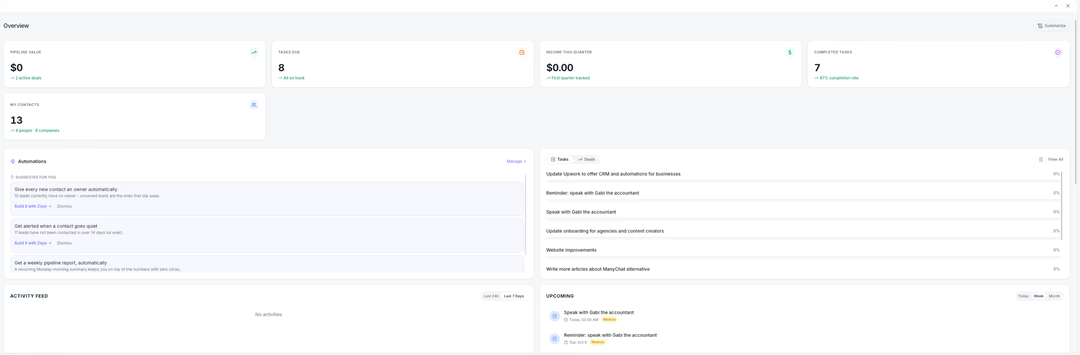 The Zoye overview: pipeline value, tasks due, suggested automations and upcoming tasks on one screen
What Zoye costs (pricing page, November 2026): a workspace is priced by plan, never by contact or by email sent. Almost Free ($5 a month, or $4 a month billed yearly, one member) and Starter cover the core tools without automations; the rules, lead-ad sync, comment replies and times offered in chat above start on Growth. Starter costs $29 a month or $23 a month billed yearly and seats 5 members; Growth, $59 a month or $47 a month billed yearly, seats 10; Scale, $119 a month or $95 a month billed yearly, seats 30; Customize is quoted. The pricing page lists what each plan contains.
Honest limits. Zoye is not a funnel or page builder: there are no sales pages, order bumps or checkout funnels. It is not a course or membership platform. It does not include a phone system for calls and texting, and it does not run ads; it captures and works the leads ads produce. If funnels and courses are how you make money, keep ClickFunnels or HighLevel for that job, and judge Zoye only on what happens after the lead arrives.
Ready to hand off the busywork?
Zoye brings AI-powered CRM, task management, and automation into one workspace.
Get StartedHow to decide in five questions
Answer five questions honestly and the choice usually makes itself: where you make money, how many brands you run, whether you text and call customers, how large your list is, and how much build time you have. Funnels and checkouts point to ClickFunnels; clients, calls and texts point to HighLevel.
- Where is the sale made? On a checkout page: ClickFunnels. In a call, a chat or a booked meeting: HighLevel, or a follow-up tool next to your page builder.
- How many brands or clients? One: either works. Four or more clients you manage: HighLevel Unlimited. Reselling software: HighLevel Founder (formerly Agency Pro).
- Do you text and call customers? If yes, HighLevel's built-in phone service saves you a second vendor. If rarely, ClickFunnels plus your own Twilio account is fine.
- How big is your list, and how fast is it growing? ClickFunnels' contact caps (10,000, 75,000, 150,000) can force upgrades; HighLevel never caps contacts but bills each send.
- Who builds it? If you will build it yourself in the evenings, ClickFunnels is the shorter road. If an agency builds it, HighLevel's depth pays off.
If you are still choosing between several all-in-one platforms, our guides to the best GoHighLevel alternatives and the best Kartra alternatives sort the wider field by buyer type. Whichever you pick, start the 14-day trial with one real offer, not a test page, and count leads answered and sales closed by the end of it.
Related reading
- GoHighLevel pricing
- Best GoHighLevel alternatives
- Best Systeme.io alternatives
- GoHighLevel vs HubSpot