Quick answer: a chatbot for insurance pays for itself on three jobs: taking quote requests in full, starting renewal conversations before the date, and keeping policyholders informed while a claim moves. It must stop short of advice. Recommending coverage, comparing policies for a person or saying whether a loss is covered stays with a licensed human, and the bot's real skill is handing over cleanly.
Key takeaways (October 2026)
- Shoppers collected 3.5 quotes on average and 48% of new auto policies were bought digitally, per J.D. Power's 2026 U.S. Insurance Shopping Study of 12,437 customers.
- In J.D. Power's 2026 Property Claims Satisfaction Study, 45% of customers received claim updates digitally and final payment took 40.7 days on average.
- 25 US jurisdictions had adopted the NAIC model bulletin on insurers' use of AI by 1 April 2026, per the NAIC's own implementation map.
- Meta has charged for each delivered WhatsApp message since 1 July 2025; from 1 October 2026, every business number receives a monthly allowance of 1,000 free service messages.
- The six tools below start at $0 (Dante AI's free tier) and reach $109 a month billed yearly (SleekFlow Pro) before message fees.
What can a chatbot for insurance do, and where does it stop?
An insurance chatbot should gather facts, send reminders and pass on updates, and it should stop the moment a question needs judgement about coverage. It can ask what a person wants insured and when, remind them a policy renews, and say their claim file moved. It cannot recommend a policy, promise a price or decide a claim.
That split is not caution for its own sake. Insurance runs on licensed advice and on carrier decisions, and a chatbot is neither. What it can be is the part of the agency that never sleeps: the first reply at 10 p.m. when someone wants a quote, the nudge 45 days before a renewal, the message that says "your adjuster has been assigned" so nobody has to call the office to ask.
Think of the work in two columns.
What the bot does well:
- Asks the same intake questions every time, in the same order, and saves the answers to the right fields.
- Answers general, approved questions: office hours, which lines the agency writes, what documents a quote needs, how to report a claim.
- Sends reminders on a schedule tied to dates on the client record.
- Relays a status that a person on your team recorded.
- Hands the conversation to a named person with everything said so far.
What the bot must never do:
- Recommend a coverage type, a limit, a deductible or a carrier.
- State or estimate a premium that a licensed person has not quoted.
- Say a loss is covered, not covered or likely to be paid.
- Ask for more personal data than the job needs.
- Pretend to be human.
If you keep these two lists on the wall while you build, most of the hard decisions are already made. Our CRM for insurance agents guide covers the record side of an agency in depth; this article stays on the conversation.
Job 1: quote intake a licensed person can actually quote from
Quote intake is the job where a chatbot earns the most, because a half-filled request costs an agent two extra calls. The bot's task is to collect the facts the quoting person needs, check the obvious gaps, confirm consent to be contacted, and put the finished request in front of a licensed agent quickly.
Speed matters here for a measurable reason. J.D. Power's 2026 U.S. Insurance Shopping Study, released in June 2026 and reported by CBT News, found that shoppers collected 3.5 quotes on average, the highest in the study's history, and that 53% of customers were shopping for auto insurance, down from 57% a year earlier. A shopper comparing three or four agencies tends to engage with whoever comes back first with a complete answer. A bot that turns a vague "how much for my car" into a complete request in five minutes gives the agent a head start.
The questions differ by line of business. The table below shows a general shape, not a carrier's form. Your carriers' quoting tools decide the real list, and the bot should ask only what they require.
| Line | What the bot collects | What it leaves for the licensed person |
|---|---|---|
| Personal auto | Drivers, vehicles, current insurer and renewal date, preferred start date | Limits, deductibles, coverage recommendations |
| Home or renters | Property type, rough age and size, occupancy, current policy end date | Replacement cost judgement, endorsements |
| Small business | Business activity in their words, headcount, revenue band, policies held now | Which policies the business needs, classification |
| Life or health | Only contact details, preferred time and the general need | Every health question, every product comparison |
Two design rules make intake work. First, ask in chunks of two or three questions, and confirm before moving on, because a chat that feels like a 30-field form gets abandoned. Second, keep sensitive data out of chat. Health details, full government ID numbers and payment card numbers belong in a secure form or a call with a licensed person, not in a messaging thread. Under the EU's GDPR, health data is a special category with stricter rules, and many US states have their own privacy laws, so the safest rule is to collect the minimum.
End every intake with a clear handover line: who will quote, roughly when, and how they will reach out. Then make sure that happens. Our guide to a WhatsApp lead qualification bot explains how to choose the fewest questions that still sort serious requests from browsing.
Job 2: renewals that start weeks before the date
A renewal chatbot does one thing well: it opens the conversation early enough that a licensed person has time to review the policy before the client starts shopping. It works from the renewal date on the client record, sends a short reminder on a schedule, and books a review call for anyone who wants one.
Renewal season is when retention is won or lost, and price changes push people to shop. A bot that only fires a reminder two days before the date is too late to help. A practical schedule, offered here as an illustration rather than a rule, looks like this:
- 45 days out: a short note that the policy renews on a given date, with an offer to review it with the agent.
- 30 days out: if no reply, a second note asking whether anything changed this year: a new driver, a move, a new vehicle, a new employee.
- 15 days out: a task for the account owner to call personally, because silence this close to a renewal is a retention risk.
- Renewal day: a thank-you message once the policy has renewed, with how to reach the office.
The bot's reminder must not quote a new premium or suggest switching coverage. It says the date, asks about changes, and offers a person. That keeps it inside the advice line while still doing the job that matters most: making sure the review happens before the client has three competing quotes in hand.
On WhatsApp, the first reminder usually arrives after more than 24 hours of silence, so it has to be a pre-approved template. Renewal reminders typically fit Meta's utility category, and since 1 October 2026 utility templates sent inside an open customer service window are charged again, per Meta's developer documentation on pricing. Plan the count of reminders with that in mind. Our walkthrough of a WhatsApp follow-up sequence covers spacing and stop conditions in more detail.
Job 3: claims status updates without promising an outcome
For claims, a chatbot is a messenger, not a decision maker. It can take a first notice of loss in general terms, collect photos and the claim number, and tell the policyholder when the file moves to the next stage. It never says whether something is covered or how much will be paid.
Policyholders feel the length of a claim more than almost anything else in insurance. J.D. Power's 2026 U.S. Property Claims Satisfaction Study, reported by Insurance Journal in March 2026 and based on 5,093 homeowners, found an average repair time of 29.6 days and an average of 40.7 days to final payment. The same study found that 38% of customers reported their first notice of loss digitally and 45% received updates digitally, and it lists "communicated with me how and when I want" among its satisfaction factors. On the auto side, J.D. Power's 2025 U.S. Auto Claims Satisfaction Study, reported by Autobody News, put the average repair cycle at 19.3 days and total losses at 27% of claims.
Six weeks is a long time to wonder. Most "where is my claim" calls to an agency are not complaints; they are people who heard nothing. A claim kept as a card on a board with clear stages lets the bot send a short update every time the card moves. A typical set of stages:
- Reported: the agency has the details and has passed them to the carrier.
- Claim number issued: the carrier's reference is on file.
- Adjuster assigned: someone at the carrier owns the file.
- Inspection or estimate: a visit, photos or an estimate is in progress.
- Decision from the carrier: the agency has the carrier's answer and a person will call.
- Payment issued or closed: the carrier has paid or closed the file.
Notice the fifth stage. When the carrier decides, the bot does not deliver the news; it tells the policyholder a person will call. Coverage outcomes, partial payments and denials need a human voice and a licensed explanation. In the US, claims handling is governed by unfair claims settlement practices laws based on an NAIC model act, and the safest pattern for an agency's bot is to stay entirely out of the decision.
Want to see it in action?
See Zoye catch a new lead, answer on WhatsApp and set up the follow-up, all from one message.
See How It WorksThe advice line: licensing, AI rules and data
The advice line is simple to state: a chatbot may inform, collect and remind, but anything that recommends, interprets coverage or decides a claim needs a licensed human. Regulators are also asking how AI that touches consumers is governed, and an agency should be able to show what its bot is allowed to say.
Licensing. Under state producer licensing laws modelled on the NAIC's Producer Licensing Model Act, selling, soliciting or negotiating insurance requires a licence. A bot answering "which policy should I get?" is drifting into that territory. Give it an exact handover line for any question that starts with "should I", "is it worth", "am I covered" or "which is better".
The NAIC model bulletin. The NAIC adopted its model bulletin on the use of artificial intelligence systems by insurers on 4 December 2023. It reminds insurers that decisions made or supported by AI must comply with existing insurance laws, including those on unfair trade practices and unfair claims settlement. The NAIC's implementation map showed 25 jurisdictions with the bulletin adopted and 4 more with insurance-specific AI regulation or guidance as of 1 April 2026. The bulletin is addressed to insurers, not agencies, but carriers that appoint you may ask how any AI that speaks to their policyholders is controlled.
The EU AI Act. Annex III of the EU AI Act lists AI systems used for risk assessment and pricing of natural persons in life and health insurance as high-risk. A chatbot that only collects contact details and books a call is a very different thing from a pricing model, and keeping it that way keeps the compliance work light.
Disclosure and records. Say at the start that the customer is talking to an automated assistant, and say it again when a person takes over. Keep every conversation on the client record, so a question about what was said can be answered from the log, not from memory. This is general information about the rules, not legal advice; your compliance lead or counsel should review the bot's script before it goes live.
Channel rules for WhatsApp, Instagram and Facebook in 2026
Policyholders now message agencies on WhatsApp, Instagram and Facebook, and each channel has its own clock. On WhatsApp, a business may reply freely for 24 hours after the customer's last message; on Instagram and Messenger, the same 24-hour window applies, with up to 7 days after an ad click. Outside those windows the rules narrow sharply.
WhatsApp, as of October 2026 per Meta's developer documentation:
- An agency bot needs the official WhatsApp Business Platform. The free Business app has greeting and away messages and quick replies, which are useful but are not a chatbot.
- Free-form replies are allowed within 24 hours of the customer's last message. After that, only a pre-approved template can open the conversation again.
- Pricing is per delivered message, set by message category and the recipient's country, a model in place since 1 July 2025. A monthly allowance of 1,000 free service messages per business number started on 1 October 2026, and the same date ended the free ride for utility templates sent inside an open window.
- When a person taps a click-to-WhatsApp ad in the Android or iOS app and you answer in time, Meta waives message charges for up to 7 days.
- Since 15 January 2026, general-purpose AI assistants, where the AI itself is the product, are barred from the Platform. An agency's own bot for intake, reminders and updates is business-specific and allowed.
Meta's rate card shows the price per message by country; check your market there. Our WhatsApp Business API pricing guide explains the categories.
Instagram and Facebook, per Meta's messaging policy: a reply is allowed within 24 hours of the person's message, or up to 7 days after a first message that follows a click-to-Instagram or click-to-Messenger ad. A comment can receive one private reply within 7 days. Cold messages to people who never engaged are not allowed, and bots should say they are automated. Instagram automation needs a Business or Creator account linked to a Facebook Page through an approved Meta app.
For an agency, the practical effect is this: renewal reminders and claim updates that arrive days apart will mostly travel as templates, while quote intake usually happens inside an open window right after someone writes in.
6 insurance chatbot options compared
These six cover what a small or mid-sized agency will realistically consider in 2026: an AI operator built around messaging and the client record, a messaging inbox with AI agents, a WhatsApp campaign platform, two website chatbots and an AI support platform. Each entry states the trade-off, then the price from the vendor's own page as of October 2026.
1. Zoye - for agencies whose clients write on WhatsApp, Instagram and Facebook
Zoye is not an agency management system. It does not hold carrier downloads, rate policies, track commissions or file claims with carriers, and it does not replace your comparative rater. If you need those, keep your AMS and see the CRM for insurance agents comparison for the specialist tools.
What Zoye does is make the three jobs above live on the same record. It is an AI Business Operator, which means the CRM, deals, tasks, calendar, invoices, documents, reports, both kinds of automation, Facebook and Instagram, email tracking and the AI Notetaker sit in one workspace, linked record to record, and an AI operates them.
- Quote intake: the qualification bot asks your intake questions on WhatsApp and writes each answer into a field on the contact, then hands the request to the licensed person who owns it, with the whole chat on the lead's card. Lead-ad form submissions from Facebook and Instagram arrive as contacts too, with the campaign and ad name saved.
- Renewals: a renewal date is a field on the record. Describe the rule, for example "45 days before the renewal date, send the renewal reminder and create a call task for the account owner", and Zoye builds it, shows it to you, and waits for your approval before it runs.
- Claims: keep each claim as a card on a board with your stages. When someone on the team moves the card, a rule can send the policyholder an approved update message. The decision stage hands over to a person.
Zoye runs on the official WhatsApp Business Platform and holds the WhatsApp conversations with your leads; the option to connect your own business WhatsApp number is coming soon. Its six WhatsApp automations start switched off, each one confirms with you before a message leaves, and the agent on WhatsApp page explains them. Chats is one inbox for Instagram and Facebook messages and comments plus those WhatsApp conversations, with assignment, team notes and quick replies. Every run is logged and reversible, and if Meta rejects a message you are told why. Moving from another tool is simple: imports come from Trello, Monday.com and spreadsheets today, and the assistant can pull records out of a CSV, PDF or screenshot you send it.
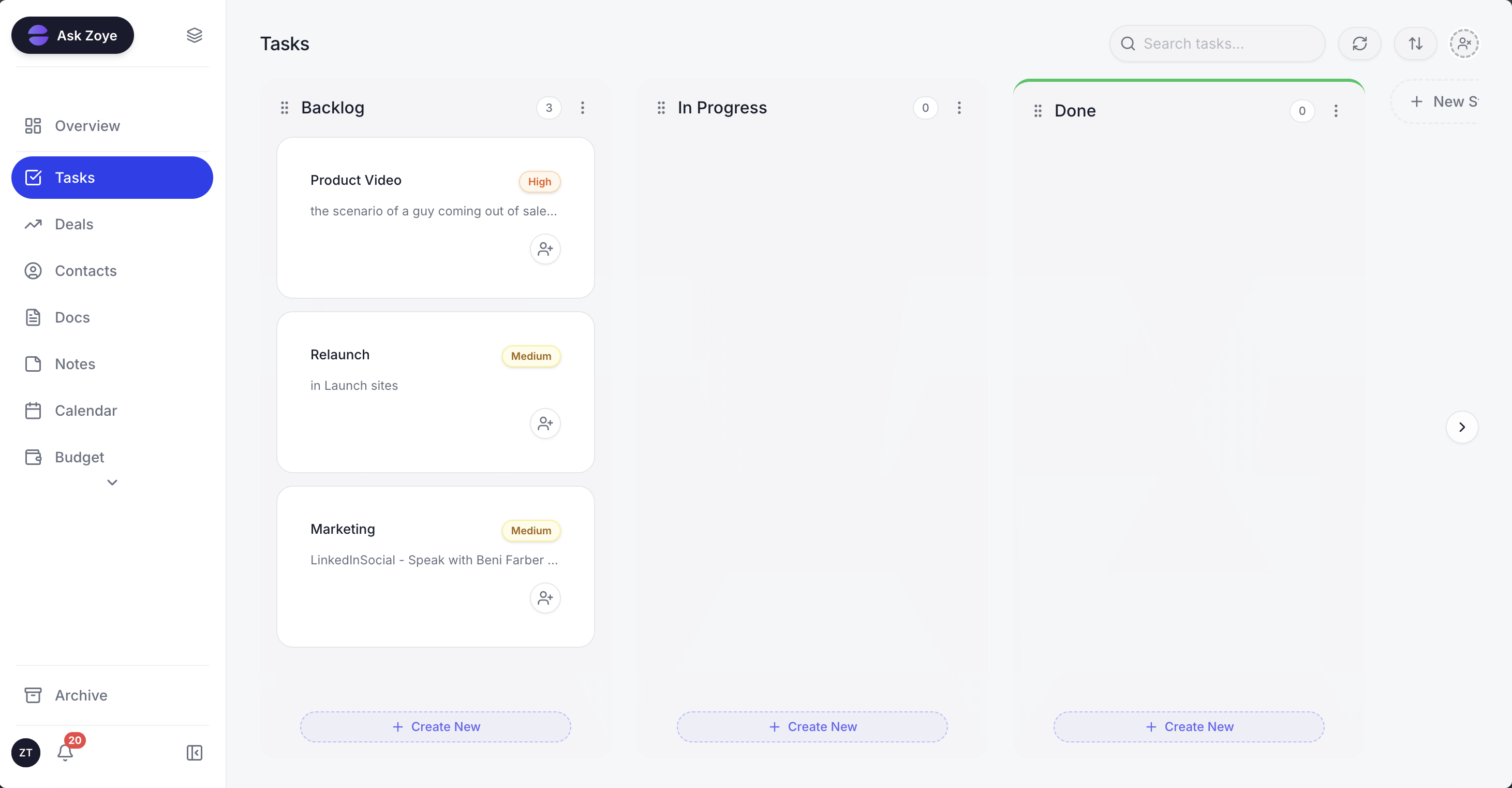
Each claim sits on a board with its stage, owner and next step, so a status update goes out when the card moves instead of when a client calls.
Pricing (as of October 2026): the $5 Almost Free plan ($4 a month billed yearly) is for 1 member and covers the core tools, 15 AI prompts a month and the Google integrations; automations are not in it, so it will not run the workflows described here. For teams, Starter costs $29 a month or $23 billed yearly with room for 10 members, Growth is $59 or $47 with 20, Scale is $119 or $95 with 100, and Customize is priced on request. The pricing page shows which plans include the automations.
Best for: independent agencies and small brokerages that sell and service through messaging and want each chat tied to a client, a task and a date.
2. SleekFlow - a messaging inbox with AI agents on the Pro plan
SleekFlow brings WhatsApp, Instagram, Messenger and other channels into one inbox and publishes material aimed at insurers. The trade-off is that AI agents start on Pro, and costs grow with monthly active contacts.
Pricing (as of October 2026): Essential is US$49 a month billed yearly for 3 users and 500 monthly active contacts, with an AI inbox co-pilot. Pro is US$109 a month billed yearly for 10 users with AI agents included. Premium is US$279 billed yearly. WhatsApp number hosting costs US$15 a month, plus Meta's charges, and SleekFlow notes that prices vary by region.
Best for: agencies with several service staff who want an omnichannel inbox first.
3. Wati - WhatsApp campaigns with a no-code bot builder
Wati is built around WhatsApp broadcasts, a shared inbox and a chatbot builder, which suits renewal campaigns. Its Astra AI agents are sold separately, and there is no figure for them on the pricing page.
Pricing (as of October 2026): Growth is $59 a month billed yearly for 3 users with 250 AI Co-pilot credits. Pro is $119 a month billed yearly for 5 users, with extra users at $39 each. Business is quoted. Extra WhatsApp numbers cost $29 a month each, and Meta's message charges are billed separately.
Best for: agencies whose WhatsApp work is mostly scheduled reminders and campaigns.
4. Tidio - a website widget with a separate AI meter
Tidio is a well-liked website chat with Flows for scripted paths and the Lyro AI agent for open questions. For an agency, it works best as the quote-request door on the website. The bill has more than one meter.
Pricing (as of October 2026): Free for 50 billable conversations, Starter at $24.17 a month for 100, Growth from $49.17 for 250 or more, and Plus from $300 a month plus usage. Lyro starts at $32.50 a month for 50 AI conversations. Tidio's pricing page says customers average a 75% resolution rate with Lyro. Our best Tidio alternatives review covers when agencies outgrow it.
Best for: agencies where most new business starts on the website.
5. Intercom - a strong AI agent for a service team with a help centre
Intercom's Fin answers from your help content and can run multi-step workflows. For a larger agency with a policyholder help centre, it can absorb many routine questions. The trade-off is two meters, seats and outcomes, and the price adds up quickly.
Pricing (as of October 2026): seats run $29 a month on Essential (the page shows $19 for new customers), $85 on Advanced and $132 on Expert. Every plan adds $0.99 for each Fin outcome. WhatsApp is charged pay-as-you-go per conversation, with no rate printed on the pricing page.
Best for: service teams with a maintained knowledge base and steady volume.
6. Dante AI - a low-cost website chatbot trained on your content
Dante AI lets you train a chatbot on your own documents and pages and put it on your site, with voice on paid plans. The pricing page does not name WhatsApp, Instagram or Messenger, so it fits the website door only.
Pricing (as of October 2026): a free tier with up to 100 messages a month and 1 AI agent; Starter at $40 a month ($33.33 billed yearly) for up to 2,000 messages; Advanced at $120 for 8,000 messages and 3 agents; Pro at $400 for 30,000 messages and 10 agents. Unused credits do not carry over.
Best for: a solo agent who wants an always-on answer box on the website for general questions.
Insurance chatbots side by side
The table compares the six on the three jobs, the channels each one covers and the entry paid price. Prices come from each vendor's own page as of October 2026, before Meta's message charges.
| Tool | Strongest of the three jobs | Channels | Handover to a person | Entry paid price |
|---|---|---|---|---|
| Zoye | All three on one client record | WhatsApp (own number coming soon), Instagram, Facebook | Whole chat on the lead's card, owner assigned | $59/mo Growth, up to 20 members |
| SleekFlow | Service questions across channels | WhatsApp, Instagram, Messenger and more | Shared inbox | US$49/mo yearly; AI agents from US$109 |
| Wati | Renewal reminders as campaigns | WhatsApp first; inbox adds Facebook and Instagram | Shared inbox | $59/mo yearly Growth |
| Tidio | Quote intake on the website | Website widget, messaging integrations | Live chat inbox | $24.17/mo Starter; Lyro from $32.50/mo |
| Intercom | Policyholder service questions | Website, email, WhatsApp pay-as-you-go | Agent inbox | $29/seat Essential plus $0.99 per Fin outcome |
| Dante AI | General questions on the website | Website, voice | Inbox handoff from Advanced | $40/mo Starter |
See what Zoye can do for you
CRM, deals, tasks and your Instagram, Facebook and WhatsApp automations in one workspace. Just ask Zoye and it sets any of it up for you.
Explore FeaturesWhat does an insurance chatbot cost each month?
For a small agency, the software usually costs between nothing and about $250 a month, plus Meta's message charges if WhatsApp is involved. The meter decides the real bill: seats, AI conversations, outcomes or active contacts can each turn a low sticker price into a high one when renewal season arrives.
Here is an illustrative month for a 4-person agency with 120 quote requests, 300 renewal reminders and 60 open claims, using October 2026 list prices. These are estimates, because every vendor counts conversations and outcomes differently.
- Zoye Growth: $59 a month for up to 20 members, which brings in the WhatsApp automations and workflow automations, with contacts, renewal dates, claim boards and tasks in the same plan. Meta's charges apply to the WhatsApp messages.
- SleekFlow Pro: US$109 a month billed yearly for 10 users with AI agents, plus US$15 for WhatsApp number hosting and Meta's charges. If the reminders reach more than 500 active contacts, extra contacts cost US$20 per 100.
- Wati Pro: $119 a month billed yearly for 5 users, plus Meta's charges, with Astra AI agents priced separately.
- Intercom Essential: 4 seats at $29 is $116, plus $0.99 for every outcome Fin delivers. If Fin resolves 120 questions in the month, that adds about $119.
- Tidio plus Lyro: Growth from $49.17 and Lyro from $32.50 covers the website side; WhatsApp reminders would need another tool.
The hidden cost is Meta. Three hundred renewal reminders sent as templates are charged per delivered message at your country's utility or marketing rate, and in-window utility templates are charged again since October 2026. Replies to clients inside the 24-hour window fall under the 1,000 free service messages per number each month. Check Meta's rate card before you plan a renewal campaign.
The other cost is time. A rule-based bot with dozens of branches needs someone to update it whenever a carrier changes its intake form. Write the script once, review it each quarter, and keep the branches few.
Sample messages for the three jobs
Short, plain messages perform best because they are read on a phone between other things. The lines below are illustrative starting points, with merge fields shown in braces. Adjust them with your compliance lead, and submit any message you send outside the 24-hour window as a template for Meta's approval.
Quote intake, first reply: "Hi {first_name}, thanks for asking about a quote. I am the agency's automated assistant. A few quick questions so a licensed agent can prepare it: what would you like to insure, and when should cover start?"
Quote intake, handover: "Thank you, that is everything we need for now. {agent_name} will review it and contact you by {day}. If anything changes before then, just reply here."
Renewal, 45 days out (template): "Hello {first_name}, your {policy_type} policy renews on {renewal_date}. Would you like a short review call with {agent_name} before then? Reply YES and we will suggest a time."
Renewal, 30 days out (template): "Hi {first_name}, a quick check before your renewal on {renewal_date}: has anything changed this year that we should know about? Reply here and {agent_name} will take a look."
Claim, stage update (template): "Hi {first_name}, an update on claim {claim_number}: {stage_description}. Nothing is needed from you right now. Reply here if you have questions."
Claim, decision stage: "Hi {first_name}, the carrier has responded on claim {claim_number}. {agent_name} will call you today to go through it."
Every message names a person and gives a next step. None of them quotes a price, compares a policy or explains a coverage decision.
Ready to hand off the busywork?
Zoye brings AI-powered CRM, task management, and automation into one workspace.
Get StartedMistakes that cost agencies trust
Most insurance chatbot failures come from the script, not the software: a bot that sounds like it is advising, asks for too much data, hides the human or keeps messaging after the client has gone quiet. Each one is avoidable with a rule written before launch.
- Advice by accident. "This policy is a good fit for you" is a recommendation. Replace it with "a licensed agent will review options with you".
- Over-collecting. Asking for health details or full ID numbers in a chat creates a privacy risk you do not need. Collect the minimum and move sensitive items to a secure channel.
- Coverage guesses on claims. "That should be covered" sets an expectation the carrier may not meet. The bot reports stages, never outcomes.
- No visible way to reach a person. Offer "talk to a person" in the first message, and honour it within business hours.
- Ignoring the messaging windows. Sending free-form WhatsApp messages days after the last reply, or messaging people who never engaged, can get a number or account restricted.
- Reminders that never stop. Stop the sequence when the client replies, books a review, renews or asks to opt out.
- Chats that never reach the record. A quote request that lives only in a chat app is lost when the thread scrolls away.
Which chatbot should your agency choose?
Choose by where clients write first and by which of the three jobs costs you the most time today. A website-led agency starts with a widget, a large service team looks at an AI support platform, and an agency that sells and services through messaging needs a tool where the chat, the client record and the renewal date are one thing.
- Most new business comes through the website, small budget: Dante AI or Tidio.
- A service team with a maintained help centre: Intercom, budgeted per outcome.
- Renewal campaigns on WhatsApp first: Wati.
- An omnichannel inbox for several service staff: SleekFlow Pro.
- Clients on WhatsApp, Instagram and Facebook, and quotes, renewals and claims that should each end in a task with an owner and a date: Zoye.
Whichever you choose, test it for two weeks on one channel and count outcomes, not chats: complete quote requests handed to an agent, renewal reviews booked, and "where is my claim" calls that stopped coming in.
If your clients already write to you on WhatsApp, Instagram and Facebook, book a Zoye demo and bring a week of real quote requests and renewal questions to test against.