Quick answer: Twilio is excellent infrastructure for teams that write code, and a heavy lift for teams that do not. If you have no developer and simply need WhatsApp and SMS to reach customers, the best Twilio alternative is a finished app: Zoye if replies should turn into customers, deals and follow-ups, Wati if you mainly need a WhatsApp inbox. If you have engineers and want a cheaper or simpler API, compare Bird, Plivo, Sinch, Vonage, Infobip and 360dialog.
Key takeaways (October 2026)
- Twilio lists US SMS at $0.0083 per segment, inbound or outbound, plus carrier fees such as $0.0035 (AT&T) or $0.0045 (T-Mobile) per outbound message, and $1.15 a month for a long code number.
- US business texting needs A2P 10DLC registration on every provider. Twilio's page lists a $4 or $44 one-time brand fee, $15 vetting per campaign and $1.50 to $10 a month per campaign.
- Twilio's WhatsApp fee is $0.005 per message, inbound or outbound, plus Meta's charge; failed messages cost $0.001 each.
- The cheapest published US SMS base rate in this comparison is Bird's $0.0035 per long-code segment; Plivo lists $0.0077 and Sinch $0.0078.
- Six of the eight options are still APIs. Only Zoye and Wati are apps a non-technical team can run from day one.
Why people look for a Twilio alternative
Most teams leave Twilio for one of three documented reasons: the bill has more lines than expected, US texting needs paid registration before it works properly, and nothing happens without code. As of October 2026, none of these are hidden; they are on Twilio's own pricing and documentation pages. They just land differently on a team without engineers.
1. It is a developer platform, by design. Twilio sells programmable building blocks: send an SMS, receive a webhook, run a flow. There is no contact list, no shared inbox for your team and no follow-up reminder until someone builds them. Twilio's own contact-centre product, Flex, exists for staffed support teams and is a separate purchase. For a product company with engineers, that flexibility is the point. For a 5-person business that wanted texts and WhatsApp messages to go out, it means a project.
2. The SMS bill has several parts. Twilio's US SMS pricing page, labelled current as of October 2026, lists:
- $0.0083 per segment, sent or received, on long code, toll-free and short code numbers.
- Carrier fees on top, listed per carrier: for long codes, $0.0035 per outbound SMS on AT&T, $0.0045 on T-Mobile and $0.005 on US Cellular.
- $1.15 a month for a long code number, $2.15 for toll-free, and $1,000 a month (billed quarterly) for a random short code.
- $0.022 per outbound MMS.
- A $0.001 processing fee on every message that ends in a failed status.
A segment is not a message. Twilio's documentation explains that a segment holds 160 characters in standard GSM-7 encoding, and only 70 once a message contains an emoji or a non-Latin script. A friendly reminder with one emoji can quietly cost two or three segments.
3. US texting needs A2P 10DLC registration. US carriers require businesses that text from ordinary 10-digit numbers to register a brand and a campaign. Twilio's 10DLC page, as of October 2026, lists a one-time brand registration of $44 for Standard or $4 for Low-volume standard and Sole proprietor, plus $15 per campaign for vetting, plus $1.50 to $10 per campaign per month. Twilio's documentation also warns that unregistered traffic incurs additional carrier fees. Twilio's help centre article with the detailed fee schedule would not load for us, so confirm the current figures when you register.
4. WhatsApp is pipes, not an inbox. Twilio's WhatsApp pricing page lists $0.005 per message, inbound or outbound, with Meta's fee passed through on top and the same $0.001 failed-message fee. Studio, Twilio's visual flow builder, includes 1,000 executions a month and then charges $0.0025 per execution. Link shortening, click tracking and scheduling sit in an add-on at $0.015 per message after the first 1,000 each month. All of it is reasonable for a developer; none of it is a screen where a salesperson answers a lead.
What Twilio does well, and who should stay
Twilio is the right choice when messaging is part of your own product: login codes, delivery alerts, in-app chat, or a custom contact centre your engineers maintain. Its documentation, global reach and reliability are why so many software companies build on it. If that describes you, a cheaper API may save cents, but a switch rarely saves the project.
Stay on Twilio if:
- Engineers already maintain your integration and it works. Migration has its own cost: re-registering 10DLC campaigns, re-approving WhatsApp templates and rewriting webhooks.
- Messaging lives inside your product, such as one-time passcodes or order notifications that your app triggers.
- You use several Twilio products together, such as voice, SMS, WhatsApp and email, and value one vendor and one bill.
Look elsewhere if nobody on the team writes code, if your WhatsApp and SMS conversations are really sales and service conversations, or if the person who built the integration has left and nobody dares touch it.
What to look for in a Twilio alternative
Start by deciding whether you need an API or an app. An API sends messages that your own software controls; an app gives your team a place to read, answer and follow up. Most disappointment comes from buying the first when you needed the second, so answer the checklist below before you compare prices.
- Who will run it? If the honest answer is "the owner and two staff", rule out anything that needs code to send a first message.
- Which channels, and where? WhatsApp dominates in much of the world, while US promotions still lean on SMS. As of October 2026, Meta's developer documentation states that marketing templates are not currently delivered to US phone numbers, which matters if your customers are there.
- Is it official? For WhatsApp, insist on the official WhatsApp Business Platform. Tools that automate WhatsApp Web or a modified app put the number at risk.
- What does the full bill look like? Ask for the platform fee, Meta's pass-through, any markup, number rental, registration fees, failed-message fees and per-user charges, in writing.
- Where does a reply land? A provider that hands you a webhook is very different from a tool that puts the reply on a customer record with an owner.
- How is consent handled? Opt-outs such as STOP should be honoured across every future send automatically.
- What happens when something fails? A rejected template or a blocked number should come back as a plain reason, not a silent gap.
- Can you leave? Check how numbers, WhatsApp senders and contact history move if you switch again.
Meta's rules apply to every WhatsApp provider in this list equally. Meta has billed per delivered message since 1 July 2025, by category and recipient country, and since 1 October 2026 each business number gets 1,000 free service messages a month. Outside the 24-hour customer service window, only approved templates can be sent. Our WhatsApp Business API pricing guide walks through the categories.
The 8 best Twilio alternatives in 2026
These eight cover both paths: two apps a non-technical team can run, and six messaging providers for teams that still want an API. Each entry opens with the catch, then the October 2026 price from the vendor's own page and the business it fits. Meta's per-message charges come on top of every WhatsApp price below.
1. Zoye: WhatsApp that runs the business, with no integration to build
Zoye is not a messaging API. It is an AI Business Operator: one workspace with thirteen tools that already link to each other, including CRM and contacts, deals, tasks, calendar, documents, invoices, reports and WhatsApp automations, plus an AI that operates them. For a team that only reached for Twilio because "we need WhatsApp to work", Zoye removes the build entirely.
Zoye runs on the official WhatsApp Business Platform (Cloud API). Its six WhatsApp automations are all off by default and all confirm before anything sends:
- A new-lead auto-message with per-source switches (ads, forms, website, API, manual) and one message per person.
- A lead qualification bot that writes the answers straight into CRM fields.
- Smart audiences that stay live as records change.
- Scheduled broadcasts with merge fields per recipient and pacing.
- Template approval handled for you: Zoye categorizes the template, submits it to Meta, tracks the status and resubmits edits.
- Click-to-chat capture, so a tap on your WhatsApp link becomes a contact with a source.
The compliance work a developer would otherwise write is built in. Each automation asks for consent confirmation, first messages and anything more than 24 hours after the customer's last reply use an approved template automatically, every outbound message carries an opt-out, STOP is honoured across the workspace, and nobody receives the same message twice. If Meta rejects a send, you are told why.
Replies land in Chats, one inbox for Instagram and Facebook messages and comments plus the WhatsApp conversations Zoye has with your leads, with assignment, team notes and quick replies, and every conversation saved on the contact's card. From there a lead can be offered times from one Booking list with automatic reminders, receive a payment link in the chat (Stripe, or Grow in Israel), and move to the next deal stage when it pays. The owner can also run the business from WhatsApp: ask for this week's overdue invoices, send a voice note with three requests, or photograph a business card and get a contact. To change how anything works, describe what should happen in the app, on WhatsApp or in Slack; Zoye builds the rule, shows it in plain English and waits for your approval. More on the WhatsApp automations page.
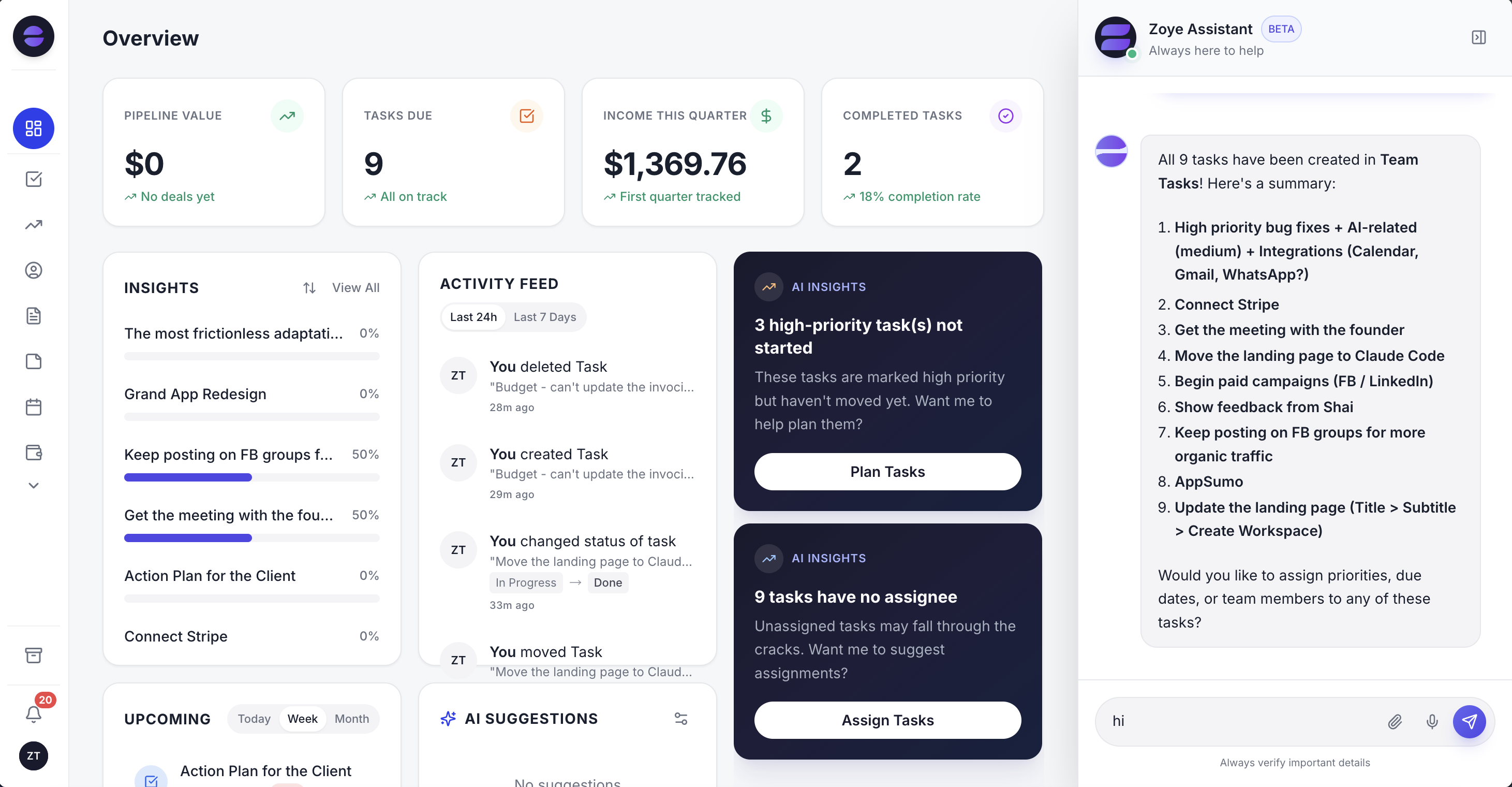
The Zoye overview puts deals, tasks and recent conversations side by side, so a WhatsApp reply is never separated from the customer it belongs to.
Honest limits. Zoye does not send SMS, so a US business that depends on text promotions should keep an SMS provider for that channel. Connecting your own business WhatsApp number is coming soon; today Zoye holds the WhatsApp conversations with your leads through the official Platform. Zoye is not an API for embedding messages in your own app, not a bulk-sender, not a helpdesk ticketing suite, and it does not run ads.
Pricing (as of October 2026): Almost Free $5 a month ($4 billed yearly) for 1 member with the core tools, 15 AI prompts a month and the Google integrations, without automations. Starter $29 a month ($23 yearly) for 10 members and 5GB, Growth $59 ($47) for 20 members and 10GB, Scale $119 ($95) for 100 members and 25GB, and Customize on quote. You pay per workspace plan, not per message segment or per registration. See pricing.
Best for: small teams with no developer whose WhatsApp conversations are really sales, bookings and follow-ups.
2. Bird (formerly MessageBird): the lowest published SMS rate
Bird is still an API-first provider, so the catch is the same as Twilio's: someone has to connect it to whatever your team uses. What it changes is the price. Bird's pricing page also lists email, an inbox, automations and other products, which makes it a broader platform than a pure SMS pipe.
Pricing (as of October 2026): Bird's SMS pricing page lists US outbound SMS at $0.0035 per segment on long code and toll-free, and $0.0070 on short code, with carrier fees charged separately. A US local number is $0.50 a month. No monthly plan is required for pay-as-you-go; plans with a monthly balance start at $15. On WhatsApp, Bird lists a $0.005 fee per outbound message in every category, with Meta's fee billed separately and inbound messages not charged.
Best for: teams with a developer who send a lot of US SMS and want the base rate to drop by more than half.
3. Vonage: an established API family, with prices you must find yourself
Vonage, the API business formerly known as Nexmo and owned by Ericsson, offers SMS, WhatsApp, voice and video APIs. Like Twilio, it expects a developer to wire it up. The practical catch for a small buyer is transparency: we could not read a single US price.
Pricing (as of October 2026): Vonage's US pricing pages blocked automated reading when we checked. Its UK messages pricing page says WhatsApp is billed per delivered message and that every channel includes a Vonage platform fee on top of carrier or provider fees, without showing a figure. Request the rate card for your countries before comparing.
Best for: companies that already use Vonage for voice or video and want messaging from the same vendor.
4. Plivo: a leaner API with Twilio-style building blocks
Plivo positions itself as a direct, lower-cost alternative to Twilio, with SMS, voice and WhatsApp APIs. It is just as developer-centred, so it solves the price question rather than the "who builds it" question.
Pricing (as of October 2026): Plivo's US SMS page lists $0.0077 per SMS on long code and short code and $0.0079 on toll-free, the same rate inbound and outbound, plus carrier surcharges such as $0.0035 on AT&T and $0.0045 outbound on T-Mobile. A long code number is $0.50 a month and toll-free $1.00. The 10DLC registration fees are not listed on that page. Plivo's WhatsApp page lists a platform fee of $0.001 per message, inbound and outbound, plus $10 a month for each WhatsApp Business Account; it says the fee applies from 1 November without giving a year, so confirm whether it is already in force.
Best for: engineering teams moving a working Twilio integration to a similar API to trim the per-message rate.
5. Sinch: carrier-grade SMS with public US rates
Sinch is one of the largest messaging providers, with direct carrier connections and APIs for SMS, MMS, voice and WhatsApp. Its SMS prices are public; its WhatsApp prices are not, which is the main catch for a buyer comparing channels.
Pricing (as of October 2026): Sinch's US SMS page lists $0.0078 per message sent or received on 10DLC and toll-free, and $0.009 on short code, with carrier fees applying on top. A 10DLC number costs $1.00 a month plus $1.00 setup, and toll-free $2.00 a month. The page links to a separate FAQ for 10DLC costs. Sinch's Conversation API page shows no WhatsApp prices and directs buyers to sales.
Best for: high-volume senders with engineers who want public US SMS rates and carrier-grade delivery.
6. Infobip: an omnichannel enterprise platform behind a calculator
Infobip combines channel APIs with its own contact-centre and customer-engagement products. It is built for large companies, and its pricing reflects that: you estimate it rather than read it.
Pricing (as of October 2026): Infobip's pricing page describes pay-as-you-go channels and an optional monthly subscription, with no amounts shown. The SMS pricing page offers a calculator rather than a US rate, and says prices are averages that vary by network. WhatsApp is billed per message by category. Custom plans go through sales.
Best for: larger organizations that want one vendor for many channels and are ready to negotiate.
7. 360dialog: the WhatsApp-only connection with flat per-number pricing
360dialog is a WhatsApp Business Solution Provider that gives you the WhatsApp API connection and little else. There is no SMS and no inbox in the base product, so it suits teams that will build or buy the interface separately.
Pricing (as of October 2026): 360dialog's pricing page lists WhatsApp API plans at 49 euros (Regular), 99 euros (Premium) and 500 euros (Scale) per number per month, plus Meta's fees, and states no markup on Meta fees. A Partner Platform for software companies starts at 250 euros a month plus 49 euros per channel.
Best for: developers or software partners who want predictable WhatsApp access at a flat rate per number. For a broader view of this layer, see our guide to WhatsApp Business Solution Providers.
8. Wati: a WhatsApp inbox you can run without code
Wati is the alternative closest to Zoye in spirit: a finished app with a shared WhatsApp inbox, broadcasts and chatbots. The catch is its focus. It manages conversations rather than the customers, deals and tasks behind them, and SMS appears only on its top plan.
Pricing (as of October 2026): Growth $59 a month billed yearly for 3 users, with no extra users available; Pro $119 a month billed yearly for 5 users, with extra users at $39 each; Business on quote, with extra users at $89. Meta's message charges are billed through Wati's rate card. SMS fallback is listed only on Business and marked beta. Our best Wati alternatives guide covers who outgrows it.
Best for: teams of three to five whose WhatsApp work is mostly broadcasts and inbox replies.
Want to see it in action?
See Zoye catch a new lead, answer on WhatsApp and set up the follow-up, all from one message.
See How It WorksTwilio alternatives compared side by side
The table puts the eight options next to Twilio on the questions a non-technical buyer should ask first: do you need code, which channels are covered, and what the published entry price is. All prices are as of October 2026, from each vendor's own page, and exclude Meta's WhatsApp charges and US carrier fees.
| Option | Needs a developer? | SMS | Published entry price (Oct 2026) | |
|---|---|---|---|---|
| Twilio | Yes | Yes | Yes | $0.0083 per US SMS segment; $0.005 per WhatsApp message |
| Zoye | No | Yes | No | $59/mo Growth (20 members, $47 billed yearly); Almost Free $5 without automations |
| Bird | Yes, mostly | Yes | Yes | $0.0035 per US SMS segment; $0.005 per outbound WhatsApp message |
| Vonage | Yes | Yes | Yes | Not readable; request a rate card |
| Plivo | Yes | Yes | Yes | $0.0077 per US SMS; WhatsApp $0.001 per message plus $10/mo per account |
| Sinch | Yes | Yes | Yes | $0.0078 per US SMS; WhatsApp via sales |
| Infobip | Yes | Yes | Yes | Calculator and sales only |
| 360dialog | Yes | Yes | No | 49 euros per number per month |
| Wati | No | Yes | Business plan only, beta | $59/mo billed yearly (3 users) |
Read the table with one caveat. The per-message columns compare the cheapest line of the bill, not the cost of a working setup. For the six API providers, the larger cost is the build: the inbox, the contact records, the opt-out handling and whoever maintains them.
What the bill really looks like: an illustrative month
The cheapest per-message rate rarely decides the total, because segments, carrier fees, registration and the build all sit around it. The example below uses published October 2026 base rates and leaves Meta's WhatsApp rate as a variable, because it depends on the recipient's country and changes by quarter.
Imagine a 6-person service business with customers in the US that sends 1,500 appointment reminders a month by SMS. Each reminder runs to about 200 characters, so it is two GSM-7 segments: 3,000 segments in total.
- Twilio: 3,000 segments at $0.0083 is $24.90, plus carrier fees, plus $1.15 for the number. Registration as a Low-volume standard brand adds $4 once and $15 per campaign for vetting, then $1.50 to $10 a month for the campaign.
- Bird: 3,000 segments at $0.0035 is $10.50, plus carrier fees and $0.50 for the number.
- Plivo: 3,000 SMS at $0.0077 is $23.10, plus carrier surcharges and $0.50 for the number.
- Sinch: 3,000 messages at $0.0078 is $23.40, plus carrier fees and $1.00 for the number.
Now add one emoji to the reminder. Under UCS-2 encoding, 200 characters needs three segments of 67 characters, so the Twilio line rises to $37.35 before carrier fees. Registration fees apply on every provider, because 10DLC is a US carrier rule.
If the same reminders go by WhatsApp instead, Twilio adds $0.005 per message (about $7.50 for 1,500) on top of Meta's utility template rate for each delivered reminder, and customers' replies cost Twilio's $0.005 each as well. Your replies inside the 24-hour window are service messages, and Meta gives each number 1,000 of those a month without charge.
The figure missing from every line above is the person who builds and maintains the system. A few hours of developer time a month costs more than every per-message difference in this example combined. That is the real comparison for a team without engineers: messaging fees plus a build, or a subscription to software where the work is already done.
See what Zoye can do for you
CRM, deals, tasks and your Instagram, Facebook and WhatsApp automations in one workspace. Just ask Zoye and it sets any of it up for you.
Explore FeaturesSMS or WhatsApp: which channel do you actually need?
Choose the channel your customers already read. WhatsApp leads in much of Europe, Latin America, the Middle East and Asia, carries rich media and buttons, and lets customers write first. SMS reaches every phone with no app, and in the US it remains the reliable promotional channel while Meta holds back marketing templates there.
A few rules of thumb hold up well:
- Customers mostly outside the US: start with WhatsApp. One message can carry up to 4,096 characters, an image or a PDF, and nothing is billed in segments.
- Customers mostly in the US: keep SMS for promotions and reminders, register 10DLC properly, and use WhatsApp for the customers who prefer it.
- Mixed audience: store the preferred channel and the consent on each contact, so nobody gets both.
- Service conversations: whichever channel you use, the conversation should end up on a customer record someone owns.
Our WhatsApp vs SMS for business comparison goes deeper into reach, cost and rules. If WhatsApp wins, the next question is whether your team needs the WhatsApp Business app or the Platform, which WhatsApp Business app vs API answers.
One policy point matters for anyone planning a WhatsApp bot. Since 15 January 2026, Meta's WhatsApp Business Solution Terms bar general-purpose AI chatbots, where the AI itself is the product, from the Platform. AI that serves the business's own customers with support, bookings, sales or qualification remains allowed.
How to switch away from Twilio
A switch goes smoothly when you move in this order: inventory what Twilio does today, keep the numbers safe, move registrations and senders, move the customer data, then run both side by side. The order matters because releasing a number or a WhatsApp sender too early is the one mistake that is hard to undo.
- List what Twilio actually does for you. Numbers, Messaging Services, Studio flows, webhooks, WhatsApp senders and approved templates. Ask whoever built it, or check the Twilio Console.
- Keep every number until the move is done. SMS numbers can usually be ported to another provider; the new provider starts the port. Do not release a number in Twilio first.
- Plan the 10DLC registration. Your brand and campaign registrations are tied to a provider. Ask the new one how they carry over or whether you register again, and budget for vetting fees either way.
- Move the WhatsApp sender. Meta supports moving a business number between providers. Ask the new provider to handle the migration and check whether your approved templates come with it or need resubmitting.
- Export the people, not just the logs. Twilio keeps message logs, not a customer database. Your contact list usually lives in your own app, a spreadsheet or a CRM. Export that first.
- Import into the new home. In Zoye, import a spreadsheet, or send the assistant a CSV, PDF or screenshot and it extracts the records. If tasks or projects live in Trello or Monday.com, those import as well. Jira, Notion and ClickUp imports are coming soon.
- Run both for two weeks. Keep Twilio answering until the new setup has handled a full cycle of reminders, replies and opt-outs without surprises.
If your current setup also pushes WhatsApp into a CRM through Twilio, our HubSpot WhatsApp integration and how to connect WhatsApp to a CRM guides show the routes and what each one syncs.
Ready to hand off the busywork?
Zoye brings AI-powered CRM, task management, and automation into one workspace.
Get StartedWhich Twilio alternative should you choose?
Let the people who will run it decide. With no developer, choose an app: Zoye when WhatsApp conversations should become customers, deals, bookings and invoices, Wati when a WhatsApp inbox with broadcasts is enough. With engineers, choose an API on price and coverage: Bird for the lowest published US SMS rate, Plivo or Sinch for public rates close to Twilio's, Vonage or Infobip for negotiated enterprise deals, 360dialog for WhatsApp alone.
Some typical shapes:
- A small service team outside the US that only adopted Twilio to get WhatsApp working: Zoye, and retire the custom code.
- A business with mostly US customers sending reminders by text: keep an SMS provider (Bird, Plivo, Sinch or Twilio) with proper 10DLC registration, and track the customers and follow-ups in a workspace such as Zoye.
- A marketing team of four that broadcasts on WhatsApp and answers replies: Wati, or Zoye if those replies should become deals.
- A software company sending login codes from its own product: stay on Twilio or compare Plivo, Sinch and Bird with your engineers.
- An enterprise across many countries and channels: put Infobip, Sinch and Vonage in a formal tender.
Whatever you shortlist, test it with real work for two weeks: send twenty real messages, answer every reply from the tool itself, and at the end count how many conversations became a booking, a payment or a follow-up with an owner. The tool that leaves the most of those behind is the one to keep.
If WhatsApp should run your customer work rather than become another integration to maintain, book a Zoye demo and bring one conversation your team handled this week.