
How to Connect WhatsApp to Your CRM in 2026 (Step by Step)
Most small businesses already run on WhatsApp. The enquiries arrive there, the quotes get sent there, the customer asks one more question there at nine at night. And almost none of it reaches the CRM, because reaching the CRM requires a human being to stop what they are doing and retype a conversation that already happened.
That gap is expensive in a quiet way. Nobody notices the enquiry that was never logged. They notice the customer who asks why nobody followed up, the salesperson who leaves and takes three months of context with them, and the report that says you had eleven leads last month when you know it was closer to forty.
This guide covers the three ways to connect WhatsApp to a CRM, what each one genuinely costs, the Meta rules that catch people out, and how to choose between them without buying infrastructure you do not need. It also covers the parts most guides skip: what actually syncs once you are connected, how conversations find the right customer record, what happens when more than one person answers the same number, and how to tell after a month whether the thing is working.
The three ways to connect, and who each one is for
Almost every integration you will be offered is one of these three, even when the marketing makes it sound otherwise.
| Method | How it works | Best for | Realistic cost |
|---|---|---|---|
| CRM with WhatsApp built in | Authorise your account once, conversations attach to records automatically | Small teams who want it working today | Included in the subscription |
| Official WhatsApp Business API | A provider connects your number to Meta's API for you | High volume, multiple agents, templated sending | Provider fee plus per-conversation charges |
| No-code connector (Zapier, Make) | A trigger copies message data into the CRM | Simple one-way logging into an existing CRM | Free tier, then roughly $20 to $30 monthly |
The decision is less about features than about honesty regarding your own volume. The API is the right answer for a business sending thousands of messages across a team. It is the wrong answer for a plumber with one number and forty customers a month, who will spend two weeks on verification to solve a problem a built-in connection solves in ten minutes.
There is a second question underneath the first, and it is the one that actually predicts whether you will still be using this in six months: do you want a record of the conversation, or do you want the work to happen? Logging messages into a CRM is useful for history and reporting. It does nothing about the follow-up that never got sent. Most businesses discover they wanted the second thing only after paying for the first.
Before you start: the rules that catch people out
Four facts save most of the pain, and all four are things people usually discover halfway through.
One number, one home. A phone number can be registered to the WhatsApp Business app or to the API, but never to both simultaneously. Migrating to the API takes the number out of the app.
Chat history does not migrate. When a number moves to the API, the conversation history in the app stays behind. Export anything you need first, because there is no way back to it afterwards.
Automating the consumer app breaks Meta's terms. Any tool that logs into the standard app on your behalf to read or send messages is operating outside the rules, and the number carries a real risk of being banned. This is the main reason "free WhatsApp CRM integration" tools have short lifespans.
The 24-hour window governs what you can send. Once a customer messages you, you can reply freely for 24 hours. After that, you can only reach them with a pre-approved template message, and that message is billed. Any follow-up plan you build has to respect this.
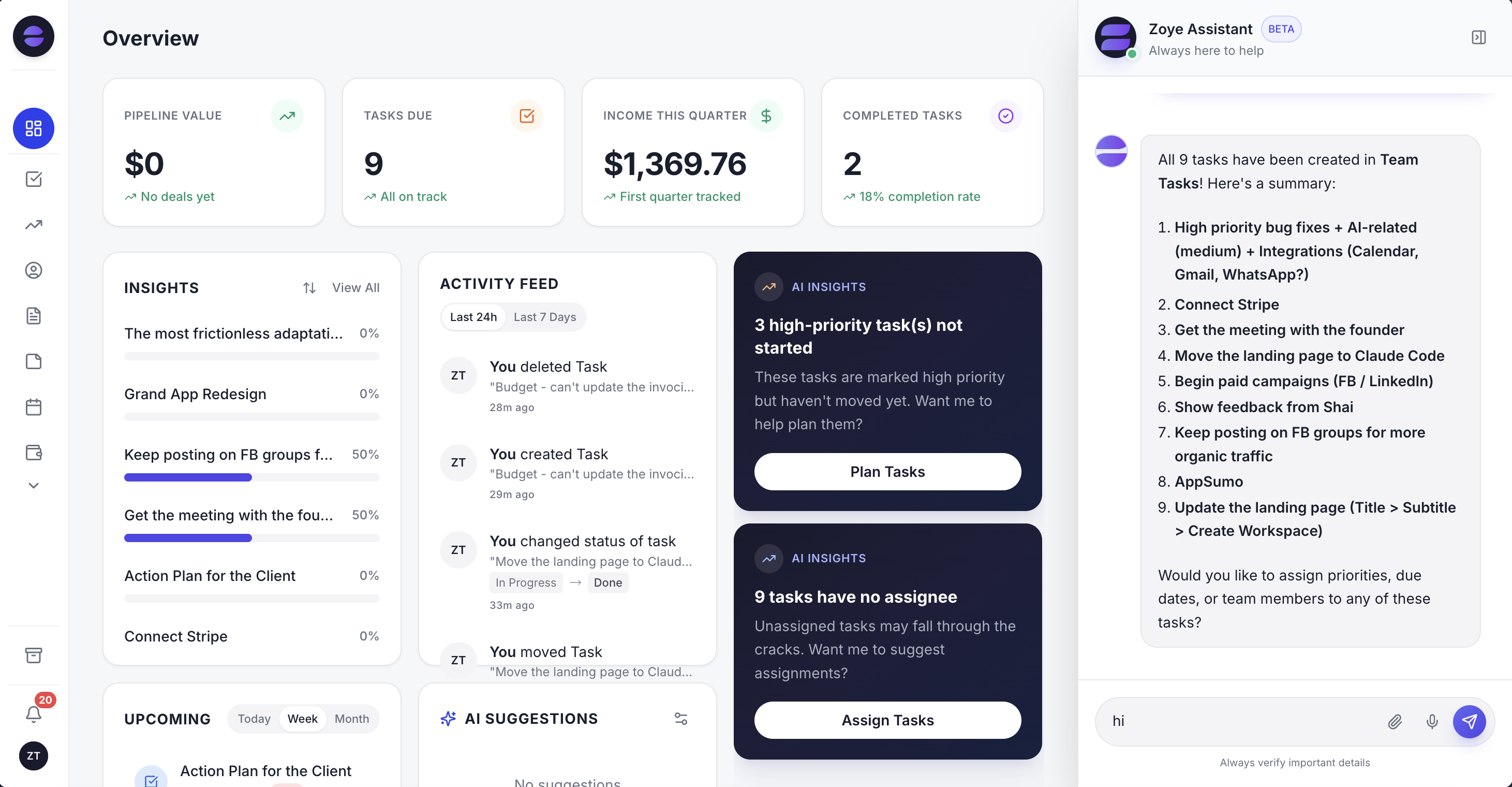 The Zoye dashboard: your whole business at a glance, with proactive AI Insights and Zoye Assistant always available on the right
Method 1: use a CRM with WhatsApp built in
This is the shortest path and, for most small businesses, the correct one. Rather than wiring two systems together and maintaining the wire, you pick a workspace that already treats WhatsApp as a first-class channel.
The setup is short. Open the connections area of your CRM, choose WhatsApp, and authorise the WhatsApp Business account you want to link. Confirm which number is being connected and which team members should see the conversations. Send one test message from a different phone and check that it appears against the right contact, creating a new contact if the sender is unknown.
From there the useful part is what happens without you. A first-time sender becomes a contact with the conversation attached. An enquiry becomes a lead with the question already recorded. Replies land against the same record, so when the customer comes back six weeks later the history is there regardless of who answers.
With Zoye this runs in both directions, which is the part most integrations miss. Conversations flow in and attach themselves to the right contact and deal. You can also message the Zoye Assistant on WhatsApp to do work: ask what is on today, add a lead, book an appointment, chase the three quotes still unanswered, and it executes and reports back. The CRM is not just receiving WhatsApp, it is operable from it.
See what Zoye can do for you
From CRM and deal tracking to AI-powered task management - explore everything Zoye offers in one workspace.
Explore FeaturesMethod 2: connect through the official WhatsApp Business API
Choose this when you genuinely need it: several agents on one number, templated messages at volume, or formal support and uptime guarantees.
The sequence is consistent across providers. You create a Meta Business account and complete business verification, which means supplying documents whose details match your registered business exactly. You choose a Business Solution Provider, which is the company that actually connects you to Meta. You register the phone number, remembering it must first be removed from the WhatsApp Business app. You submit your message templates for approval, since anything sent outside the 24-hour window must use one. Finally you connect the provider to your CRM, usually with an API key.
Budget for two things people underestimate. Business verification is the most common source of delay, and a mismatch between your documents and your Meta profile can add a week. And the per-conversation pricing is charged by Meta on top of whatever your provider bills, varying by country and by whether the conversation is marketing, utility, authentication, or service.
A third thing worth knowing before you commit: the provider you pick is harder to leave than it looks. Your number, your approved templates, and often your conversation history sit with them. Switching means re-registering the number and resubmitting templates, with a quiet period in the middle. Ask about exit before you ask about features, and prefer providers who will tell you plainly how a migration away from them works.
Method 3: use a no-code connector
Zapier, Make, and similar tools can move data from a WhatsApp provider into a CRM. This is reasonable if you already have a CRM you are committed to and only need messages logged.
Be clear about the limits. It is usually one-way, so you can record an incoming message but not hold a conversation from the CRM. It depends on a provider underneath, because these tools connect to the API rather than to WhatsApp directly, so the API cost still applies. And it breaks silently, which is the real problem: when a step fails, nobody finds out until a customer complains that their message went unanswered.
The silent failure deserves more weight than it usually gets. A connector that drops one message in fifty looks fine on a dashboard and is genuinely damaging in a business where a single unanswered enquiry is a lost job. If you go this route, build yourself a way to notice: a weekly check that the count of messages received matches the count of records created, or an alert when a day passes with no new records at all.
Comparing the three on what actually matters
| What you care about | Built-in | Official API | No-code connector |
|---|---|---|---|
| Time to working | Minutes | Days to weeks | Hours |
| Conversation history on the record | Yes | Yes | Partial |
| Reply from the CRM | Yes | Yes | Usually not |
| Multiple agents on one number | Yes | Yes | No |
| Ongoing cost | Included | Provider fee plus per conversation | Connector fee plus API cost |
| Breaks when something changes | Rarely | Rarely | Often |
| Compliant with Meta's rules | Yes | Yes | Yes, if the provider is official |
Pricing and platform behaviour reflect published rates as of September 2026. Check each vendor's pricing page for current figures, since WhatsApp per-conversation rates change by country and category.
What actually syncs, and what does not
This is where expectations and reality part company most often. "WhatsApp integration" is a phrase that covers wildly different amounts of actual capability, and the differences only surface once you are relying on it.
| What you probably assume syncs | What usually happens |
|---|---|
| The full message history from your phone | Only messages from the moment you connect; the back catalogue stays on the device |
| Photos, PDFs, and voice notes | Usually yes on official routes, often not on no-code connectors |
| The customer's WhatsApp display name | Yes, but it is whatever they set, so it is a weak basis for matching records |
| Read receipts and typing indicators | Rarely, and almost never in a way the CRM displays usefully |
| Group chats | Usually not; most business integrations handle one-to-one conversations only |
| Messages sent from the phone itself | Only if the number is on the API; a phone-based app send is invisible to the CRM |
That last row causes more confusion than any other. If your number is on the API, everyone must work through the connected system. A salesperson who picks up their personal phone and replies from the WhatsApp app has just created a conversation the business cannot see, which is exactly the problem you were trying to solve. Any rollout that does not address this directly tends to quietly revert within a month.
Getting the right conversation onto the right customer
A WhatsApp message arrives with a phone number attached and very little else. Turning that into "this is Maria, who asked about the kitchen job in March" is the part that determines whether the integration is useful or merely noisy.
Three things go wrong repeatedly. Numbers are stored inconsistently, so the same customer exists three times under different formats of the same number, and the conversation attaches to whichever record the system found first. Customers message from a second number, so a genuine repeat customer looks like a new enquiry. And a shared household or business number means two different people appear as one contact.
The practical fixes are unglamorous and worth doing before you connect anything. Normalise your existing phone numbers to full international format, because that is the format WhatsApp delivers and anything else will fail to match. Merge the duplicates you already have rather than letting the integration inherit them. And decide in advance what should happen when an unknown number messages: creating a contact automatically is usually right, but only if someone reviews new contacts periodically, otherwise you accumulate records for wrong numbers and delivery drivers.
With Zoye the matching happens on the normalised number and the conversation attaches to the contact and the open deal together, so a returning customer lands on their existing history rather than starting a new thread with no context. Where it cannot match confidently, it creates the contact and leaves it visible rather than guessing.
When more than one person answers the same number
A single shared business number answered by several people is the most common setup in small companies and the one the free app handles worst. The app allows a small number of linked devices, with no concept of assignment, no visibility of who replied, and no way to stop two people answering the same customer differently within a minute of each other.
Once you are on a proper connection, the questions that matter are about routing and accountability rather than capacity. Who picks up a new conversation by default. What happens when that person is away. Whether a colleague can see the history before replying, so the customer is not asked the same question twice. And whether the business can tell, afterwards, who said what.
This is also where the case for a connected system stops being about tidiness and becomes about risk. When conversations live on individual phones, a departing employee takes the customer relationship with them, and you have no record of what was promised. That is a commercial exposure, not an administrative inconvenience, and it is the argument that usually persuades an owner who is otherwise happy with how things are.
Opt-in, templates, and staying on the right side of Meta
The compliance rules are simpler than they are usually made to sound, and they mostly reduce to one principle: WhatsApp is the customer's personal space and Meta protects it aggressively.
You may reply freely within 24 hours of a customer messaging you. Outside that window you need a template, approved in advance, in one of Meta's categories. Marketing templates are the most heavily policed and the most expensive, and they are the ones that generate complaints. Utility templates covering things the customer expects, such as an appointment reminder or an order update, are cheaper, approved more readily, and far better received.
Two behaviours cause the trouble that gets numbers restricted. The first is messaging people who never contacted you, which is exactly what buying a list and sending a template achieves. The second is ignoring the signals: someone who blocks you, reports you, or asks to stop hearing from you must be removed immediately and permanently. Quality ratings fall fast and recover slowly, and a restricted number is an operational emergency in a business that runs on messaging.
The conservative approach costs nothing and avoids all of it. Message people who messaged you first. Keep templates to things the recipient is expecting. Make opting out easy and honour it the moment it happens.
A realistic setup plan
If you are starting from a phone full of customer chats and no system, the order that works is simple.
Begin by deciding whether you need the API at all. If you have one number and one or two people answering it, you almost certainly do not. Export anything from your current WhatsApp Business app that you would regret losing, because a migration will not bring it. Clean up your contact list before you connect, since an integration inherits whatever mess is already there. Connect the channel, then test it with a real conversation from an unknown number and confirm a contact is created correctly. Only then set up follow-ups, and set up one, not twelve. The most common failure after a successful integration is building an elaborate automation nobody trusts.
Tell your team what has changed on the same day you connect it, and be specific about the one rule that matters: replies go through the connected system, not the app on a personal phone. An integration that half the team is bypassing produces worse data than no integration at all, because now the records look complete and are not.
With Zoye that follow-up step is a sentence rather than a workflow canvas. Telling the assistant to follow up two days after a quote is sent, and again after a week if the customer has not replied, is enough for it to build and run that automation, within the 24-hour window rules.
What to measure after thirty days
Most integrations are declared successful on the day they are switched on, which is the one day they cannot be judged. Give it a month and look at four numbers instead.
| What to check | What good looks like | What it tells you |
|---|---|---|
| Capture rate | Nearly every conversation has a matching contact record | Whether messages are actually reaching the CRM |
| Median first reply time | Faster than before you connected, especially outside working hours | Whether the connection changed behaviour or just added storage |
| Follow-ups actually sent | Close to the number that were due | Whether the system does the work or only lists it |
| Duplicate contacts created | Small and stable, not growing weekly | Whether number matching is configured correctly |
If capture is high but follow-ups sent is near zero, you have bought a filing cabinet. That is a legitimate thing to own, but it is not what most businesses were trying to buy, and it is the single most common outcome of a WhatsApp CRM project.
Five mistakes that cost the most
Buying the API for volume you do not have. Two weeks of verification and a per-conversation bill, to solve a problem a built-in connection would have solved the same afternoon.
Connecting before cleaning the contacts. Every duplicate you already had becomes a split conversation history, and untangling it afterwards is far harder than merging beforehand.
Letting people keep replying from their own phones. The fastest way to end up with records that look complete and are missing the conversations that mattered.
Building twelve automations on day one. Complexity nobody trusts gets switched off, and the switch-off usually takes the useful automation with it.
Treating templates as a broadcast channel. It works briefly, then the quality rating falls, then the number is restricted, and the business that runs on messaging cannot message anyone.
What it costs, honestly
| Route | Monthly cost for a small team |
|---|---|
| Zoye, WhatsApp included | $29 flat for up to 10 members, AI included |
| General CRM plus API provider | ~$25 per user, plus $30 to $80 provider, plus per-conversation fees |
| No-code connector plus provider | ~$20 to $30 connector, plus provider, plus per-conversation fees |
| Free WhatsApp Business app alone | $0, plus the enquiries that never reach a record |
Zoye's entry Almost Free plan is $5 per month, or $4 per month billed annually, covering one member with the full platform and the AI assistant included. Starter is $29 per month for up to 10 members and Growth is $59 per month for up to 20.
Worth noting when you compare: the per-conversation charge applies on any route that runs through the official API, so it is not a differentiator between vendors so much as a cost of operating at volume. What differs is the monthly platform cost on top, and whether the AI that does the follow-up work is included or sold as an upgrade.
Ready to streamline your business?
Zoye brings AI-powered CRM, task management, and automation into one workspace.
Get StartedThe takeaway
Connecting WhatsApp to a CRM is not really a technical problem. It is a decision about where the customer relationship lives: on one person's phone, or on a record the business owns.
Most businesses over-buy here. They start a two-week API verification for a volume that never justified it, or they bolt a fragile connector onto a CRM that was never built for messaging. The simpler answer is usually the right one: choose a workspace where WhatsApp is already native, connect it in an afternoon, and let the follow-ups happen without anyone remembering to send them.
And judge it a month later on the number that matters. Not how many conversations you stored, but how many follow-ups actually went out that would otherwise have been forgotten. That is the entire return on this project, and it is the one figure most people never check.
For more context, see the best WhatsApp CRMs in 2026, the difference between the WhatsApp Business app and the API, the guide to WhatsApp automation, WhatsApp Business API pricing, and the rest of the Zoye blog.