
Airtable vs Notion 2026: Which One Should You Actually Build In?
Airtable and Notion end up on the same shortlist for a strange reason: neither of them is really a product for a specific job. They are both construction kits. Airtable hands you a relational database with a friendly grid on top. Notion hands you a page that can contain anything, including databases. In both cases the software arrives empty, and the value only appears after somebody sits down and designs something.
That is the part the usual comparison skips. The tables, the field types, the automation limits, the per-seat price: all of it matters, but only after you accept the premise that you are going to build the thing yourself and then keep it fed forever. Plenty of small businesses have a beautiful base or a gorgeous workspace that nobody has touched since the person who built it got busy.
So this comparison does two things. It settles the dimensions honestly, because Airtable and Notion each win some of them outright and you should know which. And it puts a number on the dimension nobody prices, which is who maintains what you built once the novelty wears off.
Pricing reflects published rates as of August 2026; check each vendor's pricing page for current figures.
Airtable vs Notion at a glance
| Dimension | Zoye | Airtable | Notion |
|---|---|---|---|
| What it is | An AI operator that runs the work | A relational database with views | A page-based workspace with databases |
| Setup effort | Describe what you want in a sentence | Schema design, then field-by-field build | Page architecture, then database build |
| Data model | Business records already defined | Genuinely relational, linked records | Databases inside pages, shallower relations |
| Documents and wiki | Notes module (rolling out) | Weak, not a writing tool | Best in class |
| Reporting | Live cross-workspace reports | Interfaces and dashboards you build | Basic charts and rollups |
| Automation | Built from a plain-language sentence | Strong, tiered run limits | Simpler, improving |
| AI | Executes across records and channels | Assists inside fields and Interfaces | Assists inside pages |
| Customer messaging | WhatsApp and Slack, agent replies | Not native | Not native |
| Pricing model | Flat tiers, not per seat | Per seat | Per seat |
| Ongoing upkeep | The operator updates its own records | Someone owns the base | Someone owns the workspace |
Dimension 1: the data model
Airtable is a database that decided to be approachable. Underneath the colourful grid you get typed fields, linked records between tables, lookups that pull a value across a relation, rollups that aggregate it, and formula fields that behave consistently. Build a Clients table, a Projects table, and an Invoices table, link them properly, and you can answer real questions such as which client has the most overdue value outstanding. That is a genuine relational model and it holds up as the record count grows.
Notion treats a database as a block that happens to sit on a page. That is a lovely idea for a team wiki with a task list halfway down, and relations do exist, but they are shallower. Rollups are more limited, multi-level relational questions get awkward, and once a database carries thousands of rows with several filtered views the experience slows noticeably. Notion databases are best understood as structured lists rather than a data layer you would build operations on.
Verdict: Airtable, and it is not close. If the structure of your data is the reason you are choosing a tool, Notion will frustrate you within a quarter.
Dimension 2: views and reporting
Airtable gives you grid, kanban, calendar, gallery, timeline, and Gantt on higher tiers, plus Interfaces, which let you assemble a purpose-built screen for a colleague who should never see the raw table. Interfaces are the feature that turns a base into something an operations team can actually use, and they are a real differentiator. The cost is that an Interface is another artefact you design and maintain.
Notion offers table, board, list, calendar, gallery, and timeline on any database, plus simple charts. It is enough to see what is going on and rarely enough to report on it. Anything resembling a dashboard tends to be a page of linked views that a human interprets, not a report that tells you something.
Verdict: Airtable for anything you would call reporting. Notion for a view you glance at during a standup.
Dimension 3: documents and knowledge
Here the result flips completely.
Notion is one of the best writing environments any business software has produced. Nested pages, clean typography, comments, templates, and the ability to drop a live database into the middle of a document make it a natural home for SOPs, onboarding guides, meeting notes, project briefs, and the general accumulated knowledge of a team. Small companies run their entire internal handbook in it and are right to.
Airtable has long-text fields and attachments. It can hold a paragraph. Nobody in the history of the product has enjoyed writing a policy document in a cell. If your information is mostly prose, Airtable is the wrong container.
Verdict: Notion, decisively. This dimension alone explains why so many teams pay for both tools.
Want to see it in action?
Watch how Zoye automates your daily workflow - from lead management to team collaboration.
See How It WorksDimension 4: automation
Airtable automations are the more capable of the two. Triggers on record creation, updates, form submissions, and schedules, with actions that update records, send email, post to Slack, or run a script. Run counts are tiered, so a busy base can hit ceilings, and complex logic tends to migrate to a scripting step that only one person understands.
Notion automations have improved and now handle database button actions, property updates, and page creation, but the depth is not comparable. Serious workflows in Notion usually leave Notion and land in a third-party connector, at which point you are maintaining an integration on top of the workspace.
Both share the same underlying assumption, which is worth naming. An automation exists because you sat down, anticipated a situation, and encoded a rule. The moment reality departs from the rule, the automation is silent and a human notices or does not.
Verdict: Airtable for real workflow automation. Both require you to be the person who imagined the workflow.
Dimension 5: AI
Airtable AI lives inside fields and Interfaces. It can summarise a long note into a short one, categorise an incoming record, extract a value from text, or draft a message based on the row. It is genuinely useful for enrichment work at scale, and it is metered by credits.
Notion AI lives inside the page. It writes, rewrites, summarises, translates, and answers questions using your workspace as context, which is a real advantage when your workspace holds everything. Pricing has moved between add-on and bundled depending on plan, so check the current page before budgeting.
The shared limitation is not quality, it is scope. Both AIs operate on the surface you built. They will happily summarise the follow-up note; neither will notice the follow-up never happened and send it. Everything outside the base or the page, which is to say most of running a business, remains yours.
Verdict: A tie on capability, and a shared ceiling. Both assist. Neither operates.
Dimension 6: pricing
Both bill per seat, which means the cost of the tool grows with the size of your team whether or not the extra people do anything but read.
Airtable starts free for small bases with tight record limits, then Team, then Business, then Enterprise Scale. Paid tiers land in the region of $20 to $45 per seat per month billed annually, and the jump between tiers is usually forced by record limits, sync, or advanced Interface permissions rather than by anything you wanted.
Notion starts free for personal use, with paid plans roughly in the $10 to $20 per seat per month range annually, plus Enterprise. AI has moved between a separate charge and inclusion in higher tiers.
Zoye does not price per seat. The entry plan, Almost Free, is $5 per month and covers 1 member with 1GB of storage and the full platform including AI. Starter is $29 per month for 10 members and 5GB. Growth is $59 per month for 20 members, 10GB, and 24/7 support. Scale is $119 per month for 100 members and 25GB, and there is a Customize tier for teams that need their own limits and dedicated support.
The comparison that matters is not the sticker price. It is what a ten-person team ends up paying once it has Airtable for the data, Notion for the documents, a connector service to join them, and a separate CRM because neither of them chases a customer.
Verdict: Notion is cheaper per seat than Airtable. Both get expensive as headcount grows, and neither price includes the thing you actually needed.
See what Zoye can do for you
From CRM and deal tracking to AI-powered task management - explore everything Zoye offers in one workspace.
Explore FeaturesDimension 7: who actually maintains it
This is the dimension that decides whether either tool is still in use next year, and neither vendor puts it on a pricing page.
Every Airtable base and every Notion workspace has an owner. Sometimes it is formal. More often it is the operations person, the founder, or the one team member who enjoyed setting it up, and the responsibility never appears in a job description. That person designed the schema, named the fields, built the views, wrote the automations, and now spends part of every week doing three unglamorous jobs.
Keeping records current. A base is only as true as its last update. Someone marks the deal as won, changes the stage, logs the call, and attaches the signed quote. When that person is busy for two weeks, the base quietly starts lying, and a base that lies is worse than no base because people act on it.
Absorbing change. You add a service line, so there is a new field. A client wants a different milestone structure, so the linked table needs another relation. Each change is fifteen minutes, and there are several a month, forever.
Re-explaining it. New team members do not inherit the mental model. They inherit a screen. Every hire needs a walkthrough of why the base is shaped the way it is, and the shortcuts they invent because they did not get one become the data quality problem you find later.
None of this is a criticism of Airtable or Notion specifically. It is the honest cost of any build-it-yourself tool, and it is the reason the villain in this category is not a bad product. It is software you bought, configured carefully, and stopped using.
Verdict: Both tools hand the maintenance bill to a person on your team. Price that person's hours before you compare per-seat rates.
The third option: Zoye
If the previous section landed uncomfortably, the useful question is not which construction kit to pick. It is whether the work has to be built by hand at all.
Zoye is not a database you populate or a canvas you architect. It is an AI business operator: it captures the leads, chases the follow-ups, books the clients, updates its own records, and reports back on what happened, over WhatsApp and Slack as well as in the app. You describe what should happen in one plain sentence, such as asking it to message anyone who requested a quote and has not replied in three days, and it builds and runs that automation itself.
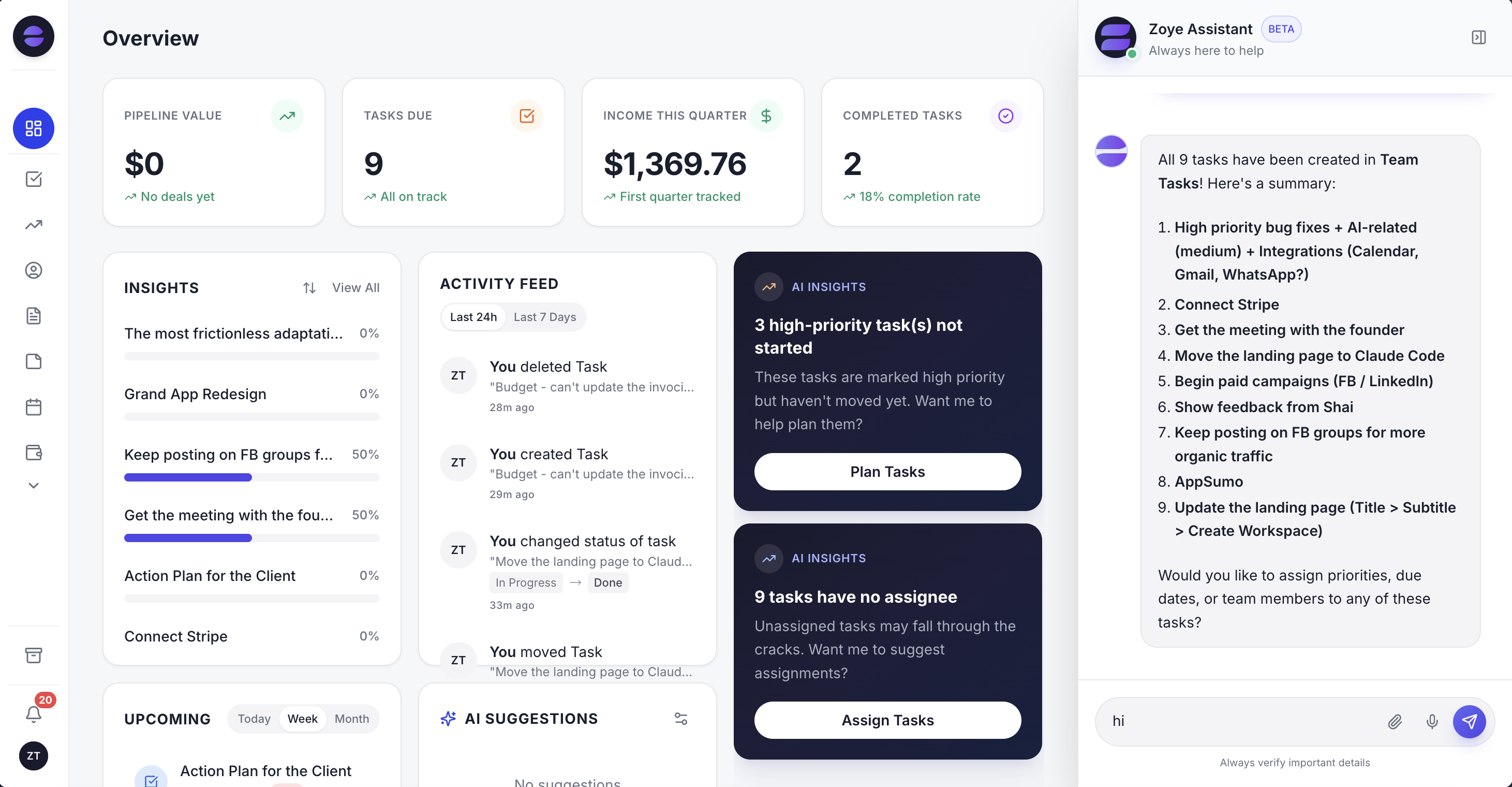 Zoye keeps the records current itself, so nobody on the team owns the upkeep
The practical difference from both tools in this comparison is the direction of effort. In Airtable you design a Clients table and then keep it accurate. In Notion you design a client page template and then keep it accurate. In Zoye the client record exists because a conversation happened, and it stays accurate because the operator that had the conversation updated it. Nobody schedules an afternoon to tidy the workspace.
Real example: A two-person consultancy gets an enquiry by WhatsApp at 9pm. Zoye replies, qualifies the budget and timeline, books the intake call into the free slot on Thursday, creates the record with everything the conversation revealed, and sets the follow-up for the day after the call. In Airtable that is a form, an automation, a Slack alert, and a human who remembers. In Notion it is a page somebody creates the next morning if they see the message.
Pricing is flat rather than per seat, starting at $5 per month on the Almost Free plan with 1 member and the full platform including AI, and rising to Starter at $29, Growth at $59, Scale at $119, and a Customize tier. Every connector is included at every level.
Ready to streamline your business?
Zoye brings AI-powered CRM, task management, and automation into one workspace.
Get StartedWhen to choose each
Choose Airtable if:
- The structure of your data is the whole point and you need real linked records, lookups, and rollups
- You want Interfaces so colleagues get a purpose-built screen instead of a raw table
- Someone on the team genuinely enjoys owning a base and has time for it
- Your reporting needs are specific enough that a general tool will not cover them
Choose Notion if:
- Most of what your team needs to keep is written knowledge, not structured records
- You want a single readable home for SOPs, briefs, notes, and light task tracking
- Budget matters and you would rather pay a lower per-seat rate for a broader canvas
- You accept that anything heavily relational will eventually move somewhere else
Choose Zoye if:
- You want customer work to happen rather than be recorded
- You would rather describe an automation in a sentence than assemble it from triggers
- You do not want one person on the team quietly owning the upkeep of a workspace
- You need WhatsApp and Slack conversations handled and captured as they occur
- You prefer flat pricing that does not grow every time you add a reader
Plenty of teams end up with a sensible combination: Notion for the handbook, and an operator for the customer-facing work that actually generates revenue.
Frequently asked questions
Yes, clearly. Airtable was built as a relational database, so linked records, lookups, rollups, multi-condition filters, and large record counts behave predictably. Notion databases are convenient because they live inside pages, but relations are shallower, rollups are more limited, and big databases with many views get sluggish. If the data model is the point, choose Airtable.
Yes. Notion is a writing and knowledge tool first, so wikis, SOPs, meeting notes, and project briefs feel natural, and a database can be embedded mid-document. Airtable has long-text fields and Interfaces, but nobody writes a company handbook in it. If your team's information is mostly prose, Notion wins that dimension outright.
Notion is cheaper per seat at every comparable tier, and its free plan is more usable for an individual. Airtable's paid tiers cost more and its record limits push growing teams upward. Both bill per seat, so the real number is seats multiplied by months, and both put their better automation and AI on higher tiers. (Pricing as of August 2026, check each vendor's pricing page.)
Both offer AI, and both meter it. Airtable AI generates or classifies values inside fields and helps build in Interfaces and Omni. Notion AI writes, summarises, and answers questions across your pages, and it is bundled or charged depending on plan. In both cases the AI works inside the surface you already built. It does not go out and run your customer follow-ups for you.
You do, or one person on your team who quietly becomes the owner. Someone designs the schema, names the fields, builds the views, writes the automations, and then keeps every record current. That upkeep is invisible in a pricing comparison but it is the largest real cost of both tools, and it is the reason so many bases and workspaces go stale after a few months.
Yes. Zoye is an AI business operator rather than a canvas you build on. It captures leads, chases follow-ups, books clients, and updates its own records, and you can describe a new automation in one plain sentence instead of wiring it. Plans start at $5 per month on the Almost Free tier for 1 member with the full platform including AI.
The bottom line
Airtable is the better database and Notion is the better document, and if you only read one line of this comparison, that is the line. Airtable wins the data model, views, reporting, and automation. Notion wins documents, knowledge, and price. Both are excellent at what they were designed for, and both are honest about being tools you build with.
The question worth sitting with is what happens after the build. A base or a workspace is an asset that decays without attention, and the attention comes from someone on your team whose time is worth more than the subscription. If that trade makes sense for you, pick whichever of the two matches the shape of your information and commit to maintaining it properly.
If it does not, the alternative is not a better canvas. It is an operator that does the work and keeps its own records, so there is nothing left to maintain.
For more context, see our Notion vs Airtable comparison, the best Airtable alternatives, Notion vs Trello, and the rest of the Zoye blog.