
Airtable invented the spreadsheet-meets-database category in 2012 and has been the standard for visual no-code databases ever since. For teams that needed structured records (inventory, project assets, customer lists, content calendars) with rich field types and multiple views, Airtable was often the only realistic answer.
In 2026, the landscape has changed. Airtable's pricing has climbed steadily, AI has become table stakes, and a new generation of platforms now combines database power with broader operational workspace functionality. Teams that started on Airtable often find themselves wanting CRM, tasks, calendar, budget, and AI in the same place as their data, not bolted on through integrations. This guide compares the seven best Airtable alternatives in 2026, ranked for teams that want richer functionality at fairer pricing.
Why teams are looking beyond Airtable in 2026
The pressure to leave Airtable comes from four directions that have intensified over the past two years.
Pricing escalates fast above the free tier. Airtable's free plan is limited to 1,000 records per base and lacks Gantt timeline, dependencies, and richer automation. The Team plan at around $20 per seat per month (billed annually) removes some limits, the Business tier at around $45 per seat per month (billed annually) adds advanced features, and the Enterprise Scale tier (custom pricing) targets large organisations. For a 15-person team on Team, that runs around $3,600 per year, before adding the separate CRM, calendar, and AI tools that Airtable does not include.
Pricing reflects published rates as of June 2026; check each vendor's pricing page for current figures.
Database-first means business operations are bolted on. Airtable is a relational database with a friendly UI. Adding CRM, project tracking, or calendar requires building those as custom apps inside Airtable, or integrating with separate tools. Either path takes engineering or admin time that small teams do not have. Modern alternatives provide CRM, PM, and calendar as native features, not custom builds.
AI is limited and bolted on. Airtable AI launched as an add-on feature that helps with field generation, classification, and summarisation. It is useful but it remains a per-field utility, not a workspace-level assistant that takes action. Teams now expect AI that drafts emails, schedules meetings, enriches records automatically, and produces reports on demand.
Record limits create friction at scale. Even the Team and Business tiers have record caps per base. Teams managing customer databases, content calendars, or operational records frequently hit these limits and need to either split bases (which complicates relationships) or upgrade further.
The 7 best Airtable alternatives in 2026
1. Zoye - the AI-native all-in-one alternative
Zoye is the strongest Airtable alternative for teams that want database power as part of a broader workspace that includes CRM, tasks, calendar, budget, and AI from the start.
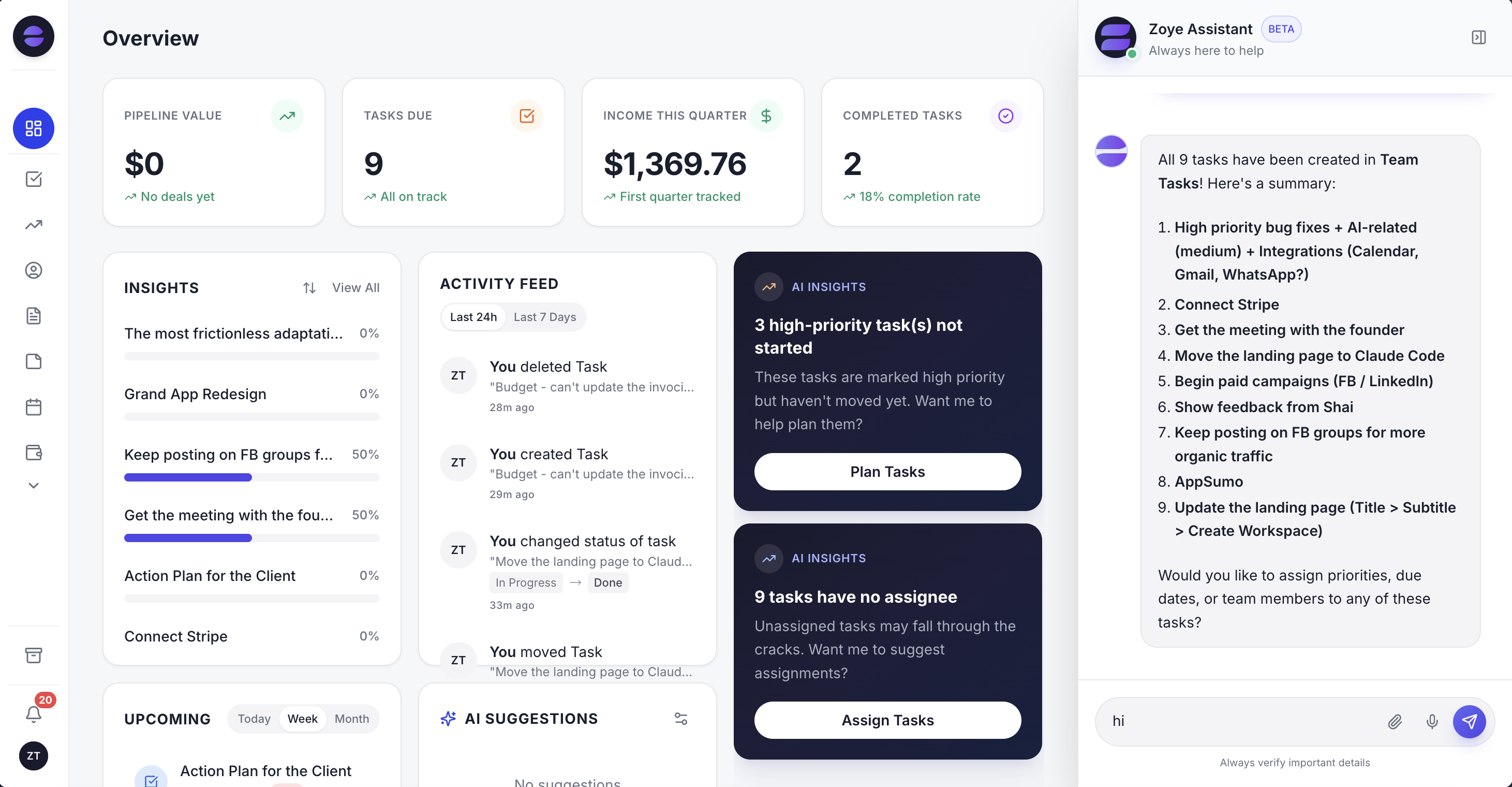
The platform provides database-style table views with custom fields, formulas, multiple views per record set (Kanban, list, calendar, grid, gallery), and automations. Beyond that, Zoye includes a native CRM with contacts, deals, and pipeline, plus tasks, calendar, budget tracking, and reports.
Zoye Assistant - AI that works, not just talks
The AI assistant lives across the entire workspace and takes action: enriches records from public data, drafts customer follow-ups, schedules meetings, generates reports, and creates new records from incoming emails. Where Airtable AI adds field-level generation, Zoye acts across the workspace as a whole.
Tasks alongside the data
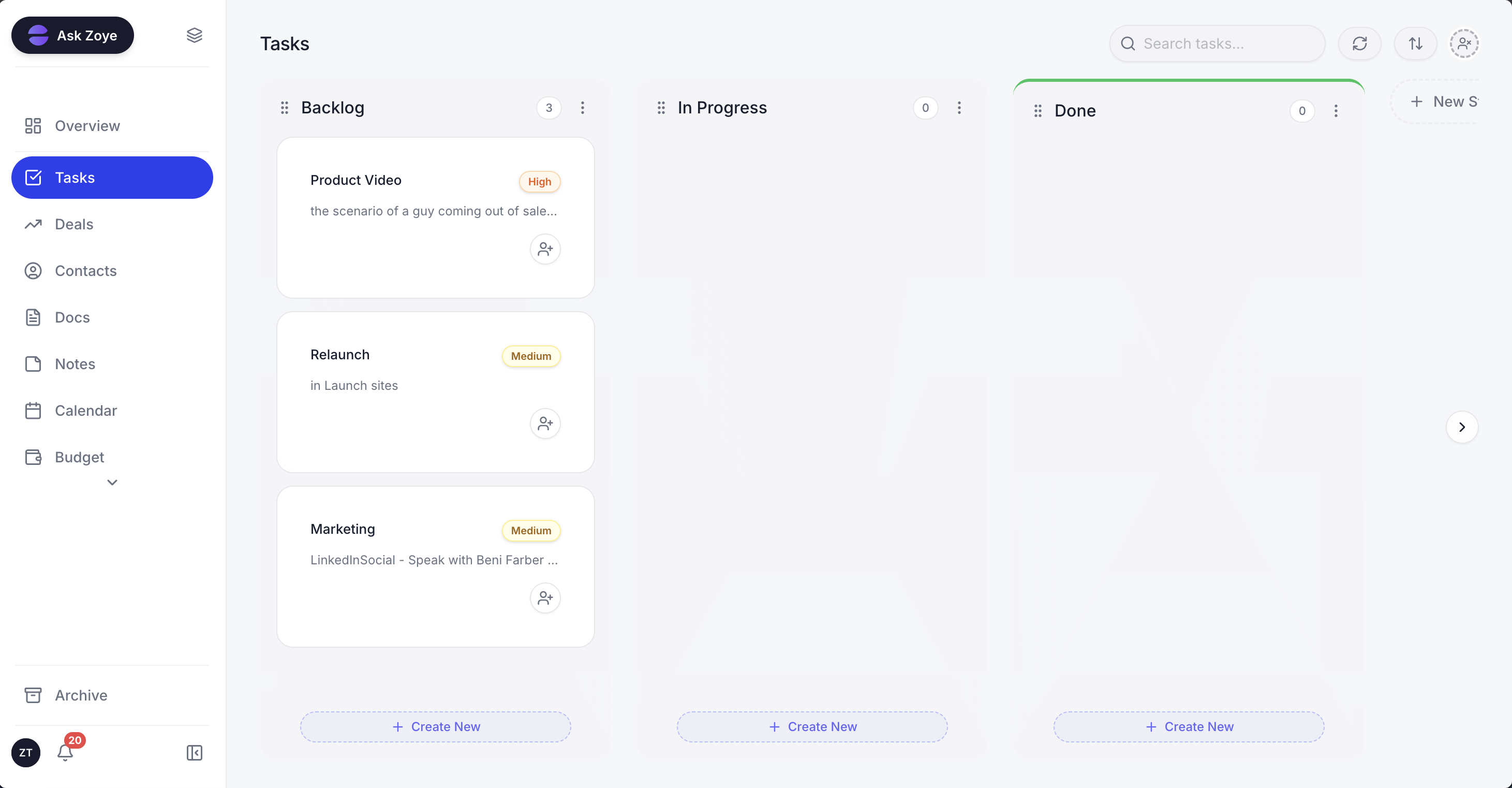
Airtable handles structured records well but task management requires building it yourself from base templates. Zoye ships with first-class tasks (list, board, calendar, timeline views) connected to the same data, with no template wiring required.
Calendar - tasks where they belong
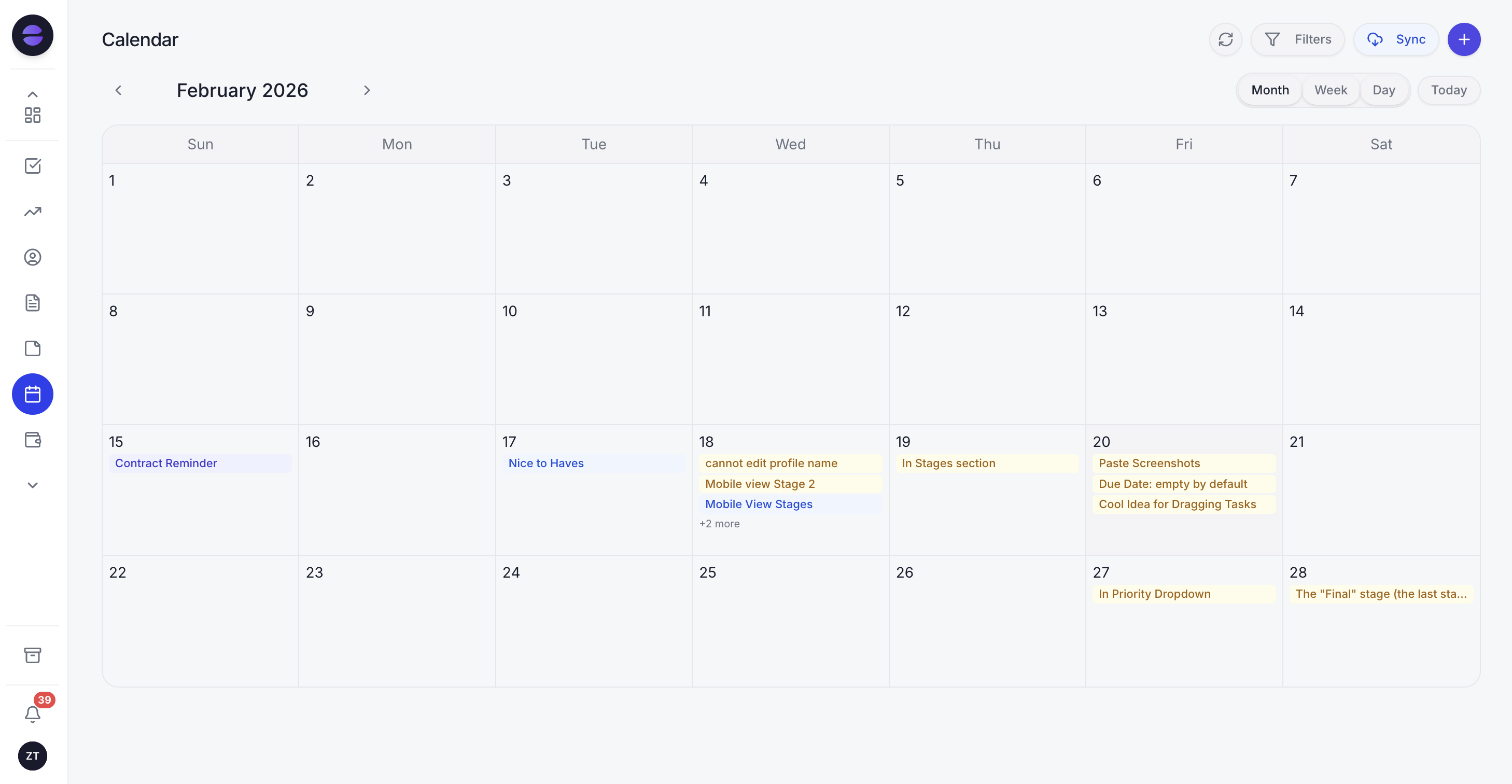
Airtable Calendar view is a tab on a base. Zoye's calendar IS the workspace calendar. Tasks appear automatically. Meetings layer over deadlines. No integration to configure across bases.
Reports that pull from the whole workspace
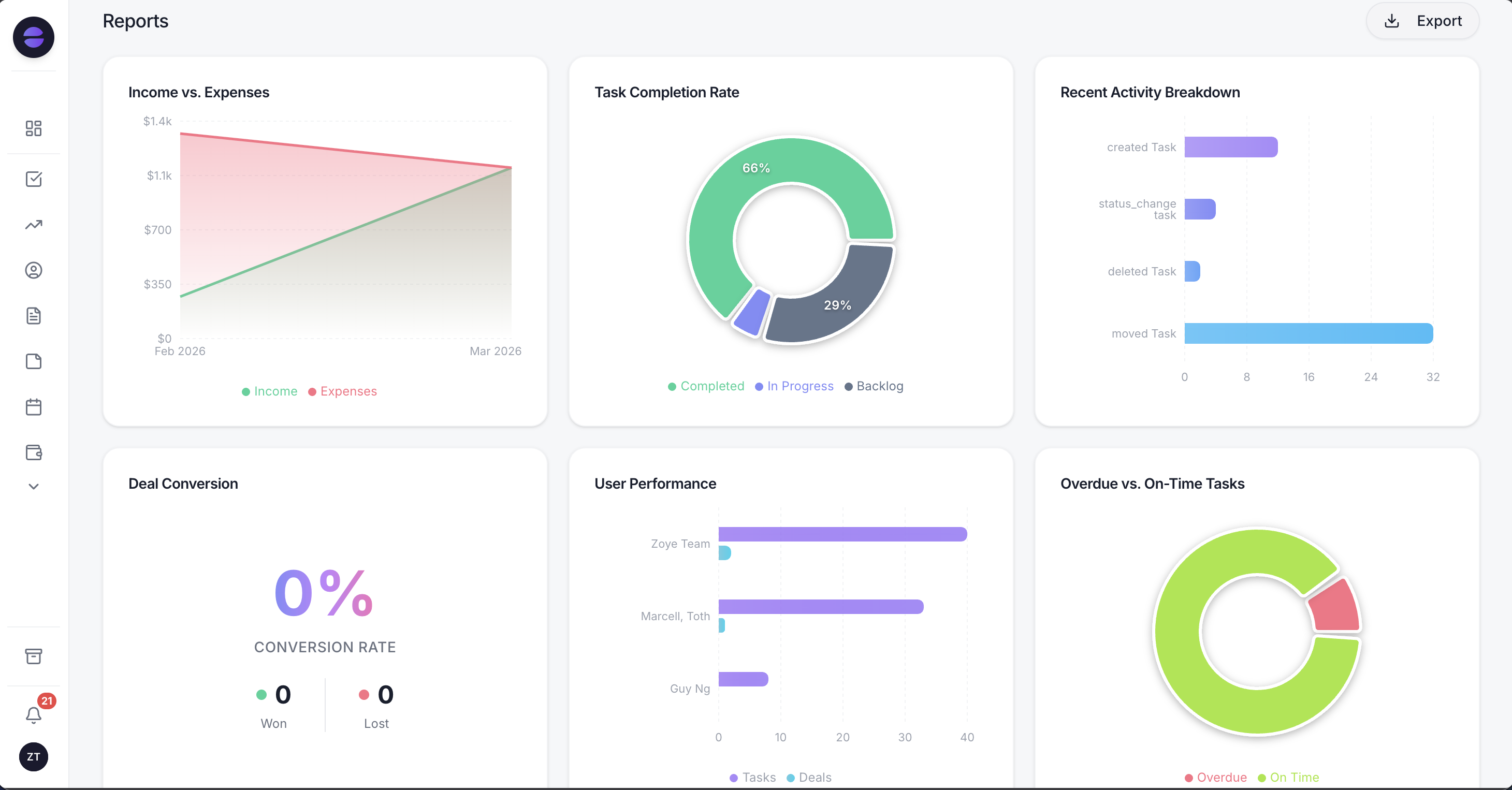
Airtable Interfaces let you build dashboards per-base. Zoye Reports brings tasks, deals, contacts, budget, and team activity into one exportable dashboard out of the box. The weekly status report writes itself from real workspace activity.
Notes - collaborative docs, built in
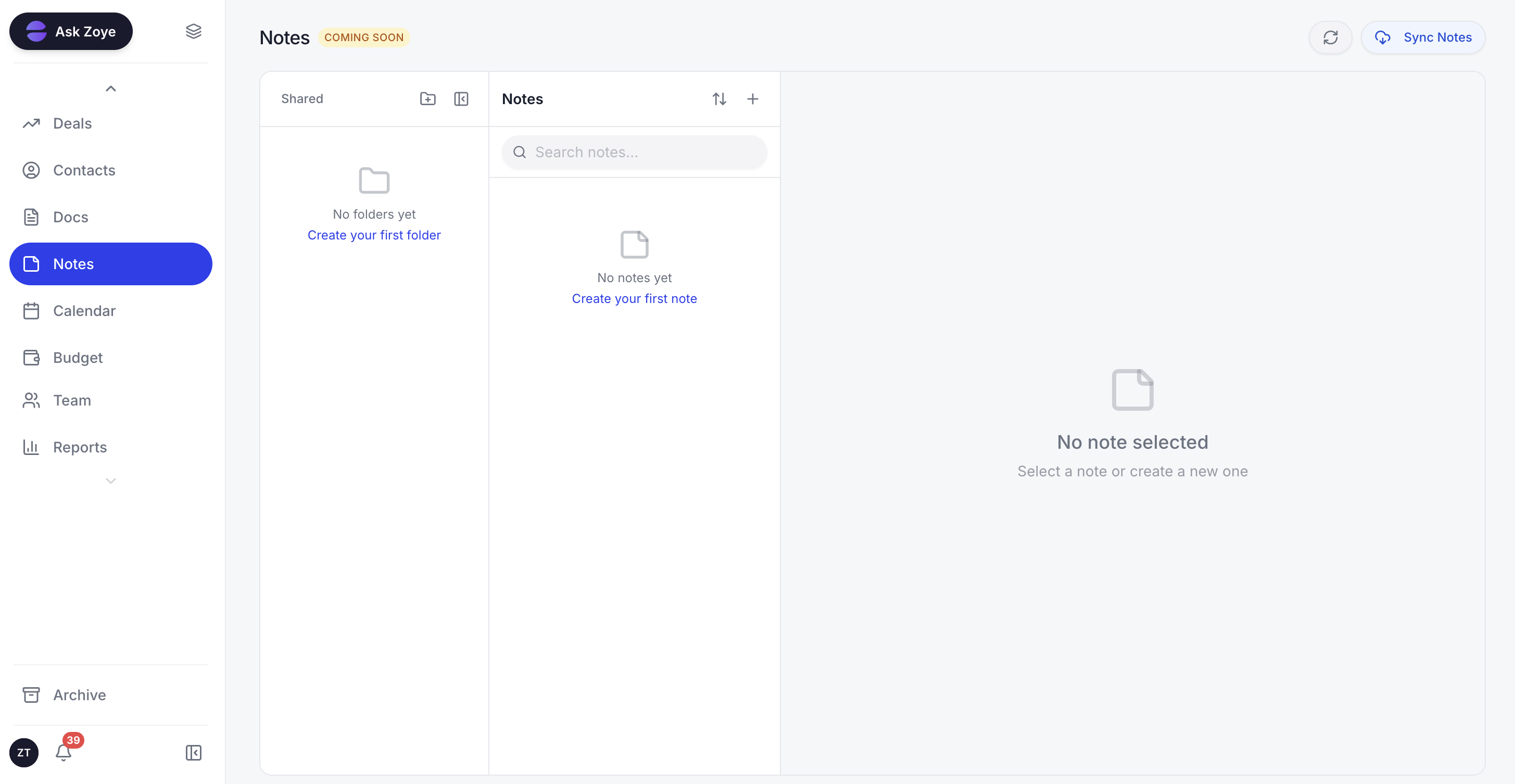
Zoye Notes brings docs and knowledge into the same workspace as tasks, deals, and database records. When a record references a runbook, the doc lives alongside the data. Available on every plan.
The pricing model is the most consequential difference. Zoye is flat-rate, not per-seat. A 15-person team pays $59 per month total on Zoye Growth, versus around $300 per month on Airtable Team (which is database-only). No per-user escalation at the small-business scale, and AI is included rather than billed as a per-field add-on.
Pricing: Almost Free from $5 per month (or $4 per month billed annually) for 1 member with the core tools. Starter from $29 per month (10 members). Growth from $59 per month (20 members). Cancel or upgrade anytime.
Best for: Small to mid-size teams that want database functionality as part of a broader operational workspace.
2. Notion Databases - the docs-first alternative
Notion is the strongest alternative when your team's data lives alongside heavy documentation, wikis, or knowledge base work. Notion databases include the same view types as Airtable (Kanban, calendar, gallery, list, timeline) and integrate seamlessly with Notion's docs layer.
The trade-off is that Notion is docs-first, not database-first. Complex formulas, advanced field types, and database-specific power user features are less developed than Airtable's. For teams that need light database functionality plus deep docs, Notion is excellent. For pure database power, it falls short.
Pricing: Free for personal use. Plus $8 per user per month. Business $15 per user per month.
Best for: Content-heavy teams that want light database functionality alongside docs.
3. Coda - the document-database hybrid
Coda is the most interesting Airtable alternative architecturally. It treats documents and databases as the same primitive, meaning a single Coda doc can contain rich text, tables, dashboards, and automations all in one. For teams that want database power inside a document-style interface, Coda is unique.
The catch is the learning curve. Coda's flexibility comes at the cost of opinionation. Teams need to design their workflow rather than follow a template, which slows down adoption.
Pricing: Free tier with limits. Pro $10 per user per month. Team $30 per user per month.
Best for: Teams that want database power inside a document-first interface.
4. Smartsheet - the enterprise spreadsheet PM alternative
Smartsheet is the enterprise-grade alternative for teams that need spreadsheet-style power with PM features (Gantt, dependencies, resource management). It is widely used in construction, professional services, and large enterprises.
The trade-off is that Smartsheet feels enterprise-priced and enterprise-styled. The UX is dated compared to Airtable, and the pricing starts at $9 per user per month and climbs to $32 per user per month, with most teams needing the higher tiers.
Pricing: Pro $9 per user per month. Business $19 per user per month. Enterprise custom.
Best for: Enterprise teams that need spreadsheet-style PM at scale.
5. Baserow - the open-source Airtable alternative
Baserow is the leading open-source Airtable alternative for teams that want to self-host or avoid vendor lock-in. The feature set covers most of Airtable's basics (multiple views, custom fields, formulas, automations) and the cloud-hosted plan is meaningfully cheaper.
The trade-off is the development pace. Open-source projects move slower on new features, and the self-hosted path requires DevOps work that small teams often cannot spare.
Pricing: Free self-hosted (Community). Free cloud tier. Premium $5 per user per month. Advanced $20 per user per month.
Best for: Technical teams that want to self-host or prioritise open-source.
6. ClickUp - the all-in-one with table view
ClickUp's table view provides Airtable-style structured data within ClickUp's broader PM platform. For teams that want PM as the primary use case and Airtable-style data as a secondary capability, ClickUp covers both surfaces in one tool.
The downside is the same as ClickUp's downside everywhere: feature complexity and a steep learning curve. ClickUp's table view is also less powerful than Airtable's standalone product, and ClickUp Brain (its AI) is a separate add-on rather than bundled into any plan.
Pricing: Free tier with limits. Unlimited at around $7 per user per month. Business at around $12 per user per month. Brain AI add-on around $9 per user per month (not included in any plan).
Best for: PM-first teams that want light database functionality alongside.
7. Monday.com - the visual board with database depth
Monday.com sits between Airtable and a pure PM tool. Its board view handles structured data with custom columns, and its automation and dashboards are stronger than Trello-class alternatives. For teams that want visual structured data with PM and Sales CRM bolted on (Monday Sales CRM is an upsell), Monday is a contender.
The pricing climbs fast and AI is a separate paid feature.
Pricing: Basic $9 per seat per month. Standard $12 per seat per month. Pro $19 per seat per month.
Best for: Visual-first teams that want structured data with PM views.
Best Airtable alternative for small business
For small businesses with under 50 people, Zoye is the clearest pick because the broader workspace consolidates four to five subscriptions into one bill. A typical 15-person team migrating from Airtable replaces:
- Airtable Team at around $20 per seat × 15 = $300 per month
- A separate CRM at $25 to $80 per user × sales reps = $250 to $800 per month
- A separate calendar/scheduling tool at around $50 per month
- A separate AI tool at around $200 per month
- Total replaced: roughly $800 to $1,350 per month, in the rough range of $9,600 to $16,200 per year
With Zoye Growth at $59 per month, the same team pays $708 per year. The savings are dramatic, and the AI works across the consolidated workspace instead of being siloed.
Best Airtable alternative for non-technical teams
Non-technical teams are Airtable's frequent users and frequent abandoners. The promise of "spreadsheet-meets-database" is exciting, but the reality of designing relations, normalising data, and configuring views often defeats users without engineering instincts.
Zoye is the strongest non-technical pick because the workspace is operations-first, not database-first. Users get database power without needing to think in database terms. The AI assistant handles setup and configuration interactively: a user describes what they need ("I want to track our customers and their projects together") and the assistant builds the structure.
Notion is the runner-up for content-heavy non-technical teams. Coda fits teams that prefer document-style interfaces. None match Zoye's native AI guidance for non-technical adopters.
Best AI-powered Airtable alternative
Zoye is the only Airtable alternative on this list with a true AI-native architecture. Airtable AI, Notion AI, Coda AI, ClickUp Brain, and Monday AI all function as utility features that summarise, classify, or draft text within their respective platforms. They do not take action across the workspace.
Zoye actively enriches records from public data, drafts customer follow-up emails based on the prior relationship, schedules meetings on your behalf with intent-based booking, surfaces records at risk of going stale, generates the weekly summary on demand, and creates new records from incoming emails without any setup. The AI is the primary interface, not the sidebar.
How to choose the right Airtable alternative for your team
Three questions filter the choice.
1. Is the data the primary use case, or is it part of a broader operation? If data is the primary use case (you are managing a complex inventory, a large content library, a structured asset database), Notion, Coda, or pure Airtable stay valid. If data is part of a broader operation (customers, projects, calendar, budget), Zoye consolidates everything.
2. How important is open source or self-hosting? If vendor lock-in is a concern, Baserow or NocoDB are strong picks. Most other alternatives, including Zoye, are SaaS.
3. What does AI mean to you? If AI as a per-field utility is enough, every option here covers that. If you want AI that takes action across the operation (drafts, schedules, enriches, generates), Zoye is the only AI-native pick.
Why teams pick Zoye as their Airtable replacement
Three points tend to settle the decision.
First, the broader workspace finally consolidates the stack. CRM, tasks, calendar, budget, AI all live with the database tables. The team stops switching apps to do related work.
Second, the AI actually does work. Records can be enriched automatically, customer follow-ups drafted, and recurring reports generated on demand, instead of every update being typed by hand.
Third, the total bill can drop substantially. Replacing several per-seat subscriptions with one flat-rate workspace removes the per-user escalation that drives Airtable-anchored stacks higher as the team grows. The exact saving depends on which tools you are currently paying for, so it is worth tallying your real stack before comparing.
Try Zoye for your team. Almost Free starts at just $5 per month, the price of a cup of coffee, and you can cancel or upgrade anytime.
For more context, see the best Notion alternatives, the best AI CRM in 2026 guide, the best project management apps in 2026, and how to build your own CRM with Zoye.