
Why CRM Implementations Fail (and How AI Fixes the Root Cause)
A CRM implementation almost never fails on launch day. The demo looks great, the pipeline is configured, the fields are mapped, and everyone agrees this is the year customer relationships finally get organised. It fails three months later, quietly, when someone opens the CRM to check a deal and finds the record is out of date, the last note is from six weeks ago, and half the contacts were never entered at all. That is the moment the team stops trusting it, and a CRM nobody trusts is a CRM nobody uses.
CRM rollouts fail often enough that the failure rate is a running industry joke, and the figures quoted swing wildly depending on who is counting and how they define failure. The exact number is unknowable, but the pattern is not: a large share of the CRMs businesses buy never deliver the value that justified them. It is tempting to blame the software, the vendor, or the rollout plan. The real cause is more uncomfortable and more consistent than any of those, and once you see it, the fix becomes obvious.
This guide breaks down the anatomy of a failed CRM implementation, the root cause that connects every failure pattern, and how the AI Business Operator model in 2026 removes that cause instead of asking you to fight it harder.
Pricing reflects published rates as of July 2026; check each vendor's pricing page for current figures.
The anatomy of a failed CRM implementation
Failed CRM projects look different on the surface, but they decompose into the same handful of failure modes. Recognising them is the first step, because most advice treats them as separate problems to solve individually, when in fact they share one root.
The empty database nobody fills in. The most common failure is the simplest: the CRM launches and then nobody enters anything. New leads stay in an inbox. Calls never get logged. Companies exist in someone's head but not in the system. Within weeks the CRM holds a fraction of the real relationships the business has, so it cannot answer the one question it exists to answer, which is "what is actually going on with our customers."
No data entry discipline. Even where entry starts well, it decays. Logging every call, updating every stage, and typing every new contact is a permanent tax on people who already have a full day. The discipline holds for the first enthusiastic month and then erodes. By the second quarter, the data is a patchwork: some records pristine, most half-finished, and no reliable way to tell which is which. Partial data is arguably worse than no data, because it looks trustworthy right up until it burns you.
Follow-ups nobody sends. The whole promise of a CRM is that the next step never gets forgotten: the quote you owe, the check-in after the sale, the lead who went quiet. But a traditional CRM only reminds. It surfaces a task and waits for a human to act. When the human is buried, the reminder gets dismissed, snoozed, or ignored, and the follow-up that would have closed the deal never happens. The CRM recorded the intention and did nothing to fulfil it.
Over-complicated setup that fights the user. Many implementations fail from the opposite direction: too much configuration. Custom fields nobody understands, required steps that slow every entry down, a process designed by a consultant that does not match how the business actually works. Complexity does not increase adoption, it kills it. Every extra click is another reason to skip the CRM and just keep the deal in your head.
No clear owner. A CRM without a person responsible for it drifts. Nobody cleans the duplicates, nobody enforces the process, nobody notices when the data starts rotting. In a small business there often is no spare person to own it, so ownership defaults to "everyone," which means no one.
A sales tool bought for a whole-business problem. Classic CRMs assume a dedicated sales rep who lives in the pipeline all day. Most small businesses do not have that person. The owner sells, delivers, invoices, and supports all at once, so a tool that only handles the sales slice sits mostly empty while the real work happens in email, spreadsheets, and chat.
Read those failure modes back to back and the shared thread jumps out. Every single one is a variation of the same underlying assumption breaking down.
The root cause: the human-maintenance dependency
Here is the uncomfortable truth at the centre of nearly every failed CRM implementation. A traditional CRM is a filing cabinet with a login. It stores whatever you put in and shows it back neatly, but it does not lift a finger on its own. The deal stage moves only when a human drags it. The call gets logged only when a human types it. The follow-up happens only when a human remembers it. Every function the CRM performs is downstream of a human doing manual work to keep it fed.
That is the human-maintenance dependency, and it is the root cause. The empty database, the eroding discipline, the unsent follow-ups, the ownership vacuum: all of them are what happens when the maintenance the CRM silently requires collides with people who do not have time to do it. The software is not broken. It is doing exactly what it was designed to do, which is nothing until a human acts.
This is why the standard advice for fixing CRM adoption rarely works for long. "Simplify the process, appoint an owner, train the team, reinforce the habit" is all reasonable, and all of it is an attempt to make humans reliably do more admin forever. It can work in a large organisation with a dedicated operations team whose job is exactly that. In a small business it is a losing battle, because the answer to a busy owner's problem can never be "do more data entry." The maintenance dependency is not a bug you can train away. It is baked into what a traditional CRM fundamentally is.
Which points at the only real fix. If the failures all come from depending on a human to maintain the database, then the durable solution is not to make the human try harder. It is to remove the dependency entirely.
Want to see it in action?
Watch how Zoye automates your daily workflow - from lead management to team collaboration.
See How It WorksWhy "software you bought and stopped using" is the real villain
Every failed CRM ends up in the same place: an open subscription for a tool nobody logs into. It is not dramatic. There is no crash, no data breach, no angry cancellation. It is just a monthly charge for software you bought and stopped using, sitting in the stack next to the other tools that were going to change everything and quietly did not.
That phrase is worth sitting with, because it names the actual enemy. The enemy is not a specific vendor or a bad feature set. Most CRMs are perfectly capable pieces of software. The enemy is the gap between buying a tool and it delivering value, a gap that a traditional CRM leaves entirely for you to close with manual effort. The tool hands you a powerful, empty container and a monthly bill, and then it waits. If your team fills it and maintains it, you get value. If life gets in the way, as it always does, you get an expensive reminder of good intentions.
Fixing CRM implementations, then, is not really about picking better software in the old category. It is about choosing a model that closes the buy-to-value gap for you, so the implementation cannot rot no matter how busy the week gets.
The shift in 2026: from a database you maintain to an operator that runs it
The change that fixes CRM implementations is not a better database. It is a different kind of system altogether: one that does the maintenance itself. Instead of a filing cabinet waiting for input, imagine describing what just happened in plain language and having the system do the recording, the linking, and the follow-through on its own.
That is the AI Business Operator model. You finish a call and say what happened, and the operator creates the contact, opens the deal at the right stage, links them, drafts the follow-up message, and schedules the next task, all from one sentence. You never open a form. A lead lands in your WhatsApp and the operator captures it, qualifies it, and chases it without you touching the app. The records stay current because keeping them current is the operator's job, not a chore delegated to a human who will eventually be too busy.
This is the model that fixes CRM failure at its root, because it removes the exact dependency that causes it. Nobody abandons a CRM they never have to feed. The empty database fills itself. The discipline problem disappears because there is no manual entry to keep up with. The unsent follow-ups get sent because sending them is the operator's job. The ownership vacuum stops mattering because the system maintains itself. You are not being asked to do more admin, you are being asked to do less.
How Zoye removes the cause of CRM failure
Zoye is built around exactly this shift. It is not a CRM you maintain, it is an AI Business Operator that runs the business and keeps the CRM current itself. It captures leads, chases follow-ups, books clients, updates the records, and even builds automations from a plain sentence, so a non-technical owner never has to do the data entry that kills a classic CRM implementation.
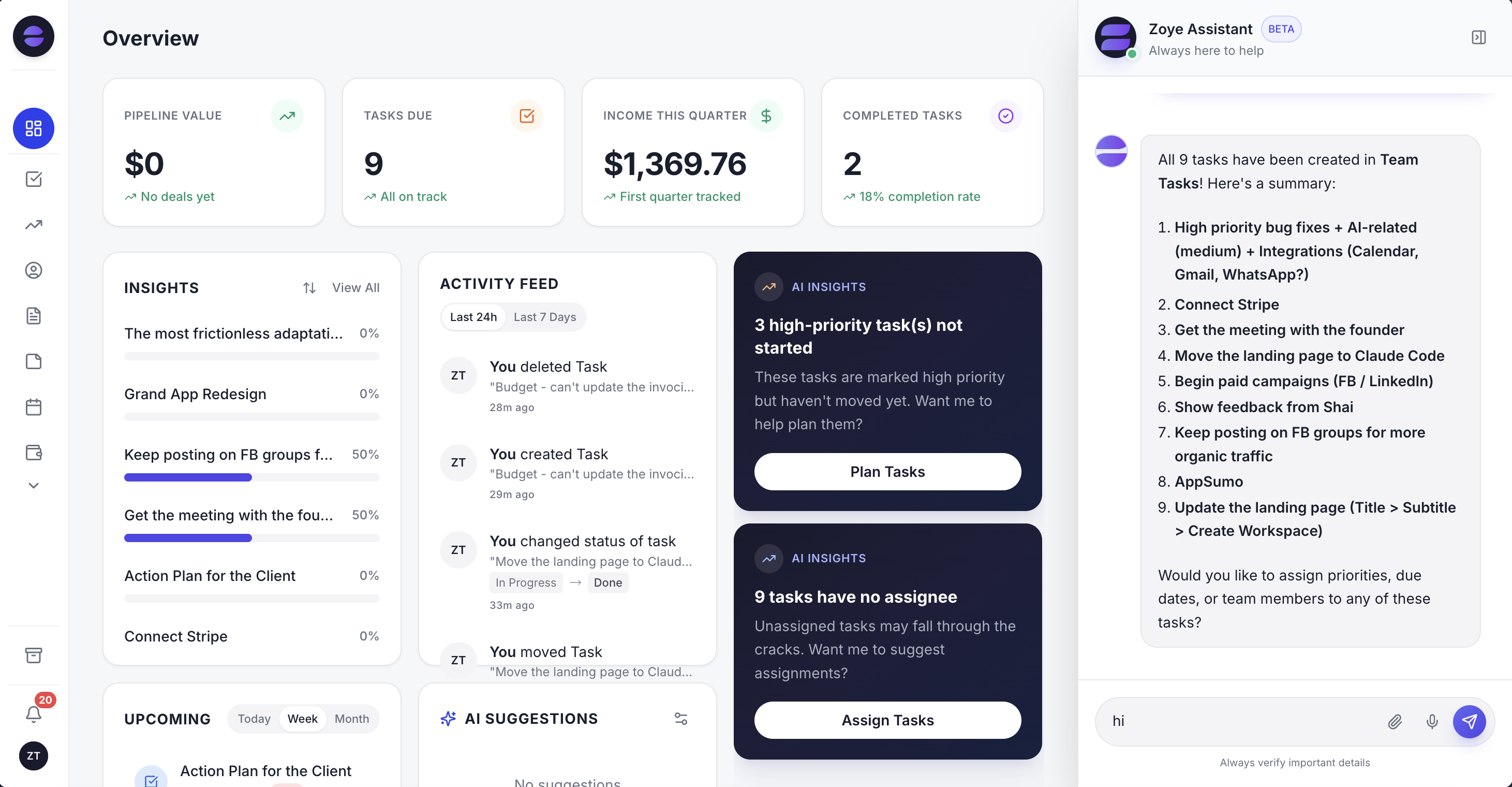 Zoye keeps contacts, deals, tasks, and calendar in one AI-native workspace and does the follow-up work for you, so the implementation cannot go stale.
Underneath, Zoye has a genuine, modern CRM: a contact database that separates people from companies, a visual deal pipeline with custom stages, centralised customer conversations, and a full activity history on every record. But the point is what happens without you touching it. Tell Zoye about a conversation you just had, out loud or by typing, and it opens the deal, creates the contact, links them, drafts the follow-up, and assigns a task with a due date. Ask it to chase everyone who went quiet this week and it drafts and queues the messages. Ask it to build an automation, for example "when a lead comes in from WhatsApp, tag it and remind me in two hours," and it wires that up from the sentence, with no builder to learn.
Because you run it by talking to it, the maintenance dependency that sinks traditional implementations simply is not there. There is no empty database to fill by hand, because the operator fills it. There is no discipline to sustain, because there is no manual entry. There is no follow-up backlog, because chasing is the operator's job. And because Zoye is a full workspace, the CRM sits alongside tasks with list, board, calendar, and timeline views, a shared calendar, budget tracking, and reports that pull from contacts, deals, tasks, and finances into one exportable dashboard. Collaborative notes are rolling out to bring documents into the same place. To be honest about scope, Zoye is a unified operator with a strong modern CRM, not a twenty-year-old enterprise sales suite with every advanced sales-ops feature the largest vendors have accumulated. For most small businesses and lean teams, an implementation that maintains itself beats enterprise depth they will never touch and never keep current.
Pricing: Almost Free at $5 per month for 1 member with the full platform including AI. Starter from $29 per month (10 members). Growth from $59 per month (20 members).
Best for: Small businesses, founders, agencies, and lean teams that want a CRM that stays current on its own instead of a project that slowly rots.
See what Zoye can do for you
From CRM and deal tracking to AI-powered task management - explore everything Zoye offers in one workspace.
Explore FeaturesWhat a CRM implementation that cannot fail looks like
The difference between an implementation that fails and one that cannot shows up in the day-to-day workflow. With a traditional CRM, the workflow after every interaction is: remember to open the tool, find the contact, update the stage, type the notes, set a reminder, and later remember to act on that reminder. Six manual steps, every time, and any one of them is the point where the implementation quietly breaks. Multiply that across a busy week and the breakage is not a risk, it is a certainty.
With an operator, the workflow is: have the interaction, tell Zoye what happened, or let it capture the incoming message itself. The contact, the stage, the notes, the follow-up draft, and the reminder all get handled from that one instruction, and the follow-up actually gets sent. The implementation stays healthy because staying healthy is the system's job. There is no month-three cliff where the data goes stale, because the data was never dependent on someone finding the time to maintain it.
That is the real test of a CRM implementation. Not how it looks in the demo, but whether it is still accurate and still used in six months. A traditional CRM passes that test only if your team wins a daily battle against their own workload. An AI Business Operator passes it because there is no battle to fight.
How to make sure your next CRM does not fail
If you are choosing a CRM after a previous one went stale, three questions cut to what actually matters.
1. Who is going to keep it updated? This is the question every failed implementation answered wrong. If the honest answer is "nobody has the time," a classic CRM will go stale no matter how good it looks in a demo, and no amount of training changes that. A system that maintains itself is the only safe bet. If you genuinely have a dedicated person who lives in the pipeline all day, a traditional CRM can work.
2. Does it do the follow-up, or only remind you? A CRM that surfaces a task and waits is a CRM that depends on a human who is already overloaded. Choose a system that does the chasing itself, so the follow-ups that close deals actually get sent rather than snoozed.
3. Does it cover the whole business or just the sales slice? If the same owner handles sales, delivery, invoicing, and support, a sales-only tool sits half-empty by design. A unified operator that holds contacts, tasks, calendar, budget, and reports in one place has no empty corners to rot in.
Why teams pick Zoye
A few themes come up consistently from businesses whose last CRM failed.
Nobody has to maintain it. The records stay current because the operator updates them from a plain sentence, which removes the single biggest reason CRM implementations fail.
It does the follow-up work, not just the reminding. Zoye chases the quiet leads, drafts the messages, books the clients, and builds the automations, all from instructions you give in plain language, including over WhatsApp and Slack, so the intentions the CRM records actually get acted on.
It runs the whole business, not just the sales slice. Contacts and deals sit alongside tasks, calendar, budget, and reports, so the owner is not stitching separate tools together and the system never sits half-empty.
The failure pattern is always the same, and so is the fix. Stop buying a database you have to feed, and start using an operator that feeds itself.
Try Zoye with your team. The entry plan is Almost Free, with the full platform including AI.
For more context, see what a CRM system is and the 7 best in 2026, the CRM that needs no data entry, and the best CRM for a one-person business.