Most WhatsApp marketing advice for small businesses skips the part that actually matters and jumps straight to "send broadcasts." The channel is genuinely powerful: people open and reply to WhatsApp messages at rates email cannot touch, and a message lands in the same place your customers talk to friends and family. But that intimacy is exactly why it is easy to ruin. Send one badly-timed promo to a list that never really opted in, and you do not just get ignored, you get muted, reported, and eventually blocked.
The real problem is not sending messages. It is running WhatsApp marketing consistently and correctly while also running the rest of the business. Building the opt-in list, timing campaigns, personalising each message, chasing the people who replied, following the rules, and measuring what worked is a lot of moving parts, and for a busy owner it is the work that always slips. So the list goes stale, the campaigns get sporadic, and the channel that should be your best performer quietly underdelivers.
This playbook walks through WhatsApp marketing the way a small business should actually do it: building a permission-based list, planning campaigns people welcome, personalising at scale, winning back quiet customers, staying inside Meta's rules, and measuring results. Then it covers the part almost no other guide does: how an AI operator runs the whole cycle for you, so the playbook happens even on the days you are too busy to run it.
Pricing reflects published rates as of July 2026; check each vendor's pricing page for current figures.
Why WhatsApp marketing works for small businesses
Three things make WhatsApp a different animal from email and social for a small business.
People actually read it. A promotional email fights for attention in a crowded inbox and usually loses. A WhatsApp message gets seen within minutes and often replied to in the same thread. For most small businesses, WhatsApp open and response rates dwarf every other channel they use.
It is a conversation, not a billboard. Social posts shout at everyone and hope. WhatsApp lets you talk to one customer at a time, answer their question, and move them toward a booking or a sale inside a thread they already trust. That two-way nature is why it converts.
It reaches the customers who never open email. A large share of your customers barely touch email but live in WhatsApp all day. Marketing there meets them where they already are, which is the whole game for a local or service business.
The catch is that all three advantages depend on doing it right. Permission, relevance, and restraint are what keep WhatsApp a welcome channel instead of an intrusion. Get those wrong and the same intimacy that makes it powerful makes it the fastest way to annoy your best customers.
Step 1: Build an opt-in list the right way
Everything in WhatsApp marketing starts with permission. Unlike email, where a weak list just gets ignored, a WhatsApp list built without real consent gets your number reported and blocked. So the first job is not "get as many numbers as possible," it is "collect genuine opt-ins from people who want to hear from you."
The formula is a clear value exchange plus a low-friction yes. Give people a concrete reason to subscribe (order and delivery updates, an exclusive first-customer discount, early access to new stock, appointment reminders) and make saying yes as simple as tapping a click-to-chat link or replying with one word. Put that link everywhere your customers already are: your Instagram bio, your website, your Google Business Profile, your receipts, your email footer, and your in-store signage.
Two rules keep you safe and trusted. First, confirm the opt-in in your very first reply, so there is a clear record that they agreed. Second, tell people how to stop at any time. Counterintuitively, an easy opt-out builds a healthier list, because the people who stay actually want to be there, and an engaged list of a few hundred beats a cold list of thousands every time.
Step 2: Plan campaigns people are glad to receive
Once you have a permission-based list, the discipline is restraint. The businesses that get muted are the ones that treat WhatsApp like a daily sales megaphone. The ones that win treat it like a channel for messages the customer is genuinely happy to get.
Think in terms of a rhythm that is mostly useful and only occasionally promotional. Useful messages carry the relationship: an order update, an appointment reminder, a restock alert for something they wanted, a helpful tip, a loyalty reward. Promotional messages (a real offer, a limited drop, a seasonal deal) land far better when they arrive against a backdrop of genuine usefulness rather than as a constant stream.
Segment before you send. A message to customers who bought in the last month should read differently from one to people who have gone quiet for six. Even simple segments (recent buyers, lapsed customers, people who enquired but never bought) let you say something relevant instead of something generic, and relevance is the single biggest driver of whether a campaign performs or gets ignored.
Want to see it in action?
See Zoye catch a new lead, answer on WhatsApp and set up the follow-up, all from one message.
See How It WorksStep 3: Personalise at scale
A WhatsApp message that reads like a mass blast defeats the point of the channel. The whole reason WhatsApp converts is that it feels personal, so the moment your marketing feels mass-produced, you lose the advantage.
Personalisation starts with the basics: the customer's name, a reference to what they bought or enquired about, and a message written in your actual voice rather than corporate boilerplate. Merge fields make this practical at scale. A template like Hi \{first_name\}, your usual \{product\} is back in stock reads as a personal note even when it goes to hundreds of people, as long as the underlying data is clean.
That last part is where most small businesses come unstuck. Personalisation is only as good as the customer data behind it, and keeping that data current (who bought what, who enquired, who went quiet) is the exact upkeep that a busy owner cannot sustain by hand. Personalisation at scale is really a data problem, and it is the reason the best WhatsApp marketing is run by a system that keeps the records current for you, not by a person copying names into a spreadsheet.
Step 4: Win back quiet customers
The cheapest sale is to someone who already bought from you. WhatsApp is the ideal channel for win-back because a past customer already has your number in their chat list and already trusts you, so a well-timed nudge feels like a friendly check-in rather than a cold pitch.
The pattern is simple. Identify customers who have gone quiet (no purchase or contact in a defined window), then reach out with something that gives them a reason to come back: a "we miss you" offer, news of something new they would like, a reminder that a service is due, or simply a genuine check-in. Keep it warm and low-pressure. The goal is to reopen the conversation, not to hard-sell.
Win-back is powerful precisely because it is systematic, and systematic is where humans fail. Nobody manually watches a list for "customers who last bought 90 days ago" and reaches out on the right day. That is the kind of repetitive, data-driven follow-up that only happens reliably when something is running it automatically.
WhatsApp marketing message templates you can adapt
Here are starting points for the common campaign types. Keep them short, swap in your voice, and replace the merge fields with your own data. Only send promotional templates to opted-in contacts, and remember that broadcast promos on the WhatsApp Business API must use an approved message template.
Opt-in confirmation: Thanks for subscribing, \{first_name\}! You will now get order updates and the occasional offer. Reply STOP anytime to opt out.
Restock alert: Good news \{first_name\} - the \{product\} you wanted is back in stock. Want me to set one aside?
Appointment reminder: Hi \{first_name\}, a reminder about your \{service\} on \{date\} at \{time\}. Reply YES to confirm or RESCHEDULE to change it.
Loyalty reward: \{first_name\}, thanks for being a regular. Here is 15% off your next visit as a thank you - just show this message.
Win-back: Hi \{first_name\}, we have not seen you in a while and wanted to check in. Here is 10% off to welcome you back whenever you are ready.
Seasonal offer: \{first_name\}, our \{season\} offer is live: \{offer\}. It runs until \{date\}. Reply here if you would like the details.
The templates are the easy part. The hard part is sending the right one to the right segment at the right time, every time, without it becoming a second job.
See what Zoye can do for you
CRM, deals, tasks and your Instagram, Facebook and WhatsApp automations in one workspace. Just ask Zoye and it sets any of it up for you.
Explore FeaturesStay compliant with WhatsApp's rules
WhatsApp marketing is safe and effective as long as you stay inside Meta's rules, and getting this wrong is the one mistake that can cost you the channel entirely. The essentials are straightforward.
Every recipient must opt in. Never message people who did not agree to hear from you, and never buy or scrape phone numbers. Consent is the foundation of the whole channel.
Promotional broadcasts use approved templates. On the WhatsApp Business API, marketing messages sent outside an active conversation must use a message template that Meta has approved. Free-form promos to a cold list are what trigger blocks.
Respect the 24-hour window. You can reply freely within 24 hours of a customer's last message; outside that window you need an approved template to reopen contact. Structure your campaigns around this rather than fighting it.
Make opting out effortless and honour it instantly. A visible, easy opt-out is not just polite, it protects your number's quality rating, which is what keeps your messages getting delivered.
Treat compliance as the thing that protects your best marketing channel, not as red tape. The businesses that respect these rules keep a high-quality, high-response list for years; the ones that cut corners lose the channel.
Measure what actually matters
WhatsApp gives you a clearer read on marketing performance than most channels, because the response happens in a conversation you can see. Track a handful of numbers rather than drowning in dashboards.
Delivery and read rates tell you whether your messages are landing and whether your number's quality is healthy. Reply rate tells you whether people still want to hear from you. Click-through on any links measures interest in the specific offer. Opt-out rate is your early-warning system: a rising opt-out rate means you are sending too much or too little relevance. And sales or bookings per campaign is the number that actually pays the bills.
The trap is that these numbers only mean something when they are tied back to the customer and the outcome. Knowing a broadcast got a 40% reply rate is interesting; knowing which of those replies became a booking is what tells you where to spend your effort next. That connection between the conversation and the revenue is where a spreadsheet falls apart and a system that links every message to a contact and a deal earns its keep.
Ready to hand off the busywork?
Zoye brings AI-powered CRM, task management, and automation into one workspace.
Get StartedHow Zoye handles WhatsApp marketing for you
Everything above is doable by hand. The problem is doing all of it, consistently, while running the rest of the business. That is the gap Zoye closes. Zoye is not a broadcast tool you operate; it is an AI Business Operator that runs the WhatsApp marketing cycle for you once you tell it what you want.
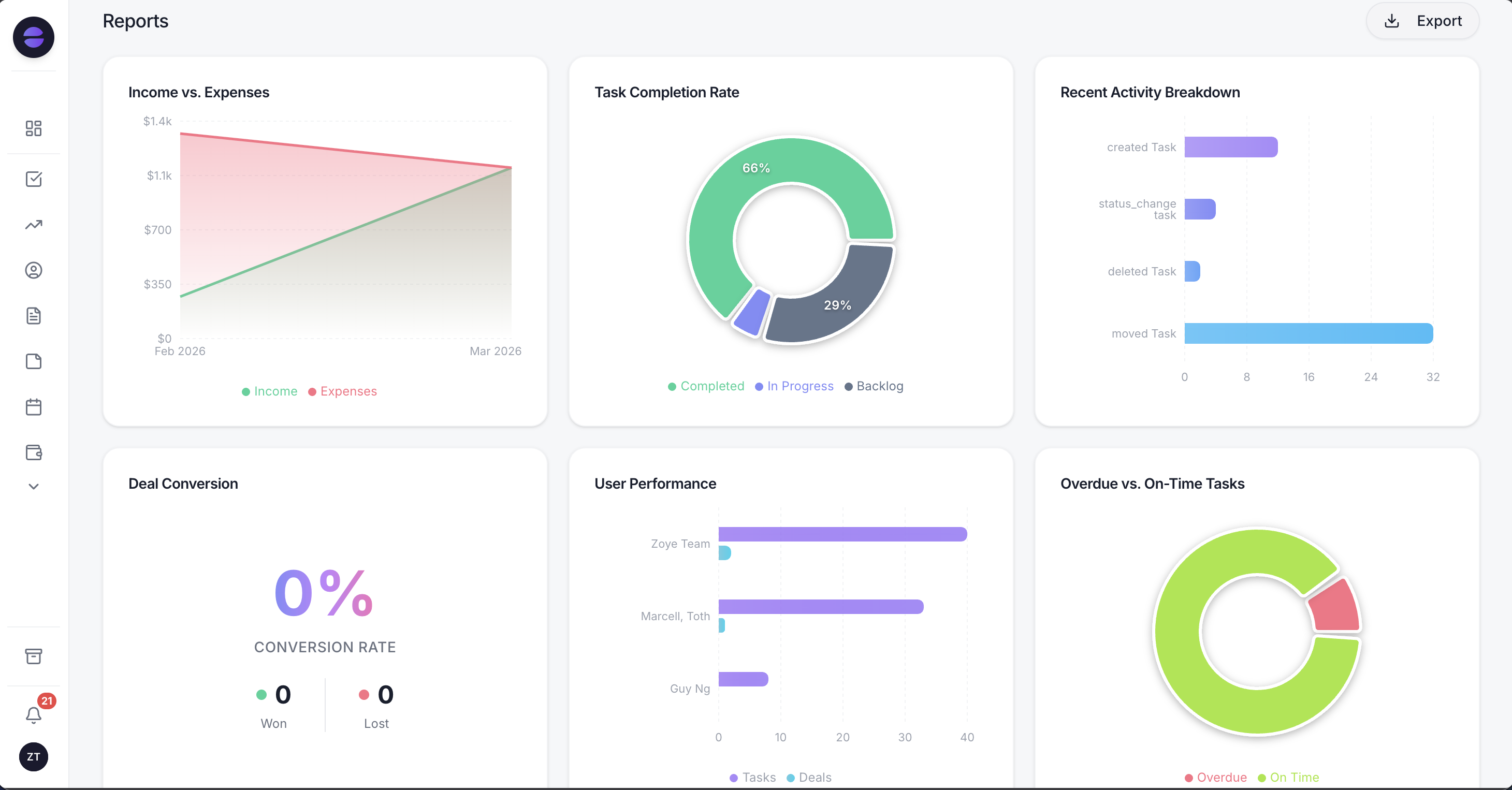 Zoye ties every WhatsApp conversation to the contact and the deal, so you can see which campaigns produced replies, bookings, and revenue.
Here is what that looks like in practice. You tell Zoye who to reach and what to say ("message everyone who bought in the last month about the new arrivals" or "win back customers who have not ordered since spring with a 10% offer"), and it builds the segment from your own contact data, drafts the personalised messages, and sends them. It captures every reply back into the CRM as a contact and a deal, chases the follow-ups on schedule so nobody who showed interest gets forgotten, and books the client when they are ready. Because Zoye keeps the customer records current itself, the personalisation is always accurate, which is the thing that breaks when you try to run this from a stale spreadsheet.
You can run all of it from wherever you already are, including inside WhatsApp and Slack, by just describing what you want. You can also tell Zoye to build the automation once ("whenever a customer goes quiet for 60 days, send them a win-back message") and it wires that up, so the win-back campaign runs itself from then on. And because Zoye is a full workspace, the WhatsApp marketing sits alongside your CRM, tasks, calendar, budget, and reports, so a campaign flows straight into a booking, a task, and a revenue number without you stitching separate tools together.
Pricing: Almost Free at $5 per month for 1 member with the core tools. Starter from $29 per month (10 members). Growth from $59 per month (20 members).
Best for: Small businesses that want their WhatsApp marketing (and the follow-up it creates) run for them instead of squeezed in between everything else.
Why small businesses pick Zoye
A few themes come up again and again.
It runs the whole cycle, not just the send. Building the segment, personalising, sending, capturing replies, chasing follow-ups, and booking the client are all handled by Zoye once you say what you want, instead of you juggling a broadcast tool, a spreadsheet, and a separate CRM.
The personalisation stays accurate because the data stays current. Zoye keeps the customer records updated itself, so merge fields and segments reflect reality instead of a spreadsheet from three months ago.
Nothing slips when you get busy. The follow-ups, the win-backs, and the reminders run on schedule whether or not you have time that week, which is the exact difference between a channel that performs and one that goes quiet.
Try Zoye with your team. The entry plan is Almost Free, with the core tools.
For more context, see how to sell on WhatsApp, the WhatsApp broadcast guide, and how to set up a free WhatsApp chatbot.
See the six automations Zoye ships for this, and how each one stays inside WhatsApp's rules, on the WhatsApp Automations page.