
WhatsApp Lead Qualification Bot: The Five Questions and the Right Order
An enquiry arrives on WhatsApp saying "hi, is this still available?" and nothing else. You have a phone number, a first name that may or may not be real, and no idea whether this is a serious buyer or somebody browsing at midnight. Multiply that by forty a week and you have the problem a qualification bot exists to solve: not answering faster, but knowing something useful about the person before a human spends twenty minutes finding out they were never a fit.
The instinct is to build a long friendly interview. That is the wrong instinct, and it is why most qualification flows underperform the plain "what can I help with?" they replaced. A qualification bot is not a form with a chat skin on it. It is a short, ruthlessly prioritised set of questions whose only job is to decide who picks this lead up, how urgently, and what they say in their first sentence. Anything that does not change one of those three things is a question you should not be asking.
This guide covers the five questions worth asking, the order that gets people to the end, how many is too many, what to do when somebody answers two questions and vanishes (the part almost everybody gets wrong), the handover from bot to human, and the thing that decides whether any of it was worth building: whether the answers land on fields or die in a chat log. If you want the shipped version of this rather than the theory, the WhatsApp Automations page shows how the qualifying bot sits alongside the other five automations.
Meta policy details in this article were checked against Meta's current WhatsApp Business Platform documentation and Business Messaging Policy in August 2026. These rules change; verify before you build.
What a qualification bot is actually for
There are three jobs people ask a WhatsApp bot to do, and they get conflated constantly.
Acknowledgement. Somebody messaged, they got a reply in four seconds, they know they are not shouting into a void. This is valuable and it takes one message. It is not qualification.
Deflection. The bot answers common questions so a human never has to. Opening hours, prices, delivery areas, whether you cover a postcode. Also valuable. Also not qualification.
Qualification. The bot gathers the specific facts that decide what happens to this lead next. Who owns it. Whether it goes to the top of the queue or the bottom. Whether it goes into the pipeline at all.
Only the third one changes your economics, and only the third one requires you to think hard about question design. The other two are configuration. Qualification is a decision about what your business actually needs to know, which is why it cannot be copied from a template someone published for a different industry.
The test for whether a question belongs in your bot: if two different answers to it would produce the same next action from the same person, cut it. You are collecting trivia.
The five questions worth asking
These five cover almost every small business that sells a service, a booking, or a considered purchase. Adjust the wording to your trade; keep the shape.
1. What do you need? The intent question. Not "how can I help?", which invites a paragraph, but a short set of concrete options: the three or four things you actually sell. Presented as tappable choices, this is answered in under two seconds and it routes the lead immediately. A roofing enquiry and a gutter enquiry go to different people; a strategy retainer and a one-off audit go to different people. This question does more routing work than the other four combined.
2. How soon? The timing question, and the single best predictor of whether this lead is worth a call today. Three options are enough: as soon as possible, within a month or so, and just researching for now. Note that "just researching" is not a rejection, it is a routing instruction. Those leads go into a slow nurture rather than into a salesperson's morning.
3. Roughly what scale? The size question, phrased as a range and never as a demand for an exact budget. "Roughly how many people?", "roughly how many square metres?", "one property or several?". A stranger will happily tap a range bracket and will refuse to type a number with a currency sign in front of it. You are not trying to price the job here. You are trying to tell a two-hundred job from a twenty-thousand job so the right person calls.
4. Who are you and where? The fit question. Usually company name plus location, or just location for consumer businesses. This is the one that saves the most wasted human time, because it catches the leads who are outside your service area or outside your market before anyone gets excited. Where the lead came through an ad or a click-to-chat link, you often already have part of this, and you should not ask for what you already hold.
5. How do you want to be contacted? The handover question, and the most underrated of the five. Call, WhatsApp, or email, plus a rough window. A lead who tapped "call me, afternoons" and got an 8am call has been actively annoyed by your qualification process. Asking this also gives you a clean, natural place to end the flow, which matters more than it sounds.
Now the ones to leave out, because their absence is as deliberate as the five above.
An exact budget. People lie, guess low, or abandon the conversation. The scale range gets you ninety percent of the signal at a fraction of the drop-off.
"How did you hear about us?" This is a marketing attribution question that you have made your prospect pay for. Get it from the source of the conversation instead: a click-to-chat link, an ad reference, a lead form. If it is not automatic, it is not worth a question slot.
Anything open-ended. "Tell us a bit about your project" is where flows go to die. It asks a stranger on a phone to compose a paragraph, and the result is either nothing or an unstructured blob that no field can hold.
Anything you can look up. If the answer is already on the record from a previous enquiry, asking again tells the lead you were not paying attention last time.
Order decides how many people reach the end
The five questions are worth roughly nothing in the wrong sequence. Four ordering rules do most of the work.
Cheapest answer first. Question one must be a tap, not a type. The first exchange is where the lead decides whether this is going to be effort, and a tappable choice teaches them the whole flow is going to be easy. Opening with a free-text question is the single most common design mistake in qualification bots.
Commitment increases, never decreases. Intent, then timing, then scale, then identity, then contact preference. Each step asks marginally more of the person than the last, and by the time you ask for a company name they have already invested four taps and are far more likely to continue. Reverse the order and you are asking a total stranger for their company details before you have given them any reason to bother.
Sensitive last. Anything that feels like it might be used against them (scale, location, name) sits after they have seen that the bot is short and useful. Anything that feels like admin sits at the very end.
One question per message, always. Two questions in one message reliably produces one answer, and you will never know which. It also breaks tappable options entirely.
One more, and it is small but it changes completion rate: tell them the length up front. "Four quick questions and I will get the right person to you" sets an end point. A flow with no visible horizon feels like an interrogation from the second question onwards. A flow with a stated length feels like a queue with a number on it.
How many is too many
Three to five. Five is a ceiling, not a target, and most businesses should start at three.
Every additional question costs you a fraction of the people who started, and the loss is not linear. The people who abandon at question six are disproportionately the busy, decisive, high-intent ones, because they are the ones with the least patience for your process. You are not filtering out tyre-kickers with a long flow. You are filtering out the buyers.
The platform enforces some of this discipline for you. On the WhatsApp Business Platform, interactive reply buttons allow up to three predefined replies per message, and an interactive list message supports up to ten rows in total across a maximum of ten sections, with row titles capped at twenty-four characters. Those limits are a useful constraint: if your question needs more than three tappable options, it is probably two questions, and if a row title will not fit in twenty-four characters, the option is probably too complicated to be a choice at all.
The right way to size the flow is to work backwards from the handover. Write down the first sentence you want your salesperson to say to this lead. Every fact that sentence depends on is a question. Every fact it does not depend on is not. Most businesses discover this exercise leaves them with three questions and a lot of habits they cannot justify.
Want to see it in action?
Watch how Zoye automates your daily workflow - from lead management to team collaboration.
See How It WorksThe half-finished answer set: the part everybody gets wrong
Here is the scenario that decides whether your qualification bot makes you money or quietly loses you leads. Someone answers question one and question two, then a customer walks in, a child needs collecting, the phone goes in a pocket. Nothing more arrives. Ever.
In a badly built flow, that lead does not exist. The automation was written to create a record when the flow completes, so a person who told you exactly what they wanted and that they wanted it this week is now nothing at all. Meanwhile the lead who tapped through all five questions out of politeness, with no intention of buying, is sitting in your pipeline with a full profile. You have built a system that rewards idleness and punishes urgency.
Four rules fix it.
Write every answer the moment it arrives, not at the end. This is the whole fix in one sentence, and it is an architectural decision rather than a setting. If your record is created on completion, you are structurally guaranteed to lose your most impatient leads. Create the contact on the first inbound message, before a single question is asked, and write each field as its answer lands.
Mark the record's qualification state explicitly. Not answered, partially qualified, fully qualified. A partial record that looks identical to a complete one is worse than useless, because whoever picks it up cannot tell which fields are blank because the lead stopped and which are blank because you never ask.
Route partials to a human anyway, with the gap visible. Two answers out of five is often plenty. If someone said "new kitchen" and "as soon as possible", you do not need the other three to justify a phone call; you need somebody to make it. The handover note should say what is known and what is missing so the human asks the remaining questions conversationally instead of re-running the bot.
Resume rather than restart. If they come back an hour later, the bot should pick up at question three, not greet them from the top. Being asked something you already answered is the fastest way to convince someone that nobody is actually reading.
There is a timing constraint worth knowing here. When a WhatsApp user messages you, a 24-hour customer service window opens, and it resets each time they message again. Inside that window you can send free-form messages, so a lead who returns the same afternoon can be picked up seamlessly. If the window has closed, restarting the conversation requires an approved message template, which is a different tool with different rules. That is a good reason to make your follow-up on a partial answer set prompt rather than leisurely, and a good reason to understand how WhatsApp message templates work before you need one at 6pm on a Friday.
Set an explicit abandonment threshold and act on it: after roughly thirty to sixty minutes of silence mid-flow, stop waiting and treat what you have as the answer set. Silence is not a pending state. It is data telling you to send in a human.
The handover moment
The bot is a receptionist, not a salesperson, and the handover is the only moment that matters to the lead. Four triggers should end the bot's turn.
The answer set is complete. Obvious, and the easiest case.
A single answer qualifies the lead outright. If someone taps "as soon as possible" on a service where that means real money, do not make them finish the remaining questions. Escalate immediately and let the human collect the rest. A bot that keeps interviewing a hot lead is costing you the deal to complete a form.
The lead asks something off-script. A question the bot was not built for is a buying signal, not an error state. Hand it over rather than repeating the menu, which is the behaviour that makes people hate bots.
Free text breaks the flow. Someone typing a paragraph instead of tapping has decided they want a conversation. Give them one.
The handover message itself should do three things: confirm what was understood, name the human, and set a time. "Got it, kitchen refit, as soon as possible, north side. Passing you to Sam who covers that area. He will message you within the hour." That is a handover. "A team member will be with you shortly" is a hold tone.
On the human's side, the requirement is simple and frequently unmet: they open the conversation already holding every answer, on the record, without scrolling a transcript. If your salesperson has to read the chat history to find out what the bot was told, the bot has created work rather than removed it. Which brings us to the point the whole article turns on.
See what Zoye can do for you
From CRM and deal tracking to AI-powered task management - explore everything Zoye offers in one workspace.
Explore FeaturesThe answers must land on fields, not in a chat log
This is the difference between a qualification bot that changes your business and one that is a novelty.
A chat log is a record that something was said. A field is a fact the rest of your business can use. They look equivalent when you are testing the flow with your own phone, and they are not remotely equivalent the moment you have four hundred leads.
Ask what you can do with an answer that lives only as a line of text in a thread. You cannot filter on it, so there is no way to pull every lead who said "as soon as possible" this week. You cannot sort by it, so urgency is invisible on your list. You cannot report on it, so you will never know which intent converts best or which service line is quietly dying. You cannot trigger on it, so no automation can assign an owner, create a task, or start a follow-up sequence based on what was said. And you cannot see it at a glance, so every handover starts with somebody reading a conversation.
Now the same five answers on fields. The intent answer sets the service field, which assigns the owner. The timing answer sets a priority field, which decides queue position and whether a task appears today or next month. The scale answer sets a deal value band, which decides how much effort this justifies. The fit answer sets location and company, which routes by territory. The contact answer sets a preference field, which tells the human how and when to make contact. Five taps, five fields, and every downstream decision is made without a person reading anything.
The economics follow from that. The chat-log version means you automated the conversation and left the work exactly where it was: a human still opens each thread, reads it, decides, and types the outcome somewhere. That is the whole failure mode. Automating the conversation without automating the work produces a faster way to arrive at the same manual pile.
Three practical rules make the field version happen:
Map every question to a field before you write a single message. If a question has no field waiting for it, either create the field or cut the question. This one rule eliminates most bad qualification design on its own.
Use structured values, not free text, wherever you can. "Within a month" as a defined option can be filtered and counted. "prob next month ish" typed by a lead cannot. Tappable options are not just kinder to the lead, they are what makes the data usable.
Keep the transcript as well, but never as the primary record. The conversation is useful context for whoever picks up the lead, and it should live on the contact record. It just must not be the only place the answers exist.
The same logic is why leads that arrive and sit unworked are the single biggest leak in most small businesses, which is covered in more depth in how to stop losing leads.
Staying inside WhatsApp's rules
Three points, checked against Meta's current documentation in August 2026.
Opt-in comes first. Meta's Business Messaging Policy states that you may only contact people on WhatsApp if they have given you their phone number and you have opt-in permission to receive subsequent messages. A qualification bot answering an enquiry the lead started is fine, because they initiated. Running the same questions at a list of numbers you bought is not.
The 24-hour window governs free-form messages. A user message opens a 24-hour customer service window, and it resets each time they message again. Your qualifying questions are free-form service messages sent inside that window. This is why the bot works without template approval, and why a stalled flow that goes cold overnight needs a different approach to resume.
Business-initiated restarts need an approved template. Outside the window you can only initiate with a pre-approved message template, and Meta categorises templates as marketing, utility or authentication and reserves the right to review, approve, pause or reject any template at any time. Plan the re-engagement message for abandoned qualifications as a template from the start rather than discovering the requirement when you need it.
How Zoye runs the qualifying bot
Zoye ships a lead qualification bot as one of six WhatsApp automations, all off by default, all on the official Meta WhatsApp Business Platform, and all asking for confirmation before anything goes out.
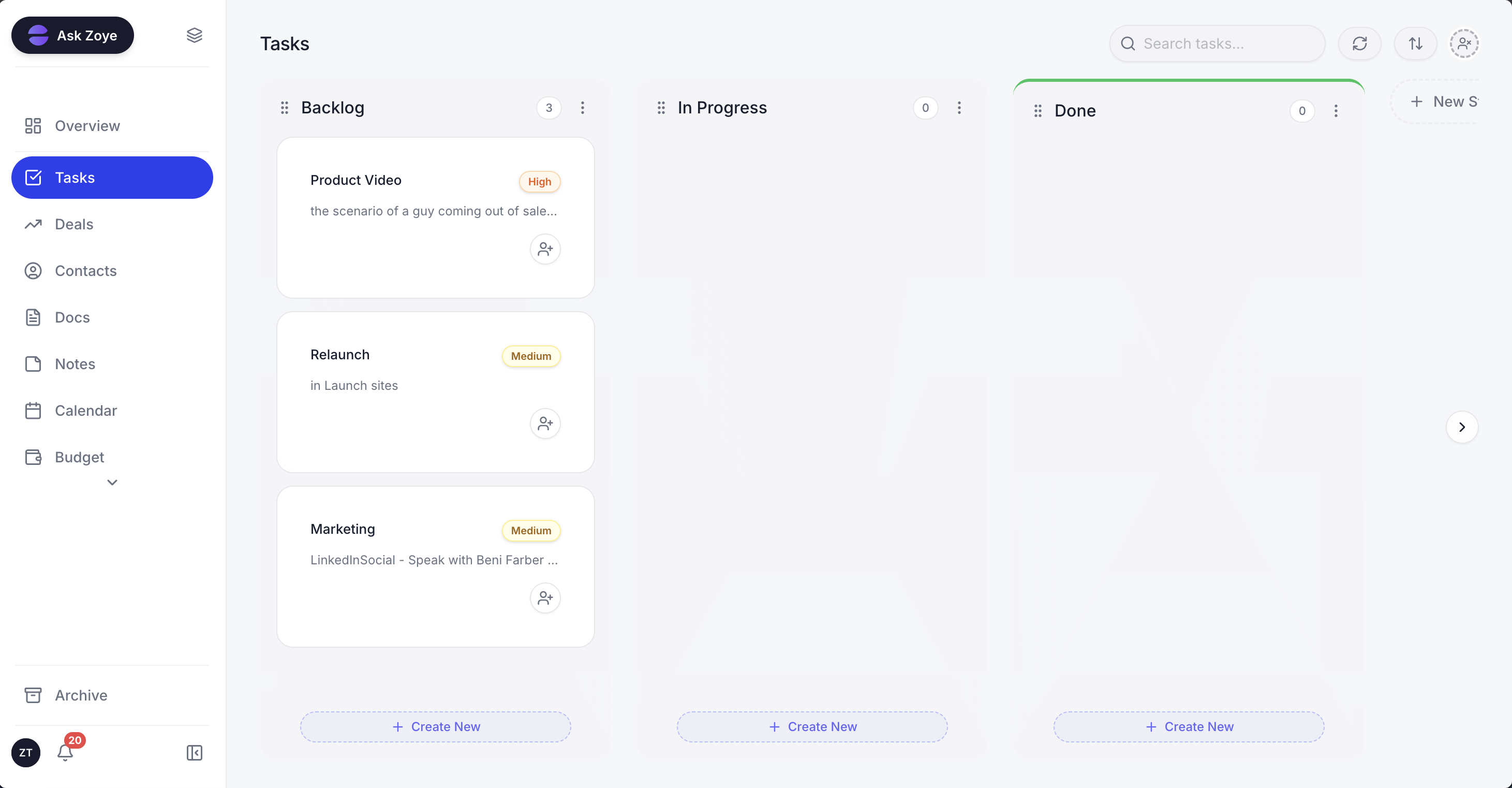 Qualified answers become fields on the record, and the follow-up becomes a task somebody owns.
The part that matters for everything above: the answers write straight into CRM fields on the contact, not into a transcript. The lead becomes a record on the first inbound message, the fields fill in as the answers arrive, and a partial answer set stays a real lead with a visible gap rather than disappearing. Because every record in the workspace links to every other one, the qualified lead already knows its owner, its deal, its tasks and its documents, so the handover is a record somebody picks up rather than a conversation somebody reads.
You describe what you want qualified in a sentence, in the app, on WhatsApp or in Slack, and Zoye turns it into a real rule with triggers, conditions and actions, shows you the finished version in plain English, and runs nothing until you approve it. Every run is logged with what fired, what changed and what was sent, and it is reversible. The same assistant is available in the web app, on WhatsApp, by voice note, in Slack and in Claude through the connector, with the same tools and the same permissions in each.
The lead sources connect to it rather than sitting beside it. A Facebook or Instagram lead-ad submission becomes an ordinary Zoye lead with its fields mapped and the campaign and ad name saved, which means the qualifying bot, the owner assignment, the tasks and the audiences all fire on it exactly as they would on a click-to-chat enquiry. Repeat enquirers are matched to the contact they already have, so the second conversation next month is the same person, not a duplicate.
To be honest about the boundary: Zoye is not a helpdesk ticketing suite and it does not run your ads. It captures the leads your ads produce and works them. If what you want is a conversation platform with campaign analytics, that is a different category of tool. If what you want is for qualified answers to turn into assigned work automatically, that is what this is for.
Best for: small businesses and lean teams whose leads arrive on WhatsApp and currently get qualified by whoever gets to the phone first.
Ready to streamline your business?
Zoye brings AI-powered CRM, task management, and automation into one workspace.
Get StartedA rollout you can finish this week
Day one: write the handover sentence. The first sentence your salesperson should say to a qualified lead. Derive your questions from it. Expect to end up with three.
Day two: create the fields. One field per question, structured values where possible, plus a qualification-state field with three values. Do this before writing any messages.
Day three: write the messages. One question per message, tappable options within the three-button or ten-row limits, an opening line that states how many questions there are, and a handover message that names a person.
Day four: decide the partial policy. Abandonment threshold, what routes to whom, what the human sees. This is the step that gets skipped and the step that determines your return.
Day five: test it as a stranger. From a phone that is not yours, and abandon it deliberately halfway through. If the abandoned lead does not appear as a real record with two fields filled and a visible gap, you are not finished.
Then leave it alone for two weeks and look at one number: how many people who answered question one also answered your last question. Below sixty percent and your flow is too long or your first question is typed rather than tapped. Fix one thing, not five.
What a good qualification bot is really doing
It is not saving you typing. It is making a decision, in the first ninety seconds, that used to take a human twenty minutes and often never happened at all: is this lead worth attention now, and whose attention.
That decision only becomes real when the answers are structured facts on a record instead of sentences in a thread. Get that part right and three tapped questions will outperform a beautifully written ten-question interview, because the three questions produce work that somebody owns and the ten produce a transcript that somebody might read.
Start with three questions, save every answer the instant it lands, treat a half-finished flow as a lead rather than a failure, and hand over by name. Everything else is polish.
Try Zoye and let your WhatsApp enquiries qualify themselves before anyone picks up the phone.
For more context, see how to stop losing leads, WhatsApp message templates, and the guide to WhatsApp automation.
The full set of six automations, and how each one stays inside Meta's rules, is on the WhatsApp Automations page.