
Most small businesses back into WhatsApp customer service by accident. A customer messages the number they found, the owner replies from their personal phone, and before long half the support inbox lives in one person's chat app, invisible to everyone else and impossible to hand off. It works right up until that person is on holiday, asleep, or simply too busy to reply, and then a paying customer sits waiting with no idea if anyone saw their message.
That is the real problem with WhatsApp support, and it is not the channel's fault. WhatsApp is arguably the best place to help customers in 2026: messages get read within minutes, the whole conversation stays in one thread, and a photo or voice note explains a problem faster than three back-and-forth emails ever could. The issue is that most businesses run it like a private chat instead of a proper support channel, with no shared inbox, no response-time standard, no saved replies, and no plan for who handles what.
This playbook fixes that. It walks through how to run customer service on WhatsApp properly: setting up a shared inbox instead of a personal phone, setting response-time expectations customers actually feel, building quick replies that save hours, routing and escalating cleanly, and knowing when a bot helps and when it hurts. It ends with copy-paste message templates and a look at how an AI operator like Zoye can handle most of it for you.
Pricing reflects published rates as of July 2026; check each vendor's pricing page for current figures.
Why WhatsApp became the customer service front door
Customers stopped wanting to call, and they never really loved email either. What they do all day is message. WhatsApp sits on more than two billion phones, notifications get opened fast, and a thread keeps its own history so nobody has to re-explain last week's issue. For a service business, that is close to ideal: the customer reaches you the same way they message a friend, and the conversation is already documented.
The upside for the business is just as real. A WhatsApp thread carries context that a phone call loses the moment you hang up. You can send a photo of the part, a short voice note, a booking confirmation, or a payment link right inside the same chat. Resolution gets faster because the customer does not have to describe a problem in words when they can just show it.
The reason WhatsApp support still goes wrong is that businesses treat a two-billion-user channel like a personal side conversation. The fixes below are about closing that gap, turning an ad-hoc chat habit into a support channel your customers can rely on.
Set up a shared WhatsApp inbox, not a personal phone
The single most important move is to get support off anyone's personal phone and into a shared inbox. A personal WhatsApp has three fatal flaws for customer service: only one person can see it, the history walks out the door if that person leaves, and there is no way to tell whether a message has been answered or is still waiting.
Start with a dedicated WhatsApp Business number, separate from any owner's private line. Then connect that number to a tool that gives your team a shared inbox, so more than one person can read and reply, assign a conversation to a colleague, and see at a glance what is open versus resolved. This is the foundation everything else sits on: quick replies, routing, and reporting all assume that support lives somewhere the whole team can reach, not on one locked phone.
A shared inbox also protects the customer relationship. When conversations live on the business record instead of a personal device, a new teammate can pick up exactly where the last one left off, and nothing is lost when someone is off sick or moves on.
Set response-time expectations customers actually feel
On email, a reply within a day feels normal. On WhatsApp, customers treat the exchange like a conversation, so the clock feels much faster. A message that sits unanswered for hours reads as being ignored, even if you would happily have replied within the day by email.
You do not need to promise instant replies. You need to be predictable. Decide on a first-response target during your working hours (a few minutes is a strong standard, fifteen is perfectly reasonable for a small team) and stick to it. Just as important, set an automatic out-of-hours acknowledgement that tells the customer you have their message and when they will hear back. A clear "Thanks, we are closed now and will reply by 9am" beats silence every time.
Consistency beats speed. A customer who knows they will always hear back within fifteen minutes is happier than one who sometimes gets an instant reply and sometimes waits a day with no pattern. Pick a standard your team can actually hold, publish it, and design the rest of your setup so it is easy to keep.
Want to see it in action?
See Zoye catch a new lead, answer on WhatsApp and set up the follow-up, all from one message.
See How It WorksBuild quick replies that save hours
Most support questions are not new. Opening hours, where an order is, how to book, what a service costs, how to reset something: the same handful of questions come in over and over. Typing a fresh answer each time is slow and inconsistent, and inconsistency is where mistakes creep in.
Build a library of quick replies (also called saved replies or canned responses) for your most common questions. A good quick reply is warm, complete, and easy to personalise in a second before you send it. Keep them short, keep them human, and review them every month or two so they stay accurate as your prices, hours, and policies change.
Quick replies do two things at once. They cut your response time because the answer is one tap away, and they keep your service consistent because every customer gets the same correct information regardless of who is on the inbox that day. The templates later in this guide give you a starting set to adapt.
Route and prioritise: decide who handles what
Once more than one person answers WhatsApp, you need a simple rule for who handles which conversation, or two people reply to the same customer while a third message sits untouched. Routing does not need to be complicated for a small team.
The simplest model is ownership: whoever picks up a conversation owns it until it is resolved, and can reassign it if it needs someone else. For slightly larger teams, route by topic (sales enquiries to one person, existing-customer support to another) or by availability. The goal is that every incoming message has an obvious owner and nothing falls into the gap between two people who each assumed the other had it.
Prioritisation matters too. A frustrated customer with a broken service should not wait behind a routine "what are your hours" question. Flag or tag the conversations that need a fast, careful human reply so they rise to the top, and let the routine ones follow a lighter path.
When a WhatsApp bot helps, and when it hurts
Automation is the difference between WhatsApp support that scales and support that burns out one person. But a bot done badly is worse than no bot at all, so the line matters.
A bot helps when it answers a well-defined, high-volume question instantly and accurately: your opening hours, the status of an order, booking an available slot, a simple troubleshooting step. For these, a fast correct answer at 11pm beats making the customer wait for a human at 9am. A bot hurts when it traps a frustrated person in a menu loop with no way to reach a human, or when it confidently gives a wrong answer to a question it should have escalated.
The rule is simple: automate the easy, repetitive questions, and hand off cleanly and quickly to a person for anything sensitive, unusual, or emotionally charged. The best modern setups do not force a choice between "all bot" and "all human." They let AI handle and draft the routine replies while a person stays in the loop for the exceptions, so customers get speed without ever feeling stuck talking to a wall. That is exactly the model the next section describes.
See what Zoye can do for you
CRM, deals, tasks and your Instagram, Facebook and WhatsApp automations in one workspace. Just ask Zoye and it sets any of it up for you.
Explore FeaturesWhatsApp customer service message templates
Adapt these to your voice, and save them as quick replies. Anything in {curly_braces} is a placeholder you fill in before sending.
First response (business hours): Hi {first_name}, thanks for reaching out. I am looking into this for you now and will come straight back with an answer.
Out-of-hours acknowledgement: Thanks for your message, {first_name}. We are closed right now but a real person will reply by {next_open_time}. If it is urgent, reply URGENT and we will prioritise it first thing.
Order or booking status: Hi {first_name}, your {order_or_booking} is confirmed for {date_time}. You will get a reminder the day before. Anything you need changed, just reply here.
Answering a common question (with a personal touch): Great question, {first_name}. {clear_answer}. Does that cover it, or would it help if I walked you through it?
Escalation handoff: Thanks for your patience, {first_name}. I want to get this exactly right, so I am bringing in {colleague_name} who handles {topic}. They will pick up here shortly with the full answer.
Resolution and review request: Glad that is sorted, {first_name}. If you have thirty seconds, a quick review at {review_link} really helps a small business like ours. Thank you, and message us any time.
Keep each one short and let the placeholder do the personalising. A template that reads like a form letter loses the warmth that makes WhatsApp feel human in the first place.
How Zoye handles WhatsApp customer service for you
Everything above is a system you can run by hand: a shared inbox, response standards, quick replies, routing, and a careful line between bot and human. Zoye is the tool that runs that system for you, because it is not a shared inbox you have to staff, it is an AI Business Operator that reads your WhatsApp messages, drafts the replies, and only escalates what needs a human.
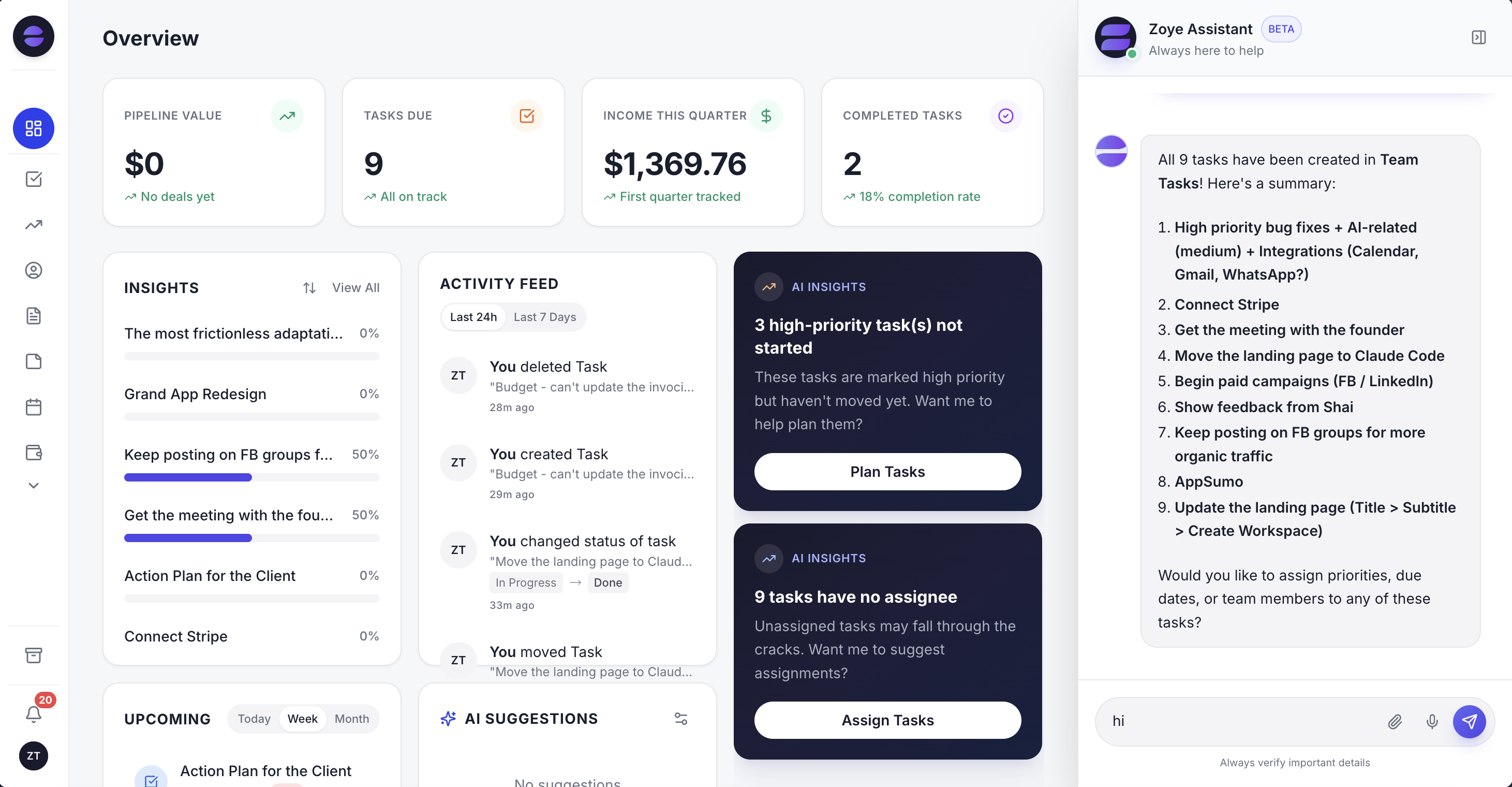 Zoye centralises WhatsApp conversations on the customer record and drafts replies for you, so nothing waits on one person watching one phone.
Here is how it works in practice. When a customer messages your WhatsApp, Zoye turns that message into a logged conversation on the customer's record automatically, so there is no personal-phone black hole and no lost history. The operator reads the message, understands what the customer is asking, and drafts a reply for you to review and send, or handles the routine ones automatically if you let it. Ask it to "reply to everyone waiting with a status update" and it drafts each one in context. Ask it to "book this customer in for Thursday and confirm on WhatsApp" and it does the booking and sends the confirmation. It follows the exact bot-versus-human line from the section above: it handles the easy, repetitive questions instantly and flags anything sensitive or unusual for a person.
Because Zoye runs by conversation, your support is not trapped on one device. The same operator works inside the Zoye app and over Slack, so any teammate can pick up a customer thread, and the response-time standard you set holds even when the owner is busy. And because Zoye is a full workspace, the customer conversation sits next to their contact record, their deals, their tasks, and your calendar, so a support message can become a follow-up task, a booking, or an updated record without you switching tools. To be honest about scope, Zoye is a unified operator with strong WhatsApp support built in, not a giant enterprise contact-centre suite with call-centre workforce planning. For a small business that wants fast, consistent WhatsApp customer service without hiring a support team, that is exactly the point.
Pricing: Almost Free at $5 per month for 1 member with the core tools. Starter from $29 per month (10 members). Growth from $59 per month (20 members).
Best for: Small businesses and lean teams that want reliable WhatsApp customer service handled for them, not another inbox to staff.
Ready to hand off the busywork?
Zoye brings AI-powered CRM, task management, and automation into one workspace.
Get StartedA simple WhatsApp customer service checklist
Pulling the playbook together, a solid WhatsApp support setup has six parts. A dedicated WhatsApp Business number, not a personal phone. A shared inbox the whole team can reach. A published response-time standard with an out-of-hours acknowledgement. A library of quick replies for your common questions. A clear rule for who owns and escalates each conversation. And automation that handles the easy questions while handing off cleanly to a human for the rest.
You can build all six by hand with a shared-inbox tool and a lot of discipline, or you can let an operator hold the discipline for you. Either way, the destination is the same: a customer who messages your business gets a fast, consistent, human reply, and never sits wondering whether anyone saw them.
Why teams pick Zoye
A few themes come up again and again with small businesses running support on WhatsApp.
Nobody has to watch the inbox. The operator reads every incoming message, drafts the reply, and flags what needs a person, so support does not depend on one owner staring at one phone all day.
It is fast without being robotic. Zoye handles the easy, repetitive questions instantly and escalates the sensitive ones, which is exactly where the line between a helpful bot and a frustrating one sits.
It runs the whole relationship, not just the message. Because the conversation lives on the customer record next to their contacts, deals, tasks, and calendar, a support chat can turn into a booking, a follow-up, or an updated record in the same place, over WhatsApp, Slack, or the app.
Try Zoye with your team. The entry plan is Almost Free, with the core tools.
For more context, see how to sell on WhatsApp, automated WhatsApp customer service, and building a free WhatsApp chatbot.
See the six automations Zoye ships for this, and how each one stays inside WhatsApp's rules, on the WhatsApp Automations page.