
One WhatsApp number, one growing team, and no clean way to share it. That is the quiet operational headache behind almost every small business that sells or supports over WhatsApp. Customers message the same number all day, but only one person can really hold the phone, replies get missed, two people answer the same chat with different answers, and nobody can tell later who said what. The free WhatsApp Business app was built for a solo owner, not for a team splitting the load, and the cracks show fast the moment a second and third person need in.
The good news is that running one WhatsApp Business number across a whole team is a solved problem, as long as you understand what the free app can and cannot do and what the WhatsApp Business API plus a proper shared inbox unlock on top of it. This guide walks through the limits of the free app, what changes with the API, how to set a shared number up, the team etiquette that keeps it sane, ready-to-use message templates, and the Meta compliance basics you cannot skip. Then it shows how an AI Business Operator turns that shared number into something that mostly runs itself.
Pricing reflects published rates as of July 2026; check each vendor's pricing page for current figures.
The limits of the free WhatsApp Business app
The free WhatsApp Business app is genuinely good for what it is: a solo owner or a two-person shop can add a catalogue, set a greeting message, save a few quick replies, and label chats. Where it falls apart is the word "team."
It is built around one phone. Your WhatsApp Business account is tied to a single phone number on a single primary device. You can add a handful of linked companion devices (a desktop, a second phone) so more than one person can be logged in, but every one of those devices sees the exact same undivided stream of chats. There is no "this conversation is mine, that one is yours."
There is no real assignment. Because everyone sees everything, two agents can open the same chat and both start typing. The customer gets two replies, sometimes contradicting each other. Nothing marks a conversation as claimed, in progress, or resolved.
There are no roles or permissions. Everyone with a linked device has full access to every conversation, every contact, and the ability to send from your business identity. You cannot give a junior agent limited access or keep a sensitive thread restricted.
There is no audit trail. When a customer disputes what was promised, or a teammate leaves, there is no record of who replied to whom. The chat history exists, but not the accountability layer a team needs.
It does not scale past a couple of people. Linked-device limits, the single shared view, and the lack of assignment mean the free app tops out at roughly one or two active people before conversations start colliding. That is the ceiling, and most growing businesses hit it quickly.
None of this is a flaw in the app; it is simply the wrong tool for multi-agent work. For that you need the layer underneath it.
What the WhatsApp Business API and a shared inbox unlock
The WhatsApp Business API is not an app you download. It is the official connection Meta provides so that approved software platforms can send and receive messages on your business number. Without such a platform it does nothing you can see; its value is that a shared-inbox platform sits on top of it and gives your whole team a proper workspace around your one number.
Connect your number to the API through a compliant platform and five things become possible that the free app can never do.
Multiple agents, truly at once. Everyone on the team works the same number from their own login, not a cloned phone. Ten people can handle conversations in parallel without stepping on each other.
Conversation assignment. Each incoming chat can be routed to a specific person or team, claimed, marked in progress, and closed. No more double replies, no more chats falling between two people who each assumed the other had it.
Roles and permissions. Owners, managers, and agents get different levels of access. You decide who can see what, who can send, and who can change settings.
Automation and an assistant. The platform can auto-reply to common questions, tag and route by keyword, send templated follow-ups, and, with an AI operator on top, draft the actual replies for a human to approve.
A full audit trail. Every message, assignment, and internal note is logged against the contact, so you always know who said what and when. That record is what turns a shared number from a liability into a system you can trust.
Want to see it in action?
See Zoye catch a new lead, answer on WhatsApp and set up the follow-up, all from one message.
See How It WorksHow to set up a shared WhatsApp number for your team
Moving from the free app to a shared team inbox is a defined process, not a hack. At a high level it looks like this.
1. Pick the number you will use. You can use a brand-new number or migrate your existing WhatsApp Business number to the API. Migrating keeps your customers messaging the same number they already know, which is usually what you want. Note that a number moved to the API can no longer be used in the free WhatsApp Business app, so plan the switch when you are ready to commit.
2. Choose a compliant shared-inbox platform. This is the piece your team actually works in. Look for one that offers assignment, roles, an audit trail, message templates, and ideally an AI assistant that can draft replies, so the platform does work rather than just displaying chats.
3. Connect the number through the platform. The platform walks you through connecting your number to the WhatsApp Business API and verifying your business with Meta. This step includes a business-verification check and setting your display name.
4. Add your team and set roles. Invite each agent, give them the right permission level, and decide how conversations get assigned: round-robin, by team, by topic, or manually claimed.
5. Load your templates and greeting. Set up your greeting message, away message, quick replies, and any pre-approved template messages you will use for follow-ups outside the 24-hour window (more on that in the compliance section).
6. Test before you go live. Message the number from a personal phone, confirm the chat lands, gets assigned, and can be answered and closed by the right person. Only then point your website, ads, and signage at it.
Done in this order, the switch is smooth and your customers never notice anything except faster replies.
Team etiquette for one shared number
Tooling solves the mechanics, but a shared number still needs a few simple team habits so the experience stays consistent for the customer.
Claim before you type. Whoever picks up a conversation assigns it to themselves first, so nobody else jumps in.
One voice, one brand. Agree on tone, signature style, and how you sign off. To the customer it should feel like one business, not five different personalities. Some teams add the agent's first name ("Hi, this is Sam from support") for warmth while keeping the tone uniform.
Use internal notes, not the customer chat, for handoffs. When you pass a conversation to a colleague, leave an internal note with the context. Never air the handoff in front of the customer.
Close what you resolve. Mark conversations resolved so the queue reflects reality and nothing sits half-answered.
Respect working hours. Set an away message so customers who write after hours get an honest expectation instead of silence, and nobody feels pressure to answer at midnight.
These habits take minutes to agree on and save hours of confusion later.
WhatsApp message templates for a shared team inbox
Templates keep replies fast and consistent across a team. Here are starting points you can adapt. Remember to swap the merge fields for your own; in a real platform these fill in automatically from the contact record.
Greeting (auto-reply on first message):
Hi {first_name}, thanks for messaging {business_name}. A member of our team will be with you shortly. In the meantime, feel free to tell us what you need and we will get straight to it.
Away message (outside working hours):
Thanks for reaching out. Our team is offline right now and will reply when we are back, usually within {response_time}. Leave your question here and we will pick it up first thing.
Assigned handoff (customer-facing):
Hi {first_name}, {agent_name} here, I will be looking after your enquiry from now. Give me one moment to catch up on your messages.
Quote follow-up (outside the 24-hour window, requires an approved template):
Hi {first_name}, following up on the quote we sent for {service}. Happy to answer any questions or get you booked in whenever you are ready.
Appointment reminder:
Hi {first_name}, a reminder of your appointment with {business_name} on {date} at {time}. Reply YES to confirm or let us know if you need to change it.
Review request (after a completed job):
Hi {first_name}, thanks for choosing {business_name}. If you have a moment, a short review really helps us: {review_link}. Thank you.
Keep a shared library of these so every agent sends the same polished message, and route them through your platform so any template used outside the 24-hour window is one Meta has pre-approved.
See what Zoye can do for you
CRM, deals, tasks and your Instagram, Facebook and WhatsApp automations in one workspace. Just ask Zoye and it sets any of it up for you.
Explore FeaturesMeta compliance basics you cannot skip
Running a business number on WhatsApp comes with rules. Break them and Meta can restrict or ban your number, which is catastrophic when it is the number on all your marketing. The essentials for a team.
Use the official API, never unofficial workarounds. Tools that automate the consumer WhatsApp app or the free Business app in unsanctioned ways risk your number. A shared inbox on the official WhatsApp Business API is the compliant path.
Respect the 24-hour customer service window. You can reply freely within 24 hours of a customer's last message. Outside that window you may only send pre-approved template messages, not free-form ones. Plan your follow-ups around this.
Only message people who opted in. Do not import a cold list and blast it. Contacts should have agreed to hear from you, for example by messaging you first or ticking a clear opt-in. Cold outreach is the fastest way to get reported and banned.
Get templates approved and keep them clean. Template messages go through Meta review. Keep them useful and non-spammy, and honour opt-outs immediately when someone asks to stop.
Keep your business verified and your quality rating healthy. Meta scores your number on how customers react. Fast, helpful, wanted messages keep the rating green; spammy behaviour drags it down and limits how many people you can message.
Staying inside these rules is not just about avoiding a ban; it is what keeps WhatsApp a channel customers actually welcome. A good platform enforces most of this for you, so the whole team stays compliant without memorising the rulebook.
How Zoye handles this for you
Coming soon: connecting your own WhatsApp Business number to Zoye, so the whole team answers from one shared inbox with no device limit, is built and waiting on WhatsApp's approval. Your number will keep working on your phone as before. Until then, the WhatsApp conversations Zoye has with your leads already land in Chats, Zoye's team inbox. Here is how it will work: WhatsApp team inbox.
Everything above is achievable with a shared-inbox platform, but most of them stop at displaying chats and leave the work to your team. Zoye goes further: it is an AI Business Operator that will run on your own WhatsApp number (coming soon) and actually do the work, so a small team can cover a busy number without drowning in it.
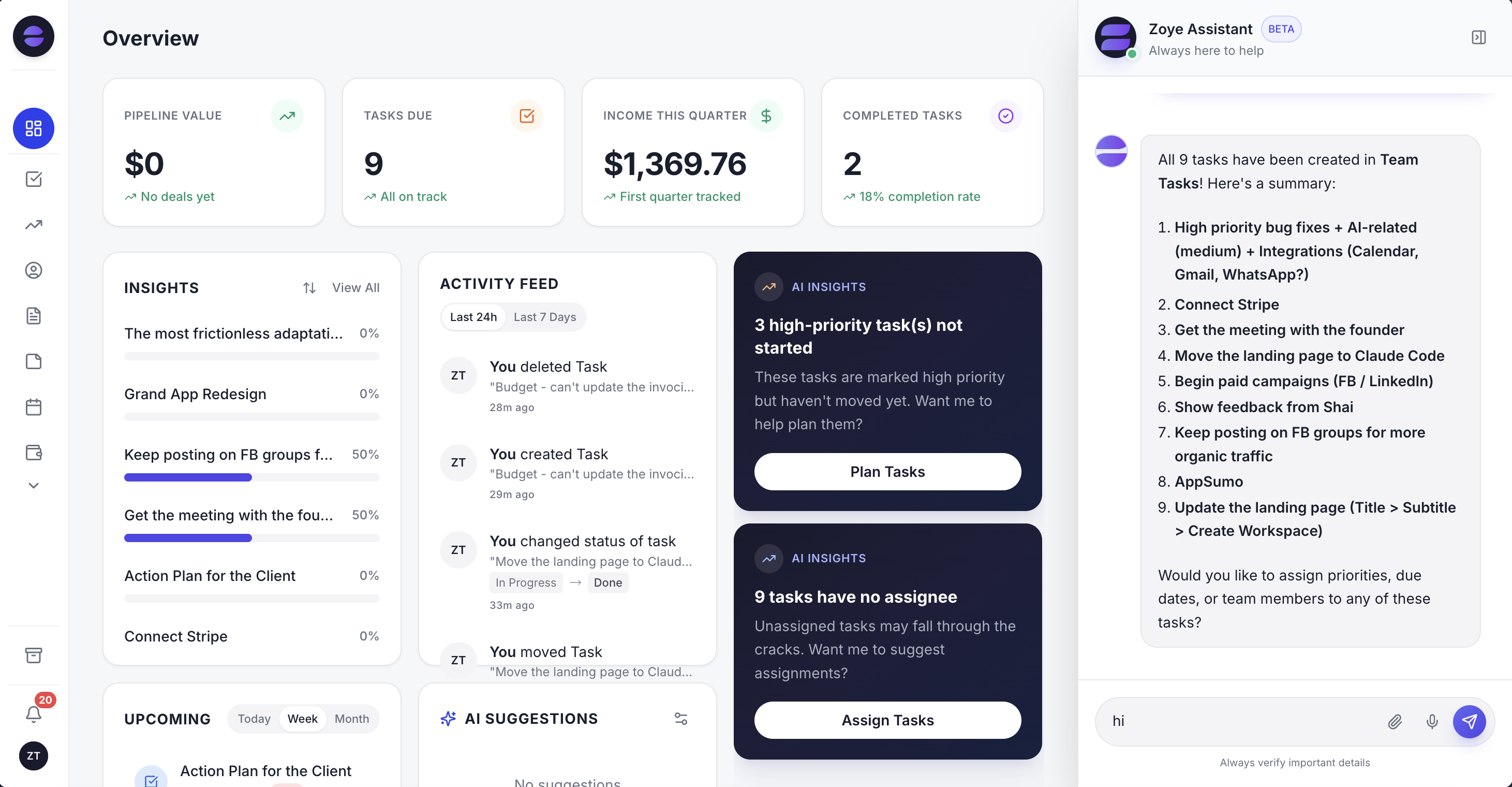 Zoye will turn your own WhatsApp number into a real shared team inbox where the operator drafts and routes replies and only escalates what needs a human.
Once your number is connected, every incoming WhatsApp message will land in a real shared inbox that the whole team works from. The operator will read each message, draft a reply in your brand voice, and either send the routine ones or route the tricky ones to the right person with the context attached. It assigns conversations, so two agents never answer the same chat. It logs every message against the contact automatically, so you get the audit trail without anyone maintaining it. And because Zoye is an operator, not just an inbox, that same WhatsApp message can become a contact, a deal, and a scheduled follow-up without anyone opening a form. You can tell Zoye, "when a new enquiry comes in on WhatsApp, tag it, reply with our intro, and remind me in two hours," and it builds that automation for you.
Roles and permissions decide who sees and sends what. The assistant handles the volume of routine questions and escalates only what genuinely needs a human, so a two-person team can feel like ten. And because Zoye is a full workspace, the WhatsApp conversations sit alongside your contacts, deals, tasks, calendar, and reports, so a customer thread and the follow-up work it creates live in the same place instead of being scattered across separate tools.
Pricing: Almost Free at $5 per month for 1 member with the core tools. Starter from $29 per month (10 members). Growth from $59 per month (20 members).
Best for: Small teams that share one WhatsApp number and want the routine replies, assignment, and follow-up handled for them instead of done by hand.
Ready to hand off the busywork?
Zoye brings AI-powered CRM, task management, and automation into one workspace.
Get StartedWhy teams pick Zoye
A few themes come up again and again.
It will be a real shared inbox, not a cloned phone. Once your number is connected, everyone works the same number from their own login, with assignment, roles, and a full audit trail, so conversations never collide and you always know who said what.
The operator does the replying, not just the routing. Zoye drafts answers in your voice, sends the routine ones, and escalates only what needs a human, which is what lets a small team cover a busy number.
It runs the whole business off that number. A WhatsApp message can turn into a contact, a deal, and a follow-up, and you can have Zoye build the automation just by describing it, so the number becomes an operator rather than another inbox to babysit.
Try Zoye with your team. The entry plan is Almost Free, with the core tools.
For more context, see how to sell on WhatsApp, automated WhatsApp customer service, and WhatsApp for customer service.
See the six automations Zoye ships for this, and how each one stays inside WhatsApp's rules, on the WhatsApp Automations page.