
For twenty years, business software has followed one unspoken rule: you do the work, the software remembers it. You have the call, then you open the tool and log it. You close the deal, then you drag the card to the next stage. You promise a customer a quote, then you set yourself a reminder to send it. The software is a very good filing cabinet with a login, but it never lifts a finger unprompted. Every useful thing it holds got there because a human typed it in.
An AI Business Operator breaks that rule. Instead of a system that waits for you to record what happened, it is a system that does the work when you describe it, and often before you have to ask. You mention that you just finished a call with a new lead, and it creates the contact, opens the deal at the right stage, drafts the follow-up message, and books the next step, just from what you told it. Nobody opens a form. The records stay current because keeping them current is the operator's job, not yours.
This is a new category, and like any new category it is easiest to understand by contrast. This guide defines what an AI Business Operator actually is, sets it clearly against the three things people confuse it with (a CRM, a chatbot, and a workflow builder), explains why the category is emerging now, and shows what it looks like in practice with Zoye, the AI Business Operator built for owners who would rather run their business than administer their software.
Pricing reflects published rates as of July 2026; check each vendor's pricing page for current figures.
What an AI Business Operator actually does
The simplest definition: an AI Business Operator runs your back office by conversation. You talk to it the way you would brief a capable operations manager, and it carries out the operational work across your whole business. Five capabilities define the category.
It captures leads automatically. A message comes in on WhatsApp, a form gets filled, an email lands. The operator reads it, creates the contact, opens a deal, and flags the next action, without you copying anything anywhere.
It books clients and manages the calendar. It offers times, confirms appointments, sends reminders, and reschedules when someone needs to move, so the booking loop runs without you playing receptionist.
It updates your records itself. This is the heart of it. You describe what happened and the operator does the data entry: the contact, the stage change, the notes, the linked task. The system of record stays accurate because the machine maintains it.
It chases the follow-ups you owe. The quiet lead from last week, the unpaid invoice, the customer due for a check-in. The operator drafts and sends the nudges on a schedule, so revenue does not leak out through forgotten follow-ups.
It builds its own automations when you describe them. You say "when a lead comes in from WhatsApp, tag it and remind me in two hours," and it wires that rule up for you. No trigger-and-action canvas to learn, no field mapping to maintain.
Put together, those five things describe something closer to a colleague than a tool. Not a place you go to record work, but something that does the work and reports back.
AI Business Operator vs CRM: store versus run
The comparison people reach for first is the CRM, because on the surface both hold your contacts and deals. But they sit on opposite sides of one line: a CRM stores, an operator runs.
A CRM is a database with a nice interface. Its job is to remember: every contact, every deal, every logged interaction, sitting in one organised place so nothing gets lost. That is genuinely valuable, but it comes with a fatal assumption baked in: someone will keep feeding it. The deal stage only moves when a human drags it. The call only gets logged when a human types it. The follow-up only happens when a human remembers it. For a busy, non-technical owner, that upkeep is the first thing to slip, which is why so many CRMs end up as half-empty databases nobody trusts, the most expensive thing in the stack that nobody opens.
An AI Business Operator removes the assumption. It does not wait to be fed; it feeds itself from what you tell it, and then it acts. Where the CRM's job ends at storing the deal, the operator's job starts there: it drafts the follow-up, books the call, and chases the payment. A CRM answers "what do I have on file?" An operator answers "what needs doing, and can you just do it?" You can think of the operator as having a modern CRM inside it, but the CRM is the memory, not the product. The product is the doing.
Want to see it in action?
See Zoye catch a new lead, answer on WhatsApp and set up the follow-up, all from one message.
See How It WorksAI Business Operator vs chatbot: customer-facing versus owner-facing
The second confusion is the chatbot, because both involve talking to an AI. The distinction is who the AI is for and what happens after the conversation.
A chatbot faces your customers. It sits on your website or your WhatsApp and answers their questions: opening hours, order status, a common how-to. A good one deflects support tickets and buys your customers a fast answer at 2am. But its world ends at the reply. It answers, and then the trail goes cold. Whatever needs to happen next inside your business (log the enquiry, create the lead, assign the follow-up) is still on you.
An AI Business Operator faces you, the owner. It works behind the counter, not in front of it. When a customer message comes in, the operator does not just fire back an answer; it reads the message, creates or updates the contact, opens a deal if there is intent to buy, drafts a reply for you to approve or send, and schedules the follow-up, all inside the same workspace where the rest of your business lives. A chatbot handles the customer's side of a single exchange. An operator handles your side of everything that exchange sets in motion. One talks to customers; the other runs the operation.
That is also why an operator can use a chatbot as one of its hands. The customer-facing conversation is a channel the operator listens on, not the whole of what it does.
AI Business Operator vs workflow builder: you build it versus it builds itself
The third comparison is the automation or workflow builder, the drag-and-drop tools that connect your apps with "if this, then that" rules. This one is the closest in spirit, because both are about getting work done automatically. The difference is who does the building.
A workflow builder hands you a blank canvas and a box of parts. You choose the trigger, connect each step, map every field, handle the edge cases, and then maintain the whole thing when an app changes or a need shifts. It is powerful in capable hands, but it turns the owner into an integration engineer. Most small business owners either never start, or build two automations, hit a wall, and leave the rest undone. The tool can do a lot; the problem is that you have to do the doing.
An AI Business Operator takes that work off your hands. You describe the outcome you want and it builds the automation for you, including the parts a builder would make you configure by hand. When the need changes, you tell it what is different rather than reopening a diagram. The workflow builder gives you the ability to automate; the operator gives you the automation. One is a set of tools; the other is the outcome those tools were supposed to produce.
Why the AI Business Operator is emerging now
Categories do not appear on schedule; they appear when a few forces line up. Four came together in 2026.
AI can finally take action reliably, not just chat. The last wave of business AI could suggest, summarise, and draft. The current wave can execute: read a message, decide what it means, and make the change across several systems safely. That jump from advice to action is what turns an assistant into an operator.
Owners are drowning in tools they do not use. The average small business has stacked up a CRM, a scheduler, an inbox, a spreadsheet, and two automation apps, and gets a fraction of the value because keeping them all fed is a full-time job nobody has. The appetite is no longer for another tool to maintain; it is for something that does the maintaining.
Customers moved to messaging. A growing share of business now happens over WhatsApp and chat, not email and phone. An operator that lives where the conversations already are, and turns them into records and follow-ups automatically, fits how customers actually behave.
Non-technical owners want outcomes, not configuration. The people running most small businesses did not sign up to be database administrators or automation engineers. Software that asks them to build and maintain is software they abandon. Software they can simply talk to is software they keep.
Put together, those forces produce a clear demand: not a better filing cabinet, and not a smarter chatbot, but something that runs the operational back office so the owner can run the business. That is the AI Business Operator.
See what Zoye can do for you
CRM, deals, tasks and your Instagram, Facebook and WhatsApp automations in one workspace. Just ask Zoye and it sets any of it up for you.
Explore FeaturesWhat to look for in an AI Business Operator
Not everything labelled "AI" is an operator. As the category fills up, four tests separate a genuine operator from a CRM with a chat box bolted on.
Full write access, not just suggestions. The core test. Can it actually create the contact, move the stage, and send the follow-up, or does it only recommend that you do those things? An operator does; an assistant advises. If every action still ends with you clicking to confirm the obvious, it is a helper, not an operator.
Owner-facing and whole-business. A real operator covers the operation, not one slice of it. Contacts and deals, yes, but also tasks, calendar, and reporting, so it does not sit half-empty the way a sales-only tool does. It answers to the owner, not just the customer.
Conversation as the interface. You should be able to run it by talking to it, the way you would talk to a colleague, from wherever you already are, including WhatsApp. If you still have to learn forms and builders to get anything done, the "operator" framing is marketing.
It maintains itself. The whole promise is that keeping the system current is the machine's job. If you still have to do the data entry to keep it useful, it will go stale exactly like the CRM it was meant to replace.
Zoye: the AI Business Operator
Zoye is the clearest example of the category, built from the ground up as an AI Business Operator rather than a CRM with an AI feature stapled on. It runs the business and keeps everything current itself, so a non-technical owner never has to do the data entry that quietly kills traditional software.
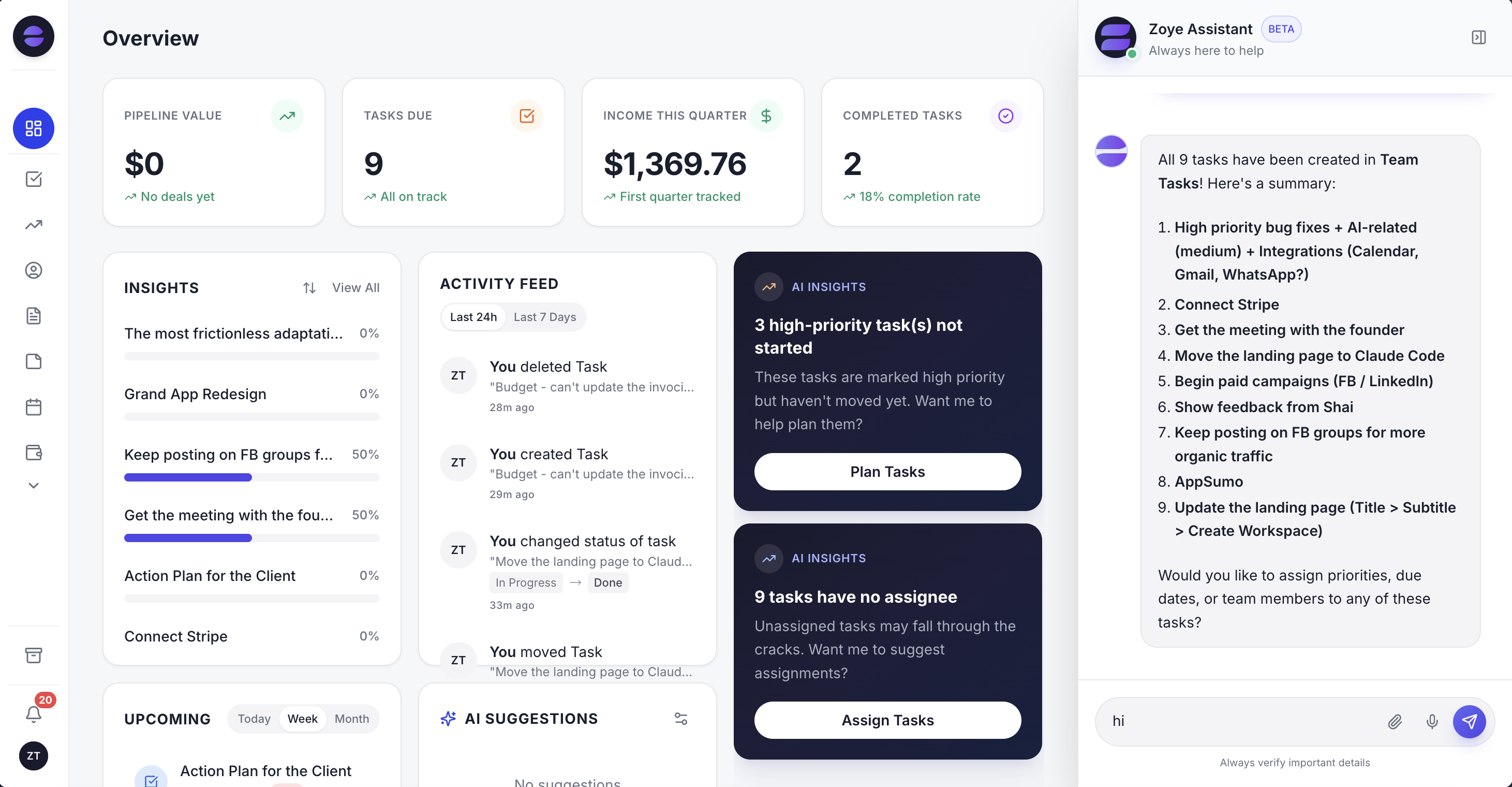 Zoye keeps contacts, deals, tasks, and calendar in one AI-native workspace and runs the follow-up work for you.
Underneath, Zoye holds a genuine, modern workspace: a contact database that separates people from companies, a visual deal pipeline with custom stages, tasks with list, board, calendar, and timeline views, a shared calendar, budget tracking, and reports that pull from all of it. But the point is what happens without you touching any of it. Tell Zoye about a call you just had, out loud or by typing, and it creates the contact, opens the deal, links them, drafts the follow-up, and assigns a task with a due date. Ask it to chase everyone who went quiet this week and it drafts and queues the messages. Ask it to build an automation ("when a lead comes in from WhatsApp, tag it and remind me in two hours") and it wires that up, with no builder to learn.
Because you run it by talking to it, you can operate the whole business from wherever you already are, including WhatsApp and Slack. An incoming WhatsApp message becomes a contact, a deal, and a follow-up without you opening the app, so a solo owner working with their hands never misses a lead. This is the operator model in full: it captures the lead, books the client, updates its own records, chases the follow-up, and builds its own automations, all from what you tell it. To be honest about scope, Zoye is a unified operator with a strong modern workspace, not a twenty-year-old enterprise sales suite with every advanced sales-ops feature Salesforce has accumulated. For the owners and lean teams this category is built for, an operator that does the work beats enterprise depth they will never touch.
An operator also improves with use, which is the part a static CRM cannot copy. Zoye remembers what each person prefers and what is true about the business, and the team shares a memory that the owner approves before it sticks. A standing instruction such as "from now on, flag any lead who mentions a deadline" applies to every new lead, whatever channel it came from. It takes on recurring open-ended jobs ("every Friday, list the deals that went quiet"), delivers a daily insights digest in the app, by email, on WhatsApp or in Slack, reverses any change when you ask, and does deep web research with sources. If you are unsure what to hand over first, just ask Zoye what it can do for your business.
Pricing: Almost Free at $5 per month for 1 member with the core tools. Starter from $29 per month (10 members). Growth from $59 per month (20 members).
Best for: Owners, founders, and lean teams who want their business run for them instead of administered by them.
When you need an operator, and when you do not
An AI Business Operator is not the right answer for everyone, and it is worth being honest about the fit.
You want an operator when you are the bottleneck: when the follow-ups slip because you are busy delivering the work, when the CRM goes stale because nobody has time to feed it, when leads arrive on WhatsApp faster than you can act on them, and when you would rather describe what you want than build and maintain the machinery to make it happen. That describes most solo owners, founders, and small service teams.
You may not need one, yet, if you have a dedicated operations person who genuinely lives in a traditional CRM all day and keeps it perfect, or if your business is a large enterprise with complex, specialised sales processes that demand the deep configuration of a Salesforce. The operator model shines where the constraint is the owner's time and attention, which is exactly where small businesses live.
Why owners pick Zoye
A few themes come up consistently.
It does the work, not just the reminding. Zoye captures the leads, books the clients, updates the records, chases the quiet follow-ups, and builds the automations, all from what you ask it to do, including over WhatsApp and Slack.
Nobody has to maintain it. The records stay current because the operator updates them itself, which removes the single biggest reason small businesses abandon the software they bought.
It runs the whole business, not one slice. Contacts and deals sit alongside tasks, calendar, budget, and reports, so the owner is not stitching separate tools together and hoping the data lines up.
You run it by talking to it. There is no builder to learn and no forms to fill. You describe what you want and the operator does it, which is what makes it usable by an owner who is not technical and does not want to become technical.
Try Zoye with your team. The entry plan is Almost Free, with the core tools.
For more context, see the AI agent for small business, business automation for small business, and the AI that runs your business.