
"AI agent" has become the most abused term in business software. In 2026, every chatbot, autoresponder, form-filler, and workflow tool has rebranded itself as an agent, and for a small business owner trying to figure out whether any of this actually helps, the noise is worse than useless. Most of what is sold as an AI agent for small business is a chat window that talks about your business without being able to touch it.
The distinction matters more than any feature list. The gap between a chatbot and a real agent is the gap between "answers questions about your opening hours" and "books the client, sends the confirmation, and chases the no-show three days later without being asked." One is a nicer FAQ page. The other is operational help, the kind a small team actually feels.
There is also a quieter truth behind the search for an AI agent: most owners have already bought software that promised to change everything. It is still there, half set up, quietly billing a card, because maintaining it turned into a second job. This guide defines the category honestly, explains what an agent needs before it can genuinely run things, maps the 2026 landscape, and shows which option was built to do the work rather than describe it.
Pricing reflects published rates as of July 2026; check each vendor's pricing page for current figures.
What is an AI agent? (And what it is not)
Three terms get blurred together, and the blur is where most disappointing purchases happen.
A chatbot answers. It sits in a chat widget, matches your question to an answer, and replies. Modern chatbots powered by large language models sound impressively human, but their relationship to your business is read-only at best. They can tell a customer your prices; they cannot create the lead, book the slot, or send the invoice. When a vendor's "AI agent" turns out to be a chatbot, the tell is simple: nothing in your business changes because the conversation happened.
An assistant suggests. One level up, an AI assistant reads your data and produces useful output: it drafts an email, summarises a pipeline, recommends what to prioritise. This is genuinely helpful, but the execution still belongs to you. The assistant writes the follow-up; you send it. It flags the overdue task; you move it. Every suggestion adds a small to-do to the list of the person it was supposed to relieve.
An agent acts. A true AI agent perceives the state of your business, decides what needs to happen, and then does it, with write-access to the real systems. It creates the record, sends the message, books the appointment, updates the stage, and reports back on what it did. The test never changes: ask it to do something. A chatbot explains how. An assistant drafts it. An agent does it and shows you the result.
Most products marketed as AI agents for small businesses in 2026 sit in the first two categories. The third is rarer, because acting on a business safely is an architecture, not a feature.
What "runs your business" actually requires
If an agent is going to run things rather than chat about them, four requirements are non-negotiable.
Write-access across the whole operation. An agent that can only touch one system is a specialist, not an operator. Running a small business means the same conversation can produce a new lead, a booked appointment, an updated deal, a task for a teammate, and a reminder next Tuesday. That requires the agent to have real create, update, and complete permissions across contacts, deals, tasks, calendar, and messages, not a plugin bolted onto one of them.
Safety and confirmation. Write-access without guardrails is how you get a deleted client list. A production-grade agent confirms before destructive actions, respects each user's permissions instead of bypassing them, never invents records it did not create, and never claims something succeeded when it failed. Ask any vendor what happens when their agent is told to delete everything; the answer tells you whether real businesses can trust it.
Memory and context. A business is a continuous story, not a series of disconnected prompts. The agent needs to know that the "Sarah" you mentioned is the lead from Tuesday, that this client always books Fridays, and that the quote you sent last week is still unanswered. Without persistent memory of your customers, deals, and history, every conversation starts from zero and the owner becomes the agent's memory, which defeats the point.
Zero maintenance for non-technical owners. This is where most agent platforms silently exclude small businesses. If the agent requires prompt engineering, flow-building, API keys, or a weekly tune-up, it has recreated the exact problem it was meant to solve: software that needs operating. For a busy owner, the only sustainable interface is a conversation, ideally in a channel they already use all day.
Want to see it in action?
See Zoye catch a new lead, answer on WhatsApp and set up the follow-up, all from one message.
See How It WorksWhy small businesses are adopting AI agents in 2026
Software fatigue reached a breaking point. Industry surveys have repeatedly found that a large majority of small businesses never fully use the customer-management software they pay for; the setup, data entry, and upkeep quietly get abandoned. Owners are not looking for another dashboard to neglect. An agent flips the model: instead of you operating the software, the software operates for you.
The follow-up math became impossible to ignore. Speed and persistence decide small business revenue. Studies of lead response consistently show that replying within minutes multiplies contact and conversion rates, while most leads never receive more than one touch. A human owner cannot chase every quote, every no-show, and every quiet lead. An agent can, every single time, and that alone often pays for the whole platform.
Customers moved to messaging, and agents followed. WhatsApp and messaging channels are where clients of service businesses actually respond. An agent that lives in the same channel can capture the enquiry, book the slot, and confirm it in the thread where the customer already is, and let the owner run the business from that same thread.
The technology crossed from demo to dependable. Two years ago, agent demos were impressive and agent reliability was not. In 2026, mature tool-calling, permission systems, and confirmation flows mean an agent can hold write-access to a real business responsibly. The category quietly moved from "interesting" to "usable by people who do not care how it works."
The AI agent landscape for small business in 2026
The honest way to map this market is not a ranked list of ten interchangeable products; it is one full business operator and a set of narrower vertical agents that each do one job.
1. Zoye - the AI Business Operator that runs things end to end
Zoye is the first full AI Business Operator: an agent with real write-access across an entire business workspace, built specifically for owner-operated small businesses rather than developers or enterprise IT. Where the rest of the category answers questions or automates a single lane, the Zoye Assistant executes: it captures leads, chases follow-ups, books clients, updates customer records itself, and builds an automation as soon as you describe what you want.
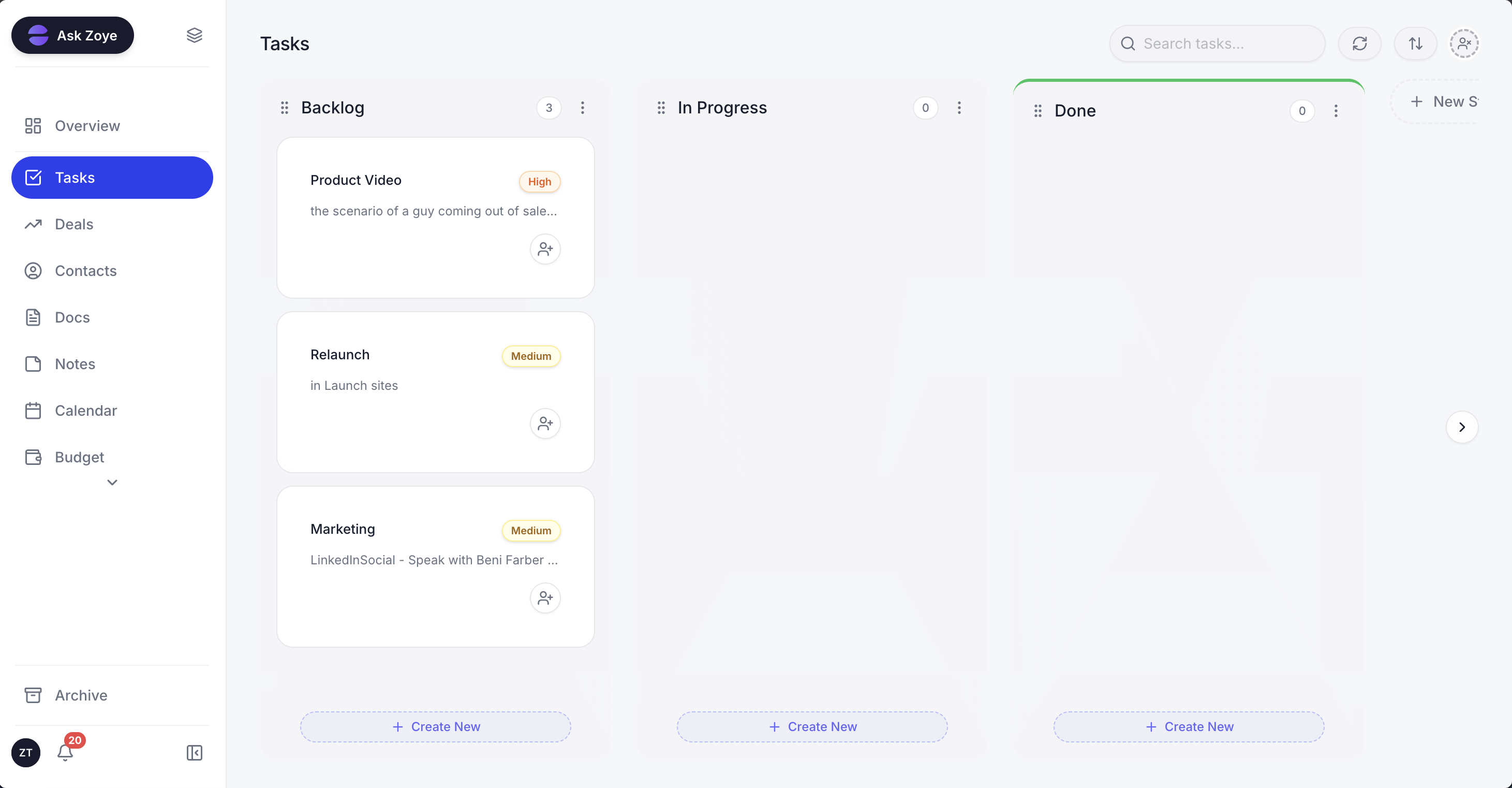 Zoye's task board: the operator creates, assigns, and updates tasks itself, so the board stays current without anyone maintaining it
The interface is a conversation. Say "new lead, Dana, wants a quote for Friday" and the lead exists, with a follow-up scheduled. Say "chase everyone who hasn't answered a quote this week" and the follow-ups go out. Say "when a new lead comes in, reply within a minute and book a call if they're interested" and the assistant builds and runs that automation itself; there is no workflow canvas to learn, because describing the outcome is the whole setup. It works the same on WhatsApp, so the owner can run the day from the same app their customers message them on.
Underneath the agent sits a complete workspace: tasks with list, board, calendar, and timeline views, customer and deal management, a shared calendar, budget tracking, and reports, so the agent's write-access covers the whole operation rather than one silo. The safety layer is what makes that trustworthy: destructive actions require confirmation, the assistant respects each user's permissions, and it never fabricates a record or claims an action succeeded when it did not. Non-technical owners never have to "maintain" any of it; you talk, it runs.
It also gets smarter the longer you use it. The assistant remembers each person's preferences and the facts of your business, and keeps a shared team memory that the owner approves. Say "from now on, tag every new lead who asks about pricing as hot" and that standing rule applies to every lead that arrives afterwards, from any source. It runs scheduled jobs ("every Monday, tell me what I missed"), sends a daily insights digest to the app, email, WhatsApp or Slack, undoes any change when you ask, and researches a question on the web with sources. Not sure where to start? Just ask Zoye what it can do for your business, and it walks you through it.
Pricing: Almost Free at $5 per month for 1 member with the full platform including AI. Starter from $29 per month (10 members). Growth from $59 per month (20 members). Scale from $119 per month (100 members).
Best for: Owner-operated small businesses (1-20 people) that want one agent to actually run leads, follow-ups, bookings, tasks, and records, instead of another tool to operate.
2. AI receptionists and phone agents
Voice agents such as Smith.ai, Goodcall, and Rosie answer your business phone, take messages, screen callers, and in some cases book appointments into a connected calendar. For businesses that live and die by inbound calls (trades, clinics, law offices), a phone agent stops missed calls from becoming missed revenue.
The limitation is scope. The agent's world ends when the call does: it does not chase the quote afterwards, update the deal, or follow up the no-show. You still need a system of record behind it, and someone (or something) to work everything the call produced.
Typical pricing: Roughly $20 to $300 per month depending on call volume and features.
Best for: Call-heavy businesses that miss revenue every time the phone rings unanswered.
3. Customer support agents
Support agents such as Intercom's Fin, Zendesk AI, and Tidio's Lyro resolve inbound customer questions automatically, drawing on your help content and past tickets. On the deflection metric they are genuinely effective, and for businesses with high support volume they reduce a real cost.
The catch for small businesses is direction: these agents face your customers, not your operation. They answer "where is my order?" but do not run your pipeline, your bookings, or your follow-ups. Pricing is also usually per-resolution or per-seat on top of a helpdesk subscription, which was designed for larger support teams.
Typical pricing: Often around $0.99 per AI resolution (Fin) or bundled into helpdesk plans from roughly $25 per agent per month.
Best for: Businesses with enough repetitive inbound support volume to justify a dedicated support stack.
4. Marketing and content agents
Tools like Jasper, Copy.ai, and the agent modes inside ad platforms generate campaigns, social posts, product descriptions, and email copy at volume. For a small business doing its own marketing, they compress hours of writing into minutes.
They are output machines, though, not operators. They produce the asset; you still plan, publish, respond to the leads it generates, and follow up. A marketing agent with no connection to your pipeline cannot tell you whether any of that content produced a paying client.
Typical pricing: Free tiers exist; paid plans commonly run $29 to $69 per month per user.
Best for: Owner-marketers who need content volume and already have somewhere for the resulting leads to land.
5. Coding and technical agents
Agents such as GitHub Copilot and Claude Code write, refactor, and debug software autonomously. They are the most mature proof that agents can do real, high-stakes work: given a goal, they modify real codebases and verify the result.
For most small businesses they are relevant only indirectly, but they are worth understanding as the category's benchmark: this is what "the agent does it and shows you the result" looks like when the pattern is fully grown. The same execution standard is what you should demand from any agent that claims to run your business.
Typical pricing: Roughly $10 to $40 per user per month for mainstream tiers.
Best for: Businesses with in-house software work; a useful mental model for everyone else.
6. Agent-builder platforms
Platforms such as Zapier Agents, Relay.app, and n8n let you construct your own agents and automations across your app stack. They are powerful and flexible, and for a business with a technical operator on staff they can automate almost anything.
That is exactly the constraint: you are the builder. Someone has to design the flows, connect the APIs, handle the errors, and maintain everything as apps change. For the typical owner, this recreates the maintenance burden that made the last system fail. If you would rather describe the outcome than build the machine that produces it, this category is not the answer.
Typical pricing: Free tiers with limits; usable paid plans typically $20 to $100+ per month.
Best for: Teams with a dedicated ops or technical person who enjoys building and maintaining automations.
See what Zoye can do for you
CRM, deals, tasks and your Instagram, Facebook and WhatsApp automations in one workspace. Just ask Zoye and it sets any of it up for you.
Explore FeaturesHow to choose an AI agent for your small business
Four questions cut through nearly all of the marketing.
1. Does it act, or does it answer? Ask for a live demonstration of the agent completing a full loop: capture a lead, book an appointment, send a follow-up, update the record. If the demo is a conversation about your business rather than actions inside it, you are looking at a chatbot.
2. How wide is its write-access? A phone agent, a support bot, and a content generator each cover one lane, and you will still need the system of record plus someone to run it. An operator covers the whole loop in one place. Decide whether you are buying a specialist or replacing the operating burden itself.
3. Who maintains it? If the answer involves flows, prompts, integrations, or a technical setup call, be honest about whether that maintenance will still be happening in six months. The graveyard of small business software is full of tools that needed an operator the business did not have.
4. What are the safety guarantees? Before giving anything write-access to your customer data, confirm it asks before destructive actions, respects user permissions, and never reports success it cannot show. A trustworthy vendor answers this immediately and specifically.
What the first week with a business operator looks like
The realistic adoption path is smaller and faster than a software migration, because there is nothing to migrate into place first. Day one, you connect your channels and tell the agent about your business the way you would brief a new hire; it starts capturing enquiries immediately. By midweek, you have delegated the reflex tasks: "follow up every quote that goes quiet for two days," "book consultations only on Tuesday and Thursday afternoons," "remind me each morning what needs my attention." By the end of the week, the pattern inverts: instead of opening software to check on the business, the business reports to you, in chat, and you answer with decisions instead of data entry.
That inversion is the entire point of the category. The measure of a real agent is not how clever the conversation feels; it is how much of your week it quietly gives back.
Why small businesses pick Zoye
A few themes come up consistently.
It is the one that executes. Leads get captured, follow-ups get chased, clients get booked, and records stay current because the agent does the work itself, not because the owner remembered to.
There is nothing to maintain. No flows, no canvas, no prompt library. Owners tell Zoye what should happen, on WhatsApp if they like, and it builds and runs the automation.
It replaces the operating burden, not just a tool. Tasks, customers, deals, calendar, budget, and reports live in one workspace the agent can act across, so the owner stops being the integration layer between five apps.
And it is safe to trust: confirmations before destructive actions, permission-aware behaviour, and no invented results, which is what write-access to a real business requires.
Try Zoye with your team. The entry plan is Almost Free at $5 per month for 1 member, with the full platform including AI.
For more context, see the best AI tools for business, the best AI project management tools, the best Zapier alternatives, and the rest of the Zoye blog.