
The 8 Best Zapier Alternatives in 2026 (Including One That Builds Automations For You)
Zapier made automation mainstream. With thousands of app integrations and a simple trigger-action model, it taught a generation of business owners that software could talk to software. But in 2026, a growing number of those owners are searching for Zapier alternatives, and the reason is rarely the integrations. It is the work. Zapier gives you a workshop; you still have to be the mechanic. You design every Zap, you debug every failed run, you pay per task, and when an app changes its API, your automation quietly breaks until you notice the leads that stopped arriving.
That maintenance burden is the real cost. Most small business owners never wanted to become automation engineers; they wanted follow-ups sent and leads captured. So the search for a Zapier alternative usually means one of three things: cheaper tasks (Make, Pabbly), more technical power (n8n, Workato, Activepieces), or, the newest option, no building at all. That last category is where Zoye sits: you describe the outcome in plain language and the assistant builds and runs the automation itself. This guide compares all eight honestly, so you can pick by how much of the work you want to keep doing yourself.
Pricing reflects published rates as of July 2026; check each vendor's pricing page for current figures.
Why teams are looking beyond Zapier in 2026
Four trends drive the migration.
Per-task pricing punishes success. Zapier bills by task, so the better your automations work, the more you pay. A modest lead-capture flow that fires 100 times a day can push a small business into three-figure monthly bills. Owners increasingly compare that against flat-rate or operations-based alternatives and do the maths.
Zaps are infrastructure you have to maintain. Every Zap is a small piece of software you now own. APIs change, fields get renamed, filters silently stop matching, and multi-step flows fail halfway. Zapier's error handling has improved, but the responsibility model has not: you build it, you fix it. For teams without an ops person, abandoned Zaps pile up like abandoned gym memberships.
Complex logic gets expensive and awkward. Branching paths, loops, data transformation, and webhooks are all possible in Zapier, but they either cost more or fight the linear trigger-action model. Builders who outgrow simple Zaps look at Make's visual scenarios or n8n's nodes and find more power for less money.
AI changed what an automation tool means. The old contract was: the tool provides the plumbing, you provide the thinking. AI-native platforms broke that contract. When an assistant can understand "chase every unpaid invoice weekly and stop when they reply", the drag-and-drop canvas starts to look like a typewriter. Owners who bought software they stopped using are choosing the option they just talk to.
The 8 best Zapier alternatives in 2026
1. Zoye - the alternative that builds automations for you
Zoye is the strongest Zapier alternative for business owners who want the outcomes of automation without becoming automation builders. It is not another canvas with cheaper tasks; it is an AI Business Operator, an AI that runs your business and wires up its own automations from a plain-language sentence.
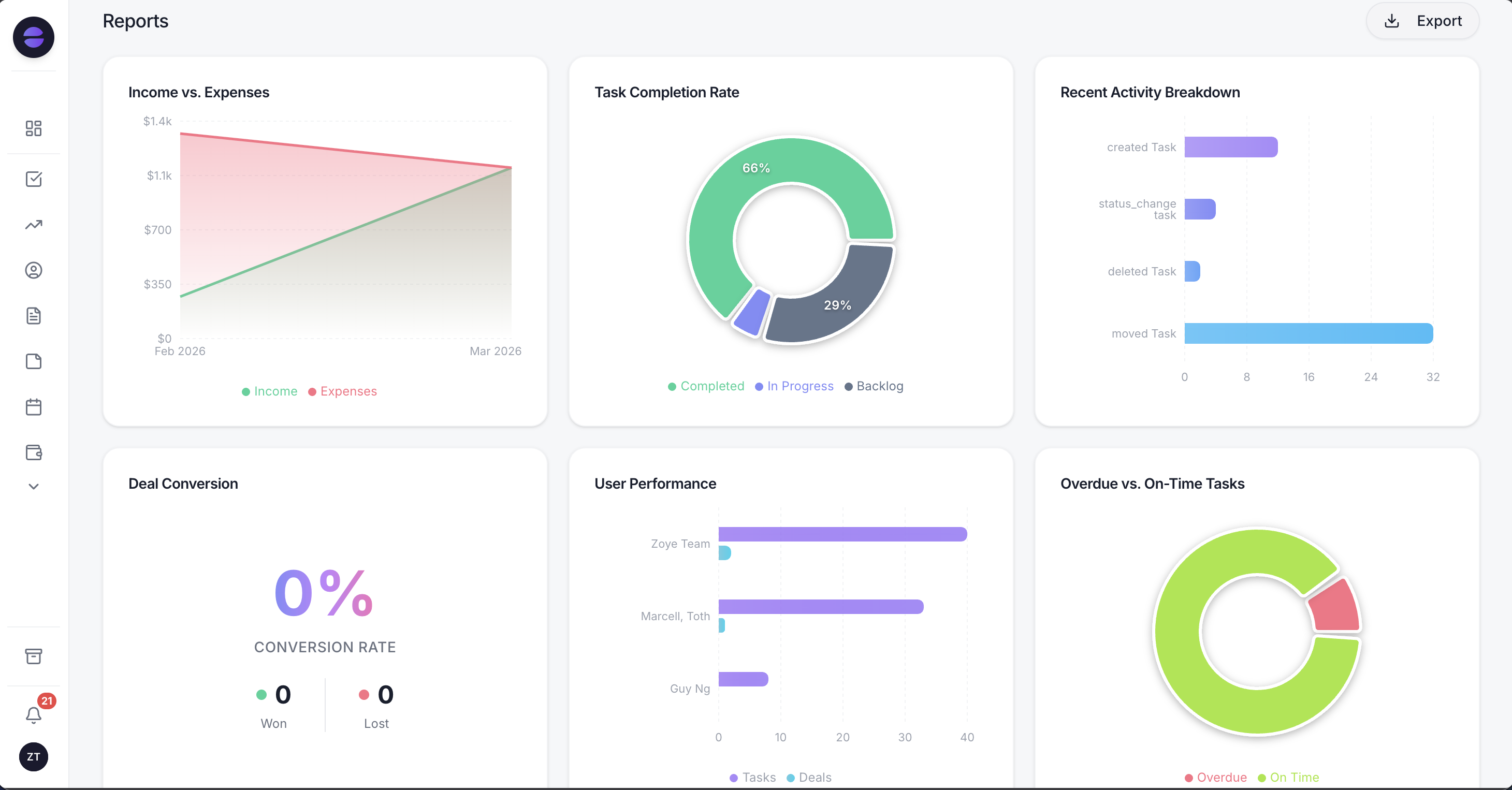 Zoye Reports: the assistant runs your automations and shows the results across deals, tasks, and budget in one dashboard
The difference is in kind, not degree. In Zapier, you build and maintain flows. In Zoye, you tell the Zoye Assistant the outcome, "follow up on every quote that gets no reply within 48 hours", "create a task and notify me whenever a new lead comes in from the website", and it builds the automation, runs it, and reports what happened. There is no workflow editor to learn and no broken Zap to debug on a Sunday. If something needs adjusting, you say so in the next message.
The assistant does not stop at plumbing. It executes across the whole workspace: it captures leads, chases follow-ups, books clients, updates the CRM records itself, schedules work on the calendar, and generates reports on demand. Because tasks, CRM, calendar, budget, and reports live in one workspace, most of the app-to-app glue that Zapier exists to provide simply is not needed; the data is already in one place, and the assistant acts on all of it. You can run the whole thing by talking to it, including on WhatsApp, which is exactly where most owners already spend their day.
That makes Zoye the practical pick for the huge group Zapier quietly underserves: non-technical owners who bought automation software and stopped using it. There is nothing to maintain, because the operator maintains itself.
Pricing: Almost Free from $5 per month ($4 billed annually) for 1 member with the full platform including AI, cancel or upgrade anytime. Starter from $29 per month (10 members). Growth from $59 per month (20 members).
Best for: Small business owners and teams who want automations described in a sentence and run for them, not built on a canvas.
2. Make - the visual power builder at a lower price
Make (formerly Integromat) is the most popular direct Zapier replacement for people who like building. Its visual scenario editor handles branching, iteration, and data transformation far more elegantly than Zapier's linear steps, and its operations-based pricing is usually significantly cheaper for the same volume.
The trade-off is a steeper learning curve. Make gives you more control by exposing more machinery: bundles, routers, error handlers. Builders love it; non-technical owners often bounce off it harder than they bounced off Zapier. You are still the mechanic, just with better tools.
Pricing: Free tier with 1,000 operations per month. Core from $9 per month billed annually.
Best for: Hands-on builders who want more power than Zapier for less money.
3. n8n - the source-available option for technical teams
n8n is the darling of technical teams and the most-asked-about Zapier alternative in developer communities. It is source-available, can be self-hosted for the cost of a server, and handles code steps, complex logic, and AI-agent workflows natively. Per-execution pricing (rather than per-task) makes heavy flows dramatically cheaper.
The trade-off is that n8n assumes technical comfort. Expressions, JSON, credentials, and self-hosting maintenance are part of the deal. For a developer, that is freedom. For a business owner, it is a second job with extra steps.
Pricing: Self-hosted community edition free. Cloud from around $24 per month.
Best for: Developers and technical teams who want ownership and unlimited complexity.
4. Pabbly Connect - the budget pick with lifetime pricing
Pabbly Connect competes almost purely on price. Its headline move is lifetime deals: pay once, automate forever, with internal tasks (filters, formatters) not counted against your quota. For cost-conscious small businesses running simple, stable flows, the economics are hard to argue with.
The trade-off is depth. The integration library is smaller than Zapier's, some connectors are shallower, and the editor is functional rather than pleasant. You get what you pay for, permanently.
Pricing: From around $16 per month billed annually; periodic lifetime deals.
Best for: Price-sensitive businesses with simple, stable automation needs.
5. IFTTT - the simple consumer-grade automator
IFTTT is where many people first met automation, and it remains the simplest option on this list. One trigger, one or a few actions, strong smart-home and consumer app coverage, and a price that undercuts everyone.
The trade-off is that IFTTT is not really a business tool. Multi-step business logic, data transformation, and deep SaaS integrations are thin. It is the right answer for personal automations and the wrong answer for a sales pipeline.
Pricing: Free tier with limits. Pro from $3.49 per month.
Best for: Personal and smart-home automation, not business workflows.
6. Workato - the enterprise-grade integration platform
Workato is what Zapier becomes when it grows up and gets an enterprise budget. It offers governed, secure, high-volume integration with real data pipelines, approval flows, and an admin model that satisfies IT departments.
The trade-off is that everything about it, from quote-based pricing to implementation timelines, is sized for enterprises. A small business inquiring about Workato is shopping in the wrong aisle, and the price list will say so.
Pricing: Custom quote-based pricing, typically starting in the tens of thousands per year.
Best for: Enterprises that need governed, IT-managed integration at scale.
7. Relay.app - the human-in-the-loop workflow tool
Relay.app is a newer Zapier alternative with a genuinely different idea: workflows that include people. Approval steps, task handoffs, and AI actions sit alongside standard triggers, so a flow can pause for a human decision instead of pretending everything is automatable.
The trade-off is a younger integration library and a team-workflow focus. It automates processes between people well; it is less suited to being the glue for a sprawling app stack, and you are still building the flows yourself.
Pricing: Free tier available. Paid plans from around $27 per month.
Best for: Teams whose workflows need human approval steps mixed with automation.
8. Activepieces - the open-source up-and-comer
Activepieces is an MIT-licensed open-source automation tool that has grown fast by being what many wished n8n was: genuinely open source and simpler to use. Self-hosters get an unlimited automation engine for free, and the cloud version is competitively priced.
The trade-off is maturity. The connector library is growing but smaller, the community is younger, and non-technical users still face a builder-style editor. It is a bet on trajectory as much as on current state.
Pricing: Open source, self-hosted free. Cloud from around $25 per month.
Best for: Teams who want a true open-source automation stack with a friendlier editor than n8n.
Want to see it in action?
Watch how Zoye automates your daily workflow - from lead management to team collaboration.
See How It WorksBest free Zapier alternative
The honest answer splits by skill. If you are technical, self-hosted n8n or Activepieces are effectively free forever, with no task limits beyond your server. If you want hosted and simple, Make's 1,000 free operations per month cover light personal use, and IFTTT's free tier handles basic applets.
If you are a business owner rather than a builder, Zoye's low-cost entry plan is the strongest option: for just $5 per month you get 1 member, the full platform, and the AI assistant included. The distinction matters because a free builder tool still costs you the hours of building and fixing. An operator does the work itself, so for the price of a cup of coffee you are free of the maintenance too.
Best Zapier alternative for non-technical business owners
This is the category where the market has quietly changed. Every classic Zapier alternative, Make, n8n, Pabbly, Activepieces, still hands you a canvas and wishes you luck. That is why so many small businesses own automation subscriptions they stopped using: the software was bought for outcomes but priced in effort.
Zoye is built for exactly this owner. You never see a workflow editor. You tell the assistant what should happen, in the same language you would use with an employee, and it builds the automation, runs it, and keeps the CRM, tasks, and calendar updated as it goes. Because you can talk to it on WhatsApp, the entire automation platform collapses into a chat thread. Nothing to learn, nothing to maintain, nothing to abandon.
See what Zoye can do for you
From CRM and deal tracking to AI-powered task management - explore everything Zoye offers in one workspace.
Explore FeaturesHow to choose the right Zapier alternative
Three questions narrow the field quickly.
1. Who will build and maintain the automations? If the answer is a developer or ops person who enjoys it, Make, n8n, or Activepieces will serve you well. If the answer is "me, reluctantly, at 11pm", choose Zoye and let the assistant do the building.
2. What are you actually automating? App-to-app glue across a large external stack points to Make or n8n. Enterprise-governed data flows point to Workato. Approval-heavy team processes point to Relay.app. Running a business, leads, follow-ups, bookings, invoices, points to Zoye, where those records live in one workspace and the assistant operates them directly.
3. What does failure cost you? A broken personal applet costs nothing; IFTTT is fine. A broken lead-capture Zap costs revenue silently. If missed follow-ups are expensive in your business, favour the option that watches itself: Zoye's assistant runs its automations, notices what happened, and reports back, instead of failing quietly in a dashboard you stopped checking.
Why teams pick Zoye over Zapier
A few themes come up consistently. The building disappears: describing an outcome in one sentence replaces an afternoon on a canvas, and adjusting it is another sentence, not a debugging session. The maintenance disappears with it, because there are no user-built flows to break. The glue itself mostly disappears too: with tasks, CRM, calendar, budget, and reports in one workspace, the assistant acts on your data directly instead of ferrying it between apps. And the whole thing runs from a conversation, including on WhatsApp, so the owner operates the business from the chat app already open on their phone.
Zapier taught the world that apps could work together. Zoye's bet is that in 2026 you should not have to be the one wiring them. Let the assistant build the automations while you simply describe them. The entry plan, Almost Free, is $5 per month (or $4 per month billed annually) for the full platform and its AI, and you can cancel or upgrade at any time.
For more context, see what business process automation really means, the best AI tools for business, and AI agents for small business, or browse the Zoye blog.