Property Management Lead Generation in 2026: Win More Homeowners
Most short-term rental management companies already run a lead generation machine. It is just pointed at the wrong person. Listings get optimised, photos get reshot, review scores get watched, enquiries get answered within the hour. All of that is guest demand, and guest demand is worth having. It fills the calendar of the properties you already manage. It does not add a single property to your portfolio.
Growth in property management comes from one event, repeated: a homeowner signs a management agreement. Every unit you add lifts revenue for years, spreads your fixed costs over a wider base, and makes the next owner conversation easier because your portfolio is bigger. And yet ask an operator with eighteen doors how many owner conversations are open right now, and at which stage each one sits, and the honest answer is usually a couple of names half-remembered from a viewing two months ago. One of those owners has already signed with the manager down the road.
This guide is about homeowner lead generation specifically: the channels that actually produce owner leads for a small management company, how to tell a serious owner from someone shopping for a number, and the part almost nobody builds, which is a pipeline with real stages and a follow-up that happens whether or not you remembered it.
Owner leads and guest leads are two different businesses
Before any channel work, this distinction has to be clean, because it decides where your time goes.
| Guest leads | Owner leads | |
|---|---|---|
| Who you are selling to | A traveller choosing a stay | A homeowner choosing who runs their asset |
| What they are deciding | A few nights, a few hundred to a few thousand | Years of income and control of a property |
| Decision speed | Minutes to days | Weeks to months, often tied to a season |
| Main channels | OTAs, your direct site, social, past guests | Referrals, agents, direct outreach, local presence, search |
| What closes them | Price, photos, location, reviews, fast replies | Trust, numbers, proof you are organised, persistence |
| Tooling you already own | PMS, channel manager, OTA inbox, pricing tool | Usually nothing at all |
That last row is the whole problem. The guest side of a rental business has been thoroughly productised. Your property management system handles reservations, calendars, channel sync, rates and guest messaging, and it does that job well. Nobody sold you anything for the owner side, so it lives in your phone, your inbox and your memory. That is the gap a vacation rental CRM is meant to fill, sitting next to the PMS rather than replacing it.
The consequence is predictable. Enquiries from potential owners arrive at the worst possible moments, in the middle of a changeover or a guest complaint, get a quick friendly reply, and then nothing. Nobody decided to abandon that lead. There was simply no system holding it.
What a homeowner lead actually is
A useful working definition: an identified owner of one or more lettable properties, with a plausible reason to consider handing over management, and a way to contact them. All three parts matter. A list of addresses is not leads. A name with no reason to change anything is not a lead either, it is a name.
The reasons owners actually change something tend to be concrete:
- They just bought a second home or inherited one and have no idea how to let it.
- They have been self-managing and the messages at 11pm have stopped being charming.
- They live in another city or country and the distance has become expensive.
- Their calendar has holes they cannot explain and their photos are ten years old.
- A guest broke something, or a booking went wrong, and they realised they are alone.
- Their current manager has gone quiet, missed payouts, or stopped sending statements.
- Their agreement is coming up for renewal and they are curious what else exists.
Every channel below is really a way of being present at the moment one of those things becomes true.
Channel 1: the owners you already manage
The cheapest owner lead you will ever get comes from an owner who is already paying you. They know your work, they talk to other owners in the same buildings and the same holiday areas, and their recommendation carries weight no advertisement can buy.
Almost nobody asks. Referrals get treated as a happy accident instead of a channel with a process. Make it deliberate:
- Ask at the right moment. Just after a strong month, a good statement, or a problem you solved quickly, not in a generic quarterly email.
- Be specific about who you want. "Do you know anyone in the building who is letting their place themselves?" gets an answer. "Let us know if you hear of anything" does not.
- Offer something clean and simple, for example a share of the first months of management fee, or a credit against their own fees. Check what is allowed where you operate and write the terms down.
- Make the introduction easy. A short message the owner can forward, with your name, what you manage and one line of proof, beats asking them to compose something.
- Log every referral as a lead with the referring owner attached, and close the loop. An owner who refers someone and hears nothing back will not refer again.
One more thing worth saying plainly: retention is lead generation. Owners who leave tell other owners why. A quiet management relationship with statements arriving on time is the cheapest marketing a management company has.
Channel 2: real-estate agents, brokers and the trades around them
Agents meet your future owners before you do. Someone buying a holiday apartment or an investment flat has a conversation with an agent weeks before they think about letting it, and at the closing table they usually have no plan for the property at all. An agent who trusts you fills that gap with your name.
The same is true of the trades that touch properties: mortgage brokers, conveyancers and property lawyers, interior designers and furnishing companies, cleaners, handymen, building managers and concierges. They all meet owners in a moment of transition.
How to make it work rather than hope:
- Pick a shortlist. Five to ten agents who genuinely sell in your area beat fifty business cards.
- Give before you ask. Send them a buyer you cannot help, a rental yield estimate for a listing they are marketing, or a short honest note on what a property in that building could earn.
- Make yourself easy to recommend. A one-page owner summary with what you manage, what you charge and what an owner receives is a document an agent can forward without thinking.
- Be genuinely useful at the handover. Furnishing advice, photography, and a realistic revenue estimate make the agent look good, which is what keeps introductions coming.
- Track the source. If two agents produce every signed door, you should know their names and treat them accordingly.
Referral partnerships die from neglect, not disagreement. A quarterly coffee and a message when something good happens keeps you in mind, and both are follow-up tasks, which means they belong in a system rather than in your head.
Want to see it in action?
Watch how Zoye automates your daily workflow - from lead management to team collaboration.
See How It WorksChannel 3: owners who are currently self-managing
This is the largest pool in most markets and the least worked, because it takes patience. Self-managing hosts are visible: they have listings, reviews, response times and calendars, all in public.
You are not looking for every host, you are looking for signs of strain. A listing with a thin calendar in high season. Photographs taken on a phone. Reviews that mention slow replies or a messy arrival. A host who has clearly been away, judging by the blocked dates. An owner who posts in a local hosting group asking how to handle a difficult guest.
When you approach one, the approach decides everything:
- Lead with a specific observation about their property, not a pitch about your company. Genuine, specific and short.
- Bring one number they do not have. What comparable units in the same street achieved last season is a reason to reply.
- Offer a small first step. A free revenue review or a walkthrough of the listing is easier to accept than a management agreement.
- Never criticise. Their property is personal. Point at opportunity, not failure.
- Respect the rules. Follow the local marketing and privacy rules that apply to unsolicited contact, use the channel the owner published, and stop when someone asks you to.
- Expect a long cycle. Many will say not now. Not now is not no, it is a date in the calendar, and it is why the nurture list below matters more than the outreach volume.
Volume is not the win here. Ten well-researched approaches a week, each with a real observation and a scheduled follow-up, outperform two hundred copy-pasted messages, and they do not damage your name in a market where every owner knows every other owner.
Channel 4: your website and search presence
Owners research quietly. Long before they contact anyone they search for what a manager in their area charges, whether letting out their apartment is worth it, and what other owners say. If your site only speaks to guests, you are invisible in exactly the moment an owner is deciding.
The fix is not a redesign, it is one honest section of the site written for owners:
- A dedicated owner page: what you manage, the areas you cover, what an owner receives each month, and how your fee works. Vagueness on fees loses more owners than a high fee does.
- One page per area you serve, written for someone searching for a manager in that specific town or neighbourhood. Local intent is where these searches happen.
- Proof: real numbers where you can share them, owner testimonials, photographs of properties you actually run, and your response commitments.
- An owner enquiry form that asks the useful questions, which are the address or area, the number of units, whether it is currently let, and when they want to start.
- A Google Business Profile that is complete and reviewed, because a manager with no local presence looks like a risk.
- Speed. An owner who fills in a form at 9pm and hears from you at noon the next day has already messaged two competitors.
Search and content take months to compound, which is the argument for starting now rather than the argument against starting. The enquiries they produce are also the warmest you will ever get, because the owner arrived already looking.
Channel 5: local presence and networking
Property management is a local trust business. In most markets the manager who is visibly present wins doors that never appear on anyone's lead list.
Practical versions of this: building committees and residents' associations in buildings with several let units, local landlord and host meetups, chambers of commerce and tourism boards, holiday-let owner groups on Facebook and WhatsApp where being helpful for months is the whole strategy, and relationships with the cleaners and handymen who are inside other people's properties every week.
Two rules keep this channel from becoming a hobby. Be useful before you are commercial, because the person who answers regulation questions honestly becomes the person people call. And write down who you met and what you promised, because a conversation at a meetup that is never followed up is not a lead, it is a nice evening.
Build the pipeline before you build the campaign
Here is the uncomfortable part. Most small management companies do not have a lead generation problem, they have a lead retention problem. They already met enough owners this year to hit their growth target. Those conversations simply had nowhere to live.
An owner pipeline needs stages that describe reality, not optimism. Something like:
- New enquiry. Captured, with the source attached, within minutes of arriving.
- Contacted. You have made real contact and know the basics: property, area, units, current setup.
- Qualified. It is a property you want, in an area you cover, with an owner whose expectations are workable.
- Property assessed. You have seen it, or seen enough of it, and can talk about revenue honestly.
- Proposal sent. Numbers, fee and terms are with the owner, and the follow-up date is already set.
- Agreement out. The management agreement is with them for signature.
- Signed. Won, with the date and the source recorded.
- Onboarding. Photos, listing setup, keys, cleaning, and the PMS work begin.
Plus two honest side lanes: Not now, with a date to come back, which is where most self-managing owners live for a while, and Declined, with a reason, which teaches you which leads to stop chasing.
Two habits make the pipeline real. Every owner has a next step with a date, always, no exceptions. And every lead carries its source, because otherwise you are guessing about where your growth comes from.
See what Zoye can do for you
From CRM and deal tracking to AI-powered task management - explore everything Zoye offers in one workspace.
Explore FeaturesQualify before you spend a week on it
Not every owner lead deserves a site visit. A single studio an hour outside your service area, an owner who wants a revenue guarantee, a co-ownership where three siblings disagree, or a host who wants to keep control of pricing and the calendar can each cost more than they return.
Qualify on a handful of things: the number of units and whether more may follow, location against the areas you already service and clean efficiently, the property's realistic earning potential, the owner's expectations on revenue and fees, whether they are locked into an existing agreement, and how they behave in the first two exchanges. Owners who are hard to reach and slow to answer during the sales process rarely become easy once they are clients.
Declining well is part of the job. A polite no now, with an honest reason and a name of someone better suited, protects your margins and your service quality, and owners remember it. There is a deeper breakdown of owner qualification and lead quality in property management leads.
The follow-up nobody does
Owner deals are slow, which means they are won on persistence rather than on the first conversation. The owner who said not now in March is often signing in September, but only if someone was still there in September.
What a working cadence looks like in practice:
- First reply within minutes, not hours. Speed is the strongest signal of how you will handle their guests.
- A proposal followed up twice in the first two weeks, by different means: a message and a call, not two identical emails.
- A dated task for every not now, at the moment the owner named, or at the end of the season if they named nothing.
- A quiet nurture rhythm for the ones who are months away: a market update, a note about what units in their building earned, an invitation to something local. Every few weeks, not every few days.
- A reason to make contact, which is the whole skill. New regulation in the area, a strong month for a comparable property, or a genuine question about their plans all beat "just checking in".
- The channel they actually answer. In most markets that is WhatsApp, and an owner who ignores email for a week replies to a message in ten minutes.
None of this is complicated. It is just relentless, and it competes for attention with a broken boiler, a double booking and a cleaner who called in sick. That is why it does not happen manually, and why it has to be automatic.
Ready to streamline your business?
Zoye brings AI-powered CRM, task management, and automation into one workspace.
Get StartedWhere Zoye fits, and what it does not do
Start with what Zoye is not, because that matters more here than the feature list. Zoye is not a property management system. It has no channel manager, no OTA sync with Airbnb, Booking.com or Vrbo, no availability calendar, no nightly rates, no booking engine, no OTA guest inbox, and no owner statements with trust accounting. Your PMS keeps doing all of that, whether that is Guesty, Hostaway, Lodgify, OwnerRez, Smoobu or something else.
Zoye runs the business around the bookings, which is exactly the half this article is about. Every owner enquiry lands as a lead with its source attached, whether it came from your site, WhatsApp, Instagram, an ad or a referral. Every owner sits at a stage in a pipeline you can actually look at. Management agreements, owner IDs, insurance documents and property photos live on the owner record instead of scattered across an email thread and someone's laptop. Cleaner and maintenance tasks get assigned and chased. Owner invoices go out.
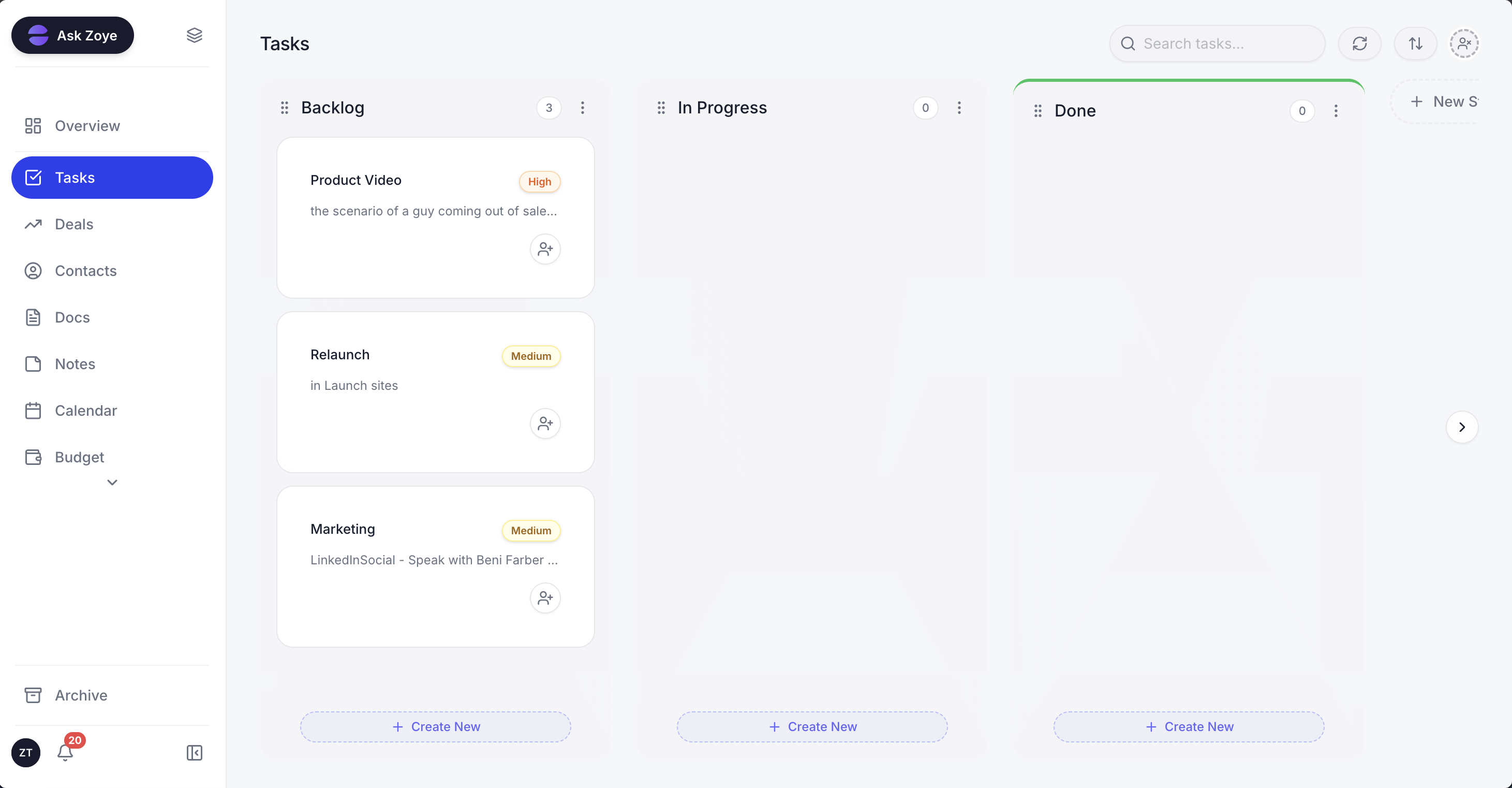 Every homeowner you are pitching sits at a real stage with a dated next step, instead of in your memory
The difference from a tidier spreadsheet is that Zoye acts. It is an AI operator you instruct in plain language, in the app or over WhatsApp and Slack, and it executes. Tell it "add the owner I met at the marina viewing, two apartments, follow up Thursday" on the way back to the car and the record exists before you arrive. Ask "which homeowner leads have gone quiet for more than ten days" and you get names, not a report to build. Describe an automation the way you would explain it to a new assistant, for example "when an owner enquiry comes in from the website, reply within five minutes with the owner pack and create a follow-up task for two days later", and that becomes a running automation rather than a project.
This is why it survives a bad week. The chasing does not depend on you having a calm afternoon, and the owner who went quiet in March gets a message in September because the system remembered, not because you did. Pricing starts at $5 per month for one member and scales by team size; the current tiers are on the pricing page.
How to know which channel actually works
Owner acquisition is slow enough that guessing is expensive. Three measurements are enough for a company of this size.
Source on every lead. Not a category like "word of mouth", but the actual person or page. Which owner referred them, which agent, which page of your site.
Cost per signed door. Add the money and the hours a channel consumed, divide by the doors it produced. Referrals usually look almost free until you count the fee you paid and the time you spent maintaining relationships, and they are still normally the best channel you have.
Time from first contact to signature, per channel. Inbound enquiries close fastest because the owner arrived already looking. Direct outreach is the slowest and can still be worth it. Knowing the difference stops you from cancelling a channel two months before it would have paid.
Review it once a quarter. The pattern in a small portfolio is usually stark: one or two channels produce nearly everything, and the effort is spread evenly across five. Move the effort.
A 90-day plan to build an owner pipeline
If you are starting from nothing, sequence it like this.
Weeks 1 and 2. Build the pipeline with the stages above. Put every owner conversation from the last twelve months into it, including the ones you assume are dead, each with a next step and a date. This step alone usually surfaces several live opportunities.
Weeks 3 and 4. Write the owner page and the enquiry form, and fix your Google Business Profile. Make sure an enquiry reaches you as a notification, not as an email you find later.
Weeks 5 and 6. Ask your existing owners for referrals, in person or by a personal message, with the specific ask. Set the referral terms and write them down.
Weeks 7 and 8. Choose five agents and five trades. Send each of them something useful before you ask for anything. Add a recurring follow-up for every one of them.
Weeks 9 to 12. Start research-led outreach to self-managing owners, ten a week, each with a real observation and a scheduled follow-up. Add one local group or event to your calendar and go without pitching.
By day 90 the pipeline matters more than the campaigns. Owners will be sitting at stages, follow-ups will be scheduled, and you will know where your last five conversations came from. That is the machine. Everything after this is volume.
Frequently asked questions
It is the work of finding property owners who might hand their homes to you to manage, and moving them from a first conversation to a signed management agreement. It is not the same as guest marketing. Guest marketing fills the calendar of the units you already have, while lead generation adds units. The two use different channels, run on different timescales, and are usually measured completely differently.
In practice, five channels produce almost all of them: referrals from the owners you already manage, introductions from real-estate agents and brokers who meet buyers with second homes, direct outreach to owners who are currently self-managing, inbound enquiries from your website and search presence, and local presence such as building managers, concierges, cleaners and community groups. Paid ads can work, but they are usually the most expensive way to reach an owner and the slowest to convert.
Look for the signals of an owner under strain rather than a list of addresses. A listing with a thin calendar, poor photos, slow replies to guest questions, a recently inherited or newly bought second home, an owner who lives in another city, or a host quietly complaining in a local group are all reasons to consider handing over management. The introduction usually works better than a cold approach, which is why agents, cleaners and existing owners matter so much.
Longer than most operators plan for. An owner is choosing who handles a high-value asset and their annual income from it, so the decision often waits for the end of a season, the end of an existing agreement, or a bad experience with a guest. Expect weeks to several months from first conversation to signature, which is exactly why a pipeline and a scheduled follow-up matter more here than a bigger volume of leads.
No tool creates owner demand on its own. What software can do is make sure nothing you generated is wasted: every enquiry captured with its source, every owner sitting at a real stage, and every follow-up sent at the time you decided instead of the time you remembered. Zoye runs that owner pipeline and does the chasing itself, including over WhatsApp, so a busy changeover week does not cost you a property.
No, and it is not trying to. Zoye has no channel manager, no OTA sync with Airbnb, Booking.com or Vrbo, no availability calendar or nightly rates, no booking engine, and no trust accounting. Your PMS keeps running the reservations. Zoye runs the business around them: the homeowner pipeline, enquiry capture and follow-up, management agreements and owner documents, cleaner and staff tasks, and owner invoicing.
The bottom line
A management company does not usually stall because owners are unavailable. It stalls because the owners who were interested were met at a viewing, spoken to once, and then quietly forgotten while a guest complained about a broken air conditioner. The channels are not a secret: your existing owners, agents and trades, self-managing hosts, your own site, and being present locally. What separates the operator who adds eight doors this year from the one who adds one is not the pitch. It is whether every one of those conversations landed in a pipeline with a stage and a date, and whether the follow-up happened on the day it was supposed to.
Build the pipeline first, then feed it. And put the chasing somewhere other than your memory, because your memory is busy running the properties you already have.
Ready to see it? Zoye runs the homeowner pipeline, the enquiry follow-up and the owner admin alongside the PMS you already use, and you can drive the whole thing from WhatsApp.
For more, see property management leads and how to qualify them, how to get property management clients, the vacation rental CRM for property managers, and the rest of the Zoye blog.