
WhatsApp Automation for Business in 2026: What Meta Allows and How to Start
For a small business, WhatsApp is not a marketing channel. It is the shop floor. Enquiries arrive there, prices get quoted there, appointments get booked and moved there, and the polite reminder about an unpaid invoice goes out there too. The number on your phone is where the business actually happens, which is exactly why the phone becomes the bottleneck. One person cannot answer forty conversations, remember who was promised a quote, and still do the work the customer is paying for.
So the owner starts working around it. A saved message for the price list. A note on the fridge with two names to call back. A group of employees who all have the number and all assume someone else replied. It holds together until a busy week, and then the pattern shows up in the numbers: the enquiry that waited five hours went to a competitor who answered in five minutes, the customer who cancelled a session was never called back to rebook, and the three people who said "send me details next week" were never contacted again. Nobody was lazy. There was simply no system.
This guide is about fixing that properly. It covers what can genuinely be automated on WhatsApp in 2026, the difference between the WhatsApp Business app and the WhatsApp Business Platform, the rules Meta enforces so you keep your number healthy, the honest gap between a bot that answers and an operator that acts, and how to get started without hiring a developer.
Pricing reflects published rates as of August 2026; check each vendor's pricing page for current figures.
The two WhatsApps, and why the difference decides everything
Almost every disappointing WhatsApp automation project starts with one misunderstanding: there are two different products with the same green icon.
The WhatsApp Business app is the free app you install on a phone. It gives you a business profile, a catalogue, labels for organising chats, quick replies you trigger with a shortcut, an automatic greeting message for a first contact, and an away message for hours when you are closed. It is genuinely useful and most small businesses should turn all of it on today. Its limits are real, though: the automation is fixed text, it does not read the conversation, it cannot book anything, broadcast lists only reach people who saved your number and are capped per send, and everything lives on one phone.
The WhatsApp Business Platform, still widely called the Cloud API, is the version businesses connect software to. It needs a business number that is not already active on the normal app, a Meta business account, and normally business verification. In return, the number can be used by a whole team at once, conversations can be handled by software, and automations can create records, book calendar slots, and send reminders on schedule. This is the layer that makes real automation possible.
The practical rule: use the Business app if you want tidier manual work, and the Business Platform if you want the work to happen without you. Most tools worth using connect to the second one for you, so you never touch a developer console.
What can actually be automated on WhatsApp
Ignore the demos with a hundred features. In a real small business, five automations carry almost all of the value.
1. The first reply. Response speed decides who wins the customer more often than price does. An automated first reply that acknowledges the message, answers the obvious question, and asks the one thing you always need to know turns a cold enquiry into a live conversation while the person is still holding the phone. It also keeps the conversation inside the free flowing 24 hour service window, which matters for the rules below.
2. Qualification. Two or three questions asked automatically save an enormous amount of back and forth: what service, roughly when, which location or budget range. By the time a human joins the chat, the enquiry is already sorted and the details are already saved against the customer record.
3. Booking and appointment reminders. Offering real available slots, confirming the one chosen, writing it into the shared calendar, and sending a reminder the day before is the single automation with the clearest return. No show rates fall, and a cancellation that arrives the evening before can be offered to the next person on the waiting list instead of leaving an empty hour.
4. Payment and renewal reminders. A polite, scheduled message about an unpaid invoice, a remaining balance on a package, or a subscription about to renew collects money that is otherwise lost to awkwardness. Nobody enjoys chasing payments in person, which is why it stops happening.
5. Post sale follow up. The message a week after the job, the check in a month later, the reminder that it has been six months since the last appointment. This is the highest margin work in any small business and the first thing to disappear when the week gets busy, because it depends entirely on somebody remembering.
Notice what these have in common. None of them is a chatbot personality. They are all ordinary business tasks that happen to be delivered over WhatsApp, and they fail for the same reason: they depend on a human being available at the right moment.
Want to see it in action?
Watch how Zoye automates your daily workflow - from lead management to team collaboration.
See How It WorksWhat Meta's rules allow, and what they do not
WhatsApp is the strictest of the big messaging channels, and that is a feature, not an obstacle. It is why customers still open their messages. Work with the rules and the channel stays extraordinarily effective; work against them and you lose the number your business depends on. Five rules matter.
Opt in comes first. Before you send someone the first message, you need their permission to be contacted on WhatsApp. It can be collected on a form, on your website, at the counter, in a booking confirmation, or by the customer messaging you first. It must be clear what they are agreeing to receive. Buying or scraping phone numbers and messaging them is a straight policy violation, and it is also the single fastest way to get blocked and reported.
The 24 hour service window. When a customer messages you, a 24 hour customer service window opens, and inside it you can send normal free form messages, automated or written by a person. When the window closes, you cannot simply message them again in free form. This is why a fast automated first reply is worth more than a clever one: it starts the conversation inside the window.
Approved message templates outside the window. To start a conversation, or to continue one after the window closed, you use a message template submitted to Meta and approved in advance, in the correct category. Utility templates cover things the customer expects, such as an appointment reminder or an order update. Marketing templates cover promotions and offers. Categorising a promotion as a utility message to get it delivered is a policy breach, and Meta reclassifies templates it disagrees with. Template messages are also billed, and the rates change, so check Meta's current pricing before you plan a large volume.
Quality rating and messaging limits. Every business number carries a quality rating that reflects how recipients respond to it. Blocks, reports, and ignored messages push it down; a number in a poor state can have its messaging limits reduced or its templates paused. This is the mechanism that punishes bulk sending to people who never asked, and it is why a smaller, permission based list beats a big cold one every time.
A path to a human, and an easy way out. Automation is allowed to answer, but it must not trap people. Anyone should be able to reach a person quickly, and anyone should be able to stop receiving messages just as easily, with the opt out honoured immediately. Beyond the policy, this is simply good business: the customer who cannot get past a bot is the customer who calls a competitor.
Two things nobody can honestly promise you: automated messaging to people who did not opt in, and any tool that guarantees your templates will be approved or your number will never be limited. Anyone who does promise that is selling you a risk you will pay for later.
See what Zoye can do for you
From CRM and deal tracking to AI-powered task management - explore everything Zoye offers in one workspace.
Explore FeaturesA bot that answers versus an operator that acts
Most WhatsApp automation on the market is a chatbot. It has a script, it matches what the customer said against that script, and it replies. When the conversation goes off the script, which it does constantly in a real business, it hands over or repeats itself. Even when it works perfectly, look at what it leaves behind: a nice conversation and no consequences. The lead is still not in your system, the appointment is still not in the calendar, the follow up in three days still depends on somebody remembering, and the details the customer just gave you still have to be typed in by a person.
That is the gap. Answering is the easy half of the job. The half that grows the business is what happens after the reply: the record created, the slot booked, the reminder scheduled, the quote sent, the silent customer chased next Tuesday.
An operator closes that gap. It reads the incoming message, understands it without a script, replies in your language and tone, and then performs the actual work: it creates the lead with the right details, books into your real calendar, sets the reminder, and comes back to the customer who went quiet without being asked. Same channel, same customer, completely different outcome. The measure of a good WhatsApp automation is not how human its replies sound. It is how much of the week's work is finished by Friday without you doing it.
Zoye: the operator you describe your automation to in one sentence
Zoye is an AI Business Operator that runs the business rather than a tool you maintain, and WhatsApp is one of the places it works. Instead of building a flowchart, you tell it what should happen in plain language, the way you would brief a very good office manager, and it does it.
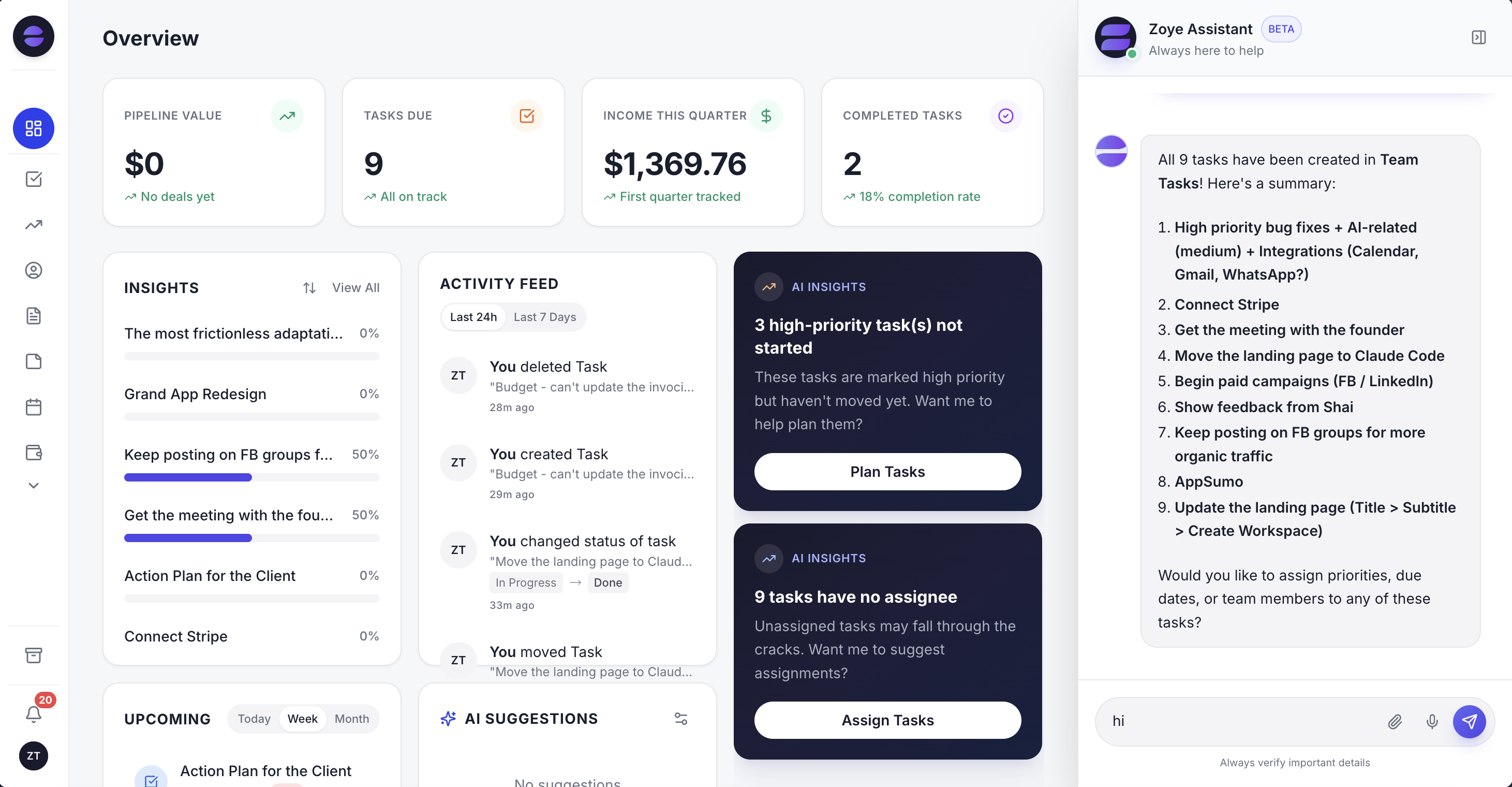 Zoye keeps WhatsApp conversations, leads, appointments and follow ups in one workspace, and does the chasing itself.
In day to day use it looks like this. A new WhatsApp message arrives and Zoye answers within seconds, in the customer's language, asks the two questions you always need answered, and saves the person as a lead with the service, the source, and the details already filled in. Nobody opens a form. If the customer wants an appointment, Zoye offers slots that are genuinely free in your calendar, books the chosen one, and sends the confirmation and the reminder. If they cancel, it offers the slot to the next person waiting and follows up to rebook. If a customer goes quiet after a quote, Zoye chases them without being told. If an invoice is due, the reminder goes out on the day you asked for.
Setting all of that up is a sentence. You type something like "when a new enquiry arrives on WhatsApp, reply with the price list, create a lead, and follow up in two days if they have not booked", and the operator builds and runs the automation. There is no builder to learn, no Zapier style wiring, and nothing to maintain when you change your mind, because changing it is another sentence.
The rest of the business sits in the same workspace, which is what makes the automation worth having: the leads, customers and deals in the CRM, the tasks in list, board, calendar and timeline views, the shared calendar the bookings land in, budget tracking, and reports that pull from all of it. You also run Zoye itself from WhatsApp, so you can ask what is outstanding today or tell it to chase everyone who has not replied while you are standing in the workshop. It works on Slack in exactly the same way. Honest scope: Zoye respects Meta's rules rather than working around them, so opt in, templates, and the 24 hour window still apply to your business as they do to everyone.
Pricing: the entry plan is Almost Free at 5 dollars per month for 1 member and 1GB storage, with the full platform including AI. Starter is 29 dollars per month (10 members, 5GB). Growth is 59 dollars per month (20 members, 10GB, 24/7 support). Scale is 119 dollars per month (100 members, 25GB), and a Customize tier covers custom limits and dedicated support.
Best for: small businesses, clinics, studios, agencies and solo operators who want the WhatsApp work done for them rather than another dashboard to keep updated.
How to start without a developer
You can be running real automation in an afternoon. Six steps, in order.
1. Decide which number is the business number. Ideally not the personal number you have used for ten years. The Business Platform needs a number that is not active on the standard WhatsApp app, and separating the business number from your private one is worth doing anyway.
2. Turn on everything the Business app already gives you. Complete the business profile, add a greeting message and an away message with real opening hours, and write quick replies for the five questions you answer every day. That alone shortens your response time this week, at no cost.
3. Write down your five sentences. Before choosing any tool, write in plain words what should happen: first reply, qualification, booking, reminder, follow up. This list is your specification, and it stops you buying features you will never switch on.
4. Collect opt in properly. Add a clear consent line to your booking form, your website form, and your intake process. Do it before you need it. Every future automation depends on this one step being done honestly.
5. Connect the number to an operator, not a script. Choose the tool by what it does after the reply. Ask whether it creates the customer record, books the real calendar, and chases the follow up by itself, or whether it just talks. With Zoye you connect the number and then describe each rule in a sentence.
6. Start with two automations, not ten. The first reply and the appointment reminder. Run them for two weeks, read the actual conversations, fix the wording, and only then add the payment reminder and the follow up. Automations that were never reviewed are how businesses end up sending something embarrassing at scale.
Ready to streamline your business?
Zoye brings AI-powered CRM, task management, and automation into one workspace.
Get StartedFive mistakes that cost businesses customers on WhatsApp
Broadcasting to everyone. A promotional message to a list that never opted in produces a handful of sales, a wave of blocks, and a damaged quality rating that then hurts the messages people actually wanted. It is the worst trade in small business marketing.
A bot with no exit. If a customer types "I want to speak to someone" and the automation keeps asking menu questions, you have automated the loss of that customer. Always leave a fast, obvious route to a human.
Automating the reply and nothing else. If the conversation ends without a record, an appointment, or a scheduled follow up, you have automated the easy part and kept all the work. Judge every tool by what exists afterwards.
Several people on one phone. Shared personal devices mean no history, no accountability, duplicated replies, and a customer relationship that disappears when an employee leaves. A proper business number with a shared workspace fixes it permanently.
Never reading the transcripts. Automation drifts. Prices change, services change, and the wording that worked in January is wrong by June. Read a sample of the conversations every month; it takes fifteen minutes and it is the highest value review you will do.
Why businesses pick Zoye for WhatsApp
Almost nobody loses customers because their WhatsApp replies were badly written. They lose them because the reply came five hours late, because the conversation ended without an appointment, and because the follow up that would have closed the sale depended on one busy person remembering it on the right day. That is not a copywriting problem or a chatbot problem. It is an operating problem.
Zoye is the strongest answer here because it does the operating. It answers immediately in the customer's language, keeps its own records so nobody does data entry, books into the real calendar, sends the reminders, chases the people who went quiet, and is instructed in a single ordinary sentence, from the same WhatsApp you already live in. Not the longest feature list, just the one that finishes the work.
Try Zoye with your business. The entry plan is Almost Free at 5 dollars per month, with the full platform including AI.
For more context, see WhatsApp automation, automated WhatsApp customer service, WhatsApp appointment reminders, and the best CRM for private clinics.