
CRM Automation: What It Really Covers, and How It Quietly Goes Wrong
Ask ten small businesses what CRM automation means and eight will describe an email sequence. Somebody fills in a form, and over the next fortnight they receive four messages written months earlier by whoever last had time to write them.
That is CRM automation the way a windscreen wiper is a car. It is real, it is visible, and it is a small fraction of the machinery. The parts that actually change how a business runs are less photogenic: data that records itself as a side effect of work, records that route themselves to an owner, stages that reflect reality without anyone dragging a card, relationships that raise their hand when they start going quiet, and reports that exist on Monday morning without a human assembling them.
This piece covers all five, and then spends real time on the section most articles skip entirely: the specific ways CRM automation goes wrong. Not the generic warning to "start small", but the three failure modes that produce genuine damage, why each one is hard to see, and what a small team should do about it. It ends with governance, which sounds like a word for companies with compliance departments and is in fact the difference between automation you trust in a year and automation you quietly switch off.
The five things CRM automation should actually cover
1. Data entry that happens as a side effect of work
The most valuable automation in a CRM is the one that stops anybody typing into it.
Every other rule you build depends on the record being there and being accurate. If enquiries live in three inboxes and a phone, if half the calls never get logged, if the deal value in the system is a guess from six weeks ago, then every downstream rule is operating on fiction. Automating on top of bad capture just makes the fiction move faster.
Capture done properly means the record comes into existence from the thing that already happened. A form submission becomes a contact. A message becomes a lead. A meeting produces its own summary, its decisions, its action items, and the corrected email address the prospect mentioned in passing. A photographed business card becomes a contact with the fields filled. None of that is a typing task, which is the point: the record exists because the work happened, not because someone found twenty minutes at the end of the day.
This is a large enough topic to deserve its own treatment, and it has one in the guide to a CRM without data entry. For the purposes of automation, the thing to hold onto is the dependency: capture is not one automation among five, it is the foundation the other four stand on.
2. Assignment, which decides whether anything happens at all
A record with no owner is a record nobody is working. In small teams this is not a theoretical risk, it is Tuesday. An enquiry arrives, two people see it, both assume the other has it, and it sits.
Assignment rules are unglamorous and they carry more weight than their complexity suggests. Route by source, by territory, by product line, by round-robin, or by whoever is genuinely available, and do it within minutes of the record appearing. Then make the assignment visible on the record and in a notification, because an owner who does not know they are the owner is the same as no owner.
Resist the urge to make this clever early. Routing by lead score, before you have enough closed business for a score to mean anything, replaces a fact with an inference and then acts on the inference. Route by something you actually know.
3. Stage transitions that follow the facts
A deal stage is a claim about reality. In most small-business pipelines it is a claim that was true about eleven days ago.
Automating stage transitions means the claim updates itself when the underlying fact changes. A proposal is sent, so the deal enters Proposal Sent, and the tasks that belong to that stage come into existence with it. A signed document arrives, so the deal moves to Won and the handover starts. A quote expires with no response, so the deal drops back rather than sitting in a stage that flatters your forecast.
Two constraints keep this honest. The first is that a stage change should be driven by an event, not by elapsed time alone, because time-based promotion is how a pipeline fills with deals that advanced by ageing. The second is that anything moving a deal backwards or into a lost state should leave a trace of why, captured on the day it happens. Loss reasons written a month later are creative writing.
4. Decay detection, which is the automation people miss
Everything above is about records moving forwards. The category small businesses systematically fail to automate is the opposite one: noticing when something has stopped moving.
Deals rarely die in a moment you can point to. They go quiet. The client stops replying, the owner means to chase, the week gets busy, and eight weeks later the deal is technically open and practically dead. The same happens to customer relationships. Nobody decides to neglect an account, they just go a quarter without speaking to it.
Decay detection is a standing rule that watches for absence rather than presence. An open deal with no activity for seven days. An active deal with no future-dated next step. A customer with no contact in ninety days. A qualified lead that was never called. Each one produces a short list and a named owner, which is a materially different experience from the vague sense that you are probably neglecting somebody.
The design detail that makes or breaks it is the exclusion clause. A deal legitimately parked until a client's board meets in three weeks should not generate a nudge every seven days. If it does, the team learns to dismiss the nudge, and a notification everyone dismisses is worse than no notification because it also teaches them to dismiss the ones that matter.
5. Reporting that assembles itself
The last category is the one with the clearest hourly value and the least resistance from anybody.
Someone in most small businesses spends a chunk of the first working day of each month copying figures out of a CRM into a spreadsheet so the same figures can be discussed in a meeting. The numbers already exist. The labour is entirely in the assembly, and assembly is the single most automatable activity in business.
A monthly summary that produces revenue, won and lost counts, average cycle time, activity by person and outstanding receivables, filed in the workspace without anyone building it, is not a sophisticated piece of automation. It is a scheduled query. It is also, reliably, the automation that people are most surprised they were doing by hand.
The weekly version matters more than the monthly one. A Monday digest of new leads, deals that moved, deals that went quiet, deals closing this week and unpaid invoices changes what the weekly meeting is for. It stops being a meeting where facts are established out loud and becomes a meeting where decisions are made, which is roughly half the time back.
Want to see it in action?
Watch how Zoye automates your daily workflow - from lead management to team collaboration.
See How It WorksHow CRM automation goes wrong
Now the part that gets left out of most articles on this subject, because it is uncomfortable and does not sell anything.
Automation failures are not like software bugs. A bug throws an error and somebody notices. An automation failure looks exactly like an automation success right up until the moment it does not, and by then it has usually been failing for a while. There are three distinct ways this happens, and they get progressively worse.
Rules nobody owns
The first failure is organisational and it is nearly universal.
Somebody sets up a rule during an energetic month. It works. Six months later the business has changed: the stage names are different, the qualifying question is different, the person who owned that segment has moved on. The rule has not changed, because rules do not change themselves. It is still running, still firing, still doing something that made sense against a version of the business that no longer exists.
Nobody switches it off, because switching off a rule requires knowing what it does, and the person who knew has gone. So it stays. New people assume it is deliberate. It gets worked around rather than fixed, and the workaround becomes process. Within a year you have a set of automations that nobody in the building can fully explain, which is a peculiar and quite common form of technical debt in a business that employs no engineers.
The fix is not documentation, because nobody reads it. The fix is a name. Every rule has one person who can explain it in a sentence and has the authority to kill it. When that person leaves, their rules get reassigned in the same conversation as their accounts. If a rule cannot find an owner, that is the strongest available evidence it should be retired.
Silent failures
The second failure is technical and it is the one that fools experienced people.
A rule that has stopped working produces no signal. It does not error. It does not appear broken. It sits in the list looking correct, and the reason it looks correct is that it is correct, in the sense that its logic is exactly what you wrote. It simply never matches anything.
This happens constantly. A field gets renamed, so the condition that looked for the old value now matches zero records. A stage is split into two, and the rule watching for the original stage now catches half the deals it used to. A connected app changes its export format and starts writing "New Zealand" where it used to write "NZ". None of these throw an error. They just quietly reduce a rule's hit rate to nothing while the rule continues to look alive.
The tell is always the same and almost nobody checks it: a rule that has fired zero times this month is either unnecessary or broken, and both possibilities warrant a look. This is why the run log matters more than the builder. A builder shows you what a rule is supposed to do. A log shows you what it did. The gap between those two is where every silent failure lives.
Multi-app chains make this worse in a specific way. When the trigger lives in one tool, the data in another, and the action in a third, a break in the middle produces a rule that half-works: it fires, it does the first thing, and the second thing silently does not happen. Each vendor's status page is green. The chain is broken anyway.
Automations that fire on bad data
The third failure is the one your customers see, and it is the only one on this list that can actively cost you a relationship.
Every automation is an amplifier. Given a good record it does the right thing quickly. Given a bad record it does the wrong thing quickly, at scale, to real people, with your name on it.
The specific shapes this takes are worth naming, because they recur across every business that runs automation:
The duplicate. Somebody submits your web form and then messages you on WhatsApp. Two records, two welcome messages, one recipient who now knows your system is not paying attention. A dedupe condition on a stable identifier such as a phone number or email is not optional on any outbound rule.
The empty merge field. A message that opens with "Hi {first_name}," is fine until a record arrives with only a company name in it, at which point you have greeted a blank space. Every placeholder needs a fallback value and every outbound rule needs testing against a deliberately incomplete record before it goes live.
The test record. Somebody creates "Test Lead" on a Tuesday afternoon to check a form. Three days later it receives a firm chase about an unpaid invoice. This is funny exactly once, and only if the test record was internal.
The paid customer who gets chased. An invoice is marked paid in one place but the chase sequence is watching a different field, so a customer who settled last week receives an escalating reminder. Nothing destroys internal trust in automation faster, and the fix is to make payment close the loop explicitly: mark paid, stop the sequence, close the chase tasks.
The stale fact acted on as if current. A deal value entered in January drives a discount rule in August. The rule is working perfectly. The input is eight months old.
Notice what these have in common. None of them is a logic problem, and none is solved by adding conditions to the rule. They are all data problems that automation converted into customer-facing events. Which means the guard belongs on the data: require the fields the action depends on, dedupe before sending, exclude test records by convention, and let a rule refuse to run rather than run on something incomplete. An automation that declines to fire is a minor inconvenience. An automation that fires on nonsense is a phone call.
There is a broader version of this failure that deserves naming. The root causes here overlap heavily with why CRM projects fail in the first place, covered in the guide to why CRM implementations fail: both are ultimately about a system that depends on human upkeep that nobody has time to provide.
Where Zoye fits
Zoye approaches this from a different direction than a builder does, and the difference is mostly about what you are asked to maintain.
You describe the rule in a sentence, in the app, on WhatsApp or in Slack. Zoye turns it into a real trigger, conditions and actions, then shows you the finished rule written back in plain English so you can check that what it understood matches what you meant. Nothing runs until you approve it. A visual builder exists if you want to see the shape of a rule or adjust one, and you are never obliged to open it.
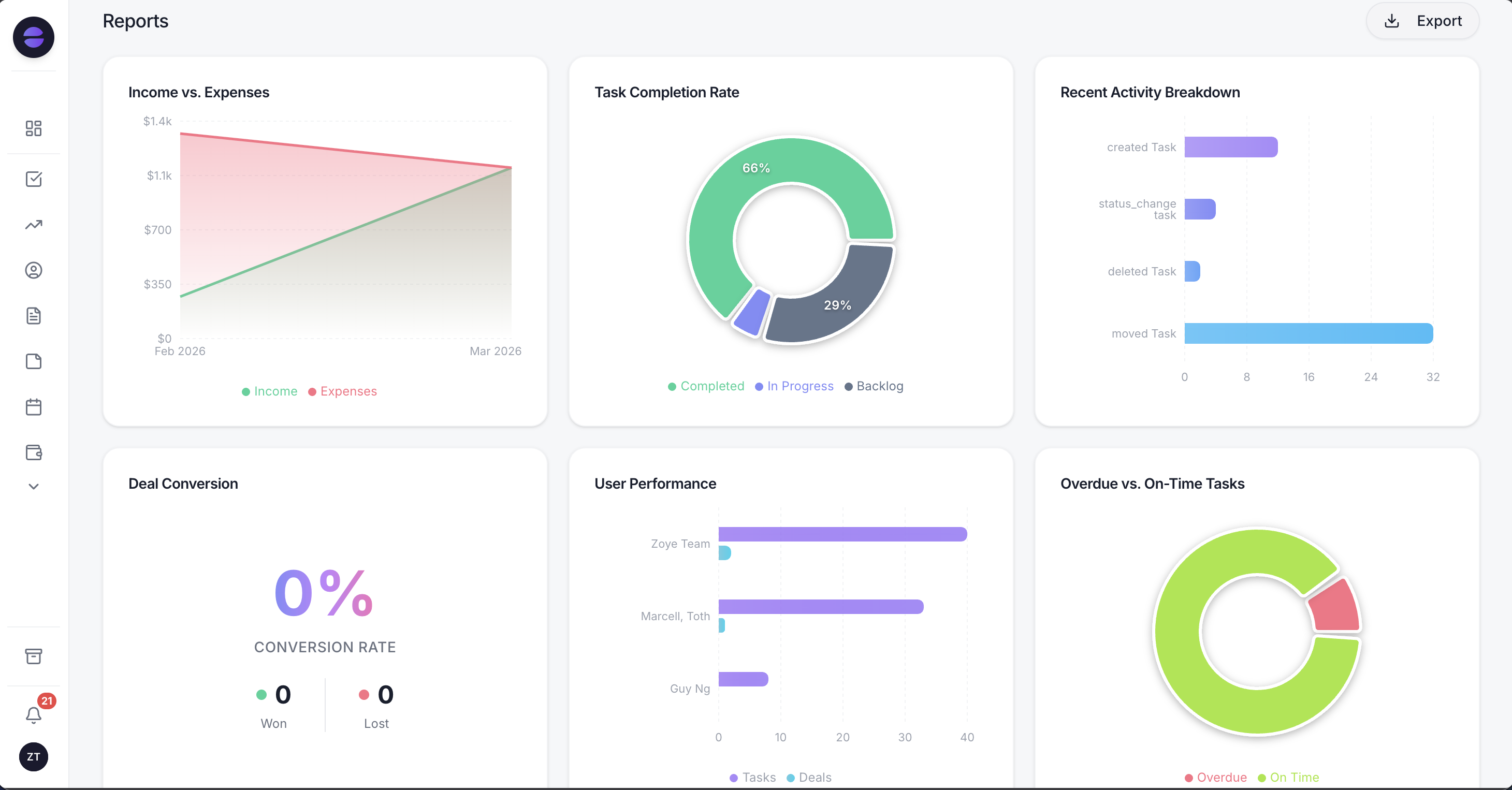 Zoye Reports pulls deals, tasks, contacts and finances into one dashboard, so the monthly summary assembles itself instead of being built by hand
Two structural things matter more than the sentence-to-rule step, and both map directly onto the failure modes above.
The first is that the records already link to each other. A deal knows its contact, its tasks, its files and its invoices, and triggers and actions reach across eight of the workspace tools. There is no field mapping between systems because there is no gap between systems, which removes the entire class of silent failures that come from a renamed field or an expired token somewhere in a chain. The trigger, the data and the action are the same workspace.
The second is the run log. Every run records what fired, what changed and what it sent, and it is reversible. That is unglamorous and it is precisely what turns automation from an act of faith into something you can audit. When a rule fires on a bad record, you want to see it that day, understand it in thirty seconds and undo it, rather than reconstructing it from a customer complaint three weeks later.
Six recipes ship ready to switch on: instant lead follow-up, a deal that has been stale for seven days, won-deal onboarding, the overdue-invoice chase, blocked-task surfacing, and a parent task that closes when all its subtasks are done. For a wider menu of rules, including the ones you would write yourself, the collection of workflow automation examples covers twenty of them with the trigger and condition spelled out. The full picture of what the engine can reach is on the workflow automations page.
Being straight about scope: Zoye is not an accounting ledger, so the invoice rules chase and record rather than reconcile your books. It is not a helpdesk ticketing suite. And it does not run your ads, it captures and works the leads your ads produce.
See what Zoye can do for you
From CRM and deal tracking to AI-powered task management - explore everything Zoye offers in one workspace.
Explore FeaturesGovernance, or how to still trust this in a year
Governance is a heavy word for three light habits. They are the difference between a set of automations that compounds and a set that slowly becomes a liability nobody wants to touch.
Log every run. Not as an audit trail for someone else, as a diagnostic for you. Every rule should record what fired, on which record, what changed, and what was sent. Without that, you cannot distinguish a rule that is working from a rule that is silently matching nothing, and those two states look identical everywhere except the log. Read the log for the first fortnight of any new rule and confirm the fire count is roughly what you predicted. If it fired twice when you expected forty, the condition is too narrow. If it fired four hundred times, you have just discovered a problem before your customers did.
Make it reversible. Before switching on any rule that touches a customer, know the answer to a simple question: if this fires on the wrong record, what do I do in the next five minutes? For an internal action the answer is usually undo. For an outbound message the answer is a human apology, which is precisely why outbound rules deserve stricter data guards than internal ones. The asymmetry should shape what you automate first: internal actions are cheap to get wrong, external ones are not.
Review monthly, prune quarterly. The monthly review is short and asks one question per rule: did this fire roughly the number of times expected? The quarterly prune is harder and asks whether the rule still describes how the business works. Retirement is the underused move here. Teams add automations enthusiastically and remove them almost never, which is how a business ends up with rules encoding a process that ended a year ago. A rule that no longer matches reality is not neutral. It is actively producing wrong outcomes with total confidence.
Pace matters too. One new rule a fortnight is a good rhythm for a small team, and it is faster than it sounds: twelve automations in six months is more than most businesses this size ever get running, and every one of them will be understood by somebody.
Ready to streamline your business?
Zoye brings AI-powered CRM, task management, and automation into one workspace.
Get StartedWhat to automate in which order
If you are starting from nothing, the sequence below is ordered by dependency rather than by appeal.
First, capture. Until records exist reliably and without typing, nothing built on top of them is trustworthy. This is unexciting and it is load-bearing.
Second, assignment. Every new record gets a named owner within minutes, by a rule simple enough that anyone can predict its output.
Third, the two revenue rules. Instant first response to a new enquiry, and a nudge when an open deal has gone quiet. These sit directly on money you have already spent to generate, they are measurable within a fortnight, and they ask nobody to change how they work.
Fourth, the chase. Invoice reminders before and after the due date, with an explicit stop condition on payment. This is the one group where the value is denominated in days of cash, which makes it easy to justify and easy to verify.
Fifth, the digest. A weekly assembly of what moved, what went quiet and what is owed. It changes the character of your weekly meeting more than anything else on this list.
Last, anything clever. Scoring, branching logic, multi-condition routing, predictive anything. Not because these are bad, but because every one of them multiplies the consequences of the four failure modes above, and none of them helps if capture is unreliable and half your rules have no owner.
Automate the record, not the relationship
The line worth holding is this one. CRM automation should take over everything mechanical about maintaining the truth: capturing it, routing it, updating it, noticing when it goes quiet, and reporting it back. It should not take over the parts of a customer relationship where being human is the entire value.
Automate the record so it is always current. Automate the timing so nothing waits on somebody's memory. Automate the assembly so nobody spends Monday morning in a spreadsheet. Then spend the time that returns on the conversation the automation just made possible, which is the only part of this that a customer will ever remember.
Try Zoye and describe your first rule in a sentence.
For more context, see the workflow automations overview, the guide to a CRM without data entry, and the analysis of why CRM implementations fail.