
Procore is not overpriced. It is priced for someone else. The platform was built for the general contractor running large commercial projects, where a formal document trail is the difference between a claim you win and one you eat, and where RFIs, submittals, drawing revisions and inspection records genuinely have to live in one auditable system. For that buyer, Procore earns its place, and the unlimited-user model means the whole project team, including the subs, gets in without a seat argument.
The problem is what happens when a nine-person residential builder, a specialty trade, or a renovation firm arrives at the same page. As of September 2026, Procore's own pricing page publishes no dollar figures at all. It explains that the fee is annual, charged per product, and sized against your Annual Construction Volume, the aggregate value of the construction work across your projects, and then sends you to sales. That is a rational model for enterprise procurement and a wall for a small builder who just wants to know whether this is a $400 decision or a $40,000 one. The searches that lead here are almost always some version of the same frustration: I cannot get a straight answer, and I suspect the answer is no.
This guide takes the question seriously by refusing to answer it with one list. A co-owner running four custom homes a year, a mid-size GC with a project engineer on staff, and a design-build studio whose real risk is unpaid change orders are three different purchases. Below, seven alternatives sorted by who you actually are, with published prices where the vendor publishes them and a plain statement where it does not.
Pricing reflects published rates as of September 2026; check each vendor's pricing page for current figures.
Why builders look past Procore in 2026
Four things push people off the platform, and only one of them is the invoice.
Quote-only pricing filters buyers out before the demo. Volume-based pricing is coherent, but it makes the platform impossible to evaluate quickly. A builder cannot model the cost against next year's revenue without a call, and a small firm often reads that as a signal it is not the customer. Every competitor that publishes a number wins the first ten minutes of the comparison by default.
Most of the depth goes unused on small residential work. Submittal logs, formal RFI workflows and drawing version control exist because commercial jobs have contractual document requirements. A kitchen remodel does not. Paying for and configuring that machinery to run six residential jobs is the classic mismatch, and it shows up as adoption failure: the office uses it, the field does not, and within a year the real schedule is back in a group chat.
The field team is the hardest part of any rollout, and weight makes it harder. Superintendents and trades adopt software that loads fast on a bad connection and does one obvious thing. Comprehensive platforms ask for more, and the gap between what the office thinks is being logged and what the field actually logs is where the value quietly disappears.
The business around the build is usually the part that is bleeding. Construction platforms are excellent at managing a job you have already won. They are much weaker at the estimate that went quiet after nine days, the owner who never got a follow-up, and the final invoice that has been outstanding for six weeks because nobody wanted to send the awkward message. For a lot of small builders, the leak is not project execution at all. It is the pipeline and the money.
Three readers, three shortlists
Before any tool name, decide which of these you are, because the right answer changes completely.
You are a small builder or specialty trade. One to fifteen people, residential or light commercial, jobs measured in weeks. You need scheduling, a shared job record, photos, and a way to stop losing money to slow quoting and slow invoicing. You do not need a submittal log.
You are a mid-size general contractor. You run commercial or larger residential work with a real document trail, multiple subs per job, and someone whose job includes paperwork. You need field-to-office document flow and you may genuinely need Procore or something in its class. Your question is whether a lighter platform covers most of it for a fraction of the commitment.
You are a design, renovation or specialty firm where the client is the risk. Studios, remodelers, high-end residential. Your disputes are about scope, change orders and payment, not about drawing revisions. Your software problem is a client and money problem wearing a construction costume.
The 7 best Procore alternatives in 2026
1. Zoye - the client and job layer that runs itself
Zoye is first on this list for a specific reason, and it is not that it out-features Procore. It does not compete with Procore at all. Zoye is the layer above and around the build: the leads, the owner relationship, the quotes, the documents, the invoicing and the chasing, with an AI operator that actually performs those jobs rather than reminding you to.
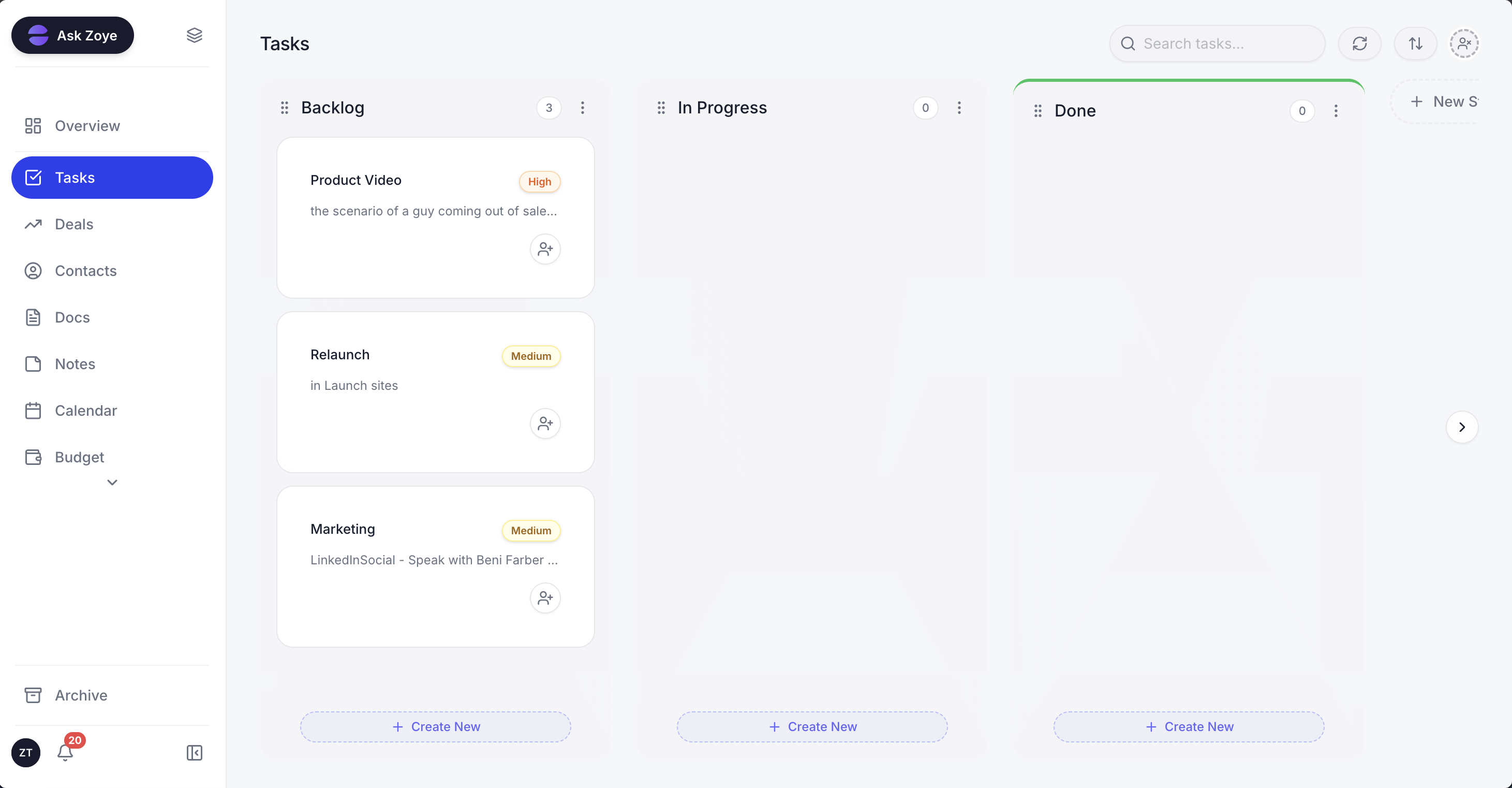
The Zoye job board: every enquiry moves from first contact to quote to won to paid, and the assistant keeps each one moving without being asked.
For a builder, a normal week looks like this. An enquiry lands from a website form, a Facebook lead ad or a WhatsApp message, and it becomes a record in the pipeline instead of a notification that scrolls away. You quote it. Two days later, if nothing has come back, the follow-up goes out in your voice, and again five days after that, because you described that cadence to Zoye once and it turned it into a rule that now runs on every quote. The job is won and lands on the calendar with its tasks, its documents and its owner attached to the same record. The final invoice goes out, and the day-7, day-14 and day-30 reminders go out too, without anyone having to feel awkward about sending them.
The assistant is the part that changes the day rather than the software stack. It works on WhatsApp and by voice note, which matters when the office is a truck. You can send a voice message from a site saying that the client approved the extra bathroom tiling and to bill for it, and it will update the record and raise the task. You can send a photo of a supplier's business card and get a contact. You can ask which quotes are still open, or what is outstanding, and get the real figure from live data rather than a guess. Anything destructive or bulk asks for confirmation first, and every automated run is logged and reversible, so the operator never becomes something you have to police.
Underneath, it is one workspace where the records already link to each other. The client knows their jobs, the job knows its tasks, its files and its invoices, and reports pull across all of it, so the win rate, the outstanding money and the jobs that have gone quiet are one screen rather than a Sunday evening with a spreadsheet. Imports come from Trello, Monday.com or a spreadsheet, and the assistant can pull records straight out of a CSV or a PDF you send it. Jira, Notion and ClickUp imports are coming soon.
What it is not: Zoye is not construction-specific project management. There is no drawing management, no RFI workflow, no submittal register, no punch list module and no inspection or compliance tooling. If those are the reason you are shopping, buy one of the tools below and put Zoye alongside it for the client side, or skip this entry.
Pricing: Almost Free at $5 per month, or $4 per month billed annually, for 1 member. Starter $29 per month, $23 annually, for 10 members. Growth $59 per month, $47 annually, for 20 members. Scale $119 per month, $95 annually, for 100 members. Flat rate, not per seat, plus a Customize option by quote.
Best for: Small builders, trades, remodelers and design-build firms whose real leak is slow follow-up and slow payment rather than site execution.
2. Buildertrend - the residential construction platform
Buildertrend is the most common landing spot for residential builders and remodelers leaving Procore, and it is a genuine platform rather than a light tool: scheduling, selections, change orders, client portal, budgets, daily logs and job costing, built around how custom home builders and remodelers actually work.
The honest catch in 2026 is that Buildertrend has followed Procore into quote-only territory. As of September 2026 its pricing page publishes no tier prices and describes pricing as tailored to job volume, team size and scope of work, with full feature access for every customer. That removes the one advantage a smaller platform usually has over Procore, which is a number you can check before booking a call. The client-facing side is the strongest part of the product; the sales pipeline and follow-up side is thinner than the project side.
Pricing: Not published. Quote based on job volume, team size and scope, as of September 2026.
Best for: Residential builders and remodelers who want deep construction project management and are willing to go through sales.
3. CoConstruct - still running, but closed to new customers
CoConstruct is worth listing precisely so you do not waste a week on it. Buildertrend acquired it in 2021, ran both products in parallel, and has since stopped taking new CoConstruct customers and stopped active development on it. Existing accounts continue to run and are being migrated across to Buildertrend, without a publicly announced final shutdown date as of September 2026.
If you are already on it, the practical decision is when to move rather than whether. If you are not, treat every CoConstruct review you find in a search result as historical. The functional answer to "what about CoConstruct" is now "that is Buildertrend".
Pricing: Not available to new customers.
Best for: Nobody new. Existing customers planning a migration.
4. Fieldwire - the field execution tool that stays light
Fieldwire attacks the part of construction software that most often fails: getting the field to actually use it. Plan viewing and markup, task assignment against a pin on a drawing, punch lists, daily reports and photos, all designed to work on a phone on a site with poor signal. Where heavier platforms sprawl, Fieldwire stays narrow and fast, which is exactly why superintendents and foremen tend to open it.
The trade-off is scope. Fieldwire is field execution, not a business system. There is no CRM, no estimating pipeline, no client-facing financial workflow and no invoicing, so it sits next to your other software rather than replacing it. As of September 2026 it publishes a free Basic tier, Pro at $39 per user per month billed annually, Business at $64 and Business Plus at $89, with custom contracts for unlimited users, SSO and API access.
Pricing: Basic $0. Pro $39 per user per month billed annually, Business $64, Business Plus $89, custom contracts by quote. As of September 2026.
Best for: Field teams that need plans, tasks and punch lists to work on site, alongside whatever runs the office.
Want to see it in action?
See Zoye catch a new lead, answer on WhatsApp and set up the follow-up, all from one message.
See How It Works5. Autodesk Construction Cloud - the Procore-class competitor
Autodesk Construction Cloud is the alternative that competes with Procore on its home ground rather than undercutting it. Built around Autodesk's design heritage, it is strongest where the model and the drawings matter: BIM coordination, clash detection, design collaboration flowing into build, plus the expected preconstruction, quality and project management modules. For firms already living in Revit and AutoCAD, the continuity from design into construction is the real argument.
It shares Procore's commercial posture, though. As of September 2026 the construction bundles, model management, preconstruction and construction operations, are all sold by quote, with flexible user, project and account-based pricing and no published rates. So if the reason you left Procore was that you could not get a price without a sales cycle, this is not the escape route. If the reason was that you wanted deeper design integration, it may be the upgrade.
Pricing: Not published. Bundles quoted, with user, project and account-based options, as of September 2026.
Best for: Design-led and larger contractors already invested in the Autodesk ecosystem.
6. Contractor Foreman - the published-price all-rounder
Contractor Foreman is the clearest answer to the specific complaint that drives most Procore alternative searches: it publishes its prices, and they are aimed squarely at small contractors. As of September 2026 its annual plans run Basic at $49 per month for 1 user, Standard at $105 for 3 users, Plus at $166 for 8, Pro at $221 for 15, and Unlimited at $332, with quarterly options priced higher per month and a 30-day trial.
The feature list is unusually broad for the price, covering estimates, invoices, scheduling, time tracking, daily logs, safety and change orders. The trade-off shows up in polish and depth rather than coverage: it does a lot of things adequately rather than a few things beautifully, and teams migrating from a very refined tool tend to notice the interface first. For a small contractor who wants one construction-shaped system with a price on the website, that is often an acceptable trade.
Pricing: Annual plans from $49 per month for 1 user up to $332 per month for unlimited users, as of September 2026.
Best for: Small contractors who want broad construction functionality and a price they can check without a call.
7. monday.com - the flexible board for firms that are not really doing commercial construction
monday.com is on this list because a large number of renovation firms, design-build studios and specialty trades end up running their jobs on it perfectly well. You build the stages yourself, so a job board can mirror your actual process rather than a generic construction template, and the automations, dashboards and file handling are mature.
The limitation is the obvious one: it knows nothing about construction. No drawing markup, no RFI or submittal structure, no punch list, no compliance record. Everything construction-specific is something you invent with columns, and the more of that you invent, the more fragile it gets. It is also seat-priced, so cost grows with headcount. As of September 2026, Work Management plans are published at $9 per seat per month for Basic, $12 for Standard and $19 for Pro, billed annually with seat minimums, plus a limited free tier for up to two seats and a quoted Enterprise plan.
Pricing: Work Management Basic $9, Standard $12, Pro $19 per seat per month billed annually, with seat minimums. Free tier up to 2 seats. As of September 2026.
Best for: Renovation, design and specialty firms whose work is project-shaped but not document-regulated.
Best Procore alternative for a small builder or trade
If you are under fifteen people, the mistake to avoid is buying a smaller version of the same thing. The features that make Procore expensive are the ones you will not open, and a lighter platform with the same shape leaves you with the same adoption problem at a lower price.
Split the decision instead. For site execution, Fieldwire is the lightest serious option and the one most likely to survive contact with the field, at a published $39 per user per month billed annually. For construction-shaped office work at a checkable price, Contractor Foreman covers estimates, scheduling and invoicing from $49 per month. And for the part that is usually costing the most money without appearing on any feature comparison, the quote that went quiet and the invoice nobody chased, that is a client-side job, which is where Zoye sits at $5 per month on the entry plan.
Plenty of small builders run exactly that pairing: one tool the field opens, and one that runs the pipeline and the money.
Best Procore alternative for a mid-size general contractor
At this size the honest answer is that you may not have an alternative, and that is fine. If your projects carry contractual documentation obligations, if you are managing formal RFIs and submittals, and if a dispute would be settled by the record, then Procore or Autodesk Construction Cloud is the category, and the choice between them usually comes down to how much of your work starts in Autodesk design tools.
The question worth asking is narrower: are you buying the platform for document control, or for coordination? If it is coordination, a Fieldwire deployment for the field plus a business layer for the office frequently delivers most of the outcome at a fraction of the commitment. If it is document control on regulated commercial work, do not try to save money there.
See what Zoye can do for you
CRM, deals, tasks and your Instagram, Facebook and WhatsApp automations in one workspace. Just ask Zoye and it sets any of it up for you.
Explore FeaturesWhat Zoye does and does not do on a construction job
This deserves stating flatly, because roundups that put a product first tend to blur it.
Zoye does not do drawings. There is no plan viewer, no markup, no version control on a drawing set. It does not do RFIs or submittals, there is no formal request workflow and no submittal register. It has no punch list module, no inspection checklists, no compliance or safety record, and no daily log built for construction. It is not an accounting ledger either, and it will not replace your bookkeeping.
What it does is everything around the build. Enquiries and leads from forms, ads and WhatsApp become records with the source attached, so you can tell which marketing actually pays. Quotes get followed up on a cadence that runs itself. Owner agreements, specs, photos and correspondence hang off the job record rather than a folder tree. Invoices go out and get chased on schedule. Meetings can be transcribed into decisions, owners and dates, and those become tasks. Reports show win rate, outstanding money and stalled jobs from live data. And the assistant does all of it from WhatsApp, which for a builder is the difference between a system that gets updated and one that does not.
For a renovation firm or a design-build studio, that may be the whole software problem. For a commercial GC, it is one layer of it, and the field tooling is a separate purchase.
Ready to hand off the busywork?
Zoye brings AI-powered CRM, task management, and automation into one workspace.
Get StartedHow to choose without booking six demos
Four questions get most builders to an answer in an afternoon.
1. Were your last three problems about documents or about money? Documents means construction-specific software, and the depth is worth paying for. Money, meaning quotes that went cold, change orders never billed and invoices sitting unpaid, means the leak is on the client side and no amount of project management depth will close it.
2. Will the field actually open it? Ask a foreman, not the office. A tool the field ignores is a tool the office types into twice. This single question kills more platform decisions than price does.
3. Can you get a price without a sales call? Procore, Buildertrend and Autodesk Construction Cloud all quote. Fieldwire, Contractor Foreman and monday.com publish. If your budget cycle cannot absorb a two-week sales process, that difference matters more than a feature grid.
4. How does the cost scale, per seat or flat? Per-seat pricing punishes you for putting subs and field staff into the system, which is exactly what makes the system work. Procore's unlimited users are a real advantage here. Flat-rate platforms behave the same way at the other end of the market.
Why builders pick Zoye alongside their site tools
The pattern repeats across small construction businesses that have already tried the big platforms.
The chasing happens whether or not anyone remembers. Quote follow-ups and invoice reminders run on schedule, which recovers jobs that would have gone silent and shortens the gap between finishing work and getting paid.
The phone is the interface. Updates arrive as WhatsApp messages and voice notes from a truck or a site, and the record is current because keeping it current takes seconds rather than an evening.
The client side finally has a home. Leads, quotes, documents, invoices and the relationship live on one linked record instead of being spread across an inbox, a phone and a folder.
And the boundary is honest. Zoye does not pretend to be Procore. It runs the business that the build happens inside, and it does that whether your field tool is Fieldwire, a construction platform, or a clipboard.
Try Zoye alongside your existing site tools. The entry plan is Almost Free at $5 per month, with the core tools.
For more context, see the best CRM for contractors, the best Basecamp alternatives, field service management software for small business, and the best project management software.