
Most business software promises to save you time and then quietly asks for more of it. You buy a tool to get organised, and within a month you are the one keeping it organised: logging the calls, updating the records, remembering the follow-ups, chasing the invoices. The software does not run anything. It waits for you to run it. For a busy owner who also sells, delivers, and supports, that upkeep is the first thing to slip, which is why so many tools end up as expensive tabs nobody opens.
An AI that runs your business inverts that deal. Instead of a system you feed, it is an operator you talk to. You tell it what happened or what you want, the way you would tell a colleague, and it does the work: it captures the lead, books the client, chases the quiet prospect, sends the reminder, updates the record, and tells you where the day stands. The point is not that it suggests. The point is that it acts.
This guide is the practical companion to the bigger question of what an AI Business Operator is. Here we stay concrete: what an AI that runs your business actually does across an ordinary day, what it should not do, and how to hand work to it safely so you get the leverage without losing control.
Pricing reflects published rates as of July 2026; check each vendor's pricing page for current figures.
What "an AI that runs your business" really means
The phrase gets used loosely, so it helps to be precise. There are three different things that all get called "AI for business," and only one of them actually runs anything.
A chatbot answers questions. It talks to your customers, replies to FAQs, and maybe collects a name. Useful, but it lives on the front desk and does not touch your operations. When the chat ends, nothing in your business has changed.
A CRM with "AI features" suggests. It might score a lead or draft a sentence, but it still waits for a human to click, log, and update. The AI is a helper bolted onto a database you still maintain by hand.
An AI that runs your business takes action. It has write access to your operations, not just your inbox. It creates the contact, moves the deal, books the slot, queues the follow-up, and sends the reminder itself. You give the instruction; it does the task end to end and updates everything that needs updating.
That last category is the one worth your attention, because it is the only one that removes work rather than adding a new thing to manage. The rest of this guide describes what that looks like hour by hour.
A day in the life: what the AI actually does
Here is the routine, operational load of a small service business, and how an AI that runs it handles each part. None of this requires you to open a form or learn a builder. You talk; it works.
Morning triage. Before you have finished your coffee, the AI has already gone through what came in overnight: new enquiries, replies to your follow-ups, messages that need an answer, and anything overdue. Instead of ten open tabs, you get a short briefing: here is what is new, here is what needs you, here is what I have already handled. You start the day knowing the state of the business rather than digging for it.
Lead capture, automatically. A new enquiry lands, from your website form, a WhatsApp message, a missed call, or a social DM. The AI creates the contact, records where they came from and what they asked for, opens a deal at the right stage, and queues the first follow-up, all without you touching it. The lead is captured the moment it arrives, not whenever you next get around to logging it, which is where most leads quietly die.
Chasing the follow-ups you owe. This is the work that never gets done and costs the most. The AI keeps track of every prospect who went quiet, every quote you sent that has not been answered, and every client due for a check-in. It drafts the follow-up messages in your voice and either sends them on the schedule you set or holds them for your approval. Nobody has to remember; the operator remembers for you.
Want to see it in action?
See Zoye catch a new lead, answer on WhatsApp and set up the follow-up, all from one message.
See How It WorksBooking and rescheduling. When a client wants an appointment, the AI offers real availability, books the slot, and adds it to the calendar. If they need to move it, it reschedules and updates everyone involved. If someone forgets, it sends the reminder that stops the no-show, and if they miss anyway, it follows up to rebook. The whole booking loop runs without you playing phone tag.
Invoice and payment reminders. Getting paid is mostly a memory problem, and memory is exactly what an owner runs out of. The AI tracks what is outstanding, sends a polite reminder when an invoice is due, escalates gently if it stays unpaid, and stops the moment the client pays. You get the money in without becoming the person who nags.
Keeping the records current. Every one of these actions updates your system as it happens. The contact history, the deal stage, the task list, the calendar: all current, because keeping them current is the AI's job, not a chore you do at the end of a long day. This is the quiet superpower. The reason records go stale is that maintaining them is manual, and here it is not.
End-of-day reporting. When you want to know how things are going, you ask. How many leads this week, what is stuck in the pipeline, who owes money, what is booked for tomorrow. The AI pulls the answer from live data and gives it to you in plain language, or a clean summary you can share, instead of you assembling it from spreadsheets.
Across a full day, none of these tasks is hard in itself. The problem has always been that there are hundreds of them and one of you. An AI that runs your business carries that volume so the load stops depending on your memory and your spare minutes.
What it does not do (and should not)
An honest picture matters, because an AI that runs your business is powerful precisely where it is bounded. The goal is leverage, not blind autonomy. Here is where the line sits.
It does not make the irreversible, high-stakes calls. Firing a client, signing a contract, making a large payment, or handling a delicate complaint that needs real empathy: these stay with you. A good operator prepares the decision, drafts the message, and lays out the context, then hands it to you. It does not pull the trigger on things that cannot be undone.
It does not replace your judgement or your craft. The AI runs the operational load. It does not do the actual work you are known for, whether that is treating a patient, shooting a wedding, or fixing a boiler. It clears the admin around your expertise so you have more time for the expertise itself.
It does not invent what it does not know. A trustworthy operator says "I do not have that" rather than guessing. It will not fabricate a price, a policy, or a fact about a customer. If it is unsure, it asks or escalates, which is exactly what you would want from a good assistant.
It does not act without a trail. Everything it does should be visible and reversible where possible. You should be able to see what it did, when, and why, and to change how much freedom it has at any time.
Read positively, this list is reassuring. The AI takes the repetitive, reversible, high-volume work off your plate and keeps the rare, weighty, human decisions firmly on it.
See what Zoye can do for you
CRM, deals, tasks and your Instagram, Facebook and WhatsApp automations in one workspace. Just ask Zoye and it sets any of it up for you.
Explore FeaturesHow to hand work to it safely
Letting AI run your business is not an all-or-nothing switch, and it should not be. Treat it like onboarding a capable new hire: you do not hand over the keys on day one, and you do not micromanage forever either. A simple progression works well.
Start with draft and suggest. For the first week, let the AI prepare everything but send nothing automatically. It drafts the follow-ups, proposes the bookings, and flags what needs attention. You review and approve. This is where you learn its judgement and it learns your voice.
Graduate the low-risk tasks first. Once you trust its drafts, let it act on the repetitive, reversible work without asking each time: capturing leads, sending routine reminders, updating records, booking against your real availability. These are the tasks where speed matters and mistakes are cheap to fix.
Keep confirmation on anything costly or destructive. Deleting records, messaging your whole list, anything involving money above a threshold you set: keep a confirmation step. A good operator asks before it does something it cannot take back, and you keep that gate for as long as you want it.
Watch the log. Keep an activity history you can scan. Seeing what the AI did each day, at least at first, builds the trust that lets you hand over more. It also means you can catch and correct any pattern early, the same way you would coach a new team member.
Done this way, the risk stays low while the leverage compounds. Within a few weeks the AI is quietly running the routine, you are approving the edge cases, and the work that used to eat your evenings simply happens.
Zoye: the AI that runs your business
Zoye is built to be exactly this: an AI Business Operator that runs the day-to-day so a non-technical owner never has to. You talk to it, in the app or over WhatsApp and Slack, and it does the work: captures the leads, chases the follow-ups, books the clients, sends the reminders, updates the records itself, and even builds an automation when you describe what should happen.
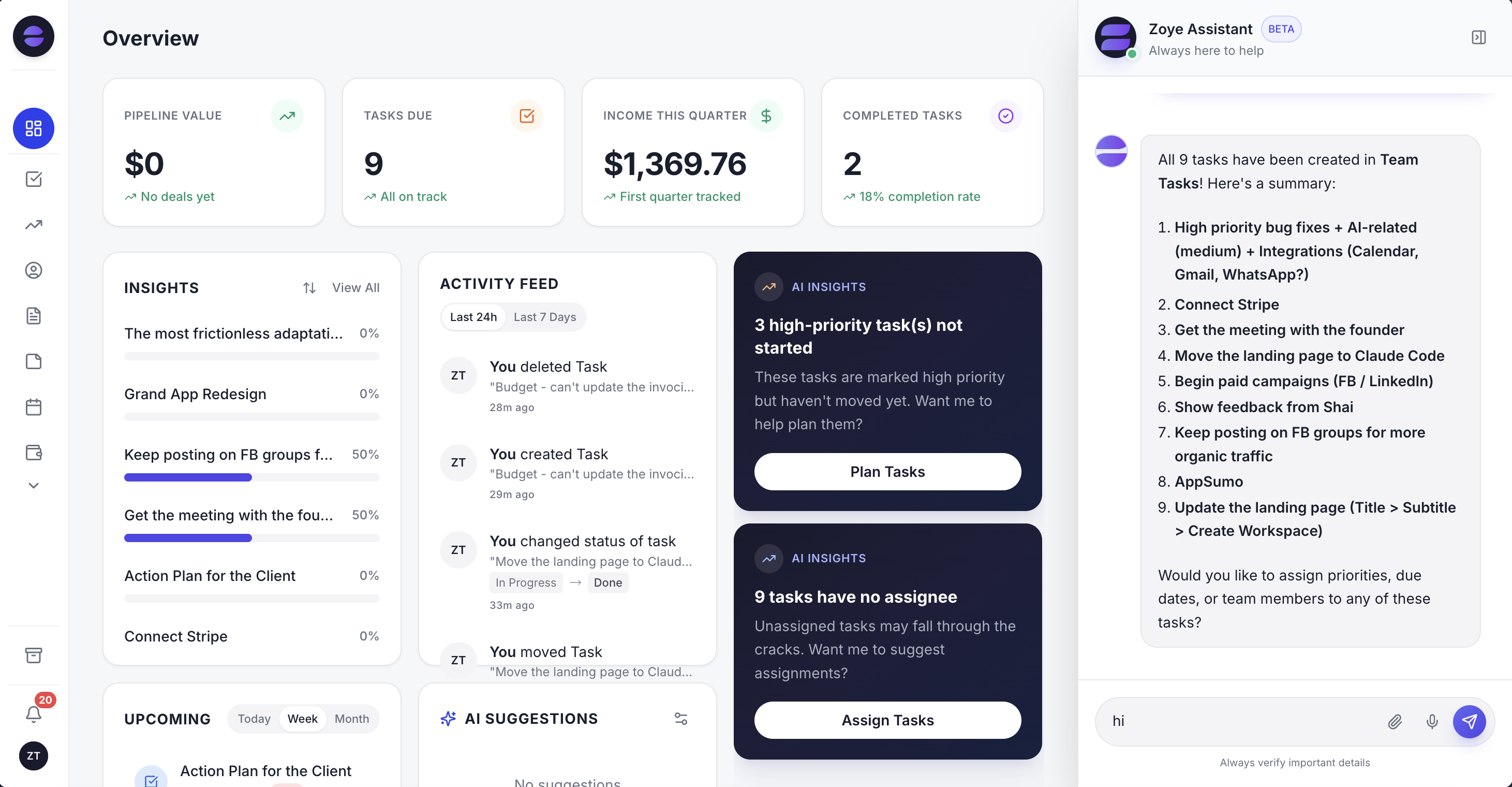 Zoye gives you the day at a glance, handles the routine work in the background, and is right there in the chat whenever you need it.
The daily loop from the section above maps directly onto how Zoye works. Your morning briefing surfaces what is new and what needs you, with proactive AI Insights on the dashboard. An incoming WhatsApp message becomes a contact, a deal, and a follow-up without you opening the app. Tell Zoye "chase everyone who did not reply to last week's quote" and it drafts and queues those messages. Ask it to book a client, send a payment reminder, or pull this month's numbers, and it does the task and updates everything attached to it. Ask it to wire up a rule ("when a lead comes in from WhatsApp, tag it and remind me in two hours") and it builds that automation from the sentence, with no builder to learn.
Because Zoye is a full workspace, the operator is not running in a vacuum. Underneath sit a real CRM that separates people from companies, tasks with list, board, calendar, and timeline views, a shared calendar, budget tracking, and reports that pull from all of it. So when the AI acts, everything stays connected and current in one place, rather than scattered across five tools you would otherwise stitch together. And the safety model matches the guidance above: Zoye keeps a full activity history and asks before it does anything irreversible, so you hand over work at your own pace.
The longer it runs your business, the less you have to explain. Zoye keeps a memory of each person's preferences and of your business facts, plus a team memory everyone shares once the owner approves it. Tell it "from now on, add a follow-up task for every lead that asks for a quote" and the rule covers every new lead from every source. Hand it open-ended scheduled jobs, read the daily insights digest wherever suits you (app, email, WhatsApp or Slack), ask it to take back any change, and send it off to research a supplier or a competitor on the web, with sources. Not sure what to hand over? Just ask Zoye what it can do for your business.
Pricing: Almost Free at $5 per month for 1 member with the core tools. Starter from $29 per month (10 members). Growth from $59 per month (20 members). Scale from $119 per month (100 members).
Best for: Solo owners and lean service teams who want the routine running of the business handled for them, mostly by conversation and over WhatsApp.
Ready to hand off the busywork?
Zoye brings AI-powered CRM, task management, and automation into one workspace.
Get StartedYour first week with an AI running the business
If you are starting out, a simple plan gets you the leverage fast without the leap of faith.
Day one: connect your channels. Point the AI at where your customers actually reach you, WhatsApp first if that is where the messages land, plus your enquiry form and calendar. From here, new leads get captured automatically.
Days two to four: let it draft. Have it prepare your follow-ups, reminders, and bookings while you approve each one. You will see its judgement and shape its voice, and you will notice how many follow-ups you were quietly missing.
Day five onward: hand over the routine. Let it send the routine reminders, capture and log leads, and book against your calendar automatically. Keep confirmation on the costly and destructive actions. Check the log at the end of each day.
By the end of the first week most owners find the same thing: the small tasks that used to pile up are simply handled, the follow-ups that used to leak revenue are going out, and the mental load of remembering it all has lifted.
Why teams pick Zoye
A few themes come up again and again.
It does the work, not just the reminding. Zoye captures the leads, chases the quiet prospects, books the clients, sends the reminders, and updates the records itself, so the routine running of the business stops depending on your memory.
It runs where you already are. You message Zoye in the app or over WhatsApp and Slack, so you can operate the business from your phone between jobs instead of sitting down to do admin.
It stays safe as you scale up its freedom. A full activity history and confirmation on anything irreversible mean you hand over work at your own pace and always see what was done.
It is one connected workspace, not five tools. The CRM, tasks, calendar, budget, and reports live together, so when the AI acts, everything stays current in one place.
Try Zoye with your team. The entry plan is Almost Free at $5 per month for 1 member, with the core tools.
For more context, see business automation for small business, the guide to an AI agent for small business, and what an AI Business Operator is.