
AI Assistant for Business Owners: What to Hand Over and What to Keep
There is a difference between using an AI assistant and delegating to one, and owners feel it faster than anyone else in the building.
If you hold a seat in a company, an AI assistant that writes well is genuinely useful. It drafts the email, tightens the proposal, summarises the thread. Your job has edges, and a good drafting tool makes the work inside those edges faster.
If you own the business, your job has no edges. The enquiry that arrived at eleven at night is yours. The invoice nobody chased is yours. The client who has gone quiet for three weeks is yours, and so is the fact that nobody noticed. A tool that writes beautifully but leaves every one of those things sitting in your head has not reduced your load. It has given you a faster way to produce work you still have to place, file and follow up on yourself.
This guide is written for that reader. Not the person evaluating an AI feature for a team, but the person deciding which parts of running a company they are willing to hand to software, and which parts they are keeping.
Drafting and executing are not the same product
The most useful distinction in this category has nothing to do with model quality. It is about where the assistant's output lands.
A drafting assistant ends at text. You ask for a follow-up to a prospect, and you get a well-judged three-paragraph message. What happens next is entirely manual: you open your email, paste it, remember the address, send it, then open your CRM and log that you sent it, then set a reminder to check back. The assistant did the part you were probably fine at. It left you the six steps of admin around it.
An executing assistant ends at a changed record. You ask the same thing, and the message goes out, the activity is logged against the right contact, a follow-up task appears on the correct date, and the deal's last-touched timestamp updates. You did not open a second application.
That difference sounds like convenience. For an owner it is closer to a category change, for a reason that has nothing to do with typing speed. The manual last mile is not just slow, it is skippable. Under pressure, a busy owner will send the message and not log it. Then not log the next one. Two months later the pipeline is a work of fiction, the reports built on it are decorative, and the only accurate picture of the business is the one in the owner's head, which does not scale and does not take holidays.
An assistant that executes closes the gap between what happened and what is recorded, because the recording is a side effect of the doing rather than a separate chore that competes with it.
There is a practical test you can run on any tool you are evaluating. Ask it to do something with a consequence: move a deal to the next stage, create a task for tomorrow, add a note to a specific contact. Then go and look at the record. If nothing changed, you are looking at a writing tool. That is a legitimate thing to buy, but do not buy it expecting it to take work off your plate.
Want to see it in action?
Watch how Zoye automates your daily workflow - from lead management to team collaboration.
See How It WorksThe permission question comes before the capability question
Owners are usually sold on capability and burned on permission. The right order is the reverse. Before you ask what an assistant can do, decide what it is allowed to do without checking with you.
There is a workable line, and it is not "ask about everything". An assistant that asks permission for every action is a form with extra steps, and you will stop using it inside a fortnight. The line falls between actions that are cheap to undo and actions that are not.
Should run without asking:
- Reading anything. Looking up a contact, counting open deals, checking who owns a task.
- Drafting. A message, a summary, a proposed task list, all held for your approval.
- Creating a single low-stakes record. A note, a task assigned to you, a contact from a business card.
- Logging what already happened. An activity on a record after a call took place.
Should always stop and ask, naming exactly what it is about to touch:
- Deleting anything. Records, files, tasks. Deletion is the one action where being right ninety-nine times does not compensate for the hundredth.
- Bulk anything. Any action whose scope is a set rather than a record. Updating forty leads, reassigning a territory, applying a tag across a segment. A misread instruction affecting one record is a correction. The same instruction affecting four hundred is an afternoon of repair.
- Sending to more than one person. Individual replies are ordinary. A broadcast is a public act with your name on it, and it cannot be recalled.
- Money. Changing a price, editing an invoice total, marking something paid, issuing a credit.
- Overwriting a field that already has a value. Filling an empty phone number is helpful. Replacing an existing one because a transcription heard the digits differently is data loss that nobody notices for months.
- Merging records. Deduplication is genuinely valuable and genuinely destructive, because unmerging is rarely clean.
- Closing or reopening a deal. The stage that decides your forecast should not move on inference.
Two details make the difference between a confirmation step that protects you and one you learn to click through without reading. First, the confirmation must be specific: "delete the 12 tasks under the Riverside project" and not "confirm this action". Second, everything the assistant does should be logged and reversible, so that the answer to a mistake is a rollback rather than an archaeology session.
Ask any vendor two questions. What does your assistant refuse to do without confirmation, and can I see everything it did last Tuesday? A product built by people who have thought about ownership answers both immediately.
The five jobs to hand over first
Most owners start in the wrong place, usually with something creative and highly visible, and conclude that the whole category is overrated when the output needs heavy editing.
Start instead with the jobs that share three properties: they happen constantly, they require almost no judgement, and skipping them costs real money. There are five, and they are the same five in almost every small business.
1. The first reply to a new enquiry
Speed of first response is the least glamorous and most reliable lever in a small business, because a prospect who filled in your form filled in two others. The first reply does not need to be clever. It needs to acknowledge, confirm you are real, and either book time or ask one qualifying question. This is pure mechanics, and mechanics is exactly what you should delegate. Note that this is also the job most damaged by a drafting-only tool: a perfect reply written at nine the next morning is worse than a plain one sent in four minutes.
2. Capturing what you already said out loud
The single biggest source of missing business data is the conversation that happened away from a keyboard. A site visit, a call in the car, a corridor conversation at an event. The information exists, it was spoken, and it evaporates because typing it up ranks below everything else in the day.
An assistant you can talk to, on the channel already open on your phone, converts a thirty-second voice note into a contact, three tasks and a note on the right deal. This is why the messaging channel matters more than it first appears. Zoye's assistant on WhatsApp exists for exactly this moment, because the alternative is not a better form, it is nothing being recorded at all.
3. Keeping the pipeline honest
Deals do not usually die from rejection. They die from silence, and silence is invisible unless something is counting. An assistant that surfaces every deal untouched for a set number of days, every task past its date, and every proposal sent without a reply, gives you the one report you would otherwise never assemble: what is quietly rotting.
4. Chasing money
Owners are famously bad at this, for an understandable reason: chasing an invoice from someone you like feels socially expensive, so it gets postponed. It is the purest case for delegation. A fixed, polite, unemotional schedule applied to every overdue invoice with no exceptions removes the awkwardness by removing the decision.
5. Answering "where do things stand"
You ask a version of this question several times a day. What is in the pipeline this month. Who is overloaded. What is due this week. What did we agree with that client in June. Each individual answer costs a few minutes of clicking, and collectively they eat an hour a day. This is the job that most rewards an assistant connected to live records, and the one where a disconnected assistant is actively dangerous, for reasons worth stating plainly.
See what Zoye can do for you
From CRM and deal tracking to AI-powered task management - explore everything Zoye offers in one workspace.
Explore FeaturesWhere these assistants fail, and why the failure matters
This is the section most articles in this category skip, which is a mistake, because an owner who does not know the failure modes cannot supervise the tool.
They invent facts with total confidence. A language model asked a question it cannot answer does not usually say so. It produces something plausible, in the same assured tone it uses for things it knows. Ask about a client's contract terms and you may get a clean, specific, entirely fictional summary. The fluency is the problem: there is no verbal tell, because uncertainty and invention sound identical.
They are worst on exactly the details that matter most. Names, numbers and dates are the weakest points, and they are also the ones that appear in contracts and invoices. Transcription compounds it. Similar-sounding surnames, digits misheard in a noisy car, a figure quoted as an aside and recorded as a commitment. A confident wrong number is worse than no number, because a blank field prompts a check and a filled one does not.
They will confidently recall figures they never had. This is the failure mode that should decide your purchase. Ask a general-purpose assistant what your pipeline is worth this quarter and, unless it queried something, it will answer from context: something you mentioned earlier in the conversation, a figure from a document you pasted last week, or an inference from the shape of the question. It will not say "I do not have that". It will give you a number, and the number will look like a number.
This is the entire distinction. An assistant that is worth trusting with your business does not answer from the model's memory. It runs a query against your live records and reports what is stored. The difference is testable in under a minute: ask for a figure you can verify by hand, then ask which records it counted. A grounded assistant can name them. An ungrounded one restates the number more confidently.
The practical implications for an owner are three. Ground every factual answer in a real query, not a recollection. Treat every name, figure and date the assistant extracts from speech as a draft until a human glances at it, which is why the confirmation step exists. And keep a log, so that when something is wrong you can find out what the assistant actually did rather than reconstructing it from memory.
None of this argues against delegating. It argues for delegating the mechanical work, where errors are visible and cheap, before the judgement work, where they are neither.
What you should keep
Some things do not belong to an assistant, and the reason is not capability.
Keep the pricing conversation. Keep the decision to fire a client, take on a difficult one, or walk away from a deal that would break your delivery capacity. Keep the apology when something has gone wrong, because a customer can tell, and the moment they detect an automated apology you have converted a recoverable problem into a story they tell other people. Keep hiring judgement. Keep the strategic no.
There is a simple heuristic. If getting it wrong costs you a relationship rather than an hour, it stays with you. Everything on the other side of that line is a candidate for delegation, and there is far more of it than most owners assume.
Ready to streamline your business?
Zoye brings AI-powered CRM, task management, and automation into one workspace.
Get StartedZoye: an assistant that acts on your records
Zoye is an AI Business Operator: one workspace holding thirteen tools that already link to each other, with an assistant that operates them on your behalf. A contact, its deals, its tasks, its files and its invoices are the same connected object, which is what makes execution possible at all. An assistant cannot move a deal it cannot see.
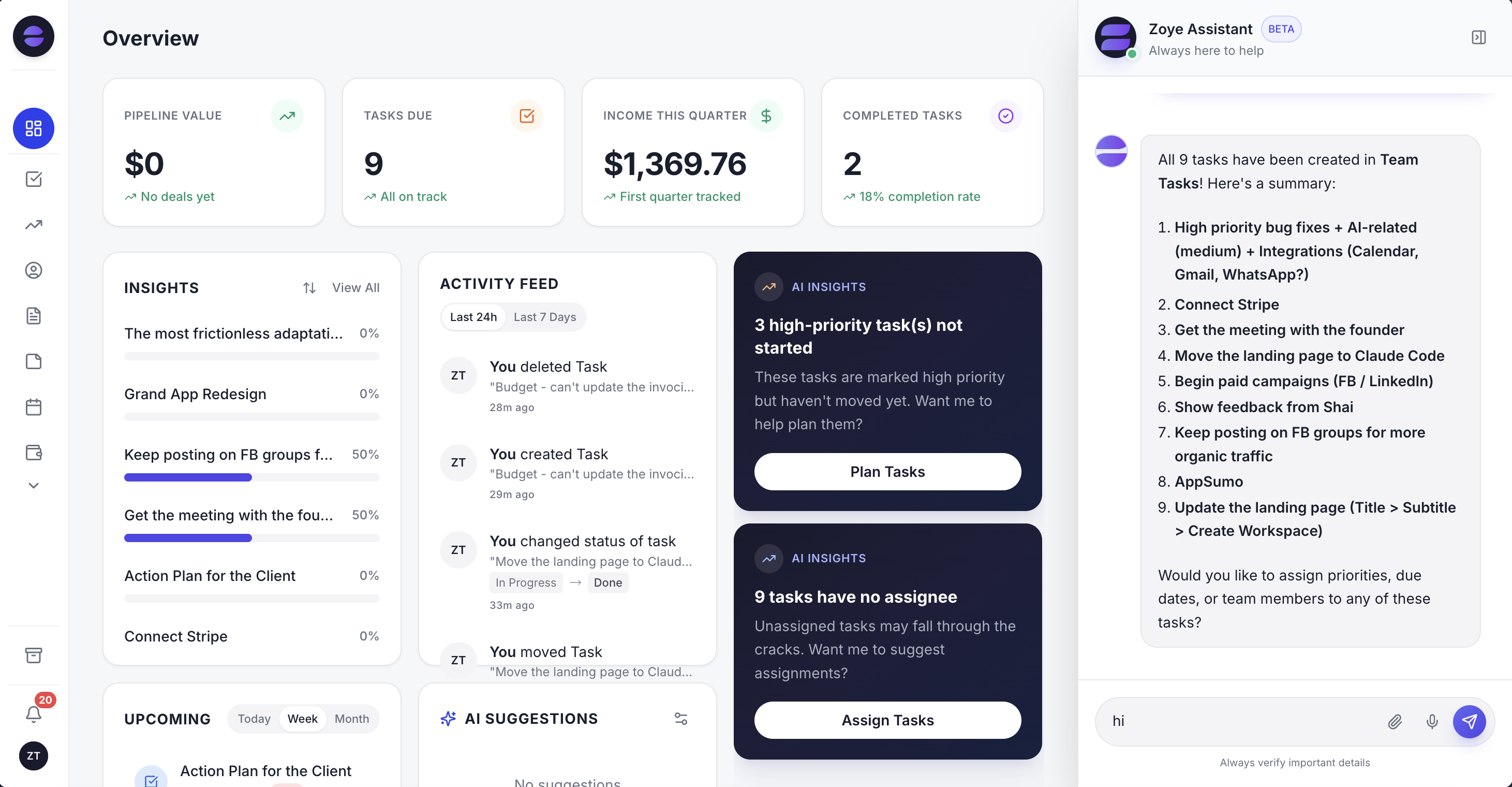
The overview brings pipeline, workload and activity into a single screen, so "where do things stand" has an answer that does not need assembling.
The assistant creates and updates contacts, companies, leads, deals, tasks, meetings, notes, documents and invoices, and it answers questions about figures by reading the live workspace rather than recalling them. It is the same assistant with the same tools and the same permissions in the web app, on WhatsApp, by voice note, in Slack and in Claude through the connector. WhatsApp is not a reduced edition, which matters for the capture problem above: a voice note recorded between meetings can carry several requests at once, and it is transcribed and acted on. Send it a PDF, a spreadsheet or a photo of a business card and it reads them.
Destructive and bulk actions stop and ask first. Automations follow the same principle from the other direction: you describe a rule in a sentence, Zoye turns it into a real trigger with conditions and actions, shows you the finished rule in plain English, and nothing runs until you approve it. Every run is logged with what fired, what changed and what was sent, and it is reversible. You are never required to open a visual builder, though one exists.
Zoye is deliberately not everything. It is not an accounting ledger, not a helpdesk ticketing suite, not a property management system, and it does not run your ads, though it captures and works the leads your ads produce. The Notes module is collaborative docs and is still rolling out. Knowing what a tool refuses to be is usually more informative than its feature list. Pricing for every tier is published on the pricing page.
A sensible first month
Pick one of the five jobs, not five. The first reply to new enquiries is the usual choice because the result is measurable within days.
Run it with confirmations switched on for anything consequential, and read them for the first fortnight rather than clicking through. You are calibrating, and you learn more from the requests it misreads than from the ones it gets right.
Then check the numbers by hand once. Ask for your open pipeline, count it yourself, and compare. If they match, you have a grounded assistant and you can start trusting the answers. If they do not, you have learned something considerably more valuable than a feature comparison would have told you.
Add the second job only when the first has stopped needing supervision. The failure mode here is enthusiasm: owners who automate six things in a week end up supervising six half-configured processes, which is more work than doing them manually.
If you want the wider context before deciding, the guide to AI agents for small business covers the landscape, and what an AI Business Operator actually is explains where the category sits relative to a CRM and a chatbot.
The question is not whether an assistant can write your emails. It can, and so can you. The question is whether it is connected to the thing you actually own.