Quick answer: a Twilio WhatsApp bill has two layers. Twilio charges $0.005 per message, inbound or outbound, and passes through Meta's per-message fee, which depends on the message category and the recipient's country. With one sender number, the cheapest realistic month in our worked examples is about $11 for 1,000 outbound messages to US numbers; the same volume to UK numbers is about $28, because Meta's UK rates are several times higher.
Key takeaways (November 2026)
- Twilio's own fee is $0.005 per message in both directions, and $0.001 for each message that ends in a failed status (Twilio's WhatsApp pricing page).
- Meta has billed per delivered message since 1 July 2025. From 1 October 2026, every business number receives 1,000 service messages a month without Meta's fee, and in-window utility templates became billable again.
- In the US, utility, authentication and service messages cost $0.0034 each in Twilio's per-country table, and marketing templates are not delivered to US numbers at all.
- At 10,000 outbound messages a month, our worked bill is about $117 for US recipients and $366 for UK recipients. Twilio's fee is roughly three quarters of the US bill and under a quarter of the UK one.
- The line no price list shows is the build: Twilio sells WhatsApp as an API, so someone has to write and maintain the code that uses it.
Sourcing note: Twilio's fees come from its WhatsApp and US messaging pricing pages, checked on 19 November 2026. Meta's per-country rates below come from the per-country table on Twilio's WhatsApp pricing page (Twilio labels that page "current as of September 2026"). None of the six markets we use appears on Meta's list of rate changes for 1 October 2026, the US figure matches Bird's page, and the Brazil figure matches Meta's developer documentation. Confirm the rates for your own countries before you budget.
How does Twilio WhatsApp pricing work?
Twilio WhatsApp pricing is the sum of two separate fees on every message. Twilio adds a flat handling fee of $0.005 whether the message goes out or comes in. Meta adds its own fee on business messages it delivers, priced by category and country, and Twilio passes that fee through to your invoice without a markup listed on its page.
That structure is simple to say and easy to misread. Three details decide what you actually pay.
Twilio charges both directions. Most people model only what they send. Twilio's pricing page is explicit that its $0.005 applies "inbound or outbound", so every customer reply also costs half a cent. In a support-heavy inbox, inbound traffic can be as large as outbound.
Meta charges only what it delivers. Meta's developer documentation says businesses are charged only when a message is delivered, and never for messages users send to the business. A template that fails to reach the phone does not carry Meta's fee.
Meta's fee changes with the category and the country, Twilio's does not. That is why the same 1,000 messages can cost $11 in one market and about two and a half times as much in another. The Twilio half of the bill is predictable; the Meta half is where budgets go wrong.
If you are new to the categories themselves, our guide to WhatsApp Business API pricing explains the model from the beginning. This article stays on the Twilio bill.
Every charge on a Twilio WhatsApp bill
A Twilio WhatsApp invoice can carry up to seven kinds of charge, and the worked bills below use three of them: Twilio's per-message fee, Meta's per-message fee, and a phone number. The table lists each line, who sets it and what Twilio's pages say about it in November 2026.
| Line on the bill | Who sets it | Price (November 2026) | When it applies |
|---|---|---|---|
| Message handling fee | Twilio | $0.005 per message | Every inbound and outbound message |
| Category fee | Meta, passed through | Varies by category and country | Every delivered business message, minus free allowances |
| Failed message fee | Twilio | $0.001 per message | Messages that end in a "Failed" status |
| Phone number | Twilio | $1.15 a month for a US local number, $0.50 if you bring your own | If your WhatsApp sender uses a Twilio number |
| Messaging Engagement Suite | Twilio | First 1,000 a month free, then $0.015 per message | Only if you use link shortening, click tracking or scheduling |
| Conversations API | Twilio | Priced on a separate page | Only if you build on Twilio Conversations instead of the Messaging API |
| Volume discounts | Twilio and Meta | Through Twilio sales; Meta tiers for utility and authentication | High monthly volumes |
Two points on that table are worth reading twice. The phone number price is from Twilio's US messaging pricing page, which lists $1.15 a month for a leased local number and $0.50 a month for a number you bring. Numbers in other countries are priced separately. And the engagement add-on is cheap to switch on and expensive at volume: at 10,000 messages a month with link tracking, it would cost 9,000 x $0.015 = $135, more than Twilio's own message fees on the same traffic.
Twilio's WhatsApp page also says "volume discounts may apply" and points to sales, without published thresholds. Meta's discounts are separate: Meta's documentation describes volume tiers for utility and authentication messages, set per market and reset each month. In Twilio's calculator, the US utility tier starts at 80,000 messages a month, so a small business will not reach it.
Meta's layer: what you pay for each message category
Meta's half of the bill depends on the message category and two allowances. Marketing, utility and authentication messages are templates and are charged per delivery. Service messages are free-form replies inside the 24-hour window: the first 1,000 a month per number are free since 1 October 2026, then they are charged too. On Zoye, your messages go out from Zoye's WhatsApp Business number, so these free service messages do not apply to your account. Connecting your own number is coming soon. Meta's fifth category, Meta Business Agent, applies only to replies powered by Meta's own AI agent.
The rules that matter on a Twilio bill, as stated in Meta's developer documentation in November 2026:
- Per-message billing since 1 July 2025. Meta replaced conversation-based pricing with a charge per delivered message. Each message has one category and incurs at most one charge.
- Marketing templates are promotions, offers, announcements and re-engagement. They are the most expensive category in almost every market and are always charged outside a free entry point window.
- Utility templates confirm or update something the customer asked for: an order, a booking, a payment. Since 1 October 2026 they are charged even inside an open customer service window. From July 2025 to 30 September 2026 they were free there.
- Authentication templates carry one-time codes. Since 1 October 2026, some businesses may pay higher authentication-international rates in up to 18 markets, with 30 days' notice from Meta.
- Service messages are your replies inside the 24-hour window that opens when the customer writes. Each business phone number gets 1,000 free per month, with no rollover. From the 1,001st, they are charged.
- Free entry point window. When a customer messages you from a click-to-WhatsApp ad opened in the WhatsApp app on Android or iOS, and you reply within the window, a window of up to 7 days opens in which marketing, utility, authentication and service messages are free. Desktop and web do not qualify. Our guide to click-to-WhatsApp ads covers how to set them up.
- No marketing to US numbers. Meta's developer documentation says WhatsApp does not currently deliver marketing templates to users with US phone numbers; the send fails with error 131049.
- Rates change only on the 1st of a quarter: 1 January, 1 April, 1 July or 1 October, with at least a month's notice for rate card updates.
One more rule changed in October. Meta's documentation says that a business without a payment method stops sending service messages once the free 1,000 are used. On Twilio, Meta's fee is passed through to your Twilio bill, so the replies after the first 1,000 are charged there at the country rate.
Meta's per-message rates in six markets
Meta's rates differ by a factor of ten or more between markets, so the country of your customers decides the size of the bill. The table shows the rates Twilio lists for six markets in November 2026, in US dollars per delivered message, before Twilio's $0.005 fee is added.
| Market | Marketing | Utility | Authentication | Service (after 1,000 free) |
|---|---|---|---|---|
| United States | Not delivered | $0.0034 | $0.0034 | $0.0034 |
| United Kingdom | $0.0635 | $0.0220 | $0.0220 | $0.0220 |
| Germany | $0.1365 | $0.0550 | $0.0550 | $0.0550 |
| Spain | $0.0707 | $0.0200 | $0.0200 | $0.0200 |
| Brazil | $0.0625 | $0.0068 | $0.0068 | $0.0068 |
| India | $0.0118 | $0.0014 | $0.0014 (international rate $0.0304) | $0.0014 |
Source: the per-country table and CSV on Twilio's WhatsApp pricing page, downloaded 19 November 2026. As cross-checks, Bird's WhatsApp pricing page lists the same $0.0034 Meta fee for US utility, authentication and service messages, and Meta's developer documentation cites 0.68 cents as the current Brazil utility and authentication rate.
The pattern is clear: a marketing template to a German number costs forty times a utility message to a US number. In a low-rate market Meta's fee is small change; for promotions across Western Europe it is the bill.
Want to see it in action?
See Zoye catch a new lead, answer on WhatsApp and set up the follow-up, all from one message.
See How It WorksThe worked bills: 1,000 and 10,000 messages a month
The worked bills below price a typical small sender at two volumes in two markets. They are illustrative, built from the rates above and stated assumptions, not quotes. The headline: at 1,000 outbound messages a month the bill is about $11 for US recipients and $28 for UK recipients; at 10,000 it is about $117 and $366.
Assumptions used in every scenario:
- One business phone number, so one allowance of 1,000 free service messages a month.
- Customers reply: for every 1,000 outbound messages, 700 inbound messages arrive. Twilio charges its fee on both; Meta charges neither inbound.
- Every outbound message is delivered (no failed-message fees) and none is sent inside a free entry point window.
- UK mix (our assumption): of every 10 outbound messages, 2 marketing, 3 utility and 5 service.
- US mix (our assumption): marketing cannot be delivered, so of every 20 outbound messages, 9 utility, 1 authentication and 10 service.
- The US scenario includes a Twilio local number at $1.15 a month. The UK scenario excludes a number because we did not verify a UK number price.
- No Messaging Engagement Suite, no volume discounts.
1,000 outbound messages a month
| Line | United States | United Kingdom |
|---|---|---|
| Marketing (Meta) | 0 messages, $0.00 | 200 x $0.0635 = $12.70 |
| Utility (Meta) | 450 x $0.0034 = $1.53 | 300 x $0.022 = $6.60 |
| Authentication (Meta) | 50 x $0.0034 = $0.17 | 0 |
| Service (Meta) | 500, inside the free 1,000 = $0.00 | 500, inside the free 1,000 = $0.00 |
| Twilio fee (1,000 out + 700 in) | 1,700 x $0.005 = $8.50 | 1,700 x $0.005 = $8.50 |
| Phone number | $1.15 | Not included |
| Monthly total | $11.35 | $27.80 |
At this volume, Twilio's own fee is the biggest single line in the US bill, about three quarters of it. In the UK, Meta's marketing rate dominates: 200 promotional templates account for $12.70 of the $27.80, almost half the bill.
10,000 outbound messages a month
| Line | United States | United Kingdom |
|---|---|---|
| Marketing (Meta) | 0 messages, $0.00 | 2,000 x $0.0635 = $127.00 |
| Utility (Meta) | 4,500 x $0.0034 = $15.30 | 3,000 x $0.022 = $66.00 |
| Authentication (Meta) | 500 x $0.0034 = $1.70 | 0 |
| Service (Meta) | 5,000 minus 1,000 free = 4,000 x $0.0034 = $13.60 | 5,000 minus 1,000 free = 4,000 x $0.022 = $88.00 |
| Twilio fee (10,000 out + 7,000 in) | 17,000 x $0.005 = $85.00 | 17,000 x $0.005 = $85.00 |
| Phone number | $1.15 | Not included |
| Monthly total | $116.75 | $366.00 |
Ten times the traffic means more than ten times the bill, because the free service allowance stays at 1,000 per number. It covered every reply at the lower volume and only a fifth of them at the higher one, which is why the UK service line jumps from zero to $88.
What moves these numbers most
- The marketing share. In the UK case, shifting 1,000 of the 10,000 messages from utility to marketing adds about $41.50 a month, because the gap between the two rates is $0.0415 per message.
- The country. The same 10,000-message UK mix sent to German numbers would more than double Meta's part of the bill, since every German rate in the table is more than twice the UK one.
- Replies. If customers write back twice as often, Twilio's inbound line rises and so do your service replies, half a cent at a time.
- Ad-driven chats. Conversations that start from a click-to-WhatsApp ad on a phone and are answered in time open a free entry point window, which removes Meta's fee for up to 7 days. Twilio's page lists no exception to its own fee for those messages.
- Engagement add-ons. Link tracking on all 10,000 messages would add $135, more than Twilio's message fees.
What does it cost to build on Twilio?
Twilio's WhatsApp product is an API, so the messaging bill is only part of the cost; someone also has to build what uses it. In the estimate below, building and maintaining the integration costs more in year one than the messages in any of the worked bills. The estimate is our illustrative assumption, not a market statistic, and your own quotes will differ.
A minimum working setup on Twilio usually needs these pieces:
- Sender registration. Connecting a WhatsApp Business Account and a phone number to Twilio and passing Meta's business checks.
- Templates. Writing, submitting and tracking approval for every message you start outside the 24-hour window, in the right category.
- A webhook receiver. A small service that receives inbound messages and delivery statuses and stores them.
- Somewhere to read and reply. An API delivers messages to your code, not to a screen, so either you build a screen for your team or you connect another product to show the conversations.
- Records. Writing each conversation to the customer's record in your CRM, with consent, opt-outs and owner.
- Monitoring. Alerts when templates are paused, the quality rating drops or messages start failing.
| Assumption (illustrative) | Low | High |
|---|---|---|
| Hours to build the pieces above | 40 | 80 |
| Hourly rate for a freelance developer (our assumption) | $60 | $120 |
| One-off build cost | $2,400 | $9,600 |
| Upkeep hours per month (template changes, fixes, Meta updates) | 4 | 8 |
| Monthly upkeep cost | $240 | $960 |
Set those numbers next to the worked bills and the picture changes. A US sender at 1,000 messages a month pays about $11 to Twilio and Meta, and somewhere between $240 and $960 a month to keep the integration alive, before the build is paid off. Even at 10,000 UK messages, the upkeep alone can cost more than the messaging.
None of this makes Twilio expensive for a company that already employs engineers and wants WhatsApp inside its own product: it pays for the build once and gets full control. The trouble starts when a team without developers chooses Twilio because its per-message fee looks low.
See what Zoye can do for you
CRM, deals, tasks and your Instagram, Facebook and WhatsApp automations in one workspace. Just ask Zoye and it sets any of it up for you.
Explore FeaturesIs Twilio worth it, and for whom?
Twilio is worth it when you have developers and want WhatsApp inside your own software; it is rarely the right buy for a small team that only needs to answer and follow up with customers. The choice is really between three kinds of product: an API like Twilio, a provider with a ready inbox, and software where WhatsApp feeds the customer record and an assistant does the routine work.
| What you need | Best fit | Why |
|---|---|---|
| WhatsApp messages sent from your own app or platform | Twilio or another API provider | Full control, one vendor for SMS, voice and WhatsApp, pay per message |
| A shared WhatsApp inbox and broadcasts for a support or sales team | A provider with a finished inbox | No build; you pay a monthly plan plus Meta's fees |
| WhatsApp chats that should turn into leads, bookings, payments and follow-ups | Software where WhatsApp lives on the customer record | The work after the message is done for you, not coded |
| Only a handful of chats a day from one phone | The WhatsApp Business app | No API, no per-message fees |
Choose Twilio if you have an engineer who owns the integration, you need WhatsApp next to SMS and voice under one account, or you are building a product that sends WhatsApp messages for your own customers. The flat $0.005 fee is easy to forecast.
Choose a provider with an inbox if your team needs to read and answer WhatsApp together today and nobody wants to maintain code. You trade a monthly subscription for zero build time.
Choose software built around the customer record if a WhatsApp chat is usually the start of a sale or a booking, and the real problem is what happens after it: who follows up, when, and whether the lead gets lost. The broader list of options is in our best Twilio alternatives roundup.
Cheaper or simpler options than Twilio
For WhatsApp alone, three published price models undercut or simplify Twilio's for a small sender, and a fourth option replaces the build. Each of them still passes on Meta's per-message fee; what changes is the provider's own charge and how much you have to build.
360dialog charges a flat fee per number instead of per message: 49 euros a month on Regular, 99 euros on Premium and 500 euros on Scale, with Meta's fees on top and, in its own words, "no markup on Meta fees" (360dialog pricing page, November 2026). The limit: Regular is a connection without an inbox (an inbox add-on comes with Premium), so on the entry plan you still build or buy the screen. At 17,000 messages a month in both directions, Twilio's fee is $85, so the flat fee is in the same range and gets relatively cheaper as volume grows.
Bird lists $0.005 per outbound WhatsApp message and states that "only outbound messages are charged; messages your customers send you are free". Optional monthly plans start at $15 and are spent as balance (Bird pricing page, November 2026). On our 10,000-message scenario, that removes the 7,000 inbound charges, so Bird's fee would be $50 against Twilio's $85. It is an API with a developer focus, though Bird also offers a free shared inbox, with channel message charges on top.
Wati is a finished WhatsApp inbox: Growth is $59 a month billed annually for 3 users, Pro $119 a month billed annually for 5 users with extra users at $39 each, and Business $279 a month billed annually for 5 users. Template messages are charged on top (Wati pricing page, November 2026). The limit: it is built around conversations, and pipeline management comes only with Business.
Zoye: the conversation and the work after it in one place
Zoye is not a messaging API. It is an AI Business Operator: one workspace where the CRM, deals, tasks, calendar, documents, invoices and reports already link to each other, and an assistant that works them for you. For a team that looked at Twilio because "we need WhatsApp to work", Zoye removes the build rather than lowering the per-message fee.
What Zoye does with WhatsApp today, on the official WhatsApp Business Platform:
- WhatsApp conversations with your leads, which land in Chats: one inbox for Instagram and Facebook messages and comments plus those WhatsApp conversations, with assignment, team notes and quick replies, and every chat saved on the contact's card.
- Five WhatsApp automations, all off until you switch them on, and each one asks you to confirm before it sends anything: a first message for new leads with switches per source, a qualification bot that writes answers into CRM fields, smart audiences that update as records change, scheduled broadcasts with merge fields and a delivery report, and click-to-chat capture. Zoye also submits your message templates for approval and tells you when they go live. More on the WhatsApp automations page.
- Payments in the chat: a payment link by Stripe (Grow in Israel), with the lead moved to the next stage when it pays.
- Running the business from WhatsApp: ask for this week's overdue invoices, send a voice note with several requests, or forward a photo of a business card and get a contact.
To change how any of it works, describe what should happen in the app, on WhatsApp or in Slack; Zoye builds the rule, shows it to you in plain English and waits for your approval.
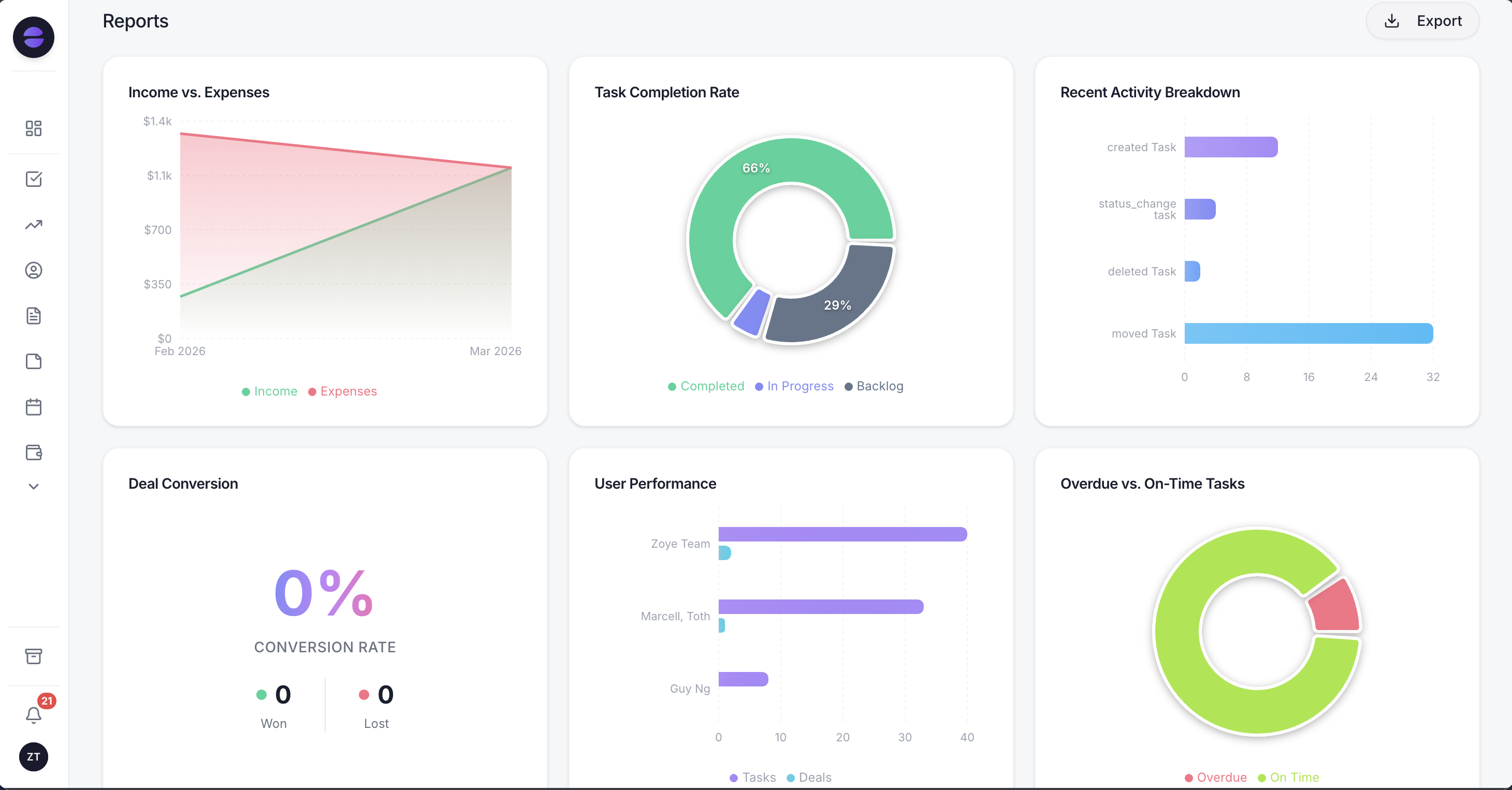 Zoye reports show where leads came from and what happened next, so a WhatsApp chat counts as business, not just as a message on a bill.
Honest limits. Connecting your own business WhatsApp number to Zoye is coming soon; today Zoye holds the WhatsApp conversations with your leads. Zoye does not send SMS and does not run ads. If you need WhatsApp inside your own app, Twilio or another API provider is the right tool.
Pricing (as of November 2026, per month, with the per-month price billed yearly in brackets): the entry plan, Almost Free, costs $5 ($4), covers one person and includes the core tools, the Google integrations and 15 AI prompts a month, but no automations. Teams pick from Starter at $29 ($23) with room for 5 members, Growth at $59 ($47) with 10, and Scale at $119 ($95) with 30; larger setups get a Customize quote. Almost Free and Starter cover the core tools without automations; the WhatsApp automations and payments in the chat start on Growth, which includes 250 WhatsApp messages a month (Scale 500). Details are on the pricing page.
Ready to hand off the busywork?
Zoye brings AI-powered CRM, task management, and automation into one workspace.
Get StartedHow to keep a Twilio WhatsApp bill under control
Most of a Twilio WhatsApp bill is decided by choices you make before the first send: which category each message falls into, which country your customers are in, and whether chats start from ads. The checklist below cuts the bill without cutting what customers receive.
- Classify templates honestly and keep promotions separate. A booking confirmation is utility; an offer added to the same message can make Meta classify it as marketing at a far higher rate.
- Watch the 1,000 free service messages per number. If you run several numbers, each has its own allowance; if you run one busy number, budget for the replies above 1,000.
- Send fewer marketing templates, to people who asked for them. In high-rate markets, segmenting a list by interest saves more than any provider switch.
- Use click-to-WhatsApp ads for acquisition. Chats from ads opened on a phone and answered in time get up to 7 days without Meta's fee.
- Do not plan US promotions on WhatsApp. Marketing templates are not delivered there; use utility messages for genuine updates and another channel for promotions.
- Turn off add-ons you do not use. The engagement suite is charged per message after the first 1,000.
- Check the rate card every quarter. Meta can change rates on 1 January, 1 April, 1 July and 1 October.
- Count inbound traffic. If replies are a large share of your volume, a provider that does not charge inbound messages may cost less.
Related reading
- WhatsApp Business API pricing explained
- Best Twilio alternatives for WhatsApp and SMS
- WhatsApp Business Solution Providers compared
- Click-to-WhatsApp ads
If WhatsApp is where your customers start the conversation and the work after it is what slips, book a Zoye demo and bring a week of real chats to test against.