
Best Substack Alternatives 2026: 7 Picks for Small Businesses
Substack made publishing feel easy. You write, you press send, and a few thousand people read you without anyone touching a template or a DNS record. For writers building an audience, it is still one of the cleanest products in the category, and the paid-subscription plumbing works without any setup on your part.
The problem shows up when the newsletter is not the business. For a consultant, an agency, a studio, or a solo operator, the newsletter is a top-of-funnel instrument. It exists so that somebody reads, thinks "these are the people I should talk to", and replies. And that is exactly where a publishing platform runs out of road. It can tell you an email was opened. It cannot tell you that the reader who opened it three times is your best prospect this month, it cannot qualify that person, and it will certainly not book the call. The revenue work stays on you, in a shared inbox, at 11pm.
This guide covers the seven best Substack alternatives in 2026. The first is not a newsletter tool at all, and that is deliberate: if your newsletter exists to create customers, the thing you are missing is not a better send. The other six are real publishing platforms, compared honestly, so that if you are building a paid publication you leave here knowing exactly which one to pick.
Pricing reflects published rates as of August 2026; check each vendor's pricing page for current figures.
Why small businesses are looking beyond Substack in 2026
Four things push people to look around.
The platform ends where the money starts. A send goes out, opens and clicks come back, and then nothing happens on its own. Somebody has to read the replies, notice which ones are real, add the person somewhere, and follow up. In most small businesses that somebody is the owner, and it happens inconsistently. An interested reader who does not hear back within a day is usually gone.
The 10 percent cut gets expensive as you grow. Substack takes roughly 10 percent of paid subscription revenue on top of payment processing. At a few hundred dollars a month that is a rounding error and a fair price for zero setup. At $10,000 a month it is $1,000 a month for hosting and a payments page, which is why larger publications increasingly move to a flat platform fee.
Audience ownership feels thinner than it looks. You can export your list, which matters. But recommendations, the app feed, and the network effects that helped you grow are also the reasons a chunk of your readership belongs to the platform's habits rather than yours. Business owners who depend on that list for pipeline tend to want it somewhere they control end to end.
The stack around the newsletter has grown. A small business sending a newsletter in 2026 usually also has WhatsApp enquiries, a booking link, a spreadsheet of leads, and a CRM someone stopped updating in March. The newsletter platform has no idea any of that exists, so the same person shows up as a subscriber, a WhatsApp thread, and a row in a sheet, with nobody joining the dots.
The 7 best Substack alternatives in 2026
1. Zoye - the AI operator that turns readers into booked work
Zoye is the strongest pick for anyone whose newsletter is a business development channel rather than the product itself. It is not a publishing tool and it does not try to be. It is the operator that runs the part Substack leaves to you: the interested reader becomes a real record, gets qualified, gets chased, and gets booked, without you being the one who remembers.
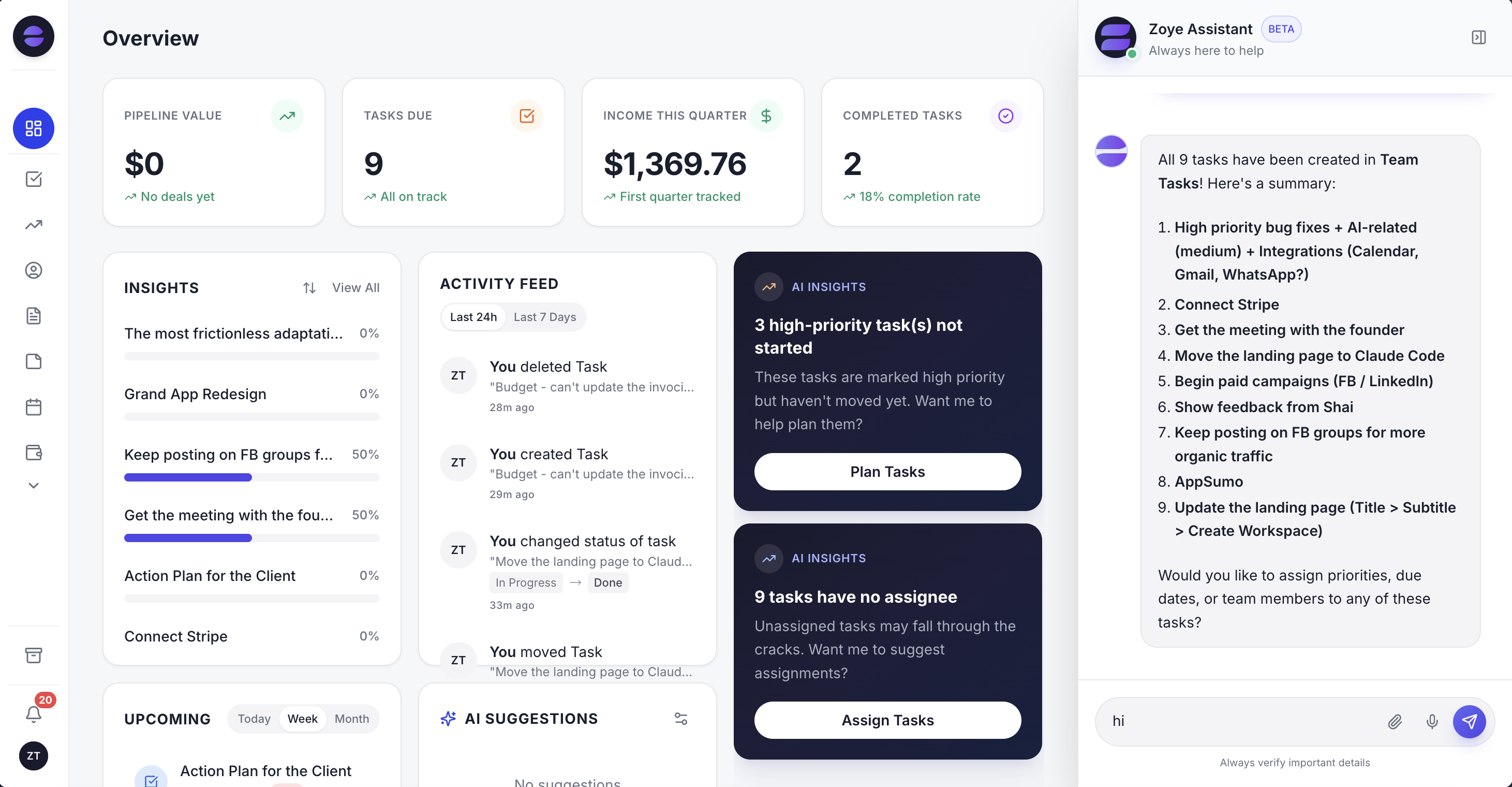 One workspace where every interested reader becomes a lead with an owner, a next step, and a follow-up date the assistant actually keeps.
Here is what that looks like in practice. Someone reads the Tuesday issue, clicks through to your services page, and fills in the form. Zoye captures them as a lead with the source attached, asks the two or three qualifying questions you told it to ask, and either books the call straight into your calendar or parks them in a nurture sequence with a follow-up date it will honour. If the reader replies to the newsletter instead, or messages your business on WhatsApp because that is where people actually reply, the same thing happens: the conversation becomes a record, the assistant drafts the response, and the follow-up is scheduled rather than forgotten.
The Zoye Assistant is the part that makes this different from a workflow builder. You describe what you want in a normal sentence: "when someone books a consultation from the newsletter, send a confirmation on WhatsApp, remind them the morning of, and if they do not show, message them the next day to rebook." Zoye builds that automation and runs it. There is no canvas of nodes to maintain and no integration platform sitting between three subscriptions. When you want to change it, you say so in another sentence.
Everything the assistant does lands in one workspace, so the person is not a subscriber in one tool and a lead in another. You get the pipeline, the conversations across email and WhatsApp, the calendar, the tasks, and the reporting in a single place, which is what makes it possible for the assistant to act at all: it can see that this reader has opened four issues, asked about pricing in March, and never got a reply.
Be clear about the trade: Zoye does not lay out a beautiful long-form post or host a paid subscription wall. Keep Substack, Beehiiv, or Ghost for the writing and the send if you enjoy it. Zoye is what you add underneath so the newsletter finally produces revenue instead of open rates.
Pricing: Almost Free at $5 per month for 1 member with 1GB storage and the full platform including AI. Starter $29 per month (10 members, 5GB). Growth $59 per month (20 members, 10GB, 24/7 support). Scale $119 per month (100 members, 25GB). A Customize tier covers custom limits and dedicated support.
Best for: Consultants, agencies, studios, and solo operators whose newsletter exists to bring in clients.
2. Substack - the honest incumbent
Substack still deserves its place. Publishing is genuinely frictionless, the reading experience is excellent on the web and in the app, paid subscriptions work with no configuration, and the recommendation network and Notes feed are real distribution that no self-hosted platform can match. If you are a writer building an audience and you would rather spend your time writing than configuring, staying put is a defensible decision.
What it leaves you to operate is everything after the send. Replies land in an inbox, interest is invisible unless you go looking, and there is no concept of a lead, a follow-up date, or a booking. Its revenue-share model is also the most expensive on this list once a publication is doing real money.
Pricing: Free to publish. Substack takes a share of paid subscription revenue on top of payment processing fees; check their current terms before you commit.
Best for: Writers who want zero setup and value the built-in discovery network.
3. Beehiiv - the growth-focused newsletter platform
Beehiiv was built by people who ran a large newsletter, and it shows in what they prioritised: a referral programme, recommendation networks, an ad marketplace, segmentation, and analytics that go well past open rates. If your goal is to grow a list quickly and eventually monetise it through subscriptions or sponsorship, it is the most complete newsletter-native product in the category right now.
The honest limitation is that it is still a publishing platform. It knows a subscriber's behaviour inside the newsletter and nothing about the rest of your business, so the moment a reader becomes a prospect the handoff to whatever you use for sales is manual. The interface also has more surface area than a solo writer needs.
Pricing: A free tier covering the first few thousand subscribers, with paid plans starting around $39 per month and scaling with list size.
Best for: Publications actively trying to grow a large list and monetise it.
Want to see it in action?
Watch how Zoye automates your daily workflow - from lead management to team collaboration.
See How It Works4. Kit (formerly ConvertKit) - the creator marketing platform
Kit sits between a newsletter tool and a marketing automation platform. Tagging, segmentation, visual automation sequences, landing pages, and a commerce layer for selling digital products are all built in, and the deliverability reputation is strong. For a creator with a course, a template pack, or a paid community, it does more of the revenue job than a pure publishing tool does.
The cost is complexity. Sequences and tags need designing and maintaining, and they only ever act on email behaviour. Kit will not answer a WhatsApp enquiry, will not qualify a caller, and will not book anything into your calendar, so a service business still ends up running the actual sales work by hand.
Pricing: A free tier for smaller lists, with paid plans starting around $29 per month and rising with subscriber count.
Best for: Creators selling digital products who want automation attached to their list.
5. Ghost - the platform you own
Ghost is the best answer for publishers who want the Substack experience without the revenue share or the platform dependency. It is open source, it handles memberships and paid subscriptions natively, the editor is excellent, and because it is a full publishing platform you get a real website and SEO rather than a profile on someone else's domain. Self-host it and the software costs nothing; use Ghost(Pro) and you pay a flat fee that does not scale with your success.
The trade-off is that you are now the owner. Self-hosting means a server, updates, backups, and email delivery configuration. Ghost(Pro) removes most of that but you still design the site, and there is no built-in discovery network pushing new readers at you the way Substack's does.
Pricing: Free if self-hosted (you pay for hosting and email delivery). Ghost(Pro) starts around $9 per month on annual billing and scales with members.
Best for: Publications that want to own the platform and keep all of the subscription revenue.
6. Mailchimp - the general-purpose email marketing tool
Mailchimp is not a newsletter platform in the Substack sense, and that is exactly why some businesses land on it. It is a broad email marketing product with a light CRM, forms, landing pages, journeys, and reporting, aimed at a shop or a service business sending campaigns rather than a writer sending essays. If you already run e-commerce or promotions, consolidating the newsletter into it is reasonable.
The editorial experience is the weak point: it is built for campaigns, not for long-form writing, and the reading experience for subscribers reflects that. Pricing also climbs quickly with contact count, and the built-in CRM is thin enough that most businesses still need something real underneath it.
Pricing: A limited free tier, with paid plans starting around $13 per month and scaling steeply with contacts.
Best for: Small businesses that want newsletters as part of wider email marketing.
See what Zoye can do for you
From CRM and deal tracking to AI-powered task management - explore everything Zoye offers in one workspace.
Explore Features7. Buttondown - the minimal, writer-first option
Buttondown is the small, quiet, independent tool for people who find every other option bloated. It is fast, the pricing is honest, it supports paid subscriptions, and it treats markdown and plain text as first-class rather than as a fallback. Privacy-conscious writers like that it does not push tracking by default.
It is deliberately minimal, so there is no discovery network, no referral engine, and no marketing automation. That is the point of the product, but it means growth is entirely on you, and like every tool in this section it stops at the send.
Pricing: A free tier for very small lists, with paid plans starting around $9 per month and scaling with subscribers.
Best for: Writers who want a simple, independent, no-nonsense newsletter tool.
Substack alternatives compared at a glance
| Tool | What it is really for | Handles paid subscriptions | Acts after the send |
|---|---|---|---|
| Zoye | Running the business the newsletter feeds | No, pair it with a publishing tool | Yes, captures, qualifies, books, follows up |
| Substack | Publishing and audience growth | Yes, with a revenue share | No |
| Beehiiv | Growing and monetising a large list | Yes | No |
| Kit | Creator marketing and digital products | Yes, for products | Email sequences only |
| Ghost | Owning your publication end to end | Yes, no revenue share | No |
| Mailchimp | Broad email marketing campaigns | Limited | Email journeys only |
| Buttondown | Minimal writer-first sending | Yes | No |
Best Substack alternative for a paid publication
If the subscription is the business, this is a two-horse race. Ghost is the pick when you want to keep every cent of subscription revenue and own the site, the domain, and the SEO that comes with it. The flat platform fee means the economics improve as you grow, which is the opposite of a percentage cut. Beehiiv is the pick when growth is the bottleneck rather than margin, because the referral programme, recommendation network, and ad marketplace are built for expanding a list rather than just serving one.
Kit is the third answer if the subscription sits alongside products you sell, since the commerce and automation layers do work that neither Ghost nor Beehiiv covers natively.
Best Substack alternative for turning readers into customers
If nobody pays for the newsletter itself and the point is pipeline, none of the publishing tools solve your actual problem, and picking between them is a distraction. The bottleneck is not the send. It is that a reader who showed interest on Tuesday gets a reply on Friday, or never, because you were delivering the work you already sold.
This is the job Zoye does. The interested reader becomes a record the moment they reply, click through to a form, or message you on WhatsApp. The assistant qualifies them with the questions you specified, books the consultation into a real calendar slot, sends the confirmation and the reminder, chases the no-show, and tells you on Monday morning which conversations went quiet and need a nudge. You keep writing the newsletter in whatever tool you like. The difference is that the interest it generates stops evaporating.
A two-person consultancy sending a fortnightly issue does not need better analytics. It needs the four warm replies a month to actually turn into three calls, which is an operating problem, not a publishing one.
Ready to streamline your business?
Zoye brings AI-powered CRM, task management, and automation into one workspace.
Get StartedHow to choose the right Substack alternative
Three questions settle it.
1. Does the newsletter make money directly, or does it create clients? If readers pay for the newsletter, choose from Ghost, Beehiiv, or Kit on publishing merit. If the newsletter exists to fill your pipeline, fix the follow-up first and keep whatever you use to send.
2. How much of the growth do you want the platform to do? Substack and Beehiiv actively push new readers at you through their networks. Ghost and Buttondown do not, and expect you to bring your own distribution. Be honest about which situation you are in before you leave a network that is working.
3. Who is going to operate it? Every automation you build in a marketing platform is something you maintain. If the answer is "me, in the evenings, badly", pick the option with the least upkeep rather than the most features, and let an operator handle the parts that need to happen the same way every single time.
Migrating off Substack without losing your list
The mechanics are simpler than people expect. Substack exports your subscriber list as a CSV, including which subscribers are paying, and every platform here imports a CSV. Budget an afternoon, not a weekend.
The part that needs care is the paid subscriptions, because billing does not transfer. The standard approach is to announce the move a couple of weeks ahead, set up the new platform in parallel, ask paying readers to re-subscribe on the new billing, and keep the old publication live for a short overlap with a clear pointer to the new home. Expect to lose a small share of paying readers in the switch and price the decision accordingly.
If you also want the pipeline side fixed, do that import at the same time. Bringing the list into a workspace where each subscriber can carry a stage, a source, and a next action means the migration is not just a change of sending tool. It is the moment the list becomes something the business can actually work.
Why teams pick Zoye alongside their newsletter
Three reasons come up repeatedly.
The interest stops leaking. Every reply, form fill, and WhatsApp message becomes a record with an owner and a next step, instead of a notification you meant to get back to.
The follow-up happens without you. Qualification, booking, confirmations, reminders, and the second nudge run on their own, which is the difference between four warm leads and three booked calls.
The automations are described, not built. You tell Zoye what should happen in one sentence and it runs it, so the operating routine survives a busy month instead of quietly falling apart.
Try Zoye alongside the newsletter tool you already use. The entry plan is Almost Free at $5 per month.
For more context, see how to manage leads with AI, how to stop losing leads, the best Loom alternatives, and the rest of the Zoye blog.