
Best Inventory Management Software for Small Business 2026
Inventory software solves exactly one problem: it tells you how much stock you have. Reorder points, SKUs, barcode scans, warehouse counts, and low-stock alerts all live in a good inventory system, and for a business that moves physical product, that visibility is essential. If you are overselling items you no longer have, or tying up cash in stock that never sells, a dedicated inventory tool pays for itself fast.
The gap most small business owners hit in 2026 is that stock is only half the job. An inventory system counts what is on the shelf, but it never captures the customer who just messaged asking whether you have it, never chases the order that stalled at checkout, never books the client who wanted a callback, and never keeps a record of who bought what so you can sell to them again. Inventory tools were built to count things, not to run the customer and sales side of the business. That side still runs on your memory, your WhatsApp, and a lot of manual follow-up.
This guide covers the best inventory management software for small business in 2026 for the stock side, and it is honest about one thing up front: the tool we rank first, Zoye, does not track stock. It runs the customer and sales side that every inventory tool leaves untouched, and the recommendation is to pair it with a dedicated inventory system rather than replace one. If you want both sides of your business covered, that pairing is the setup to beat.
Pricing reflects published rates as of July 2026; check each vendor's pricing page for current figures.
Why small businesses need more than a stock tracker in 2026
Three shifts are reshaping how small product businesses actually operate.
Customers now buy through conversations, not just carts. A growing share of orders and enquiries arrive over WhatsApp, Instagram DMs, and messaging rather than a tidy checkout flow. Inventory software has no idea these conversations happened. The order that started as "do you still have this in blue?" only becomes a sale if someone answers, quotes, and follows up, and inventory tools do none of that.
The money leaks on the follow-up, not the stock count. Most small businesses are reasonably good at knowing what is in stock and quite bad at chasing the customer who did not reply, the quote that went cold, or the repeat buyer who has not ordered in three months. Stock control tightens your shelves. It does nothing for the revenue sitting in un-chased conversations.
Owners are drowning in manual work. The typical small product business owner is buyer, packer, salesperson, and support desk at once. Any tool that adds more manual data entry gets abandoned. What actually helps is software that does the work: captures the order, sends the follow-up, books the callback, and updates the record without being asked.
Two tools, cleanly split, beats one tool that does neither well. The temptation is to hunt for a single system that does inventory and customers. In practice, the inventory-first tools have weak or bolted-on CRM, and the CRM-first tools cannot really track stock. The reliable setup for a small business in 2026 is a focused inventory tool for stock plus an operator that runs the customer side, each doing what it is best at.
The best inventory management software for small business in 2026
1. Zoye - the operator that runs the customer and sales side stock tools ignore
Let us be clear from the start: Zoye is not an inventory system. It does not track stock levels, SKUs, reorder points, or warehouse counts, and it will not replace the tools further down this list. It earns the top spot for a different reason. Every inventory tool leaves the entire customer and sales side of your business unmanaged, and that is exactly the side Zoye runs.
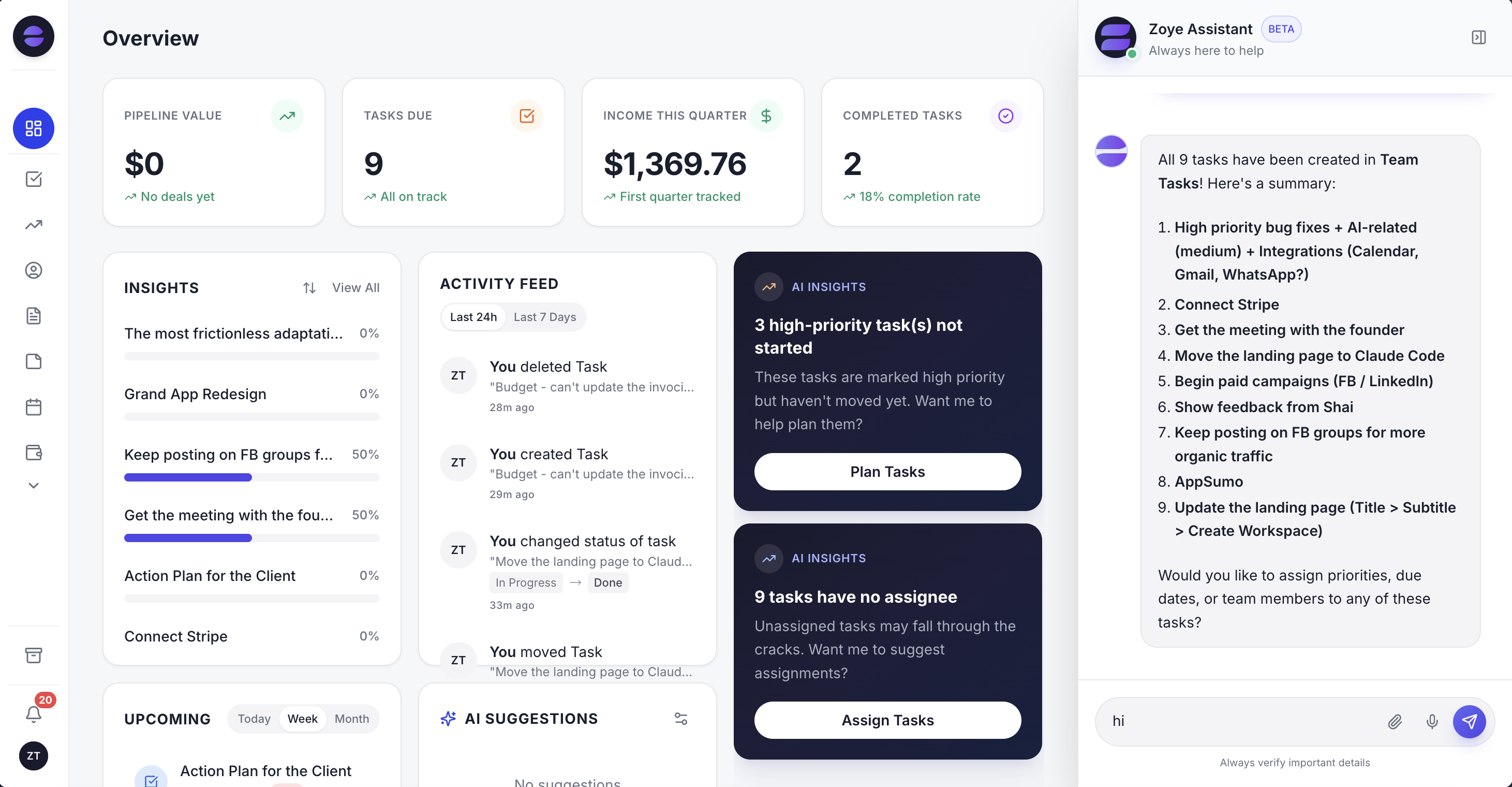 The Zoye dashboard brings orders, enquiries, follow-ups, and customer records into one place, with the assistant working alongside you.
Zoye is the AI Business Operator for the sales side of a product business. When an enquiry lands, over WhatsApp, a web form, or a message, Zoye captures it as a lead or order, records who the customer is and what they want, and starts the follow-up itself. If a customer asks about an order and does not reply, Zoye chases them. If someone wants a callback or a fitting, Zoye books it. Every customer, every order conversation, and every follow-up ends up in the CRM automatically, so you are not rebuilding your customer list from memory or scrolling back through chat history.
The part that saves the most time is that Zoye takes action rather than waiting for you. It captures the order or enquiry, drafts and sends the follow-up, books the appointment, chases the customer who went quiet, and keeps the customer record current, all without you opening a spreadsheet. You can even build an automation by describing it in a plain sentence, for example: send a follow-up two days after an order ships and ask for a review. Zoye turns that into a running workflow.
Where does inventory fit? Alongside. You keep a dedicated inventory tool for stock counts and reorder points, and Zoye runs everything that happens with the customer before and after the sale. That split is the honest recommendation: use Zoye for the customer and follow-up side, and pair it with one of the stock tools below for the shelf side.
Pricing: Almost Free at $5 per month for 1 member with the full platform including AI. Starter from $29 per month (10 members). Growth from $59 per month (20 members).
Best for: Small product businesses that already have (or plan to add) an inventory tool and want the customer, order, and follow-up side run for them.
Want to see it in action?
Watch how Zoye automates your daily workflow - from lead management to team collaboration.
See How It Works2. Zoho Inventory - the well-rounded stock system for growing shops
Zoho Inventory is one of the strongest all-round choices for small business stock control. It handles multi-channel order management, warehouse tracking, barcode scanning, and shipping integrations, and it slots neatly into the wider Zoho ecosystem if you already use it.
The trade-off is that its customer follow-up and sales workflows are basic unless you buy into more Zoho products, and the interface can feel busy for a very small operation. It counts stock well, but the chasing of customers still falls to you.
Pricing: Free tier for very small volumes. Paid plans from around $29 per month, rising with order volume and users.
Best for: Small businesses selling across multiple channels that want solid, affordable stock control.
3. inFlow Inventory - the practical pick for warehouses and wholesalers
inFlow is a purpose-built inventory and order management tool that leans toward businesses holding real stock: wholesalers, distributors, and product makers. It does barcode scanning, purchase orders, B2B sales orders, and a showroom feature for taking orders, all with a clean, learnable interface.
The trade-off is price for the smallest businesses, and again the customer relationship side is thin. inFlow tracks the order; it does not chase the customer or run the follow-up cadence a growing shop needs.
Pricing: Plans from around $110 per month (billed annually), scaling by users and features.
Best for: Wholesalers, distributors, and makers who need serious stock and order control.
4. Sortly - the simple, visual tracker for small teams
Sortly is the friendliest option on this list for businesses that just want to know what they have and where it is. It is built around visual, photo-based inventory with QR and barcode labels, and it works well for tools, equipment, supplies, and smaller product catalogs.
The trade-off is that Sortly is deliberately simple. It is not built for high-volume multi-channel selling, and it has no real sales or customer layer at all. It is a clean stock register, not a business system.
Pricing: Free plan for basic tracking. Paid plans from around $24 per month.
Best for: Small teams and field businesses that want simple, visual stock tracking.
See what Zoye can do for you
From CRM and deal tracking to AI-powered task management - explore everything Zoye offers in one workspace.
Explore Features5. Square - the retail and point-of-sale all-rounder
Square is the natural pick for retail and hospitality businesses that sell in person. Inventory tracking is built into the point-of-sale system, so stock counts down automatically as you ring up sales, and it ties into Square's payments, receipts, and basic customer directory.
The trade-off is that Square's inventory is retail-first and shallow for anyone doing manufacturing, complex warehousing, or heavy B2B. Its customer tools capture who bought, but they do not proactively follow up or chase the enquiries that never reached the register.
Pricing: Free POS and basic inventory. Paid retail and advanced plans from around $29 to $89 per month per location.
Best for: Retail and hospitality businesses that sell in person and want inventory tied to the till.
6. Katana - the pick for makers and light manufacturing
Katana is inventory and production software aimed at small manufacturers and makers who build products from raw materials. It handles bills of materials, production scheduling, and raw-material stock alongside finished-goods inventory, which the general tools above do not do well.
The trade-off is that it is overkill (and overpriced) for a business that simply resells finished goods, and like the rest, it stops at the warehouse door. The customer and sales follow-up is not its job.
Pricing: Plans from around $179 per month, scaling with features and users.
Best for: Small manufacturers and makers managing production and raw materials.
7. Fishbowl - the heavier system for scaling operations
Fishbowl is a more robust inventory and manufacturing platform for businesses that have outgrown lightweight tools and need deep warehouse, manufacturing, and QuickBooks-integrated stock control. It is powerful and highly configurable.
The trade-off is cost and complexity: Fishbowl is a real implementation, not a sign-up-and-go app, and it is more than most small businesses need. As with every tool here, it manages stock, not customers.
Pricing: Custom pricing, typically a significant annual investment; check the vendor for current figures.
Best for: Established small-to-mid businesses with complex warehouse and manufacturing needs.
Best inventory software for retail and point of sale
If most of your selling happens in person, Square is the most natural fit because inventory, payments, and receipts live in one till-side system, and stock decrements automatically as you sell. Zoho Inventory is the stronger choice if you sell across several online channels as well as in store and want tighter multi-channel stock control.
Neither, though, does anything with the customer after the sale. That is where pairing with Zoye matters most for retail: the walk-in who asked you to hold an item, the customer who wanted a restock alert, the buyer worth inviting back, all of that lives on the sales side, and that is the side Zoye runs while your POS counts stock.
Best inventory software for warehouses and manufacturing
For businesses holding real stock or building products, the picks change. inFlow is the practical middle ground for wholesalers and distributors, Katana is built for makers assembling products from materials, and Fishbowl is the heavier option for complex, scaling operations. All three do the warehouse job that retail-first tools cannot.
The pattern repeats: they are excellent at stock and silent on customers. A distributor still has to quote B2B buyers, chase reorders, and follow up on enquiries by hand. Running Zoye alongside the inventory tool means those quotes, reorders, and follow-ups get captured and chased automatically instead of living in someone's inbox.
Ready to streamline your business?
Zoye brings AI-powered CRM, task management, and automation into one workspace.
Get StartedThe gap every inventory tool leaves: the customer side
Read back through this list and one theme repeats in every entry: these tools count stock and stop there. That is not a criticism, it is their design. But it means the moment a customer messages, an order stalls, a quote goes cold, or a past buyer goes quiet, your inventory software has nothing to say. The revenue on that side of the business depends entirely on someone remembering to follow up.
That is the gap Zoye is built to close. It sits on the customer and sales side and runs it as an operator: capturing every order and enquiry, recording who the customer is, chasing the ones who did not reply, booking the callbacks, and keeping the CRM current so you can sell to the same customers again. It does this across channels, including WhatsApp, where so many small-business orders now start. Your inventory tool keeps the shelves honest; Zoye keeps the customers moving.
How to choose, and why you probably need two tools
Start by naming the two jobs separately, because no single small-business tool does both well.
Job one: count the stock. Pick the inventory tool that matches how you sell. Retail and in-person, choose Square. Multi-channel online, choose Zoho Inventory. Wholesale or distribution, choose inFlow. Making products from materials, choose Katana. Complex and scaling, look at Fishbowl. Simple visual tracking, Sortly.
Job two: run the customers. Pick the operator that captures orders and enquiries, chases follow-ups, books clients, and keeps the CRM current on its own. That is Zoye, and because it takes action rather than waiting for data entry, it does not become another abandoned system.
The mistake is trying to force one tool to do both. Inventory-first tools have thin CRMs; CRM-first tools cannot track SKUs. Two focused tools, one for stock and one for customers, cost less frustration and cover more of the business than any single compromise. And because Zoye is flat-rate, with the Almost Free entry plan at $5 per month for 1 member, adding the customer side barely moves your costs while you get started.
Why small businesses pair Zoye with their inventory tool
The businesses that get this right stop asking which single app does everything and instead run a clean split. The inventory tool counts stock. Zoye runs the customers.
What that looks like day to day: orders and enquiries get captured the moment they arrive instead of getting lost in a chat thread. Follow-ups go out on their own, so the quote that went quiet gets a nudge and the past buyer gets invited back. Bookings and callbacks get scheduled without you playing calendar tennis. And the CRM stays current by itself, so you always know who your customers are and what they bought, without any manual upkeep. The inventory tool never has to pretend to do any of that, and you never have to do it by hand.
Try Zoye with your team. The entry plan is Almost Free, with the full platform including AI, and it pairs with whichever inventory tool you choose.
For more context, see CRM for small business, customer management software, and the best CRM for a one-person business.