Late payments are the quiet tax on every small business. You did the work, you sent the invoice, and now the money is sitting in someone else's account while your own cash flow tightens. The awkward part is the chasing. Nobody starts a business because they enjoy sending "just following up on that invoice" messages, and most owners put it off because it feels rude, until the overdue pile is big enough to hurt.
Email is where most reminders go to die. It lands in a crowded inbox, gets marked "deal with later," and is quietly forgotten. WhatsApp is different. It is a channel your customer already checks dozens of times a day, and a short, friendly message there gets read in minutes and answered far more often than a formal email. Used well, WhatsApp turns invoice chasing from a dreaded confrontation into a light, routine nudge that gets you paid faster and keeps the relationship intact.
This guide covers the practical mechanics: the reminder cadence that actually works, the tone that gets a reply instead of a grudge, a full set of copy-and-paste templates for every stage from pre-due to final notice, the compliance basics so you stay inside Meta's rules, and when to stop. At the end we show how Zoye does the whole thing for you, so you never have to personally remember to chase anyone again.
Pricing reflects published rates as of July 2026; check each vendor's pricing page for current figures.
Why WhatsApp is the right channel for payment reminders
Three things make WhatsApp uniquely good for getting invoices paid.
It gets read. Open rates on WhatsApp sit far above email. A payment reminder that would be buried under forty other unread emails is seen within minutes on WhatsApp. For a message whose entire job is to be noticed, that difference is everything.
It feels personal, not institutional. An email from accounts@ reads like a system. A WhatsApp message reads like a person you know reaching out. That human tone is exactly what you want early in the chase, because it makes paying feel like doing a favour for someone rather than satisfying a faceless creditor.
It shortens the loop. Because customers reply to WhatsApp quickly and casually, you often get an instant answer: "paying today," "sorry, missed it, sending now," or "can I pay next week?" That information is gold. It lets you stop chasing the ones who are about to pay and focus on the ones who are genuinely stalling, instead of firing the same reminder at everyone.
The one rule that makes all of this work: the customer has to have agreed to hear from you on WhatsApp. Which brings us to compliance.
The rules first: staying compliant
Before you send a single reminder, get the compliance basics right. They are simple and they protect your number from being blocked.
Get opt-in. The customer must have agreed to be contacted on WhatsApp. In practice this is easy: they messaged you first, they ticked a box at checkout, or they gave you their number for order and billing updates. Never message people who never agreed to hear from you, and never use purchased lists.
Understand the 24-hour window. WhatsApp Business lets you reply freely for 24 hours after a customer's last message. Outside that window, you can only start a conversation with a pre-approved message template. Payment reminders almost always fall outside the window, so you will typically send them as approved templates. Meta approves invoice and billing reminders as legitimate service messages, so getting a template approved for this is routine.
Keep it a service message, not a marketing blast. A reminder about a specific invoice the customer owes is a service message and is welcomed. Do not bolt marketing onto it. Mixing "you owe us money" with "check out our new offer" is the fastest way to get reported.
Always allow an opt-out. Give people a way to say "stop." Honour it immediately. One clean opt-out line protects your sender reputation more than any clever copy.
Get these four right and WhatsApp stays a reliable channel. Ignore them and you risk your business number, which is a far bigger problem than one late invoice.
Want to see it in action?
See Zoye catch a new lead, answer on WhatsApp and set up the follow-up, all from one message.
See How It WorksThe payment-reminder cadence that works
The single biggest mistake owners make is sending one reminder, feeling awkward, and giving up. The second biggest is sending ten identical ones. The sweet spot is a short, escalating sequence where each message has a distinct job and tone. Here is a cadence that gets results without burning goodwill.
1. Pre-due heads-up (3 days before due date). A friendly, no-pressure note that the invoice is coming up. This alone prevents a huge share of late payments, because most late payments are not refusals, they are forgetfulness.
2. Due-today note (on the due date). A short, neutral reminder that payment is due today, with the link right there. Easy to action in one tap.
3. Gentle nudge (3 days overdue). Warm and understanding. Assume the best: they got busy, it slipped. Give them an easy out in case it has already been paid.
4. Firm reminder (14 days overdue). The tone shifts from casual to businesslike. Still polite, but clear that this now needs attention, with a specific ask.
5. Final notice (30 days overdue). Direct and professional. State the amount, the overdue period, and the next step if it stays unpaid. This is the last automated touch before you switch to a phone call or a formal process.
The escalation matters. Early messages are soft because most people just forgot and a gentle nudge is all it takes. Later messages get firmer because the small group still not paying at 30 days needs a clearer signal. Sending the "final notice" tone on day one is aggressive and damages relationships; sending the "friendly nudge" tone on day 45 gets ignored. Match the tone to the stage.
WhatsApp payment reminder templates for every stage
Here are ready-to-use templates for each stage. Replace the merge fields with the real details. Keep your business name warm and human. In these examples, fields in braces like {first_name} are placeholders that get filled in automatically with each customer's real details.
Stage 1 - Pre-due heads-up (3 days before):
Hi {first_name}, just a friendly heads-up that invoice {invoice_number} for {amount} is due on {due_date}. No action needed yet, but here is the link if it is handy to sort now: {payment_link}. Thanks so much for working with us. Reply STOP to opt out of billing reminders.
Stage 2 - Due today:
Hi {first_name}, a quick reminder that invoice {invoice_number} for {amount} is due today. You can pay in one tap here: {payment_link}. Thank you, we really appreciate it.
Stage 3 - Gentle nudge (3 days overdue):
Hi {first_name}, hope you are having a good week. Invoice {invoice_number} for {amount} was due on {due_date} and looks to be outstanding. It may well have slipped through, it happens to all of us. Here is the link when you get a moment: {payment_link}. If it has already crossed with your payment, please ignore this and thank you.
Stage 4 - Firm reminder (14 days overdue):
Hi {first_name}, following up on invoice {invoice_number} for {amount}, which is now 14 days overdue. Could you let me know when we can expect payment, or pay directly here: {payment_link}? If there is an issue with the invoice, just tell me and I will sort it out. Thanks for your prompt attention.
Stage 5 - Final notice (30 days overdue):
Hi {first_name}, this is a final reminder that invoice {invoice_number} for {amount} is now 30 days overdue. Please arrange payment within the next 5 days using this link: {payment_link}. If payment is not received by {final_date}, we will need to pause further work and follow up through our standard process. If you have already paid or want to discuss a payment plan, please reply and we will help. Thank you.
A few notes on using these. Keep each message to a few lines; long paragraphs get skimmed. Always include the payment link so the reply to your message can be the payment itself. And personalise the first line where you can, because "Hi {first_name}" plus a real, specific invoice reference reads as human attention, not an automated dunning notice.
See what Zoye can do for you
CRM, deals, tasks and your Instagram, Facebook and WhatsApp automations in one workspace. Just ask Zoye and it sets any of it up for you.
Explore FeaturesTone: how to chase without damaging the relationship
The reason owners hate chasing payments is fear of seeming pushy and losing the client. The fix is not to avoid chasing, it is to chase in a way that protects the relationship. A few principles do most of the work.
Assume forgetfulness, not refusal. Nine times out of ten, an overdue invoice is an oversight, not a decision. Writing every early reminder from that assumption ("this may have slipped") keeps the tone warm and gives the customer a graceful way to pay without feeling accused.
Make paying effortless. Every reminder should carry the payment link. The goal is that the easiest possible response to your message is simply to pay, in one tap, right there in the thread. Friction is your enemy; every extra step is a reason to defer.
Stay specific and brief. "Following up" is vague and easy to ignore. "Invoice {invoice_number} for {amount}, due {due_date}" is concrete and hard to wave away. Specifics signal that you are organised and tracking it, which quietly encourages payment.
Escalate the firmness, never the warmth. As the sequence progresses you get more direct about the ask and the consequences, but you never get rude. A firm, professional final notice can still be courteous. Losing your temper in writing is the one thing that genuinely damages the relationship.
Give an easy out for the honest ones. A line like "if this has crossed with your payment, please ignore" costs nothing and saves the customer who paid yesterday from feeling wrongly chased. It keeps the goodwill of your best payers intact.
When to stop, and what to do next
An automated WhatsApp cadence is the right tool up to a point, and knowing where that point is keeps you from either giving up too early or nagging forever.
Stop the automated sequence at the 30-day final notice. Repeating the same reminders past that stage does not work; the customer has already seen five messages and another identical one just teaches them to ignore your number. When the final notice lapses, change the channel and the seriousness: a direct phone call to a human, a formal written demand on your letterhead, or handing the debt to a collections process, depending on the size of the invoice and the value of the relationship.
Two practical guardrails. First, set a clear internal cut-off so no invoice drifts indefinitely. An unpaid invoice with no next step is just a slow loss. Second, pause the sequence the instant a customer replies with a genuine reason ("cash flow is tight this month, can we split it?"). At that moment a template is the wrong response; a short human conversation about a payment plan recovers far more money than another automated nudge. The cadence exists to handle the forgetful majority automatically, so you have the time and goodwill to handle the genuine cases personally.
How Zoye handles this for you
Everything above works, but it still assumes someone is watching the calendar, sending each message at the right moment, tracking who replied, and stopping the sequence when an invoice gets paid. For a busy owner, that tracking is exactly the job that slips, which is why invoices go uncollected even when the templates are good. This is where Zoye changes the model.
Zoye is not another app you have to remember to open. It is an AI Business Operator that runs the chasing for you. You tell it how you want to handle payment reminders ("chase unpaid invoices on WhatsApp: a heads-up 3 days before, a nudge 3 days after, and a firm reminder at 14 days, then flag anything still unpaid at 30"), and it builds that sequence and runs it. No workflow builder to learn, no rules engine to configure. You describe the outcome and Zoye wires it up.
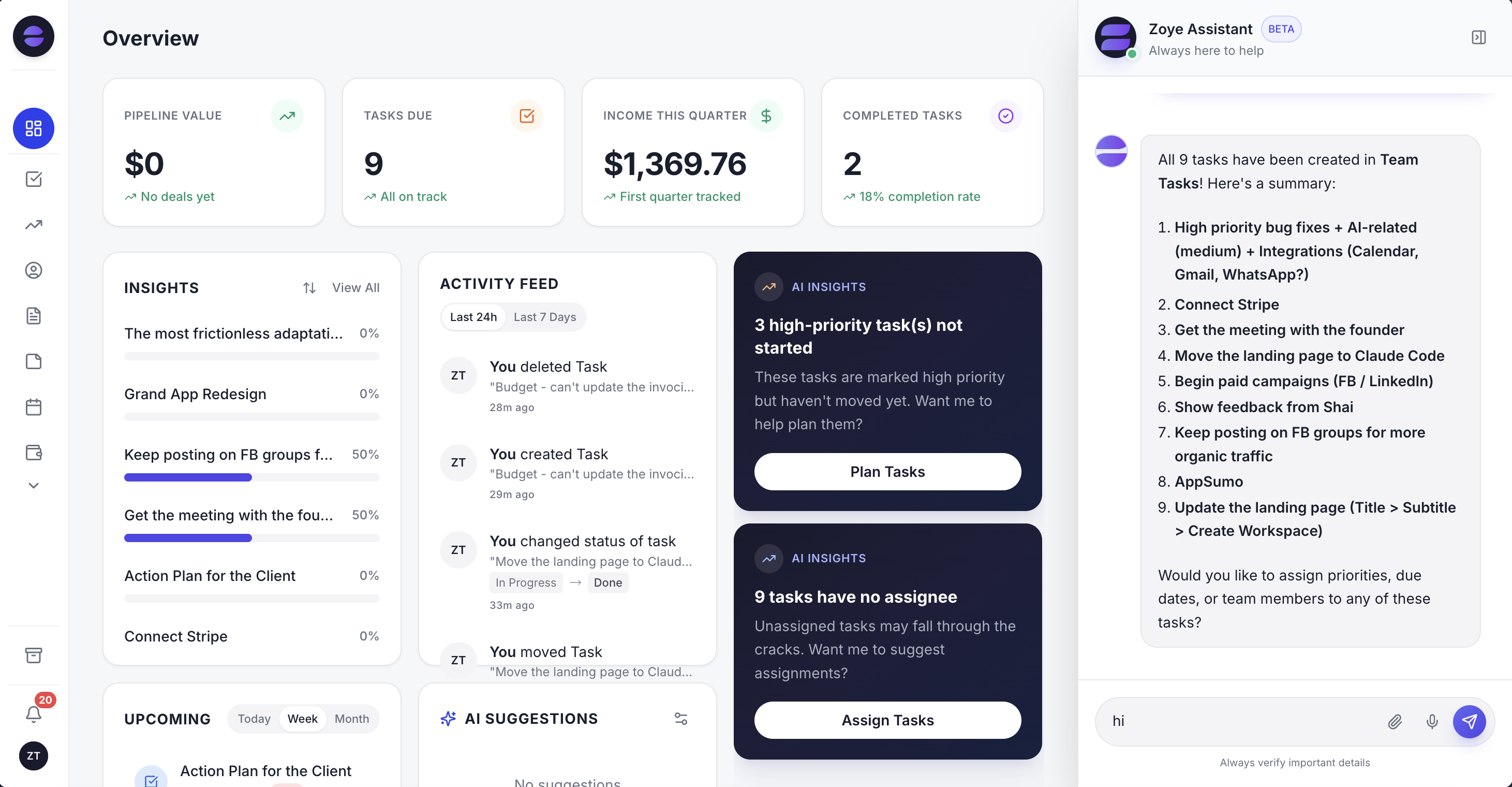 Zoye tracks every invoice, sends the WhatsApp reminders on schedule, and stops the moment a payment lands, so you get paid without doing the chasing.
From there it runs automatically. Zoye watches each invoice's due date and sends the right message at the right stage, with the invoice number, amount, due date, and payment link already filled in. It reads the replies: if a customer says "paying today," it notes it and holds the next reminder; if they ask for a payment plan, it flags the thread for you to handle personally instead of firing another template. The moment an invoice is marked paid, Zoye stops that sequence automatically, so nobody ever gets a reminder for money they already sent. And because Zoye centralises your customer conversations, the whole exchange lives on the contact record next to their deals and history, not lost in a personal phone.
The reason this matters is that the chasing stops depending on your willpower. The forgetful majority get nudged and pay, on time, without you thinking about it. The genuine cases get surfaced for a human touch. Your cash flow improves not because you finally got disciplined about sending reminders, but because you handed the discipline to an operator that never forgets. And because Zoye is a full workspace, the same operator that chases invoices also captures your leads, books your clients, updates your CRM, and reports on it all, so payment reminders are one job among many that simply get handled.
Pricing: Almost Free at $5 per month for 1 member with the core tools. Starter from $29 per month (10 members). Growth from $59 per month (20 members).
Best for: Small businesses and solo owners who want their invoices chased on WhatsApp automatically, without personally nagging anyone.
Ready to hand off the busywork?
Zoye brings AI-powered CRM, task management, and automation into one workspace.
Get StartedWhy teams pick Zoye
A few themes come up again and again.
It removes the willpower problem. Payment reminders fail not because owners lack templates but because they forget or feel awkward. Zoye sends them on schedule, every time, so getting paid stops depending on you remembering to chase.
It knows when to stop. Because Zoye watches replies and payment status, it holds reminders for customers who are about to pay and stops instantly when an invoice is settled, so you never annoy a good customer with a reminder they do not need.
It runs the whole business, not just the reminders. Zoye chases invoices and also captures leads, books clients, updates the CRM, and builds automations from what you describe, including over WhatsApp, so the reminders are part of a system that runs itself rather than one more app to babysit.
Try Zoye with your team. The entry plan is Almost Free, with the core tools.
For more context, see how to sell on WhatsApp, automated WhatsApp customer service, and WhatsApp appointment reminders.
See the six automations Zoye ships for this, and how each one stays inside WhatsApp's rules, on the WhatsApp Automations page.