
Business Operating System: What It Means in 2026
The phrase "business operating system" gets used two ways, and they are not the same thing. One is about people: a management framework, a meeting rhythm, a scorecard, a way of running the company that outlives whoever is in the room. The other is about software: the thing your business actually runs on, where the customer record lives, where the work sits, where the numbers come from when someone asks how the quarter is going.
This article is about the second one, and about a specific claim that gets made too easily. A lot of software now calls itself a business operating system. Most of it is a suite. The gap between the two is not feature count and it is not branding. It is whether a human being is still the part that carries information from one place to another.
An operating system, in the original computing sense, is not the biggest program on the machine. It is the layer that lets everything else assume a shared world: the same filesystem, the same memory, the same clock. Nothing above it has to negotiate with anything else about where things are. That is the useful part of the metaphor, and it is exactly the part that most business software fails at. Your CRM and your project tool and your invoicing app do not share a world. You are the shared world. You are the thing that knows the deal in one app is the client in another and the invoice in a third.
So the honest version of the question is not "which suite should I buy". It is "what would have to be true for my business to actually run on something".
Why the phrase is having a moment
Three things happened at roughly the same time.
The first is that the tool count in a typical small company stopped feeling clever and started feeling expensive. Consolidation pitches land now in a way they did not five years ago, because the people hearing them have personally re-typed the same phone number into three systems this month.
The second is that integration got easier and therefore less impressive. When connecting two apps was hard, connecting them was the product. Now that almost everything has an API and a connector marketplace, connection is table stakes, and the interesting question moved one level up: connected to do what, and who decides when it fires.
The third is that software can now take an action rather than just record one. For twenty years business tools were passive by design. They stored what you told them and waited. A system that can read what came in, decide what it means and make the change is a different kind of object, and it is the piece that makes the operating system metaphor stop being marketing.
Put those together and the category pressure is obvious. People are not shopping for another place to type. They are shopping for something that reduces how much typing exists.
Layer one: the records
Every business runs on a small set of durable facts. Who the people are. Which companies they belong to. What is being sold and at what stage. What was agreed, what was invoiced, what was paid. Which documents matter and which version is current.
These are the nouns. They change slowly, they outlive individual projects, and almost every argument inside a company is really an argument about them being wrong somewhere.
The failure at this layer is not that the records are missing. It is that they are duplicated. The same customer exists as a contact in one tool, a client folder in a drive, a row in a billing spreadsheet and a thread in an inbox, and no two copies agree. Nobody decided this; it accumulated. Each copy was created by someone doing something reasonable in the tool that was open at the time.
The test for this layer is embarrassingly simple. Pick a customer. Ask where their phone number lives. If the honest answer is "in a few places, and I would check two of them", the records layer is not solid, and nothing built on top of it will be either. Reports assembled from a fractured record layer are not analysis, they are averaging of guesses.
Layer two: the work that moves the records
Records on their own are inert. What makes a business a business is the work: the tasks, the stages, the meetings, the approvals, the messages that move a fact from one state to another. A lead becomes a qualified lead because someone had a conversation. A deal becomes won because someone sent a contract. An invoice becomes paid because someone chased it.
This layer is where most companies have decent software and still lose things, for one structural reason: the work usually lives in a different system from the records it changes. Tasks sit in a project tool that has never heard of the deal. The meeting lives in a calendar that does not know it was about a renewal. The chase message lives in an inbox that has no idea an invoice exists.
That separation is where the human integration layer gets born. When the work and the record are in different systems, somebody has to walk between them. That walking is invisible on any org chart and it is one of the largest hidden costs in a small company. It is also the first thing to be skipped when the week gets busy, which is why records go stale in exactly the weeks when they matter most.
The fix at this layer is not a better task manager. It is that the task and the deal are the same object seen from two angles. A task attached to a deal cannot silently drift out of sync with it, because there is nothing to drift from. This is the point in the article where an all-in-one workspace stops being a convenience argument and becomes a correctness argument. Linked records are not tidier. They are more likely to be true.
Want to see it in action?
Watch how Zoye automates your daily workflow - from lead management to team collaboration.
See How It WorksLayer three: the operator
Here is where most of the category stops, and where the interesting part starts.
Suppose the records are clean and the work is attached to them. You still have a passive system. It knows everything and does nothing. Every state change still waits for a person to notice that it should happen: that this lead has gone quiet, that this invoice is eleven days late, that the meeting produced three commitments nobody wrote down.
The third layer is something that acts on the first two without being asked. Not a chatbot answering questions about your data, and not a builder waiting for you to configure it. Something that reads what arrived, works out what it implies, makes the change, and tells you what it did.
This is where the operating system metaphor finally earns itself. An operating system does not just store your files; it schedules work, allocates resources and handles interrupts so that nothing above it has to. The business equivalent is a system that handles the interrupts of a working week: the message that came in while you were driving, the commitment made verbally in a meeting, the follow-up that was owed on Tuesday.
Two properties separate a real operator from a demo.
It acts on live data rather than on what it remembers. The distinction matters more than it sounds. A system that answers from a model's memory will be confidently wrong about a number that changed this morning. A system that reads the record before it answers can only be as wrong as the record.
It is reversible and it is logged. Anything that can change your records without being asked must be able to show you exactly what fired, what changed and what it sent, and let you undo it. An operator you cannot audit is not an operator, it is a liability with good marketing.
For a longer treatment of that third layer specifically, see what an AI Business Operator is.
The progression: spreadsheet, point tools, suite, operator
Almost every company walks the same road, and it is worth naming the stages, because knowing which one you are in tells you what your next problem will be rather than what your last one was.
Stage one: the spreadsheet. One file, one truth, total flexibility, zero enforcement. It works far longer than software vendors like to admit. It breaks when more than about three people need to change it at once, or when the file becomes the only thing standing between you and forgetting a customer exists.
Stage two: point tools. A real CRM because the spreadsheet lost a lead. A real task tool because the checklist lost a deadline. A real invoicing tool because the accountant asked. Each one is a genuine upgrade in its own lane, and each one adds a boundary that a human now has to cross.
Stage three: the suite. One vendor, one login, one bill, several modules. This solves procurement and it solves the login problem. Whether it solves the actual problem depends entirely on something buyers rarely check before signing: are the records inside the modules the same records, or does the suite simply ship a connector between them.
Stage four: the operator. The records are shared, the work hangs off them, and something acts on both. The distinguishing feature is not that you can do more. It is that less of it requires you.
Most companies believe stage three is the destination. It usually is not, and the reason is uncomfortable enough to deserve its own section.
See what Zoye can do for you
From CRM and deal tracking to AI-powered task management - explore everything Zoye offers in one workspace.
Explore FeaturesA suite is not an operating system if you are the integration layer
This is the honest part, and it applies to every product in this category including ours.
Buying nine tools from one vendor instead of nine vendors changes your invoice. It does not, by itself, change your operations. If the CRM module and the project module in the same suite keep separate copies of the customer, you have simply moved your integration problem inside a single billing relationship. You still open one module, read something, and type it into another. You are still the operating system. You just have fewer passwords.
There is a fair counter-argument, and it should be stated properly. Best-of-breed is genuinely better in some categories. A specialist accounting ledger, a specialist helpdesk, a specialist design tool will each beat the equivalent module inside a general workspace, sometimes by a lot. Consolidation is not a virtue in itself, and anyone telling you to replace everything with one thing is selling, not advising.
The distinction that survives that counter-argument is this: consolidation pays specifically where a record has to travel. A design tool holds no customer record and integrates with nothing important, so keeping the specialist costs you nothing. A CRM, a task system, an invoicing system and a calendar all hold pieces of the same customer, so keeping them separate costs you a hop every single time something happens.
So the test is not "how many tools do I have". It is "how many times does a fact about a customer have to be carried by a person". Count the hops for one real customer over one real month. That number is your integration tax, and it is the only number that tells you whether you have an operating system or a collection.
What it looks like when the three layers are actually one thing
Zoye is built as an AI Business Operator rather than a suite, and the difference shows up precisely at the seams described above. Thirteen tools sit in one workspace and already link to each other: a deal knows its contact, its tasks, its files and its invoices, because they are not copies that need reconciling. Any tool can be hidden for a workspace or a person and brought back later, so the surface matches how the company actually works instead of how a feature list is organised.
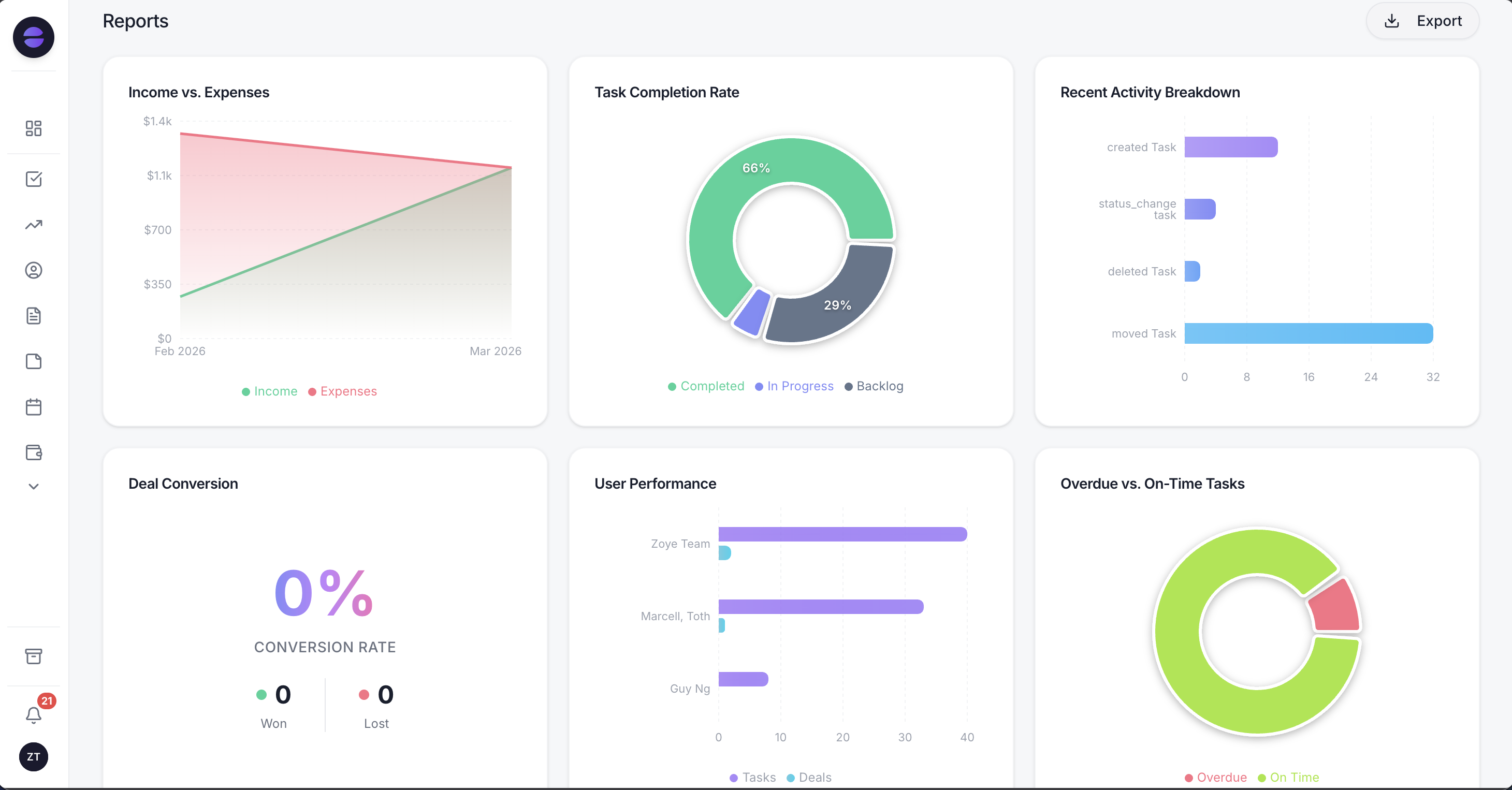 Reports assemble themselves from the same records the work runs on, so the numbers do not need an evening of copy and paste.
The work layer hangs off those records rather than beside them. Tasks belong to deals. Meetings belong to contacts. The AI Notetaker joins Zoom, Google Meet and Teams, transcribes with speaker labels, and turns what was decided into action items with owners and dates plus corrections written back onto the right contact, company or deal, which is the meeting-to-record hop that otherwise never happens.
The operator layer is the same assistant everywhere: in the web app, on WhatsApp, by voice note, in Slack, and in Claude through the connector. Same tools, same permissions, no cut-down mobile edition. You describe a rule in a sentence and Zoye turns it into a real trigger with conditions and actions, shows it back to you in plain English, and runs nothing until you approve it. Every run is logged with what fired, what changed and what it was sent, and it is reversible. A visual builder exists for people who want it; nobody is forced to open it.
Being straight about the boundaries matters more than the pitch. Zoye is not a property management system, not a channel manager, not an accounting ledger and not a helpdesk ticketing suite. The Notes module is collaborative docs and is still rolling out. Zoye does not run advertising; it captures and works the leads advertising produces. If your operating system needs a general ledger with statutory reporting, that stays where it is, and it should.
Ready to streamline your business?
Zoye brings AI-powered CRM, task management, and automation into one workspace.
Get StartedThe parts no software can be
There is a version of this idea that oversells badly, so it is worth marking the limits.
An operating system cannot supply judgment. It can tell you a deal has not moved in three weeks; it cannot tell you whether that customer is stalling or thinking. It can hand you the objection; it cannot handle it. The pitch, the price conversation and the difficult call stay human, and any product suggesting otherwise is describing a business without customers in it.
It also cannot fix a process that nobody has decided. Automation applied to an unclear rule produces confident, fast, consistent mistakes. If your team disagrees about when a lead is qualified, encoding that disagreement into a trigger does not resolve it, it just makes it run more often. Decide first, then automate.
And it cannot save a records layer that is already wrong. Importing four contradictory copies of your customer list into one workspace gives you one workspace with four contradictory copies. The cleanup is real work and it happens before, not after.
Where to start if you want one
You do not build a business operating system by buying one. You build it by removing hops, in an order that produces results early.
Start with the record that everything else hangs off, which for almost every company is the customer. Decide, out loud and in writing, which system holds the authoritative version. Everything else becomes a view of that, not a rival copy.
Then attach the work to it. The next thing to move is whichever work system most often needs a customer fact to make sense, usually tasks or the calendar. When those are attached, the daily walking between apps drops noticeably, and that is the moment people stop resisting the change.
Then automate one rule, not twelve. Pick the one with the clearest trigger and the most obvious cost when it is missed, which is usually first response to a new lead. Let it run for a month, watch the log, and only then add the second.
Then, and only then, add the operator layer across the rest. By that point the records are trustworthy enough for something to act on them, which is the precondition everyone skips and everyone regrets skipping.
If you want the arithmetic behind the first step, the real cost of tool sprawl works through the audit method in detail, and the case for software that runs the business covers what changes once the operator layer is in place.
The phrase will keep getting used loosely, and that is fine. Just apply the same test every time you hear it: point at a customer, follow one thing that happened to them, and count how many times a person had to carry it. That number, not the feature grid, is what tells you whether the business is running on a system or on you.
See how the three layers fit together in one workspace at Zoye's features.